The 12 Color Seasons Explained: Find Yours with Palette Swatches
Carole Jackson's original 4 seasons became the modern 12, three sub-seasons each, to capture every nuance of natural coloring. Here's the full chart, plus a 5-question matcher.
What's in this guide
Why 4 became 12
Carole Jackson's 1980 book Color Me Beautiful introduced the 4-season system to the mainstream. It was a revelation, and an oversimplification. People kept showing up to consultations and not quite fitting one of the four buckets. Was this person a "warm Summer" (technically impossible)? An "almost Spring but not quite"? The framework needed more resolution.
By the 1990s, color theorists like Christine Scaman (12 Blueprints) and Suzanne Caygill expanded the system into 12 sub-seasons, three per original season, to capture the in-between cases. Today the 12-season framework is the standard among professional colorists and AI color analysis apps.
The three axes
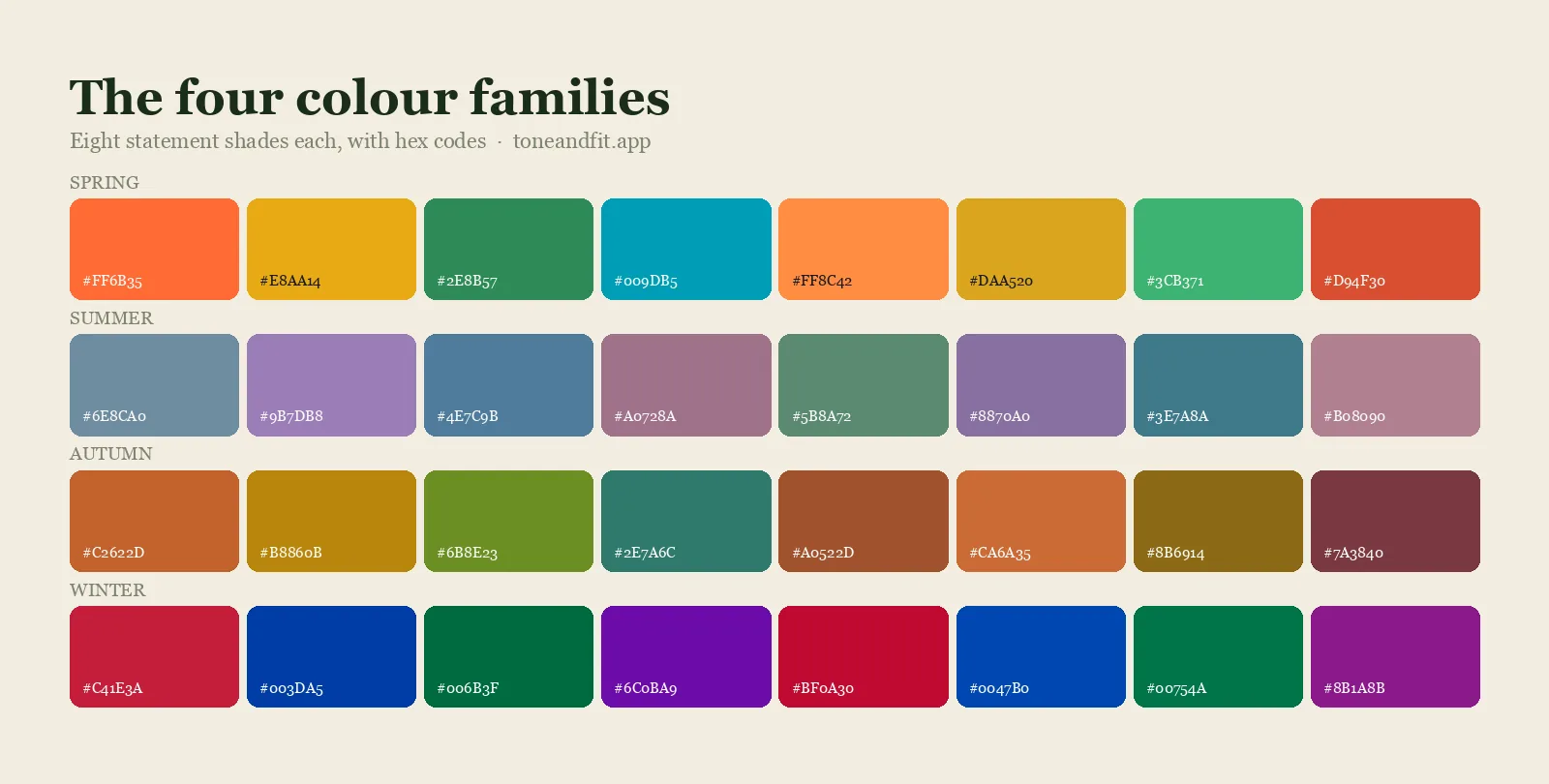
Each season is decided by three traits, each on a spectrum:
- Undertone: Warm ↔ Cool (with Neutral in between)
- Value: Light ↔ Deep
- Chroma: Soft ↔ Bright
Two of these traits dominate for each season, the third is "secondary." A Deep Autumn, for example, is dominantly warm and deep, with medium chroma. A Light Summer is dominantly cool and light, with soft chroma.
If you're new to undertone, value, and chroma, the foundational explainer is in Seasonal Color Analysis Explained.
The full 12-season chart
Each card below shows the dominant traits and a palette sample.
Light Spring
Warm · Light · Bright
True Spring
Warm · Medium · Bright
Warm Spring
Warm · Medium · Mid-bright
Light Summer
Cool · Light · Soft
Cool Summer
Cool · Medium · Mid-soft
Soft Summer
Cool · Medium · Soft
Soft Autumn
Warm · Medium · Soft
Warm Autumn
Warm · Medium · Mid-saturated
Deep Autumn
Warm · Deep · Medium
Deep Winter
Cool · Deep · Bright
True Winter
Cool · Medium · Bright
Cool Winter
Cool · Medium · Mid-bright
Skip the matching exercise.
Tone & Fit's AI gives you your exact season + 40+ curated colors in 60 seconds. Free. Private.
Try the App ↗The 5-question matcher
Answer in your head, track which letter wins
1. What's your hair like in natural sunlight?
2. What's the temperature of your skin?
3. Your eye color is..
4. Which jewelry suits you?
5. The colors that make you glow are..
Mostly As: Light or Cool Summer
Mostly Bs: Light or Warm Spring (or Warm Autumn)
Mostly Cs: Soft Summer or Soft Autumn (the muted family)
Mostly Ds: Deep Winter or Deep Autumn
If you got a tie or it doesn't quite feel right, you're likely a sub-season we'd narrow down with a photo. Our six-question season quiz asks a slightly different set of questions and shows you how to read a tied result. Tone & Fit will give you a definitive read.
What season are you
You are one of the twelve seasons above, and the fastest way to tell is to compare a short list of signals against your own coloring rather than guessing from the calendar meaning of "season." If a search for what season is this or what season are you led here, you are in the right place: this page is about the color-analysis kind of season, not the weather kind, and the table below turns the three axes into quick tells.
| What you notice | Points toward |
|---|---|
| Gold jewelry flatters you more than silver | A warm season: Spring or Autumn |
| Silver or platinum flatters you more than gold | A cool season: Summer or Winter |
| Hair, skin and eyes are all light with low contrast between them | Light Spring or Light Summer |
| Dark hair against fair skin, high contrast | True Winter or Deep Winter |
| Nothing about your coloring reads stark or high-contrast | Soft Summer or Soft Autumn |
| Your coloring reads rich, saturated, never washed out | True Spring, True Winter or Deep Autumn |
None of these signals alone is definitive, which is why the 5-question matcher above uses five of them together. A photo analysis narrows the same signals down to one specific sub-season instead of a family of three.
What are the "funky" seasons
Funky seasons is a casual label some quiz sites and TikTok creators use for the boldest, most saturated members of the 12-season system, the ones this page's own chart marks with a Bright chroma trait: Light Spring, True Spring, True Winter and Deep Winter. Each of the four thrives in clear, high-chroma color rather than the blended, muted tones that suit a Soft Summer or Soft Autumn.
Wearing "funky" well is really about chroma, not just boldness for its own kind. A True Spring reads best in golden yellow, true turquoise and pure coral. A True Winter reads best in true red, magenta and royal blue. A Deep Winter carries ruby, royal purple and emerald without looking costumey, because those colors match its natural depth and saturation. A Light Spring gets the same clear quality in paler doses: bright coral, clear mint, periwinkle. Putting a "funky," saturated color on a Soft Summer or Soft Autumn tends to overpower the face instead, since those two seasons are built around muted chroma. The lesson carries into the family sections below: chroma, not just color choice, decides whether an outfit reads sharp or off.
The color theory behind the seasons
Color theory seasons is really asking how the basic properties of color, hue, value and chroma, plus warm or cool temperature, combine to produce the twelve seasons. Seasonal color analysis borrows all four ideas straight from classic color theory and renames two of them.
| Color theory term | Seasonal color term | What it controls |
|---|---|---|
| Hue temperature | Undertone | Whether a color leans warm (yellow-based) or cool (blue-based) |
| Value | Value | How light or deep a color reads next to your skin |
| Saturation | Chroma | Whether a color is clear and vivid or muted and blended |
| Contrast between features | Not a formal axis, but used to separate close sub-seasons | How far apart your hair, skin and eye values sit, which is why True Winter and Deep Winter both test as Bright but differ in Value |
Undertone alone only gets you to one of four families. Value and chroma are what split each family into its three sub-seasons, which is the entire reason the 12-season system exists instead of the older 4-season one.
Color draping explained
Color draping is the traditional in-person method a colorist uses to confirm a season: they hold different colored fabric drapes up under your chin, in natural light, with your hair pulled back and no makeup, and watch how each one changes your face. A flattering drape brightens the eyes, evens out the skin and softens shadows. An unflattering one does the opposite: it can bring out redness, deepen under-eye shadows, or make the skin look gray or sallow.
A typical session starts broad, one test drape per season family, to find which quadrant you sit in, then narrows with closer, more saturated or more muted swatches to land on a sub-season. Lighting matters enough that colorists insist on daylight near a window; see how color season reads change in different lighting for why the same drape can look different at noon versus under indoor bulbs. A photo-based analysis like Tone & Fit's evaluates the same undertone, value and chroma signals a physical drape reveals, just from a still image instead of fabric.
Take a color season quiz
The quickest color season quiz is the 5-question matcher above: note which letter, A, B, C or D, you pick most often and read it against the key underneath. For a longer quiz that walks through the same three axes in more depth, Tone & Fit's step-by-step guide to finding your color season and its free color analysis quiz both work through undertone, value and chroma one question at a time and point you to a family. For the full background on how the underlying method works before or after taking a quiz, see the personal color analysis guide. Any quiz will get you to a family of three; a photo analysis is what narrows a family down to one sub-season.
Spring family
Springs are warm and bright. They thrive in clear, fresh, vivid colors that mimic spring blossoms and morning sunlight. There's no muddiness or grayness to a Spring's coloring, everything reads clean and sunlit.
Light Spring
Warm + light + bright-soft. Pale skin with a peachy glow, light hair (often warm blonde or strawberry), light eyes (soft green, hazel, soft blue with golden flecks). Best in: peach, soft warm pink, butter yellow, mint, periwinkle. Famous Light Springs: Reese Witherspoon, Taylor Swift (in her natural blonde phase).
True Spring
Warm + medium + bright. The clearest, brightest member of the family. Golden-tan skin, golden blonde to light brown hair, vivid hazel or light brown eyes. Best in: pure coral, golden yellow, true turquoise, leaf green. Famous True Springs: Blake Lively, Kate Hudson.
Warm Spring
Warm + medium + medium-bright. The warmest, richest Spring. Bronze or golden tan skin, copper or warm-brown hair, eyes with strong gold or amber. Best in: terracotta, warm coral, amber, leaf green, golden orange. Famous Warm Springs: Jessica Chastain, Amy Adams.
Summer family
Summers are cool and soft. They thrive in muted, hazy colors that mimic a misty morning or a watercolor painting. Where Winter is sharp and bright, Summer is soft and quiet.
Light Summer
Cool + light + soft. Porcelain or rosy-pale skin, ash blonde or light brown hair, light cool eyes (icy blue, gray-green, soft gray). Best in: powder pink, dusty blue, lavender, mint green, soft white. Famous Light Summers: Naomi Watts, Cate Blanchett.
Cool Summer
Cool + medium + medium-soft. The most "true cool" Summer. Pink-beige skin, ash brown or cool blonde hair, blue/gray/cool-green eyes. Best in: rose, blue-pink, slate, cool plum, soft fuchsia. Famous Cool Summers: Jacqueline Kennedy.
Soft Summer
Cool-neutral + medium + soft. The mutedest of the Summer family. Beige or olive skin, mousy brown or muted dark blonde hair, gray-green or hazel-cool eyes. Best in: dusty mauve, slate gray, dusty teal, muted plum, soft taupe. Famous Soft Summers: Jennifer Aniston.
Autumn family
Autumns are warm and earthy. They thrive in colors that mimic October, rich rusts, golds, deep greens, and browns. Where Spring is sunlit, Autumn is sun-filtered through leaves.
Soft Autumn
Warm-neutral + medium + very soft. The mutedest Autumn. Olive or beige skin, muted brown hair, hazel or warm-mid eyes. Best in: dusty olive, taupe, muted rust, soft peach, muted yellow-green. Famous Soft Autumns: Jennifer Lopez (in muted-styled phases).
Warm Autumn
Warm + medium + medium-saturated. The most "true warm" Autumn. Golden-tan skin, copper or chestnut hair, hazel or warm-brown eyes. Best in: pure rust, golden orange, warm green, mustard, terracotta. Famous Warm Autumns: Drew Barrymore, Julianne Moore.
Deep Autumn
Warm + deep + medium. The deepest Autumn, covered in detail in our Deep Autumn guide. Best in: burgundy, espresso, deep mustard, forest green, copper. Famous Deep Autumns: Sofia Vergara, Beyoncé.
Winter family
Winters are cool and bright. They thrive in high-contrast, jewel-toned, sharp colors. Where Summer is hazy, Winter is crystalline.
Cool Winter
Cool + medium + medium-bright. Less stark than True Winter but still bright. Cool-fair to medium skin, dark cool brown hair, gray-blue or cool-blue eyes. Best in: blue-red, fuchsia, sapphire, icy lilac, true white. Famous Cool Winters: Megan Fox.
True Winter
Cool + medium + bright. The sharpest member of the family. High-contrast features, pale skin with dark hair and dark eyes is the classic look. Best in: pure red, pure royal blue, ice white, magenta, true black. Famous True Winters: Anne Hathaway, Lucy Liu.
Deep Winter
Cool + deep + bright. The deepest Winter. Olive-deep or rich-deep skin, very dark hair, deep eyes (dark brown, black, deep blue). Best in: jewel-toned ruby, royal purple, midnight blue, true black, ice white. Famous Deep Winters: Lupita Nyong'o, Megan Markle.
Ready to find your season?
One selfie, your 12-season result, and the palette that goes with it. Free, no sign-up.
Find your season free ↗FAQ
What if I'm between two seasons?
Most people fit cleanly into one of the 12. About 10-15% sit on a boundary, usually between two adjacent sub-seasons within the same family (e.g., Soft Summer / Cool Summer). For boundary cases, wear from both palettes and notice which feels stronger. The deciding factor is usually chroma: do you look better in slightly more saturated colors or slightly more muted ones?
Can I change my season?
No, your underlying coloring is fixed. What can shift you between sub-seasons within the same family: dramatic hair color changes, significant weight changes that affect facial fullness, or aging (which can soften contrast). The temperature and depth don't change.
What's the difference between True Winter and Cool Winter?
True Winter is the highest-contrast, most-saturated Winter. Cool Winter is slightly less extreme, same temperature, slightly less contrast and slightly less brightness. A True Winter looks great in jet black; a Cool Winter looks slightly better in deep navy than in pure black.
Why do some sources call them by different names?
The 12-season framework has multiple naming conventions: "Light Summer" (most common), "Cool Light," and "Soft Light Summer" all refer to the same season. Christine Scaman uses "True Summer / Light Summer / Soft Summer" while older systems use "Cool / Light / Soft." Don't worry about the names, focus on the traits.
Do men have color seasons too?
Yes. The framework is gender-neutral and the analysis is identical. Men's wardrobes traditionally rely more on neutrals, so understanding your season helps you pick the right shade of "blue button-down" or "gray suit", which is where the difference between Cool Summer gray and Deep Autumn brown becomes visible.
How accurate is AI vs an in-person colorist?
With a good photo, taken in natural light with no makeup and no filter, AI color analysis is generally consistent with what a professional draping session finds. Photo quality changes the result more than the choice between an AI and a human colorist does.
What are the 12 color seasons?
The 12 color seasons expand the four-season system into three sub-types each: Bright, True, and Light Spring; Light, True, and Soft Summer; Soft, True, and Deep Autumn; and Deep, True, and Bright Winter.
How do I find my color season with Tone & Fit?
Download Tone & Fit, take a selfie in natural light without makeup, and the AI will analyze your skin undertone, contrast, and chroma to place you in one of the 12 seasons in about 60 seconds.
What if I don't fit neatly into one season?
Many people sit between two adjacent seasons. Tone & Fit shows you your primary season and how close you are to neighboring ones, so you can borrow from those palettes too.
Is the 12-season system better than the 4-season system?
The 12-season system is more precise because it accounts for chroma and value, not just undertone. It helps you narrow down shades that genuinely work instead of an overly broad palette.
Can men use the 12-season color system?
Absolutely. Color seasons are based on skin undertone, hair, and eye pigment, which apply to everyone regardless of gender.
What does "what season am I" mean here?
It means which of the twelve color seasons matches your natural coloring, not the time of year. People search what season is this or what season are you and land on this page because both phrasings are asking about the same twelve-season system.
What are the funky seasons?
Funky seasons is an informal name for the boldest, most saturated seasons: Light Spring, True Spring, True Winter and Deep Winter, the four this page's chart marks with a Bright chroma trait.
What is color draping?
Color draping is when a colorist holds different colored fabric under your chin in natural light to see which ones brighten your face and which ones wash it out. It is the traditional in-person way to confirm a season.
Is there a free color season quiz?
Yes. The 5-question matcher on this page is the fastest option, and Tone & Fit's free color analysis quiz and step-by-step color season guide both work through the same undertone, value and chroma questions in more depth.