How to Find Your Skin Undertone at Home: 5 Tests and a 2-Minute Checklist
Short answer: your undertone is warm, cool or neutral, and you find it at home by combining four quick checks: the colour of your wrist veins in daylight, whether gold or silver flatters you, whether pure white or cream looks cleaner against your face, and how your skin reacts to sun. When three of the four agree, that is your answer; when they split, a drape test or a photo analysis breaks the tie.
Forget the single test that gives you a single answer. Your undertone is decided by triangulating four signals, and one of them takes 60 seconds.
Quick answer
The most reliable at-home check is the white paper test: hold a sheet of pure white paper next to your clean, makeup-free face in daylight. Skin that looks yellowish against the paper is warm, pinkish or bluish is cool, and no clear cast is neutral. Confirm with the vein and jewelry tests below, or let AI read it from a selfie.
What's in this guide
- Why undertone matters more than skin tone
- How to find your skin tone (not just your undertone)
- Test 1. The white paper skin tone test (start here)
- Test 2. The vein test (and why it's wrong half the time)
- Test 3. The jewelry test
- Test 4. The AI shortcut (most accurate)
- Can a phone camera detect your undertone
- How to know your undertone in one quick check
- How to triangulate when tests disagree
- What to do once you know your undertone
- Is there a quiz to find your undertone
- FAQ
What is my undertone?
Your undertone is the permanent colour underneath your skin: warm (golden, peach or yellow), cool (pink, red or blue) or neutral, sitting between them. It never changes with a tan or the season, unlike your surface tone, which does.
Why undertone matters more than skin tone
"Skin tone" is what you see, porcelain, beige, tan, deep brown. It changes with the seasons, sun exposure, and age. Undertone is what's underneath: the temperature of your skin, decided by the proportion of melanin (which absorbs blue light) and hemoglobin (bluish-red) in your dermis. Undertone is permanent. Two people with identical surface skin tones can have opposite undertones, and they need different colors to look their best.
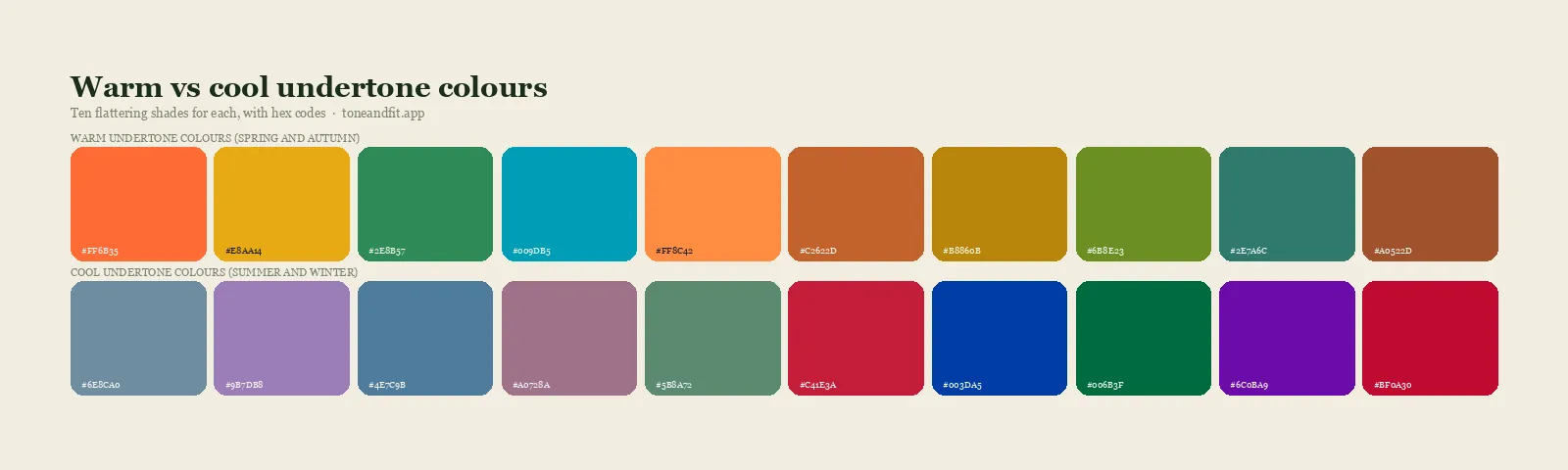
The three categories are warm (golden, peachy, yellow cast), cool (pink, red, blue cast), and neutral (a balanced mix that leans subtly one way or the other). About 40% of people are warm, 40% cool, and 20% neutral, though the boundary cases are why most people get this wrong on the first try.
Once you know your undertone, you've solved half of seasonal color analysis. The other half is value (light or deep) and chroma (soft or bright), which decides which sub-season you fall into.
How to find your skin tone (not just your undertone)
To find your skin tone, look at your bare face in natural daylight, away from tinted windows or screens, and match its depth to a shade name such as fair, light, medium, tan, or deep. That is a different question from undertone: skin tone is how light or dark your skin reads, undertone is its warm, cool, or neutral cast, and the two combine to describe your full coloring.
| Skin tone (depth) | Typical named shades | How to spot it |
|---|---|---|
| Fair | Porcelain, ivory | Burns easily, veins clearly visible, little natural tan |
| Light | Beige, sand | Pale to light beige, tans gradually rather than burning |
| Medium | Honey, olive, caramel | Beige to light brown, tans easily, may carry an olive cast |
| Tan | Golden, bronze | Golden brown year round, rarely burns |
| Deep | Chestnut, espresso | Rich brown, high natural pigment |
| Rich deep | Ebony | Dark brown to near black |
The mistake behind most "check my skin tone" searches is treating tone and undertone as the same test. They are not: two people can share the exact same depth on that table, one warm and one cool, and need opposite color palettes to look their best. Name your depth first from the shades above, then run the four undertone tests below to name your temperature. For makeup specifically, shade matching goes one step further, pinned to your exact pigment rather than a six-way category; our guide to finding your foundation undertone walks through that next step.
Test 1. The white paper skin tone test
The one colorists swear by
Hold a sheet of pure white paper (printer paper, not off-white) directly next to your bare, makeup-free face. Stand by a north-facing window if possible. Look at your skin in the mirror.
Step by step, the white paper undertone test takes about two minutes:
- Remove makeup and pull your hair off your face. Foundation defeats the entire test.
- Find indirect daylight. A north-facing window is ideal; any window without direct sun works. Never overhead bulbs.
- Hold true-white printer paper at your jawline, touching your skin, and look in a mirror at arm's length.
- Name the cast, not the shade. Ignore how light or deep your skin is. Ask only: next to this white, does my skin pull yellow-golden, or pink-blue?
- Repeat on the inside of your wrist as a cross-check; it tans less than your face.
White paper is a neutral reference point. Against true white, your skin's underlying color suddenly becomes obvious, the warm cast or cool cast that was masked by your usual environment. This is the closest of the home tests to what professional colorists do: they hold true-white drapes against your face for exactly the same reason.
Pro tip: if you can, also do the test holding a warm cream-colored paper and a cool blue-white paper. The cream will make warms look great and cools look sallow; the blue-white reverses it. Doing all three (true white + cream + blue-white) gives you a near-professional reading.
Test 2. The vein test
The classic 30-second check
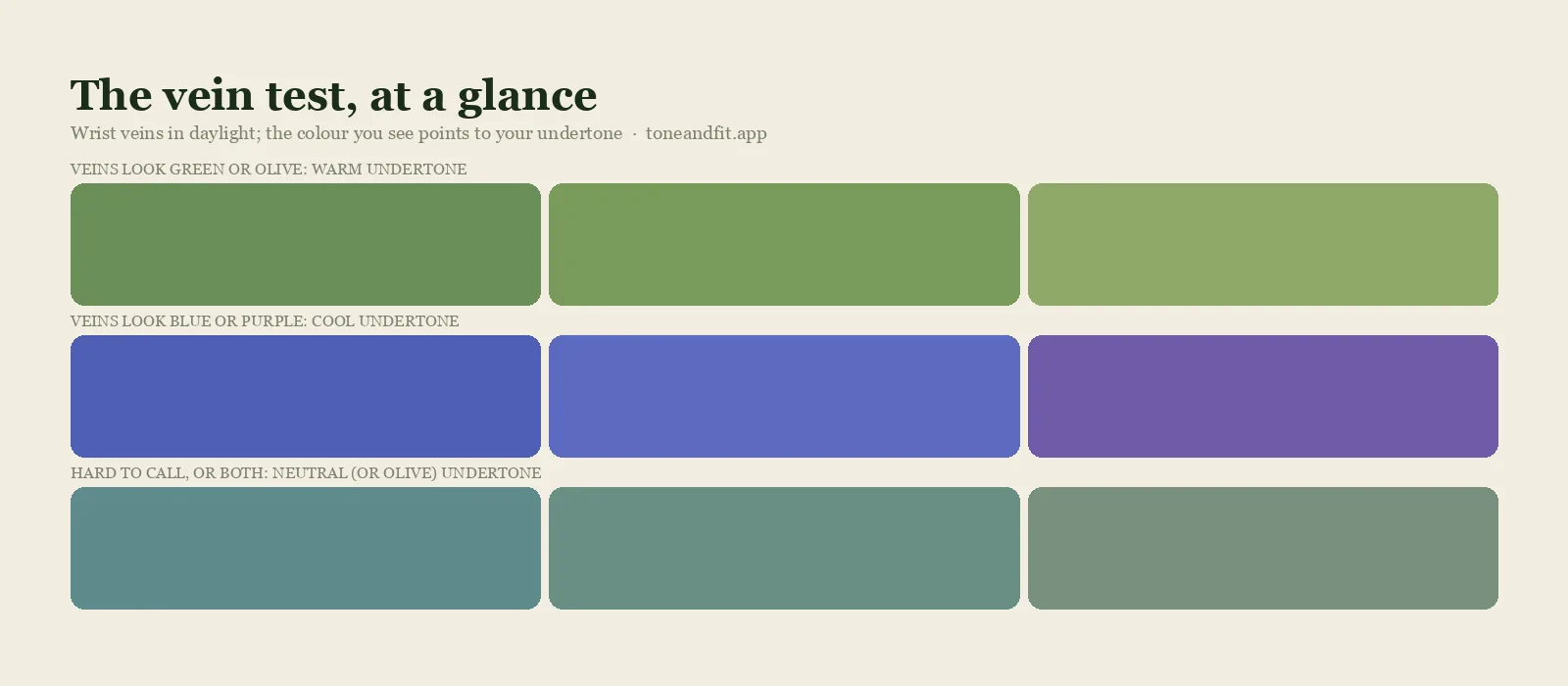
In natural daylight (not indoor lighting!), turn the inside of your wrist toward you and look at the veins.
Why this works: warm undertones absorb more red light, making the veins underneath appear greenish. Cool undertones absorb less red, leaving the veins their natural blue-violet.
Why this fails about half the time:
- Lighting, indoor incandescent light makes everything look warmer. Yellow filters from your phone screen distort it more.
- Vein depth varies, deeper-set veins look bluer simply because more skin is between you and them. This has nothing to do with undertone.
- Surface tone interferes, if your skin is tanned or has a strong red flush, you can't see the vein clearly enough to call it.
- Color-blindness, about 8% of people genuinely can't reliably tell green from blue.
Treat the vein test as a first hint, not a verdict. If the veins look obviously one color, lean that direction. If they look ambiguous, the test is telling you "you might be neutral", or it's telling you nothing.
Test 3. The jewelry test
Gold or silver? The metal that makes you glow
Hold a piece of yellow gold jewelry on one side of your bare neck and a piece of silver on the other (in front of a mirror, in daylight).
"Wins" means: the metal that makes your skin look more luminous, makes the jewelry pop instead of clashing, and doesn't make your face look duller. It's a subjective call but most people see the difference clearly within 30 seconds.
Why this is more reliable than the vein test: it directly measures the undertone-vs-color reaction on your face, which is the actual thing color analysis cares about. The vein test is an indirect proxy.
Caveats: rose gold is a wildcard (works for both warms and cool-leaning neutrals). Antique brass and copper read warm. Platinum reads cool. White gold is technically cool but gets read as neutral because the alloy is yellowed.
Skip the tests. Get your undertone in 60 seconds.
Free · No account · Photo never stored
Try Tone & Fit ↗Test 4. The AI shortcut (most accurate)
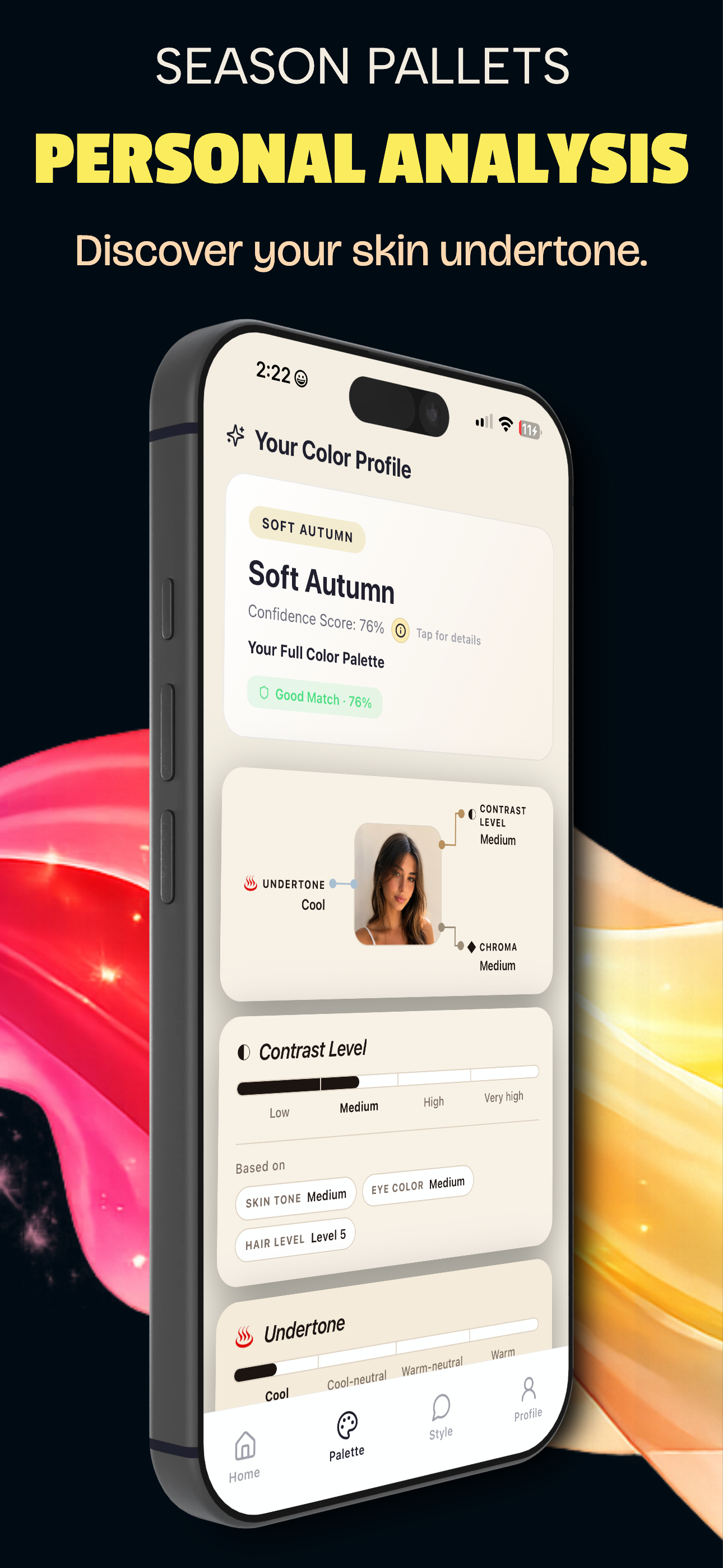
Modern computer vision can read your skin's undertone from a photo more consistently than any single at-home test, and as good as a colorist's read.
How it works: the AI samples thousands of pixel points across your face (skin, eyes, hair). It measures the RGB temperature of each region, removes lighting artifacts, and computes the dominant undertone. Then it cross-checks that against your eye color and hair color (which carry their own undertone signal) to rule out lighting noise.
The catch: photo quality matters a lot. The AI is only as good as the input. To get an accurate read:
- Take the photo in natural daylight, by a window, no direct sun, no overhead bulb
- No makeup (or remove foundation; minimal eye/lip color is fine)
- No filter or "beauty mode", turn those off in your camera app first
- Plain background (a white wall is ideal)
- Hair off your face
Can a phone camera detect your undertone
Yes, a phone camera can detect your undertone, but only if the photo is taken the right way; most casual "skin tone detector" attempts fail because the camera is actively working against you. Auto white balance, beauty filters, and night mode all shift color temperature to make skin look more even and more flattering, which is the opposite of what an undertone reading needs.
Before you point a camera at your face for this purpose:
- Turn off any beauty filter, skin smoothing, or portrait auto-enhance mode
- Turn off auto white balance if your camera app allows manual control, or at minimum avoid night mode and HDR
- Shoot in natural daylight facing a window, never under mixed indoor bulbs
- Use the plain camera app, not a filtered social app, for the reference photo
Once the lighting is controlled, a photo becomes a genuinely useful undertone signal, which is what Test 4 above relies on: instead of you eyeballing a vein or a scrap of jewelry, software reads the color values directly from the image. See how AI color analysis works for the mechanics behind that reading, or for the phone camera method compared side by side with the classic tests, our phone camera color analysis guide covers both.
How to know your undertone in one quick check
The fastest way to know your undertone is to run the three physical tests above in the same five minutes and see which answer repeats, rather than trusting any single test on its own. Here is the condensed version to scan before you commit to a verdict:
| Test | Warm sign | Cool sign | Neutral sign |
|---|---|---|---|
| White paper | Skin looks yellow or golden against it | Skin looks pink or blue against it | No clear cast either way |
| Veins | Predominantly green | Predominantly blue or purple | An even mix of both |
| Jewelry | Gold makes skin look brighter | Silver makes skin look brighter | Both look equally good |
| Photo reading | Warm undertone reported | Cool undertone reported | Neutral undertone reported |
Whichever column fills up fastest is very likely your answer. If your results land in two different columns, you are probably neutral, or you caught one test in bad lighting; the section below on triangulating disagreement walks through exactly what to do next.
How to triangulate when tests disagree
Take all four tests and tally the results. The honest answer is whichever undertone wins 3 out of 4. Here's how to read the patterns:
- 4 of 4 agree → high confidence. You know your undertone.
- 3 of 4 agree → strong signal. The disagreeing test was probably affected by lighting or vein depth. Trust the majority.
- 2 of 4 agree, with the other 2 split → you're likely neutral. Neutrals lean slightly toward one side or the other depending on the test conditions, which is why they "tie" across tests.
- The AI test disagrees with all three classics → take the photo again with better lighting. The AI is only as good as your photo.
For the deeper question, what color season you fit into, undertone alone isn't enough. You also need value and chroma. Read our complete guide to seasonal color analysis to see how the three traits combine, or jump to the 12-season matcher to find yours.
What to do once you know your undertone
Knowing your undertone is the first step, but the real payoff comes when you take it further into seasonal color analysis. Your undertone (warm, cool, or neutral) answers one of three questions. The other two are value (how light or deep your overall coloring reads) and chroma (how soft or bright your features are). Together, they place you in one of 12 color seasons, each with a palette of 30-50 colors custom-fitted to your coloring.
If you tested warm
You are in the Spring or Autumn family. Light-haired, light-eyed warm types are often a Light Spring or Warm Spring. Deeper, richer warm types tend toward Warm Autumn or Deep Autumn. Muted warm types with ashy undertones often land in Soft Autumn, one of the most common seasons.
If you tested cool
You are in the Summer or Winter family. Soft, muted cool types are usually a Soft Summer or Light Summer. High-contrast cool types with vivid eyes and dark hair are likely a Cool Winter, True Winter, or Deep Winter.
If you tested neutral
True neutrals (about 5-10% of people) usually lean slightly warm or slightly cool. The practical test: look at whether your best colors tend toward the warm side (cream, camel, olive) or the cool side (slate, dusty rose, charcoal). If warm-leaning, explore the Autumn family. If cool-leaning, explore the Summer family. Either way, you get the most flexibility of any type.
For the quickest path from undertone to full season, try Tone & Fit. It reads all three traits from one photo and gives you your season, your palette, and specific wardrobe, hair color, and makeup recommendations in 60 seconds.
For a deeper understanding of the differences between warm and cool, read our companion guide on warm vs cool skin undertone. And if you are wondering whether an app can actually do this, our comparison of app vs in-person consultant breaks down the accuracy tradeoffs.
Is there a quiz to find your undertone
Yes, a short multiple-choice quiz can estimate your undertone by asking the same questions this page answers with tests, which metal flatters you, what your veins look like, how you burn in the sun, and it works well as a first pass when you cannot do a hands-on test right away. The tradeoff is that a quiz relies on your memory and self-judgment for each answer, where a direct test or a photo reads the signal in the moment.
Tone & Fit's seasonal color analysis quiz asks undertone questions as part of placing you in a full season rather than undertone alone, so it is a reasonable starting point if you want one answer that covers undertone, contrast, and chroma together. Treat the result as a hypothesis, then confirm it against the white paper or AI test above before you commit a wardrobe to it.
Ready to find your season?
One selfie, your 12-season result, and the palette that goes with it. Free, no sign-up.
Find your season free ↗The 2-minute undertone checklist
Answer the four questions as honestly as you can and the checklist tallies your undertone. It is the same triangulation described above, just faster; the photo tool is more accurate because it measures instead of asking.
1. In daylight, the veins on your inner wrist look
2. Held against your face, which metal makes your skin look healthier?
3. Pure white against your face, compared with cream or ivory
4. In the sun, your skin usually
Test 5. The drape test (the one professionals trust)
How to do it
- Pick one color in a warm and a cool version: coral vs fuchsia, tomato red vs cherry red, olive green vs emerald, camel vs gray.
- In daylight, hold each fabric directly under your chin for ten seconds and watch your face.
- Look for the flattering effects: evened skin, brighter eyes, softened shadows. Then the unflattering ones: gray cast, amplified redness, heavier jaw shadows.
- Repeat with two or three color pairs and keep score.
Read it: warm versions consistently winning means warm undertone, cool versions mean cool, genuinely mixed results mean neutral or olive.
Draping is how professional analysts test undertone, and the home version is the closest you can get to their answer without booking a session. It beats the wrist tests because it measures the thing you actually care about: what colors do to your face. Its limits are the fabrics you happen to own and the discipline to judge effects rather than whether you like the color. If you want a structured version with a full checklist, our step-by-step guide to finding your skin undertone at home walks through it drape by drape.
How to score your results
No single test is trustworthy, but the panel of five is. Give each test one vote, weight the drape test double, and read the total like this:
| Your results | Verdict | Confidence |
|---|---|---|
| 4 to 6 votes warm, drapes agree | Warm undertone | High |
| 4 to 6 votes cool, drapes agree | Cool undertone | High |
| Split votes, both metals pass, moderate colors all fine | Likely neutral | Medium |
| Split votes, green veins, foundations run orange or pink | Likely olive | Medium |
| Tests contradict across sessions or lighting | Measure it with AI | Get a scan |
Two practical rules. First, run the whole panel in one sitting under the same daylight, because mixing results from different days and different lighting is how contradictions sneak in. Second, if you retest and get a new answer, believe the setup changed rather than your skin: undertone is fixed for life.
When the tests split: neutral vs olive
A split verdict is not a failed test. It usually means you belong to one of the two categories the classic tests were never designed to find.
Neutral means neither golden nor pink dominates. Both metals pass, both whites are fine, and most colors work at moderate intensity while extremes in either direction feel slightly off. If that sounds like you, our guide to neutral undertone skin covers how to confirm it and what to do with it.
Olive means golden pigment layered under a cool, faintly gray-green cast. Olive skin fails the tests in a recognizable pattern: veins read green, both metals sort of work, pure white and cream both feel slightly wrong, and nearly every foundation runs too orange or too pink. The two layers answer different tests differently, which is why olive is the most mistyped undertone in color analysis. If foundation shopping has always felt rigged against you, start with our guide to color analysis for olive skin.
For both groups, the honest advice is the same: manual tests can tell you that you are in-between, but not where in-between. That is a measurement problem, not a judgment problem, and it is exactly the case where an AI skin tone analyzer earns its keep, because software can place your hue on a numbered warm-to-cool axis instead of forcing a binary answer.
FAQ
Does my undertone change with a tan?
No. Your undertone is decided by the chemistry of your dermis, not the surface pigmentation. A tan adds melanin to the surface, which can make warm-undertone skin look more golden and cool-undertone skin look more bronze, but the underlying temperature doesn't shift. A tanned warm is still warm.
Why do my veins look different at different times?
Lighting is the biggest factor. Indoor incandescent light is yellower than daylight, which can shift apparent vein color. Body temperature also matters, when you're warm, blood is closer to the surface and veins look more prominent. Always do the vein test in natural daylight when your hands are at room temperature.
What if I'm a "true neutral"?
True neutrals (skin that doesn't lean meaningfully warm or cool) make up about 5-10% of people. They get the freedom to wear from both warm and cool palettes. The downside: very few colors are uniquely "yours." The upside: you can wear gold and silver jewelry with equal success, and you'll never look obviously wrong in a color.
Can my undertone be different on my face vs my body?
Slightly, yes. Faces tend to have more red surface tone than bodies (because of more capillaries near the surface). For color analysis, the face is what matters, it's where the colors near your collar will be judged.
Are there racial / ethnic differences in undertone?
Surface skin tones vary enormously by ethnicity, but undertone (warm/cool/neutral) distributes roughly evenly across all ethnicities. Black skin can be warm or cool. East Asian skin can be warm or cool. South Asian skin can be warm or cool. The skin-tone-to-undertone mapping is independent.
What is a skin undertone?
Your skin undertone is the subtle hue beneath the surface of your skin. It stays consistent regardless of tanning or flushing and falls into warm, cool, or neutral categories.
Why is the vein test unreliable?
The vein test asks you to judge vein color, but vein visibility varies with skin thickness, lighting, and hydration. It gives inconsistent results for many people, especially those with deeper skin tones.
Can Tone & Fit detect my undertone from a selfie?
Yes. Tone & Fit's AI analyzes your skin in a selfie to determine whether your undertone is warm, cool, or neutral, then assigns you a color season based on that plus your contrast and chroma.
What if my undertone seems neutral?
Neutral undertones have a mix of warm and cool. You can usually wear colors from both warm and cool palettes. Tone & Fit will still place you in the season that fits best overall.
Does ethnicity determine undertone?
No. Undertone is independent of ethnicity or skin depth. People of every background can be warm, cool, or neutral. That is why individual analysis matters more than assumptions.
How do I check my skin tone at home?
Look at your bare face in natural daylight next to a neutral background and match its depth to a shade name such as fair, light, medium, tan, or deep. That gives you your skin tone. Add the white paper, vein, or jewelry test from this guide to name your undertone on top of it.
Can an app work as a skin tone detector?
Yes, provided the photo is taken in natural daylight with filters and beauty modes turned off. Auto white balance and beauty filters are the main reason a casual selfie gives an unreliable read, not a limit of the underlying technology.
Is a quiz reliable for finding your undertone?
A quiz is a reasonable starting point because it asks the same questions as the tests on this page, but it depends on your memory and judgment for each answer. Confirm a quiz result with a hands-on test or a photo reading before you commit to it.