Seasonal Color Analysis: How It Works and Why It Changes Everything
Why some shirts make you look tired and others make strangers say "you look great today", and the 90-year-old framework that explains it all in one sentence.
What's in this guide
- What is seasonal color analysis?
- Is a "skin tone season" the same thing?
- A brief history (and why it isn't a fad)
- The three traits that decide your season
- The 4-season vs 12-season frameworks
- What is a seasonal color palette?
- How analysis is done, drape, photo, AI
- Is there a free way to do it?
- Using your season in real life
- Common myths and why they're wrong
- Explore your season
- FAQ
What is seasonal color analysis?
Seasonal color analysis is a system that classifies your natural coloring, your skin undertone, eye color, and hair color, into one of 4 (or 12, in the modern version) "seasons." Each season has a corresponding palette of colors that harmonize with your features. When you wear those colors, your skin looks brighter, your eyes pop, your jawline sharpens. When you wear colors from a season that isn't yours, you look duller, washed out, or more tired than you actually are.
It is, at its core, a contrast and harmony framework. The same rules a painter uses to make a portrait pop are being applied to the canvas of your face, except instead of choosing pigments, you're choosing the shirt you wear to a job interview.
Is a "skin tone season" the same as a color season?
Yes. "Skin tone season," "skin color season," and "color season" all point at the same 12-season framework this guide covers, built from your undertone, value, and chroma rather than your literal skin shade alone. The phrasing varies by who is searching for it, but the underlying system is identical.
The naming causes real confusion because "skin tone" also means something else entirely elsewhere on this site: the actual depth of your complexion (fair, light, medium, tan, deep), independent of season. Your skin tone in that sense can be light or deep at any season; your skin tone season is the much bigger classification that adds undertone and chroma on top of it. If you searched for this wanting to know how your specific coloring translates into colors you should actually wear, what colors look good on me is the practical next stop after this page.
A brief history (and why it isn't a fad)
The roots go back to the early 20th century. The Bauhaus painter and color theorist Johannes Itten noticed in his 1928 work that students preferred painting palettes that resembled their own coloring. He categorized this by season, those with warm, golden coloring loved Spring/Autumn palettes; those with cool, muted coloring loved Summer/Winter ones. That was the origin of the seasonal model.
It hit the mainstream in 1980 when Carole Jackson published Color Me Beautiful, which sold over 7 million copies. By the early '80s, "color analysis parties" were a cultural moment, and "having your colors done" was something you mentioned at dinner. The framework was simple: you were Spring, Summer, Autumn, or Winter.
The 4-season framework eventually felt incomplete. People kept showing up to consultations and not quite fitting one of the four buckets. So in the 1990s, color theorists like Christine Scaman and Suzanne Caygill expanded the system to 12 seasons, three sub-types of each original season, to capture the in-between cases. That's the framework most modern colorists use, and it's what Tone & Fit uses too.
The reason seasonal color analysis isn't a fad: it's just contrast theory applied to a face. Painters have used the same rules for 600 years.
The three traits that decide your season
Modern color analysis comes down to three measurements of your natural coloring:
1. Undertone (warm, cool, or neutral)
The dominant temperature underneath your skin's surface. Warm undertones lean golden, peachy, or yellow, typically Spring or Autumn. Cool undertones lean pink, red, or blue, typically Summer or Winter. Neutral sits in the middle, leaning slightly toward one or the other depending on the day. Undertone is decided by the proportion of melanin (which absorbs blue light) and hemoglobin (which is bluish-red) in your skin, it's literally a chemistry fact about you, not an opinion.
Want the practical version? Read our guide on how to find your skin undertone at home, three classic tests plus the AI shortcut.
2. Value (light or deep)
How light or dark you read overall. Pale-skinned, blonde-haired, light-eyed people are light. Deeper-skinned, dark-haired, dark-eyed people are deep. This is independent of undertone, you can be a light person who is warm (Light Spring) or a light person who is cool (Light Summer).
3. Chroma (soft or bright)
How saturated and clear your natural coloring is. Someone whose features stand out crisply against their skin (sharp eyebrows, vivid eye color, defined hairline) reads bright. Someone whose features blend more softly into their skin (muted eyes, ash-toned hair) reads soft. A bright person looks great in jewel tones; a soft person gets overpowered by them.
Take those three traits, undertone, value, chroma, and you've classified yourself in a 3D space. Each combination corresponds to one of 12 color seasons.
The 4-season vs 12-season frameworks
The original 4 seasons
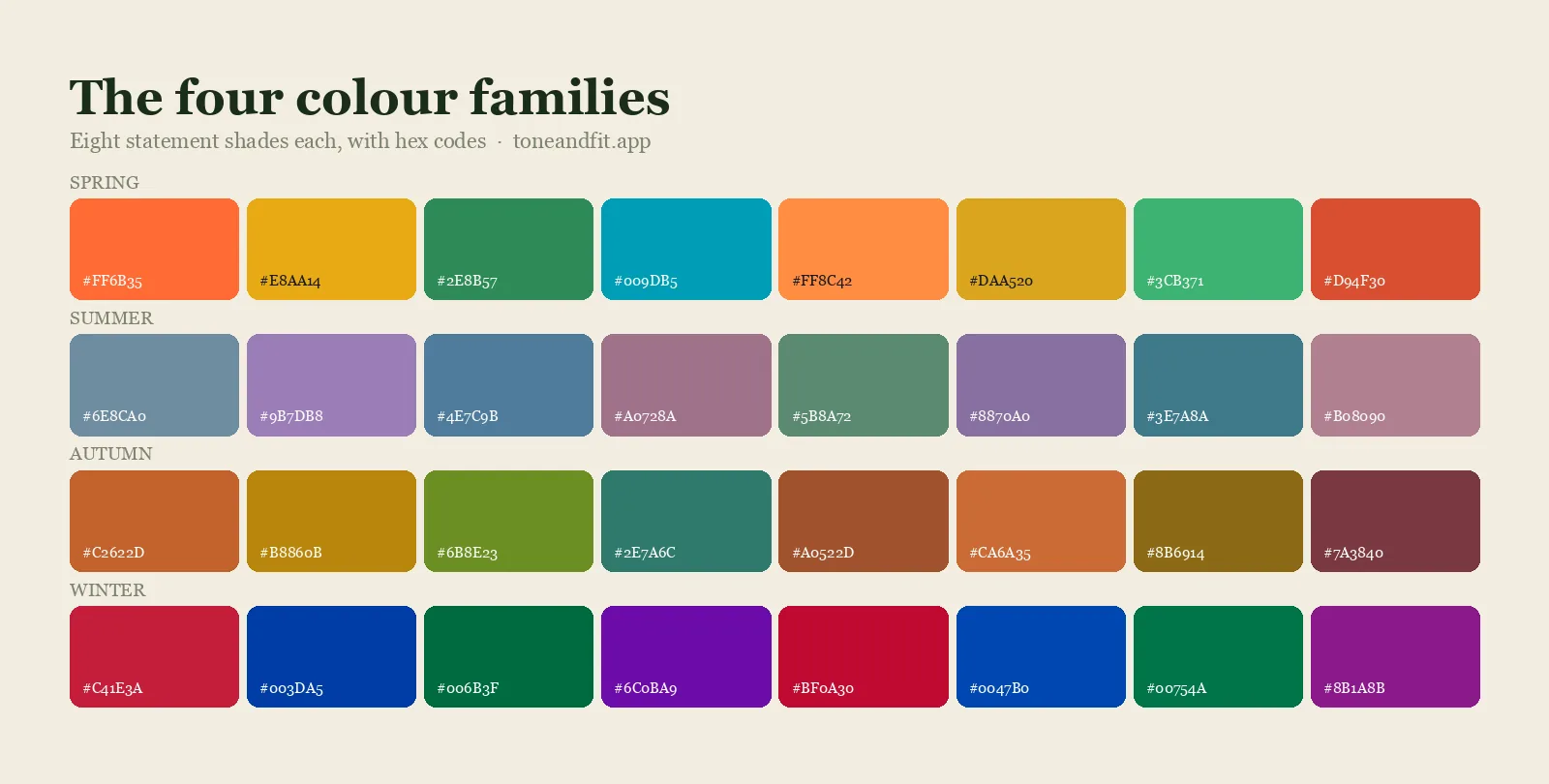
- Spring, warm, light to medium value, bright chroma
- Summer, cool, light to medium value, soft chroma
- Autumn, warm, medium to deep value, soft to medium chroma
- Winter, cool, medium to deep value, bright chroma
Easy to remember, but limited. A "Spring" who's actually a deep, warm, slightly-soft person doesn't really fit. Hence:
The modern 12 seasons
Each of the four becomes three sub-types based on which trait is most dominant:
- Spring family: Light Spring, True Spring, Warm Spring
- Summer family: Light Summer, Cool Summer, Soft Summer
- Autumn family: Soft Autumn, Warm Autumn, Deep Autumn
- Winter family: Cool Winter, True Winter, Deep Winter
Each season has a palette of 30-50 specific colors that work for it. Wearing colors from your palette = your features pop. Wearing colors from a different season's palette = you look "off" in ways most people can describe but can't pinpoint.
For a deeper breakdown of all 12 with palette swatches, read The 12 Color Seasons. Which Am I?. If you would rather narrow the field before reading all twelve, start with the color season quiz guide, which walks you through the six traits that decide it.
What is a seasonal color palette?
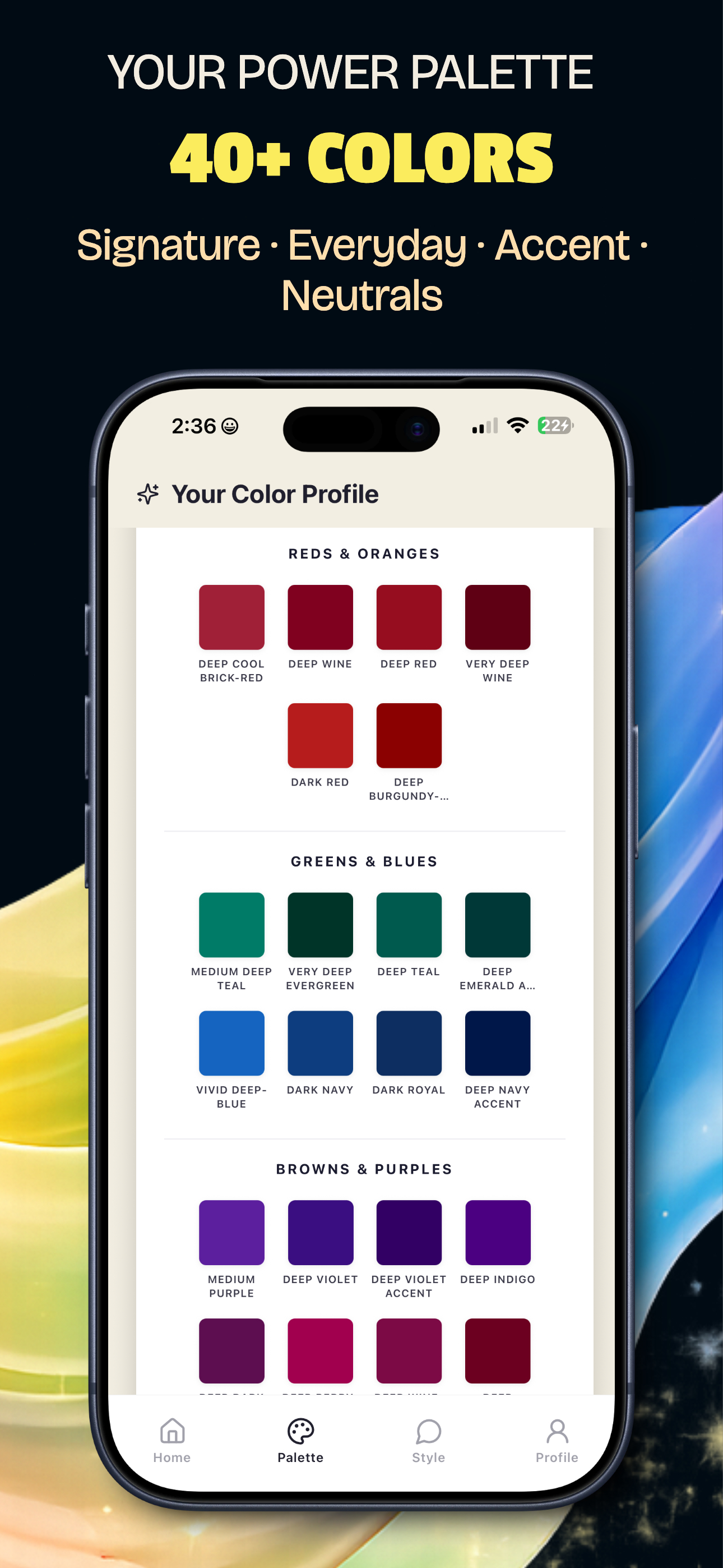
A seasonal color palette is the set of colors assigned to one of the 12 seasons above, structured so that every color in it shares the same undertone, sits at a similar value, and carries a similar chroma, which is why the colors in a palette work together as well as they work on you individually.
Every seasonal palette is built the same way regardless of which season it belongs to: a run of neutrals that carry most of a wardrobe, a set of main colors for the pieces people actually see, a smaller group of accent colors, and a metal recommendation. What changes from season to season is not the structure but the fill. An Autumn palette leans into rust, olive, and camel, while a Summer palette leans into rose, slate, and dusty blue, because each is filled from a different point on the undertone, value, and chroma map. Our guide to building a personal color palette walks through that structure layer by layer, once you know which season's palette you are filling.
How analysis is done, three methods
Method 1. Drape (the classic)
An in-person colorist drapes ~150 pieces of fabric in different colors against your face under controlled lighting. They observe which colors brighten you and which mute you. Pros: highest accuracy, the colorist sees you in 3D. Cons: a few hundred dollars, requires an appointment, requires you to live near a certified colorist.
Method 2. Photo analysis (DIY-style)
You upload a clear, natural-light photo of yourself to an online colorist. They analyze digitally and email you a verdict + palette. Pros: cheaper, accessible. Cons: depends entirely on photo quality, takes 1-3 days, color calibration of the colorist's monitor matters.
Method 3. AI analysis (where Tone & Fit lives)
An AI model trained on thousands of color profiles analyzes your selfie. It reads your skin's RGB values, your eye color, your hair tone, and your contrast ratio, then classifies you. Pros: 60 seconds, free or near-free, no human variability. Cons: only as good as the training data; has historically been weaker for very dark skin tones (an issue we've actively worked to fix in Tone & Fit's training set).
The best modern approach combines both: AI for the typical case, with a human escalation option for edge cases. We do this at Tone & Fit: if our model returns a low confidence score, you can email us and a real colorist (yes, a human one) will run your photo manually.
Is there a free way to do seasonal color analysis?
Yes. The home tests on this site (vein, jewelry, white paper) cost nothing but your own judgment, and a photo-based AI reading is also free, precisely because it replaces a paid consultant's time with a model instead of a person's hours. Free does not mean lower quality here: a free method built around a real photo is reading the same undertone, value, and chroma signals a fee-based service reads. It is simply not charging you for a person's time to do it.
Tone & Fit's free photo color analysis is one such option: upload a photo and get your season without an app download. The app itself works the same way from a selfie, and both routes skip the drape appointment and its cost entirely.
Using your season in real life
Knowing your season is half the battle. The other half is using it without becoming a color robot. Three ways to apply it without overthinking:
1. The "next purchase" rule
You don't need to throw out your existing wardrobe. Just commit that the next shirt, sweater, or coat you buy will be from your palette. Over 12-18 months, your closet quietly migrates to "everything looks great on me" without a single shopping spree.
2. The face-first rule
Color matters most for items near your face, tops, scarves, lipstick, hair. Pants and shoes can be off-palette without much visual cost. So if you're going to invest in colors anywhere, invest above the collarbone.
3. The neutrals decision
Black is universal, sort of. The colorist's secret: black "works on everyone" only because it's so dominant that no skin tone wins or loses against it. But you have a better neutral than black in your palette, for Autumns it's camel; for Cool Winters it's true black; for Soft Summers it's slate gray. Find your best neutral and own it.
Common myths and why they're wrong
"Your colors change when you tan / get older / dye your hair"
No. Your undertone (the temperature of your skin) doesn't change with sun exposure or age, only the surface tone does. A tanned Cool Summer is still a Cool Summer; the hair-and-eye contrast just shifts a bit. Hair dye can technically push you toward a different season, but most colorists analyze you in your natural coloring.
"Color analysis is racist / Eurocentric / not for people of color"
This came up because the original 1980 framework was developed mostly with white women in mind. The science is universal, undertone, value, chroma exist on every face, but the palette swatches were biased. The modern 12-season framework, especially as practiced by colorists like Terumi Murao and 12 Blueprints, has been actively rebuilt with palettes that work across all skin tones. Tone & Fit's training data was specifically diversified to address the historic bias, and the model is recalibrated quarterly.
"You can do it yourself with a vein test"
The vein test (look at your wrist, blue veins = cool, green veins = warm) is famously unreliable. Lighting changes the result, vein depth varies, and it ignores the other two traits (value and chroma). It's a useful first hint, not a diagnosis. Read more on warm vs cool skin undertone for why.
"AI can't do it as well as a colorist"
True historically. Less true today. Modern computer vision can read RGB values directly from a face image in a controlled photo, without the subjectivity a human eye brings to the same read. A human colorist has an edge in poor light because they have stereo vision and can move around you, but in a controlled photo, AI agrees with a colorist most of the time. Where it does not, it is mostly people with mixed-ethnicity coloring or unusual contrast patterns, and that's exactly the case where the human escalation matters.
Explore your season
Once you have a sense of your undertone, value, and chroma, dive into the specific season that matches your coloring. Each guide below covers the tells, the palette, celebrity examples, and the most common mix-ups with neighboring seasons.
Spring family (warm, bright)
- Am I a Light Spring? Light, warm, and delicate. Golden blonde, peachy skin, light eyes.
- Am I a True Spring? The balanced warm season. Clear, bright, and radiant.
- Am I a Warm Spring? The warmest Spring. Honey-toned, golden, vivid.
Summer family (cool, soft)
- Am I a Light Summer? Cool, light, and gentle. Rosy skin, ashy hair, soft eyes.
- Am I a Cool Summer? The most classically cool Summer. Slate, dusty rose, muted blue.
- Am I a Soft Summer? Muted, cool-neutral, and understated. The "quiet elegance" season.
Autumn family (warm, muted)
- Am I a Soft Autumn? Warm-neutral and muted. Earth tones, olive, sage.
- Am I a Warm Autumn? The richest warm season. Camel, rust, terracotta.
- Am I a Deep Autumn? Warm, deep, and intense. Mahogany, bronze, espresso.
Winter family (cool, bright)
- Am I a Cool Winter? Cool, bright, and crisp. Jewel tones, high contrast.
- Am I a True Winter? The most extreme Winter. Icy, stark, dramatic.
- Am I a Deep Winter? Cool, deep, and rich. Dark hair, vivid eyes, strong contrast.
Not sure where to start? Take the at-home undertone test first to narrow it to Spring/Autumn or Summer/Winter, then read the season guide that matches your value and chroma. Or skip the manual process entirely and let Tone & Fit's AI do all three readings from a single selfie.
Curious how this system compares to the Korean "personal color" approach? Read our Korean color analysis guide. And if you are skeptical about the whole concept, is color analysis a scam? covers the evidence honestly.
Ready to find your season?
One selfie, your 12-season result, and the palette that goes with it. Free, no sign-up.
Find your season free ↗FAQ
Is seasonal color analysis scientifically proven?
The underlying principles, that contrast theory and warm/cool harmony affect perception of a face, are solidly established in color science research. The exact 12-season framework is a heuristic built on top of that science. It works in practice; it isn't a peer-reviewed diagnostic tool.
Can I be between two seasons?
Most people fit cleanly into one of the 12. About 10-15% sit on a boundary, usually between two adjacent seasons within the same family (e.g., Soft Summer / Cool Summer). For boundary cases, the practical answer is to wear from both palettes and notice which feels stronger.
What if my season's colors aren't my favorite?
That's the most common reaction. People who love bright cobalt blue often find out they're a Soft Autumn (which calls for muted earth tones). The fix: you keep your bright cobalt for accessories or items below the collarbone. The face-frame items follow your palette. You don't have to give up colors you love, you reorganize where they live in your outfit.
Does the lighting in a photo affect my AI analysis?
Yes, significantly. Indoor incandescent light makes everything look warmer than it is. Phone cameras with "skin-smoothing" filters mute contrast. The best photo for analysis: daylight from a window, no direct sun, no makeup, no filter. Tone & Fit's model corrects for moderate lighting variation, but a poor photo will return a low confidence score.
How long does it take to actually use color analysis in your wardrobe?
About 30 days to internalize. You'll start noticing colors that feel "you" vs colors that feel "off" within a week. By a month, you're shopping in your palette automatically. By 90 days, you can't go back, wearing the wrong colors will feel jarring.
What is seasonal color analysis?
Seasonal color analysis is a method that matches your natural coloring - skin undertone, hair, and eyes - to a palette of colors that flatter you. It groups people into one of 12 color seasons based on undertone, value, and chroma.
How does Tone & Fit determine my color season?
Tone & Fit uses AI to analyze a selfie and measure your skin undertone, contrast level, and chroma. In about 60 seconds, it assigns you to one of the 12 color seasons and gives you a personalized palette.
Is seasonal color analysis accurate?
When done properly, seasonal color analysis is backed by real optical principles. AI apps like Tone & Fit can match the accuracy of in-person consultants at a fraction of the cost.
Can my color season change over time?
Your underlying undertone stays the same, but surface changes like tanning, hair dye, or aging can shift your perceived season slightly. Retesting occasionally is a good idea.
Do I need to remove makeup before getting analyzed?
Yes. For the most accurate result, use a bare-face selfie in natural daylight. Makeup, filters, and artificial lighting can throw off the analysis.
What is a skin tone season?
A skin tone season and a skin color season are the same thing: an informal name for the 12-season framework built from your undertone, value, and chroma. The formal term is seasonal color analysis. Searchers just describe it differently.
What are seasonal colors?
Seasonal colors are the specific shades assigned to your color season, not colors tied to autumn, winter, spring, or summer fashion trends. A Winter season's seasonal colors are icy and jewel-toned regardless of the calendar month, which is the most common mix-up with the term.
Is there a seasonal color palette quiz?
Yes. Our seasonal color analysis quiz guide walks through six traits to estimate your season without a photo, though a photo-based read is faster and does not depend on your own self-assessment of your hair or eye color.