Warm vs Cool Skin Undertone: What It Actually Means for Your Colors
Short answer: a warm undertone has a golden, peachy or yellow cast beneath the skin and looks best in gold, cream and coral; a cool undertone has a pink, red or blue cast and looks best in silver, pure white and berry. The vein test misleads more often than it helps, so the two signals that work are the metal test and the white versus cream test, both explained below.
Two people with identical surface skin tones can have opposite undertones, and need completely different colors. Here's how to tell them apart.
What's in this guide
- Skin tone vs skin undertone, why they aren't the same
- The 30-second cheat sheet
- What warm skin actually looks like
- What cool skin actually looks like
- Why the vein test fails so often
- What your undertone actually decides
- Warm red vs cool red
- How undertone maps to your color season
- Undertone across skin tones and ethnicities
- FAQ
Skin tone vs skin undertone, why they aren't the same
"Skin tone" is what's on the surface. Porcelain, beige, tan, deep brown, what your skin looks like. It changes with seasons, sun exposure, and time.
"Skin undertone" is what's underneath. Decided by chemistry, the proportion of melanin (which absorbs blue light) and hemoglobin (which is bluish-red) in your dermis. Undertone is permanent.
The crucial point most people miss: two people with identical surface skin tones can have opposite undertones. A pale beige Italian woman and a pale beige Irish woman can be standing side-by-side looking similar, but one will glow in gold jewelry and the other will need silver. That's because surface tone tells you what light reflects off the top of the skin; undertone tells you what's happening one millimeter below.
The 30-second cheat sheet
WARM
- Skin has yellow, golden, peachy, or olive cast
- Veins look green in daylight
- Gold jewelry makes you glow; silver looks pale on you
- You tan easily, freckle in golden tones, rarely burn
- Your favorite "white" is actually ivory or cream
- You look great in autumn / earth tones
COOL
- Skin has pink, red, or blue cast
- Veins look blue or purple in daylight
- Silver makes you glow; gold looks brassy on you
- You burn easily, freckle in pink tones, tan to a pinkish-brown
- Your favorite "white" is pure white or blue-white
- You look great in jewel tones / pastels
Neutrals sit between, neither cast is dominant. Roughly 20% of people are neutral. Tests give mixed results, and gold and silver both work. Our neutral undertone guide goes deeper into how to tell a true neutral from a warm or cool lean that just tested inconclusively.
What warm skin actually looks like
The warmth comes from yellow pigments in the dermis. The visible signs across all skin colors:
- Light skin: peachy, ivory, golden beige. Freckles tend to be golden brown rather than pink-brown.
- Medium skin: golden tan, olive, honey. Looks "sun-kissed" even without recent sun.
- Deep skin: deep golden brown, mahogany, bronze with red-orange highlights.
The reliable diagnostic signs are how the skin reacts to cool light sources: under fluorescent lights, warm skin can look slightly yellowed or sallow. Under daylight, it looks rich. The opposite of cool skin, which often looks washed-out under daylight but pleasant indoors.
Hair and eye color tend to follow: warm skin often pairs with hair that has gold, copper, or red highlights, and eyes with amber, gold, or warm-green flecks. (Tend to, not always. There are warm people with naturally cool-toned hair.)
What cool skin actually looks like
The coolness comes from pink and blue pigments dominating over yellow. Across skin colors:
- Light skin: rosy, porcelain, pink-beige. Burns easily under sun. Blushes pink, not red.
- Medium skin: beige with pink tones, neutral-cool tan. Often described as "fair" or "rosy" rather than "warm."
- Deep skin: deep brown with red, blue, or violet undertones. Rich purple lipstick reads gorgeous; orange-red reads off.
Cool skin is at its best in pure white and blue-white, colors warm skin can't pull off. Under cool fluorescent lighting, cool skin actually looks better than under warm light, which is the reverse of warm skin.
Why the vein test fails so often
The vein test (look at your wrist, green = warm, blue = cool) is the most-shared at-home undertone test. It's also unreliable about half the time. Three reasons:
- Indoor lighting, incandescent bulbs cast warm light, making veins look greener than they are. Always do this test by a window.
- Vein depth varies, deeper veins look bluer simply because more skin sits between you and them. People with thicker dermis get false "blue" results.
- Skin sensitivity, about 8% of people have minor red-green color discrimination differences that make this test ambiguous.
The fix: triangulate. The vein test is one signal. The jewelry test is another. The white-paper test is a third. AI analysis is a fourth. When 3 of 4 agree, you have your answer. Read the full method in How to Find Your Skin Undertone at Home.
What your undertone actually decides
Once you know warm vs cool, the practical implications:
Clothing colors that flatter
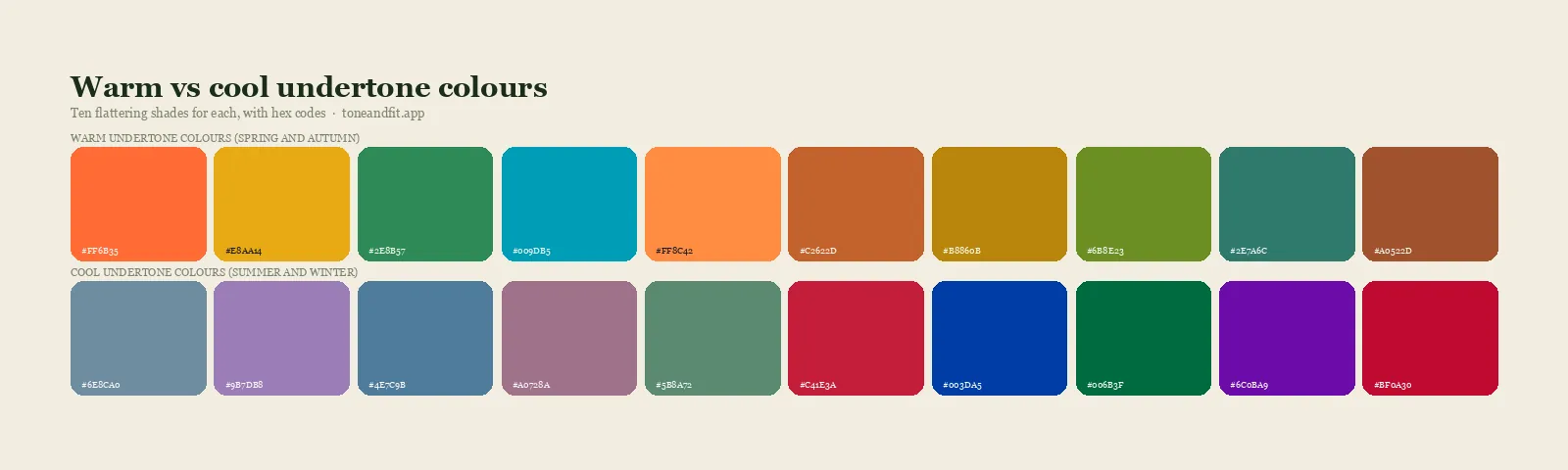
- Warm: camel, rust, mustard, olive, terracotta, cream, espresso, warm reds (tomato), warm pinks (coral, salmon), warm greens (forest, sage, olive)
- Cool: navy, charcoal, true black, ice blue, lavender, fuchsia, true white, blue-based reds (cherry), cool pinks (raspberry, rose), cool greens (emerald, mint)
Jewelry metals
- Warm: yellow gold (best), brass, copper, rose gold, antique brass
- Cool: silver (best), platinum, white gold, gunmetal, pewter
For the full breakdown of which specific metals and finishes work best, see our guide on gold vs silver jewelry by skin undertone.
Hair colors that suit
- Warm: chocolate brown, caramel, honey blonde, copper, auburn, warm chestnut
- Cool: ash brown, ash blonde, platinum, blue-black, jet black, cool burgundy
Lipstick and makeup
- Warm: brick red, terracotta, peach, copper-pink, warm berry, brown-nudes
- Cool: blue-red, cherry, raspberry, fuchsia, mauve, rose, cool nudes
Once you know the temperature, the rest of color analysis (which sub-season. Light, True, Deep, Soft, etc.) becomes a smaller question. Read Seasonal Color Analysis Explained to see how value and chroma layer on top.
Warm red vs cool red: how to tell them apart
Warm red leans orange, shades like tomato, brick, and rust, while cool red leans blue or pink, shades like cherry, raspberry, and true blue-red. The fastest way to tell which side a red falls on is to picture adding a drop of yellow to it or a drop of blue: if yellow makes it look more like itself, it is a warm red; if blue does, it is a cool red.
| Warm red (orange-based) | Cool red (blue-based) |
|---|---|
| Tomato | Cherry |
| Brick | Raspberry |
| Rust | True red (blue-red) |
| Terracotta | Crimson |
| Coral red | Fuchsia red |
Matching the right half of red to your undertone matters more than most people expect, because red sits right next to your face in lipstick more than almost any other color. A warm undertone wearing a cool, blue-based red can look like the color is fighting the skin underneath it, slightly muddy at the lip line. A cool undertone wearing a warm, orange-based red can look the opposite: the red reads orange rather than red, and the skin around it looks sallow by contrast. Test it the way you would test any color: hold two reds, one from each column, near your jaw in daylight, and the one that makes your skin look clearer rather than duller is your half. Our guide to lipstick by undertone carries this same warm-red-versus-cool-red logic through every other lip shade family, not just red.
Skip the tests. Get a definitive read in 60 seconds.
Tone & Fit's AI scans your photo and tells you warm, cool, or neutral, and corrects for the light you took the photo in.
Try the App ↗How undertone maps to your color season
Once you know warm vs cool, you've answered the first of three questions in seasonal color analysis. The remaining two are value (how light or deep your overall coloring reads) and chroma (how soft or bright your features are). Together, these three traits place you in one of 12 color seasons.
Warm undertone seasons
If your undertone is warm, you fall into the Spring or Autumn families:
- Light Spring: warm + light + bright. Think golden blonde hair, peachy skin, light eyes.
- True Spring: warm + medium + clear. The classic "warm glow" look.
- Warm Spring: the warmest of the warm. Golden, radiant, honey-toned.
- Soft Autumn: warm + muted + medium. Ash-touched, earthy, understated warmth.
- Warm Autumn: warm + rich + earthy. Deep golden browns, amber eyes.
- Deep Autumn: warm + deep + rich. Mahogany, bronze, intense warmth.
Cool undertone seasons
If your undertone is cool, you fall into the Summer or Winter families:
- Light Summer: cool + light + soft. Rosy, delicate, often with gray-blue eyes.
- Cool Summer: cool + muted + medium. Think dusty rose, slate, soft lavender.
- Soft Summer: cool-neutral + muted. The gentlest contrast in the cool family.
- Cool Winter: cool + bright + medium-deep. Jewel tones, high contrast, crisp.
- True Winter: the most extreme cool. Icy brightness, stark contrast.
- Deep Winter: cool + deep + bright. Rich, dramatic, intense.
Not sure which season fits? The fastest way to find out is to try Tone & Fit, which reads all three traits from a single photo. Or start with our at-home undertone test guide and work from there.
Undertone across skin tones and ethnicities
A common misconception is that undertone correlates with ethnicity or surface skin color. It does not. Warm and cool undertones distribute roughly evenly across all ethnic backgrounds. A dark-skinned West African woman can be a Cool Winter. A pale Scandinavian man can be a Warm Autumn. The surface is independent of the temperature underneath.
That said, some undertone tests work differently depending on skin depth. The vein test, for instance, is harder to read on deeper skin because the veins are less visible through more melanin. The jewelry test and white-paper test tend to work better across all skin tones. And AI analysis, which reads the actual pixel temperature of your skin, is the most consistent method regardless of how light or deep you are.
If you are a man wondering whether color analysis applies to you, the answer is absolutely yes. The science is the same. Read our guide on color analysis for men for specifics on how to apply your season to menswear. And if you have olive skin, which often gets misread as neutral or warm, our olive skin tone guide breaks down how olive fits into the seasonal framework.
Ready to find your season?
One selfie, your 12-season result, and the palette that goes with it. Free, no sign-up.
Find your season free ↗FAQ
Does my undertone change with a tan?
No. The surface darkens with melanin, but the underlying chemistry stays warm or cool. A tanned warm is still warm. The colors that flatter you don't change with a tan, though some specific shades within your palette will look better in summer (richer, more saturated) than winter (softer, more muted).
Can I be warm in some seasons and cool in others?
No. Undertone is permanent. What might change: your contrast between hair, skin, and eyes shifts when you tan or your hair lightens, which can move you between sub-seasons within the same temperature. But warm doesn't become cool.
I'm pale with green eyes. Am I always warm?
Not necessarily. Pale + green eyes describes a lot of cool Summers (especially Light Summer) and warm Springs (especially Light Spring). The deciding factor is the temperature of your skin underneath, pink/rosy = cool; peach/golden = warm.
What if my undertone is "olive"?
Olive is technically a neutral or neutral-warm undertone with a green-yellow surface cast. People with olive skin often look great in muted, warm-leaning palettes (Soft Autumn, Warm Spring) and struggle with overly pastel or icy colors. You're closer to warm than cool, in most cases.
What does it mean if both gold and silver look fine on me?
You're likely a true neutral. Gold-leaning neutral types do better with warm-warm color palettes (rich camels, soft rusts). Cool-leaning neutrals do better with muted cool palettes (slate, dusty pink). True neutrals, neither leaning, get the freedom to wear from both, which is the upside; the downside is no color is uniquely yours.
What is the difference between warm and cool undertones?
Warm undertones have golden or peachy hues beneath the skin, while cool undertones lean pink or bluish. The difference determines which color palettes will be most flattering on you.
How does Tone & Fit determine if I'm warm or cool?
Tone & Fit's AI analyzes the color data in your selfie to measure your skin's undertone precisely. It goes beyond simple warm-or-cool and factors in chroma and value for a full season match.
Can someone have both warm and cool undertones?
Yes, that is called a neutral undertone. Neutral-leaning people can wear colors from both warm and cool palettes, though one side usually dominates slightly.
Does my undertone affect what hair color I should choose?
Definitely. Warm undertones look best with golden, copper, or auburn shades, while cool undertones suit ashy, platinum, or burgundy tones. Matching hair color to undertone creates a more harmonious look.
Why do some colors make me look tired or washed out?
When you wear colors that clash with your undertone, they can cast unflattering shadows on your face, making you look dull or tired. Wearing colors that harmonize with your undertone has the opposite effect.
What are cool skin tones?
Cool skin tones are skin that carries a pink, red, or blue cast beneath the surface rather than a golden or peachy one. Regardless of how light or deep the skin is, from porcelain to deep brown, a cool undertone means silver jewelry, blue-based reds, and true white tend to flatter more than their warm equivalents.
Where does neutral undertone fit between warm and cool?
Neutral sits between warm and cool rather than being a third separate category: it means neither a golden or peachy cast nor a pink or blue cast clearly dominates your skin. About 20 percent of people test neutral, and most neutrals still lean slightly warm or slightly cool once you look closely, which is why a neutral result is a starting point for testing both directions rather than a stopping point.
How do I know if a red is warm or cool?
Look at its base. Reds with an orange or brown base, like tomato, brick, and rust, are warm. Reds with a blue or pink base, like cherry, raspberry, and true red, are cool. Hold the color near your jaw in daylight, and whichever version makes your skin look clearer rather than duller is the one to wear.