How to Pick the Best Hair Color for Your Skin Tone and Season
Your hair color is the biggest color swatch on your body. It frames your face every single day. Get it wrong and no amount of makeup or wardrobe adjustment will compensate. Get it right and everything else clicks.
What's in this guide
Why your skin tone determines your best hair color
Think about the last time you wore a shirt in a color that didn't suit you. Your face looked washed out, or suddenly blotchy, or older than it should. Now imagine you couldn't take that shirt off. That's what the wrong hair color does. It sits against your face from the moment you wake up to the moment you fall asleep, casting its temperature onto your skin in every photo, every mirror, every Zoom call.
The reason this happens is physics, not taste. Every color has a temperature, it leans warm (golden, yellow, coppery) or cool (ashy, blue, violet). Your skin has a temperature too, decided by your undertone. When the temperature of your hair matches the temperature of your skin, the two harmonize: your complexion looks clearer, your eyes look brighter, and the overall effect is healthy and coherent. When they clash, your skin fights the frame around it.
The key principle is simple: your best hair color matches your season's temperature (warm or cool) and respects your season's value (light or deep). A warm-toned person with light coloring looks radiant in golden blonde. Put that same golden blonde on a cool-toned, deep-complexioned person and the result is visually jarring, like hanging a warm-toned painting in a cool-lit gallery.
This isn't about limiting your options. It's about narrowing the field so every choice you make lands well. Within your temperature and value range, you still have dozens of beautiful hair colors to choose from.
Step 1: Find your undertone
Before you can pick a hair color, you need to know one thing: are you warm, cool, or neutral?
If you already know your undertone, skip ahead. If you don't, read our full guide to finding your skin undertone at home, which walks you through four tests including the vein test, jewelry test, white-paper test, and the AI shortcut. The short version:
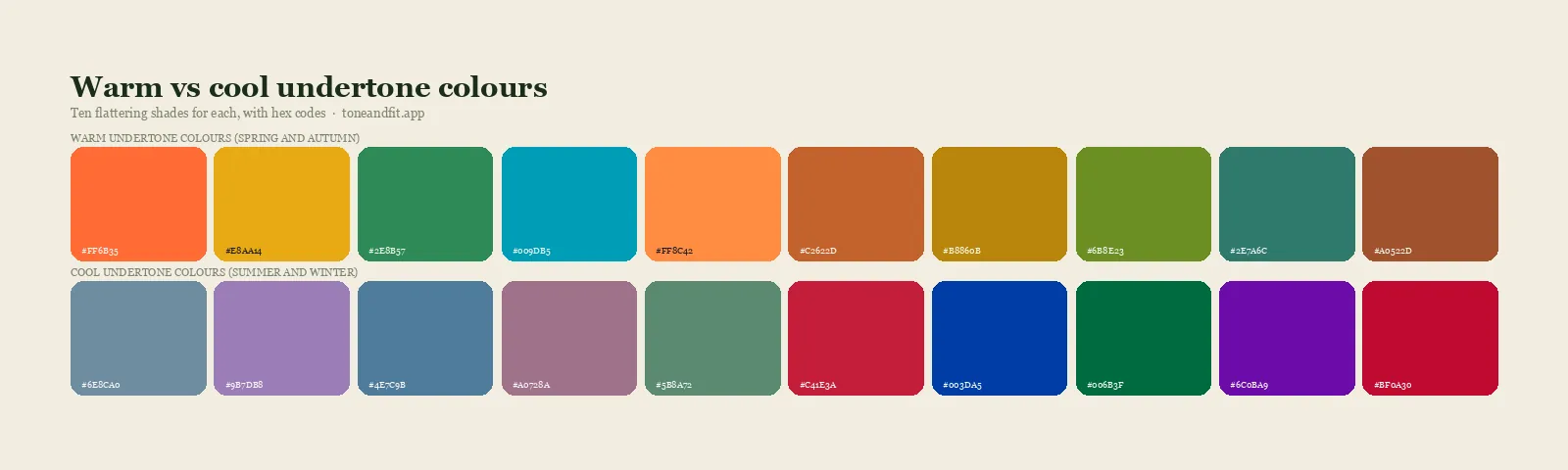
- Warm undertone: your skin has a golden, peachy, or yellow cast. Gold jewelry looks better on you than silver. Your veins appear greenish in daylight. Warm hair colors (gold, copper, caramel, warm brown) will harmonize with your skin.
- Cool undertone: your skin has a pink, red, or blue cast. Silver jewelry flatters you more. Your veins appear blue or purple. Cool and ashy hair colors (ash blonde, cool brown, blue-black, platinum) will harmonize with your skin.
- Neutral undertone: you're a balanced mix. Both gold and silver work. You have more flexibility but should still lean toward the temperature of your color season.
Once you know your undertone, the next question is your value, how light or deep your overall coloring is (skin + eyes + natural hair combined), and your chroma, how muted or vivid your coloring is. Together, undertone + value + chroma give you your color season. And your season is the most reliable roadmap to your best hair color.
The hair color chart by undertone and depth
Everything in this guide, condensed into two charts. Find your undertone row, match it to your natural depth, and you have your shortlist before you ever open a box-dye aisle or a salon menu. Screenshot the one that applies to you.
Warm hair colors for your skin tone: the chart
| Your depth | Best hair colors | Use caution | Likely seasons |
|---|---|---|---|
| Light (fair, light eyes) | Golden blonde, honey blonde, strawberry blonde, light copper | Platinum, ash blonde, blue-black | Light Spring, Warm Spring |
| Medium (golden or olive skin) | Caramel, golden brown, copper, warm chestnut, bronde | Ash brown, jet black, cool platinum | Warm Autumn, Soft Autumn |
| Deep (rich brown to deep skin) | Espresso, dark chocolate, auburn, mahogany, warm black-brown | Ash tones, icy highlights | Deep Autumn |
Cool hair colors for your skin tone: the chart
| Your depth | Best hair colors | Use caution | Likely seasons |
|---|---|---|---|
| Light (fair, pink cast) | Ash blonde, beige blonde, platinum, silver blonde | Golden blonde, copper, honey tones | Light Summer, Soft Summer |
| Medium (neutral-cool, rosy) | Ash brown, mushroom brown, cool chestnut, smoky bronde | Caramel, golden brown, warm copper | Soft Summer, Cool Winter |
| Deep (high contrast, cool cast) | Blue-black, espresso with cool sheen, cool dark brown, burgundy | Warm auburn, golden highlights, honey balayage | True Winter, Deep Winter |
Neutral undertone? You can borrow from both charts, but stay in the muted middle of each: bronde, mushroom brown, soft chestnut. Skip the extremes (platinum and copper both fight neutral skin). Not sure which chart is yours? Run the white paper undertone test first, it takes two minutes.
Best hair colors by season
Each of the four season families has a distinct temperature-and-value combination. Here's what works, and what to steer away from, for each one.
Spring (warm + light/bright)
Springs have warm undertones with light-to-medium coloring and clear, bright features. Think golden skin, light eyes, and a natural warmth that makes them look sun-kissed even in winter. The goal is to keep that warmth and brightness alive.
| Best hair colors | Why they work |
|---|---|
| Golden blonde | Mirrors the natural warmth and lightness of Spring coloring |
| Honey blonde | Adds richness without losing the warm temperature |
| Strawberry blonde | The warm-red-meets-gold tone that Springs own |
| Warm copper | Brightens the complexion and pairs beautifully with golden skin |
| Golden brown | A richer option that still stays in the warm family |
| Caramel highlights | Adds dimension while reinforcing the warm undertone |
Avoid: Ash blonde (too cool, will make you look dull), blue-black (far too deep and cool), burgundy (cool-red clashes with warm skin), platinum without warmth (reads icy against golden skin).
Summer (cool + light/soft)
Summers have cool undertones with light-to-medium coloring and a softness to their features. There's a muted, gentle quality to their complexion, like soft-focus photography. Hair colors should stay cool and relatively soft, nothing brassy or orange.
| Best hair colors | Why they work |
|---|---|
| Ash blonde | The quintessential Summer shade, cool and soft |
| Cool brown (mousy brown) | Matches the natural, muted quality of Summer coloring |
| Mushroom brown | A trendy option that's naturally cool-toned and soft |
| Dusty rose | A cool-pink tone that complements cool skin beautifully |
| Platinum blonde | Works because it's a cool, icy tone (Light Summers especially) |
| Cool balayage (ash + cool brown) | Adds movement without introducing warmth |
Avoid: Warm copper (too brassy, will clash), golden blonde (too warm, makes Summers look sallow), orange-red (screams "wrong temperature"), warm caramel (introduces the golden tones that fight cool skin).
Autumn (warm + deep/rich)
Autumns have warm undertones with medium-to-deep coloring and a richness to their look. Their natural palette feels earthy, like burnished leaves and warm spices. Hair colors should be warm and saturated, with depth and dimension.
| Best hair colors | Why they work |
|---|---|
| Auburn | The signature Autumn color, warm red with depth |
| Copper | Rich and fiery, mirrors the warmth of Autumn coloring |
| Warm chocolate brown | Deep and warm without going too dark |
| Chestnut | A red-brown hybrid that Autumns wear effortlessly |
| Warm espresso | For Deep Autumns who want richness without cool tones |
| Red with golden undertones | Keeps the red in the warm family where it belongs |
Avoid: Ash tones of any kind (fight the warmth in your skin), platinum (too cool and too light for most Autumns), blue-based black (the cool undertone clashes), cool burgundy with blue or violet undertones.
Winter (cool + deep/bright)
Winters have cool undertones with deep coloring and high contrast. There's a crispness and intensity to their look, dark hair against lighter skin, or deep skin with striking clarity in the eyes. Hair colors need to be bold, cool, and definitive, nothing muddy or warm.
| Best hair colors | Why they work |
|---|---|
| Blue-black | The classic Winter power shade, deep and cool |
| Espresso (cool-toned) | Rich depth without any warmth |
| Cool dark brown | A versatile base that respects Winter's temperature |
| Platinum (high-contrast) | Works for Winters because the stark contrast matches their natural drama |
| Cherry red | A blue-based red that stays firmly in the cool family |
| Jet black | Clean, cool-toned black that maximizes Winter's natural contrast |
Avoid: Warm golden tones (immediately clash with cool skin), honey blonde (far too warm and soft), copper (wrong temperature entirely), warm brown with red or orange undertones.
See it on your own hair first. Our sister app HairGlam puts any hair color on a photo of you in a few seconds, free, so you can check a shade against your skin tone before you book the salon.
Find your season first. Then pick your hair color.
Snap a selfie. Get your undertone, contrast, and season in 60 seconds.
Try Tone & Fit free ↗Hair color for specific skin tones
Knowing your season gives you the roadmap, but people often search by their specific skin tone + undertone combination. Here's how it maps.
Fair skin with warm undertone (Spring)
You likely have a peachy or golden-ivory complexion. Your best range runs from golden blonde to warm medium brown. Strawberry blonde is a standout choice here because the warm red tones echo the warmth in your skin without overpowering your light coloring. Avoid going very dark, it creates too much contrast for your naturally soft, warm look and can make fair warm skin appear paler than it is.
Fair skin with cool undertone (Summer)
You have a porcelain or pinkish complexion. Ash blonde, cool-toned light brown, and mushroom brown are your sweet spot. Platinum can work beautifully, especially if your eyes are blue or gray. The key rule: stay away from anything golden or coppery. On cool, fair skin, warm blonde reads as brassy and makes the pink in your skin look ruddy instead of luminous.
Medium and olive skin
Olive skin is one of the most commonly misread skin tones. The greenish-yellow undertone can register as "warm" on simple tests, but olive skin actually spans both warm and cool seasons. If you're a warm olive (Autumn), lean into warm chocolate, chestnut, and copper. If you're a cool olive (Winter or Summer), cool dark brown, espresso, and cool-toned highlights work beautifully. What to avoid regardless: very warm, very light colors like golden blonde tend to look disconnected against olive skin.
Dark/deep skin with warm undertone
Rich, deep skin with golden or red undertones has an enormous range to play in. Warm espresso, auburn, copper, warm chocolate, and chestnut all look stunning because they match the warmth already present in the skin. For a bolder move, warm red and warm caramel highlights add dimension while staying harmonious. The colors to avoid: ashy tones can make warm, deep skin look grayish and flat. Blue-black, despite being a "dark" color, has a cool base that can work against warm undertones.
Dark/deep skin with cool undertone
Deep skin with blue, red, or purple undertones has striking clarity that pairs beautifully with bold, cool hair colors. Blue-black and jet black are naturals. Cool espresso with no warm undertones works seamlessly. For standout options, cherry red and cool burgundy look dramatic and harmonious at the same time. Platinum and silver are high-risk, high-reward, they work when the contrast is intentionally dramatic, but they need to stay firmly cool-toned. Stay away from warm golden, copper, and honey tones, which will clash with the cool undertone in the skin.
The contrast principle
Season and undertone tell you the temperature of your best hair color. But there's a second factor that determines how light or dark you can go: your natural contrast ratio.
Contrast is the difference between your lightest and darkest feature. Compare your skin, hair, and eyes. If there's a dramatic difference (very dark hair, light skin, bright eyes), you have high contrast. If your features are all in a similar value range (medium skin, medium hair, soft eyes), you have low contrast.
Why this matters for hair color:
- High-contrast people (most Winters, some Deep Autumns) can go dramatically dark or dramatically light and still look balanced. The stark difference between hair and skin reads as intentional and striking. A Winter with dark skin and high contrast can pull off platinum precisely because the drama matches their natural pattern.
- Low-contrast people (most Summers, many Light Springs) look best when their hair color stays within two to three shades of their natural color. Going too dark or too light creates a disconnect, the hair looks like it belongs to someone else's face. Subtle balayage and tonal shifts work much better than full-head transformations.
- Medium-contrast people (most Springs and Autumns) have a comfortable middle range. They can shift a few levels in either direction without looking off, but a 10-level jump from dark to platinum will usually feel jarring.
Rule of thumb: match the amount of contrast in your hair to the amount of contrast already in your face. If your face is dramatic, your hair can be dramatic. If your face is subtle, keep your hair subtle.
When people say "she can pull off any hair color," they usually mean the person has high contrast and cool-neutral undertones, the widest playing field. That's not better or worse, just a wider lane.
Hair color trends vs your season
Every year a new "it" hair color takes over social media. Copper was everywhere in 2024. "Expensive brunette" dominated before that. Cherry cola red has been gaining momentum. The question is always: does the trend work for me?
The answer is almost always "yes, with adjustments." Most trending colors exist in both warm and cool versions. The trick is translating the trend to your temperature:
- Copper trend: Warm seasons (Spring, Autumn): go for it, this is your territory. Cool seasons (Summer, Winter): adapt it to a cool-toned strawberry or a rose copper that leans pink rather than orange.
- "Expensive brunette": This trend is about dimension and shine, not a specific shade. Warm brunettes should add caramel and golden highlights. Cool brunettes should add ashy, mushroom, or cool-toned highlights. Both versions look expensive.
- Platinum/ice blonde: Works as-is for cool seasons (Summer, Winter). Warm seasons can adapt with a warm platinum that has the faintest golden undertone, sometimes called "champagne blonde."
- Cherry/burgundy red: This is naturally cool-toned. Warm seasons can adjust toward a warm cranberry or tomato red. Cool seasons can wear cherry and burgundy straight off the shelf.
The bigger point: you don't have to skip a trend. You have to translate it. Every color has a warm version and a cool version. Ask your colorist to match the trend to your undertone rather than copying the exact shade from a celebrity photo, because that celebrity may be a completely different season than you.
Ready to find your season?
One selfie, your 12-season result, and the palette that goes with it. Free, no sign-up.
Find your season free ↗FAQ
Will the wrong hair color actually damage my look?
It won't damage your hair physically, but visually, yes. A hair color in the wrong temperature for your skin makes your complexion look duller, emphasizes redness or sallowness, and can make you look tired even when you're not. The effect is the same as wearing a shirt in a bad color for you, except the hair is always there. The good news: correcting it is as simple as adjusting the tone at your next salon visit.
Can I go red if I'm a Winter?
Absolutely, but it needs to be a cool-based red. Cherry red, cranberry, and cool burgundy all have blue or violet undertones that work with Winter's cool skin. What won't work: copper, warm auburn, or orange-red. Those are warm-temperature reds that belong to Springs and Autumns. The shade name matters less than the undertone of the dye itself, so tell your colorist you need a red with a blue or violet base, not an orange or gold one.
How do highlights work with color seasons?
Highlights should follow the same temperature rule as all-over color. If you're warm, your highlights should be warm (golden, caramel, honey, warm copper). If you're cool, they should be cool (ashy, icy, platinum, mushroom). Where people go wrong: adding warm golden highlights to cool-toned brown hair. The mix of temperatures creates visual noise. A good colorist will keep all the tones in one temperature family even when adding dimension.
Does going gray or silver change my season?
Your season is determined by your undertone, which doesn't change. But gray and silver hair are inherently cool-toned, which means warm-season people who go naturally gray sometimes find that their warm skin and cool hair create a slight temperature clash. This is why some warm-toned people look better with a warm toner on their gray (adding a hint of champagne or warm cream) rather than leaving it pure silver. Cool-season people, on the other hand, tend to look stunning as they go silver because it matches their natural temperature.
What if I just want to try something completely different from my season?
Go for it. Color analysis is a guide, not a law. The worst thing that happens is your skin doesn't look its absolute best for a few months, and then you adjust. Many people learn more about what works for them by experimenting outside their season than by staying safely inside it. The analysis just gives you a higher hit rate so you spend less time and money on trial and error.