Taylor Swift Is a Light Summer: Her Color Season, Skin Tone and the Evidence
Taylor Swift Color Season
Short answer: Taylor Swift is most often typed as a Light Summer: fair skin with a cool, rosy undertone, naturally ash-blonde hair, blue-green eyes and low contrast between them. Light Spring is the usual counter-argument because she is so fair; the deciding factor is the cool undertone, and the evidence below walks through it era by era.
Taylor Swift is one of the most-searched names in color analysis. Here's the evidence-based case for her season, the eras that prove it, and what her color journey can teach you about your own wardrobe.
In This Article
Why Celebrity Color Analysis Matters
Celebrity color analysis is not about celebrity worship. It is about pattern recognition. When you study someone whose face you have seen in hundreds of photos across different lighting conditions, outfits, hair colors, and makeup looks, you build a practical understanding of how color seasons work in real life.
This matters because seasonal color analysis can feel abstract when you are staring at yourself in a mirror. You know your own face too well. But when you look at a celebrity and notice that they seem to glow in lavender and wash out in mustard, the framework clicks. You start to see the mechanism.
Taylor Swift is a particularly useful case study for three reasons. First, she is one of the most-photographed people on earth, giving us an enormous dataset of outfits across every color imaginable. Second, she has publicly experimented with dramatically different hair colors, from platinum blonde to deep brunette to copper red. Third, her musical eras correspond to distinct color palettes, so we can compare entire periods of her visual identity side by side.
She is also, according to search data, the single most-searched celebrity for color analysis. If you have ever Googled "what season is Taylor Swift" or "Taylor Swift color analysis," you are not alone, and you are about to get a thorough answer.
Taylor Swift's Color Features: The Evidence
Before we assign a season, we need to examine the raw data. In seasonal color analysis, we evaluate four things: skin undertone, natural hair color, eye color, and overall contrast level. The key word is natural. We are looking at what genetics gave someone, not what a stylist chose.
Skin Undertone
Taylor has fair skin with a pink-cool undertone. In unretouched paparazzi photos and candid shots, her skin reads rosy rather than golden. She shows light freckling, which is common in cool and neutral-cool skin types. Under warm studio lighting she can appear warmer, but in natural daylight the cool-pink quality is consistent. This is an important distinction: lighting shifts how anyone looks, which is why colorists always emphasize analyzing in neutral, natural light.
Natural Hair Color
Taylor's natural hair is a dark blonde to light brown with cool, ashy undertones. This is the diagnostic color, not the platinum she wore during one era, not the darker brunette of another, and not the copper-red she experimented with. Her natural base lacks the golden, honey, or strawberry warmth you see in warm-season blondes. Instead, it sits in that cool-ash zone that is characteristic of Summer-family seasons.
Eye Color
Her eyes are blue-green, sometimes described as blue with green flecks. They are cool-toned and sit at a medium depth, not the icy light blue of a Winter type, and not the warm teal of a Spring type. This particular shade of blue-green is one of the hallmark eye colors of the Light Summer season.
Contrast Level
Contrast refers to the difference between your lightest feature (usually skin) and your darkest (usually hair or eyes). Taylor's contrast is low to medium. Her skin is light, her hair is light-medium, and her eyes are medium. Everything lives in a narrow, light-to-medium range. There is no dramatic difference between any of her features. This low contrast is a strong indicator of a Light-family season, as opposed to a Deep or True season where contrast is much higher.
Taylor Swift skin tone and undertone
Taylor Swift has fair, light-value skin with a cool, pink-leaning undertone rather than a golden or peachy one. In daylight photographs her skin flushes pink at the cheeks and reads slightly rosy at the jaw. Combined with the ash in her natural hair and her cool grey-blue eyes, that undertone is the strongest single piece of evidence for a Summer placement over a Spring one.
Her depth is light and the contrast between her hair, skin and eyes is low to medium, which is why heavy black and hot saturated brights tend to overwhelm her while soft rose, periwinkle and dove grey sit comfortably. If you want to check your own undertone using the same markers, the at-home undertone tests walk through them.
The Case for Light Summer
In the 12-season color analysis system, each season is defined by three dimensions: undertone (warm or cool), value (light or dark), and chroma (bright/clear or soft/muted). Light Summer sits at the intersection of cool undertone, light value, and soft chroma.
Here is how Taylor's features map to each dimension:
| Dimension | Light Summer Definition | Taylor Swift |
|---|---|---|
| Undertone | Cool (pink, rosy, blue-based) | Pink-cool skin, ash-toned hair, cool blue-green eyes |
| Value | Light (features sit in the light range) | Fair skin, light hair, medium-light eyes |
| Chroma | Soft (muted, not vivid or saturated) | Low-medium contrast, no extreme brightness in features |
All three align. Her undertone reads cool, her value reads light, and her chroma reads soft. That is the textbook Light Summer combination.
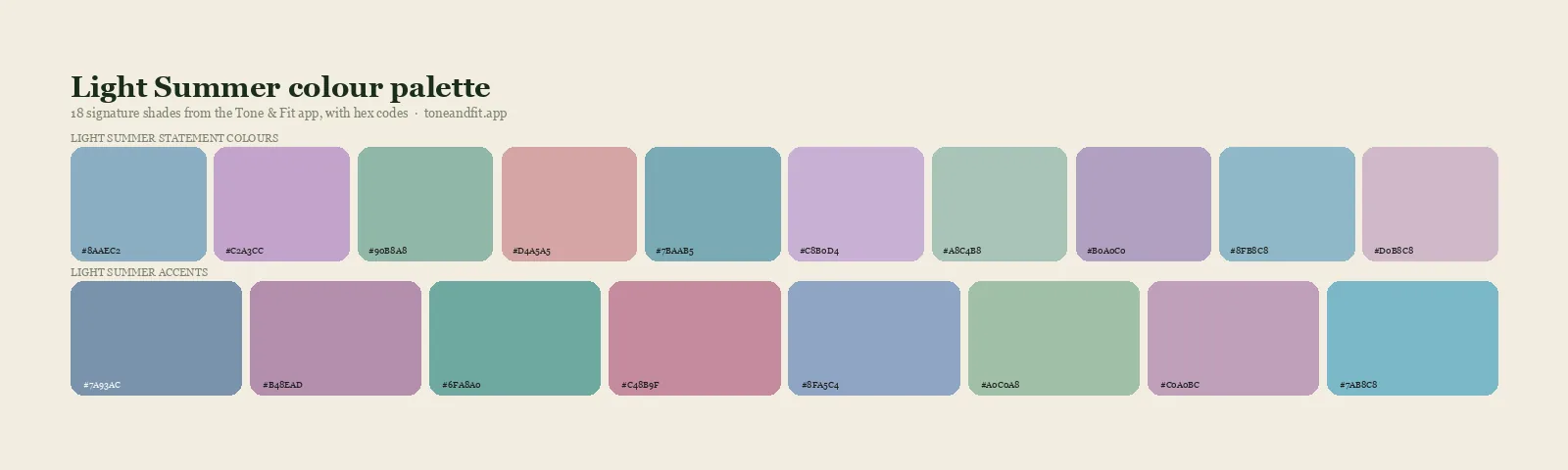
The Light Summer palette consists of colors that mirror these qualities: soft lavender, powder blue, dusty rose, cool gray, muted sage, icy pink, periwinkle, and soft teal. When Taylor wears these colors, her skin looks clear and luminous, her eyes pop, and the overall effect is harmonious. The colors do not compete with her features or overpower them.
Conversely, colors that oppose these qualities (warm, dark, or highly saturated shades like mustard, burnt orange, deep forest green, or neon anything) create visual tension. They can make her skin look sallow, her features look washed out, or the outfit look like it is wearing her instead of the other way around.
The simplest test of a color season is this: in the right colors, people notice you. In the wrong colors, people notice the outfit. Light Summers disappear behind bold, warm, or heavy colors.
The Light Spring Counterargument
Not every colorist agrees on Light Summer. A vocal minority places Taylor in Light Spring, and the debate is worth examining because it illustrates one of the trickiest distinctions in color analysis.
Light Spring shares one dimension with Light Summer: light value. Both seasons have people with fair skin, light hair, and lighter eyes. The difference is undertone. Light Spring is warm: think golden, peachy, and sun-kissed. Light Summer is cool: think rosy, ashy, and silvery.
The Light Spring case for Taylor rests on a few observations. In certain photos, particularly those taken in warm golden-hour light, her hair can appear more golden than ashy. Some argue that her skin has a neutral-warm quality rather than a purely cool one. And there are moments where she looks good in warm-adjacent colors like cream and soft peach, which could suggest Spring warmth.
Why Most Colorists Still Land on Light Summer
The counterarguments have counterarguments. Warm lighting makes everyone look warmer; that is what warm light does, and it is not diagnostic. Her hair's natural root color, visible in unprocessed candid photos, consistently reads ash rather than gold. And the neutral-warm argument actually supports a cool-leaning neutral undertone. Light Summers are not ice-cold cool like a True Winter. They sit on the lighter, softer end of cool, which can sometimes read as neutral.
As for cream and soft peach, these are borderline colors that can work on Light Summers precisely because they are low in saturation. A highly saturated warm color like tangerine or sunflower yellow is a better litmus test, and those do not tend to be Taylor's strongest looks.
The honest answer is that Taylor likely sits close to the border between Light Summer and Light Spring. In the 12-season system, these two seasons are neighbors; they share lightness and softness and only diverge on the warm-cool axis. People who land on or near the border between two seasons will look decent in both palettes and outstanding in neither's extremes. But if forced to choose, the weight of evidence (the ash in the hair, the pink in the skin, the cool in the eyes) tips toward Light Summer.
What Season Are You?
Skip the guesswork. Tone & Fit uses your selfie to analyze your undertone, contrast, and color season in seconds, the same framework we just walked through for Taylor, applied to you.
Find Your Season Free ↗Best and Worst Color Moments, Era by Era
One of the advantages of analyzing Taylor Swift is that her career is organized into distinct visual eras, each with its own color story. Let's walk through them with a colorist's eye.
Lover Era: Peak Light Summer Alignment
The Lover era is the closest Taylor has come to dressing fully within a Light Summer palette. The pastels, lavender, powder blue, and soft pink that defined this period are core Light Summer colors. This is the era where many fans and casual observers noted that she looked especially radiant. That is not a coincidence. When your clothing colors harmonize with your natural coloring, you look healthier, more vibrant, and more "yourself." The Lover palette was, whether by intention or instinct, Taylor's most color-harmonious era.
Red Era: Bold but Mismatched
The Red era leaned heavily on, well, red. Specifically saturated, warm-leaning reds and deep burgundies. These are not Light Summer colors. They are too dark, too warm, and too saturated for someone with light, cool, soft coloring. So why did it work as branding? Because branding and color harmony are different things. A bold red lip and a red dress create visual impact through contrast and cultural association, not through color-season alignment. Taylor looked striking in those reds, but striking is not the same as harmonious. The color wore her; it drew attention to itself, which was exactly the point of the era's aesthetic.
Reputation Era: The All-Black Gamble
Black is one of the most universally worn colors, but it is flattering on a relatively narrow range of seasons, primarily Winters, who have the depth and contrast to stand up to it. Light Summers are among the seasons least served by head-to-toe black. It can drain color from their skin and create a stark, harsh frame around their naturally soft features.
The Reputation era was wall-to-wall black, snake motifs, and dark metallics. Again, the artistic and branding logic was impeccable. The visual departure from everything that came before was the whole point. But from a pure color-analysis perspective, this era's palette was working against Taylor's natural coloring. If you have ever thought that she looked "harder" or "more intense" during this period, part of that was intentional styling, and part of it was the colors themselves creating higher contrast than her features naturally support.
Folklore and Evermore: An Interesting Mismatch
These twin eras introduced a palette of muted earth tones, warm creams, forest greens, and browns. This is Soft Autumn territory, muted like Light Summer, but warm instead of cool. The result was interesting. The mutedness worked. The warmth did not quite work. Taylor looked cozy and cohesive in these palettes, but she did not have that same lit-from-within quality she had during the Lover era. The colors were close but not quite right, like a song played in a slightly different key.
This era is actually useful evidence in the Light Summer vs. Light Spring debate. If Taylor were a Light Spring (warm undertone), the warm earth tones of Folklore should have been very flattering. The fact that they looked "good but not great" supports the cool-undertone interpretation.
The Eras Tour: Everything at Once
The Eras Tour is a greatest-hits of color palettes, cycling through every era's visual identity in a single show. From a color-analysis perspective, it is a fascinating controlled experiment. The segments where Taylor wears cool pastels and soft, light shades tend to be where she looks most naturally radiant. The segments with bold black or warm saturated colors read as costuming, visually coherent but not color-harmonious. Neither approach is wrong, but they serve different functions.
What You Can Learn from Taylor's Color Journey
Taylor Swift has worn every color imaginable at the highest level of professional styling, and that gives us a few practical takeaways for your own wardrobe:
1. Your best colors are not always your favorite colors
Taylor's most iconic visual moments (the red lip, the black bodysuit, the sequined mini-dresses) are not necessarily in her best colors from a color-analysis perspective. And that is fine. Color analysis is a tool for understanding what harmonizes with your natural features, not a set of rules you must follow. There is real value in knowing that powder blue makes your skin glow, even if you choose to wear black because you love black.
2. Branding and harmony are different goals
Sometimes you want to harmonize (daily wear, professional settings, looking your natural best). Sometimes you want to create impact, make a statement, or build a visual identity. Red lipstick on a Light Summer might not be "harmonious," but it can be iconic. The point of knowing your season is that you are making that choice consciously, not defaulting to colors that fight your features without realizing it.
3. Mutedness matters as much as temperature
One reason the Folklore palette looked decent on Taylor despite being warm is that it was muted. Chroma (soft vs. bright) is just as important as undertone (warm vs. cool). If you are a soft, muted season, whether Summer or Autumn, you will generally look better in muted versions of "wrong" undertone colors than in vivid versions of "right" undertone colors. A soft warm taupe will look better on a Light Summer than a vivid cool fuchsia.
4. Hair color changes everything
Taylor's experiments with hair color (platinum, copper, darker brunette) changed how her overall coloring read. When she went platinum, she pushed her contrast lower and her value lighter, leaning harder into Light Summer territory. When she went darker, she increased contrast and moved toward Cool Summer. If you are considering a hair color change, understanding your season helps you predict which shades will harmonize and which will fight your skin.
5. Lighting is not lying, but it is editorializing
Taylor looks different in every photo depending on the lighting. Golden-hour outdoor shots make her look warmer. Cool studio lighting makes her look cooler. Flash photography washes everything out. This is not unique to her; it happens to everyone. When you are analyzing your own coloring, natural daylight near a window is the only lighting condition that gives you reliable data. Everything else is editorializing.
Ready to find your season?
One selfie, your 12-season result, and the palette that goes with it. Free, no sign-up.
Find your season free ↗Prefer to have it measured? Try free color analysis from a photo and get your season with a confidence score.
Frequently Asked Questions
What color season is Taylor Swift?
Most professional colorists type Taylor Swift as a Light Summer. Her fair, cool-toned skin, ash-toned natural hair, and blue-green eyes all point to a cool undertone with light value and soft chroma, the three defining traits of the Light Summer season.
Is Taylor Swift a Light Spring or Light Summer?
This is one of the most debated questions in celebrity color analysis. Both seasons share light value, but they differ on undertone: Light Spring is warm, Light Summer is cool. Taylor's natural hair leans ash rather than golden, and her skin reads pink-cool rather than warm-peachy. Most colorists place her in Light Summer, though she likely sits near the border between the two.
What are Taylor Swift's best colors to wear?
Based on a Light Summer typing, her most flattering colors include soft lavender, powder blue, dusty rose, cool gray, sage green, icy pink, and muted periwinkle. These are cool, light, and softly saturated shades that harmonize with her natural coloring. The Lover era demonstrated this palette in action.
Can I use celebrity color analysis to find my own season?
Celebrity analysis is a great learning tool, but it should not replace your own analysis. Celebrities wear professional makeup and are photographed under controlled lighting, both of which shift how their coloring reads. Use celebrity examples to understand the framework and train your eye, then analyze your own features in natural daylight, or use an app like Tone & Fit for a personalized result.
Is Taylor Swift a Soft Summer?
Soft Summer is sometimes suggested because her colouring is soft and cool, but Soft Summer is a medium-depth, muted season and Taylor is distinctly light with fairly clear eyes. Light Summer fits the lightness; Soft Summer would put her a step too deep and too muted.