Color Analysis for Men: Your Guide to Looking Sharp in the Right Shades
The difference between a guy who "cleans up well" and one who just looks fine is almost always color. Here's the framework that tells you exactly which ones work on you.
What's in this guide
Yes, color analysis is for men too
Let's skip the pep talk. Color analysis is applied contrast theory. It was invented by Johannes Itten, a Bauhaus painter and art teacher, in the 1920s. Itten noticed that his students instinctively gravitated toward palettes that matched their own natural coloring. He mapped those preferences onto the four seasons and called it a day. A man studying color theory at art school. Nothing gendered about it.
The reason color analysis became coded as "feminine" is an accident of marketing. Carole Jackson's 1980 bestseller Color Me Beautiful targeted women, sold 7 million copies, and permanently wired "color analysis" to "women's magazine" in the public imagination. The underlying framework has nothing to do with gender. It's about the relationship between pigment in your skin, contrast in your features, and the wavelengths of light bouncing off your clothes into other people's eyes.
In practice, the men who already use color analysis just don't call it that:
- K-pop stylists color-type every idol before building their stage and press wardrobes. BTS, EXO, Stray Kids, all of them have documented color seasons that dictate their styling.
- Executive image consultants charge several hundred dollars a session to tell C-suite men whether they should wear a navy or charcoal suit to a board meeting. That's color analysis.
- Menswear influencers on YouTube and TikTok have driven a surge of interest in men's color analysis, because the advice is immediately actionable. Wear this, not that, and look better tomorrow.
- Film and TV costume designers choose wardrobe palettes based on actors' coloring. It's why certain characters look iconic in certain colors. That's not coincidence.
You don't need to care about fashion theory. You just need to know which colors make your face look sharp and which ones make you look like you slept in your car. This guide gives you that.
How seasonal color analysis works for men
Seasonal color analysis classifies your natural coloring into one of 12 seasons. It does this by measuring three traits of your appearance:
- Undertone: Is the pigment beneath your skin warm (golden, peachy, olive) or cool (pink, red, blue)? This is chemistry, not opinion. It comes from the ratio of melanin to hemoglobin in your skin.
- Value: How light or deep does your overall coloring read? Light hair, light eyes, lighter skin = high value. Dark hair, dark eyes, deeper skin = low value.
- Chroma: How saturated are your features? If your eyes are vivid, your eyebrows are sharp, and your coloring "pops," you're high chroma (bright). If everything blends softly together, you're low chroma (muted).
These three traits map you to one of the 12 seasons: Light Spring, True Spring, Warm Spring, Light Summer, True Summer, Cool Summer, Soft Autumn, True Autumn, Deep Autumn, Cool Winter, True Winter, Deep Winter. The system is completely gender-neutral. A Deep Autumn man and a Deep Autumn woman get the same palette.
For the full breakdown of all 12 seasons, read our complete guide to seasonal color analysis.
Quick self-assessment: find your season in 5 minutes
You can do a rough self-typing right now. Grab two t-shirts (one bright white, one off-white or cream) and stand near a window with natural light. No direct sun, no fluorescent bathroom light. Then run through these five tests:
1. The beard shadow test
If you can grow facial hair, look at your stubble or the shadow on your jaw in natural light. Warm-toned men tend to have stubble that reads brown, reddish-brown, or golden. Cool-toned men tend to have stubble that reads blue-gray, ashy, or near-black without warmth. If you can't grow facial hair, skip this and weight the other tests more.
Quick read
Brown/red/golden shadow = likely warm (Spring or Autumn). Blue-gray/ashy shadow = likely cool (Summer or Winter).
2. The vein test
Turn your inner wrist toward the window. Look at the veins just below the skin. Green-leaning veins suggest warm undertone. Blue or purple veins suggest cool undertone. Both equally suggests neutral, which usually means you'll land in a "true" season rather than a strongly warm or cool one.
3. The white vs. off-white t-shirt test
Hold a bright white t-shirt under your chin, then swap it for an off-white or cream one. One will make your skin look cleaner and your jaw sharper. The other will make you look slightly yellowish or washed out. If bright white wins, you're likely cool. If off-white/cream wins, you're likely warm.
4. The watch test
Try on a silver watch (or hold something silver next to your wrist), then a gold one. Which metal makes your skin look more even? Silver flatters cool undertones. Gold flatters warm undertones. This also tells you what color belt buckle, cufflinks, and glasses frames will work best.
5. The sunlight hair test
Step outside or stand near a window and look at your hair where light catches it. Warm types show reddish, copper, or golden highlights in sunlight. Cool types look ashy, blue-black, or show no warm shimmer at all. If your hair is shaved very short or you're bald, focus on the other four tests instead.
If you got 3+ warm signals, you're likely a Spring or Autumn. If you got 3+ cool signals, you're likely a Summer or Winter. To narrow it further: lighter overall coloring points to Spring or Summer, deeper overall coloring points to Autumn or Winter.
For a more detailed walkthrough with photos, check our guide on how to find your skin undertone at home. Or skip the guesswork entirely and use Tone & Fit, which analyzes a selfie and gives you your season plus a full personal palette in under a minute.
Find your colors in 60 seconds
Take a selfie. Get your season, your personal palette of 40+ colors, and specific wardrobe recommendations. No drape test needed.
Download Tone & FitWhat each season looks like on a man
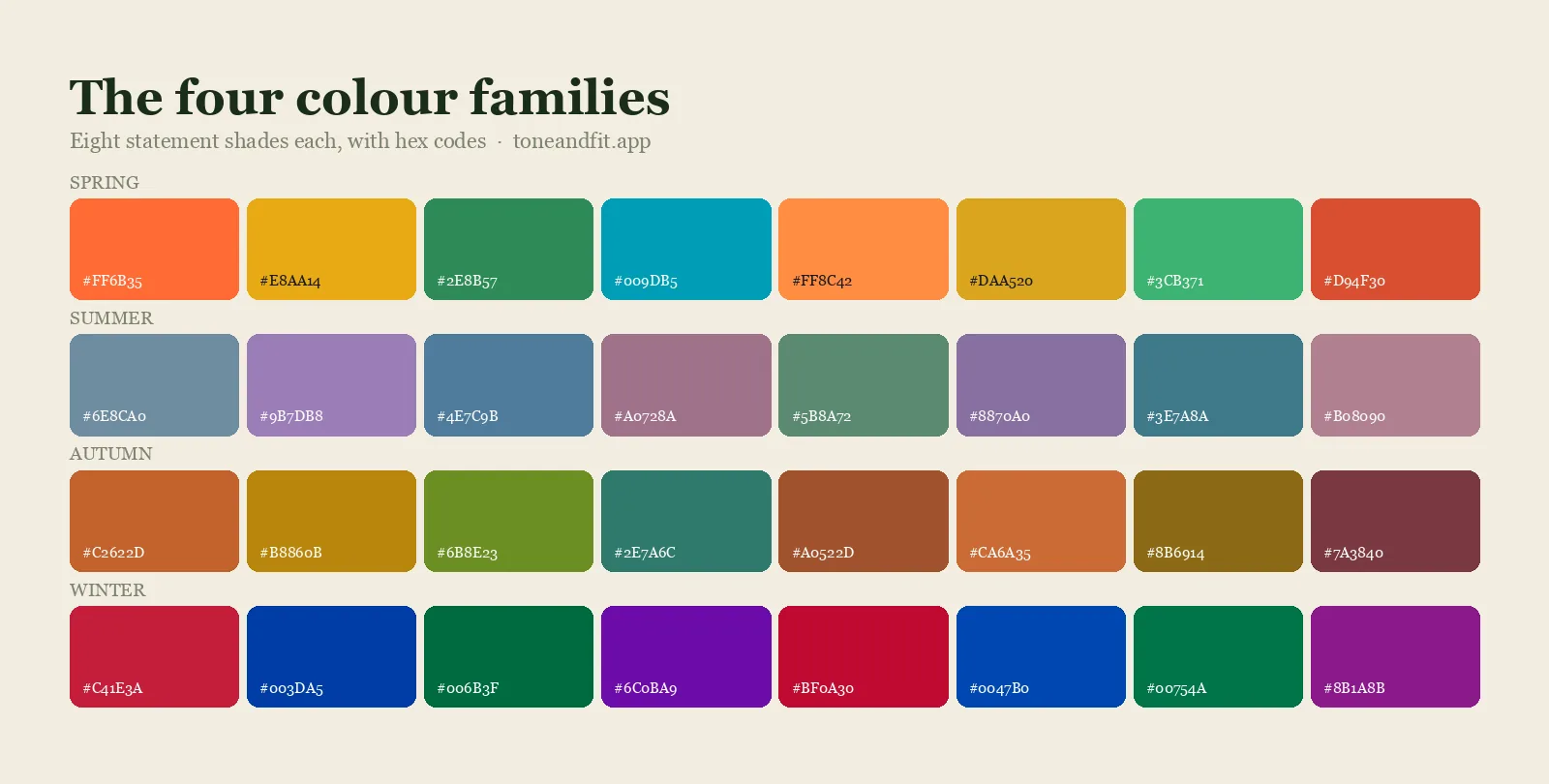
Here's what each of the four main season groups typically looks like on a man, and the colors that make each type look their sharpest. Once you know your group, the men's color seasons hub goes a level deeper, with a page per season giving the exact suits, shirts, ties and denim in hex codes.
Spring men
Spring men are warm-toned with lighter to medium coloring. Think: golden-brown or strawberry-blond hair, blue or green eyes, skin that tans golden. Their features have a warm brightness to them.
Your best colors: warm khaki, peach, coral, warm green (think grass, not olive), golden yellow, ivory, warm light gray, camel. These colors amplify the natural warmth in your skin without overpowering your lighter features.
Avoid: Black (too stark), cool gray, icy pastels, anything blue-based or overly muted. These drain the warmth from your face and make you look flat.
Summer men
Summer men are cool-toned with lighter to medium coloring. Think: ash-brown or mousy-blond hair, gray or soft blue eyes, skin with a pinkish or neutral cast. Features tend to blend softly rather than contrast sharply.
Your best colors: light gray, dusty blue, slate, lavender, sage, muted navy, rose-toned neutrals, soft white (not stark white). Muted, cool-leaning colors that harmonize with your low-contrast coloring.
Avoid: Bright orange, warm brown, golden yellow, anything vivid and warm. These create a visual clash with your cool, soft features.
Autumn men
Autumn men are warm-toned with medium to deeper coloring. Think: dark brown or auburn hair, brown or hazel eyes, skin with golden or olive undertones. These are the guys who look great in earth tones without even trying.
Your best colors: olive, rust, camel, chocolate brown, forest green, burnt orange, warm navy, mustard, terracotta, khaki. Rich, warm, grounded colors that match the depth and warmth of your natural palette.
Avoid: Pastel pink, icy blue, fuchsia, stark white, cool gray. These feel disconnected from your warm depth and make you look like you borrowed someone else's shirt.
Winter men
Winter men are cool-toned with high contrast between features. Think: very dark hair against lighter skin, or deep coloring overall with striking eyes. Sharp eyebrows, defined jawline, coloring that "pops." This is the season that actually looks good in black.
Your best colors: navy, charcoal, true black, burgundy, pure white, emerald, royal blue, deep plum, icy silver. High-contrast, saturated colors that match the intensity of your features.
Avoid: Muted earth tones (camel, olive, rust), warm pastels, golden brown. These soften your natural contrast and make you look washed out despite having strong features.
The men's wardrobe cheat sheet
Here's the practical version. Pin this, screenshot it, whatever. If you want the shopping-floor version, with the reasoning behind each choice and a section on how a beard changes your contrast, that lives in our playbook on men's wardrobe colors by skin tone.
| Season | Suits | Shirts | Ties / Accents | Casual | Metals |
|---|---|---|---|---|---|
| Spring | Warm tan, camel, light warm gray | Ivory, peach, warm light blue | Coral, warm green, golden yellow | Khaki chinos, cream tees, warm denim | Gold, brass, warm bronze |
| Summer | Light gray, blue-gray, soft navy | Soft white, lavender, dusty blue | Sage, mauve, muted burgundy | Gray tees, slate chinos, faded denim | Silver, white gold, pewter |
| Autumn | Chocolate brown, olive, warm navy | Cream, warm white, terracotta | Rust, forest green, burnt orange | Olive cargo pants, earth-tone tees, raw denim | Gold, antique brass, copper |
| Winter | Charcoal, true black, deep navy | Bright white, icy blue, light gray | Burgundy, emerald, royal blue | Black jeans, white tees, monochrome layers | Silver, platinum, gunmetal |
Notice the metals column. Your watch, belt buckle, ring, glasses frames, and cufflinks should all lean toward the same metal family. It's a small detail that pulls everything together. Warm seasons wear gold. Cool seasons wear silver. If you're neutral, either works, but don't mix them in the same outfit.
Common men's color mistakes
1. Wearing black by default
Black is a Winter color. It works on maybe 25% of men. On a Spring or Autumn man, a black suit or black t-shirt creates too much contrast with their warm, softer coloring. The shirt wears you instead of the other way around. If you're Spring or Autumn, swap black for charcoal, chocolate brown, or deep navy. You'll look just as sharp without the color working against your face.
2. Ignoring the navy vs. charcoal decision
Your first suit should be navy or charcoal, not both. But which one? Warm-toned men (Spring, Autumn) look better in a warm navy. Cool-toned men (Summer, Winter) look better in charcoal. This is the single most impactful wardrobe decision most men never think about. If your one interview suit is the wrong shade, you're starting at a visual disadvantage.
3. Defaulting to gray everything
Gray is safe. It's also boring, and more importantly, it's not even safe, because the wrong shade of gray actively dulls your appearance. Cool gray flattens warm-toned men. Warm gray muddies cool-toned men. If you're going to live in gray (no judgment), at least pick the right temperature. And throw in one accent color from your palette. An Autumn man in warm gray with a rust-colored watch strap looks a hundred times sharper than the same guy in head-to-toe neutral gray.
4. Matching colors to your clothes instead of your face
Men tend to think about colors in terms of what "goes together" in an outfit. Blue shirt and khaki pants? Sure, those match each other. But the real question is whether that shade of blue matches your face. A warm teal looks great on an Autumn and terrible on a Summer, even if the outfit itself is perfectly coordinated. Your face is the anchor. Start there.
5. Ignoring the undershirt
If your t-shirt or undershirt is visible at the collar, it matters. Bright white undershirt on a warm-toned man peaking out of a v-neck = instant clash right at the neckline, exactly where people look. Match your undershirt to your white: warm men wear cream or off-white, cool men wear bright white.
Ready to find your season?
One selfie, your 12-season result, and the palette that goes with it. Free, no sign-up.
Find your season free ↗If you are comparing options, see which color analysis apps are worth it before you install anything.
Going deeper: suits, shirts, ties and beards
The sections below were merged in from our longer menswear guide, so everything on the subject lives on one page.
Suit colors by undertone
If you have ever searched "best suit color for my skin tone," here is the two-list answer, no seasonal jargon required.
Warm undertone: your suits
- Chocolate or espresso brown: this is your black. Deep, serious, and it makes warm skin look expensive.
- Olive: the most underrated suit color in menswear, and warm-toned men are the ones who can actually wear it.
- Tan or camel: summer weddings, daytime events, linen season.
- Warm navy: navy with a softer, slightly green-leaning cast rather than a blue-black one.
Cool undertone: your suits
- Charcoal: sharpens cool skin the way espresso flatters warm skin.
- True navy: the classic blue-black navy; it echoes the cool in your skin instead of fighting it.
- Cool mid-gray: clean and modern on cool coloring, especially under a bright white shirt.
So can you wear a black suit?
Black flatters one specific profile: cool undertone plus high contrast, the Winter family. Dark hair, cool skin, sharp features. On that man, black looks like a decision. On a warm-toned or low-contrast man, black overpowers the face, deepens under-eye shadows, and reads slightly flat in daylight. If your dress codes demand black, own one; just spend your real suit budget on the lists above. For interviews specifically, an undertone-correct navy or charcoal beats black in almost every industry; we broke that down in what colors to wear to a job interview. For the full rack, we have a season-by-season breakdown of which suit colors work with each of the twelve seasons, including the browns and olives most menswear guides leave out.
Shirts: the white decision, then blue depths
White vs off-white
This is the highest-return swap in the entire guide. Bright, optic white is a cool color: on cool undertones it sharpens the jaw and makes eyes look clearer. On warm undertones that same shirt casts gray and turns skin sallow; you want off-white, ecru, cream, or oatmeal instead. Test it in a mirror: hold both whites at your chin and watch which one cleans up your face. Then replace your shirts one by one, as they wear out, in the white that won.
Blue shirts: pick your depth
Nearly every man "looks fine" in a light blue shirt, which is exactly why it is the default gift. To go from fine to sharp, match the blue's depth to your own. Light or low-contrast coloring: pale sky blue. Medium coloring: French blue or a classic mid-tone chambray. Deep, high-contrast coloring: deep chambray or a saturated French blue. The rule of thumb: when the shirt is darker or louder than your own coloring, people photograph the shirt, not you.
Ties and knitwear: accent by season family
Here is the professional shortcut: keep the suit and shirt in your undertone's neutrals, then let one accent near the face carry the actual color. A tie, a roll-neck, a crew-neck sweater under a jacket. Because the accent sits at your collar it has to be in-season; because it is small, it is the cheapest thing in your wardrobe to get right.
- Spring family (warm and fresh): coral, golden yellow, clear grass green, warm sky blue.
- Summer family (cool and muted): dusty blue, mauve, slate, soft raspberry, gentle burgundy.
- Autumn family (warm and deep): rust, mustard, olive, tobacco brown, forest green.
- Winter family (cool and sharp): true red, emerald, cobalt, deep burgundy, black-and-white patterns.
Knitwear follows the same list with a bigger payoff, since a sweater frames your whole face for months of the year. A rust roll-neck on an Autumn, or an emerald crew on a Winter, does more for a video call than any tailoring bill.
Grooming notes: beards change your contrast
A beard is a color decision. Grow a full dark beard and you have added a solid block of depth to the lower half of your face: your contrast jumps, and you can suddenly carry deeper, bolder shades that would have overwhelmed you clean-shaven. Let that beard go heavily gray and the effect reverses; your coloring softens and mutes, and a notch-quieter palette starts winning. Shave it all off and you are back to baseline.
The same drift happens as the hair at your temples silvers: most men slide slightly cooler and softer with age. If you have grown or shaved a beard, or gone noticeably gray since you last checked, re-run the three-minute self-check. Edge cases shift between neighboring seasons more often than people expect. Our walkthrough on how to find your contrast level shows how to measure that jump rather than guess at it.
Frequently asked questions
Does color analysis actually work for men?
Yes. Color analysis is based on contrast theory and the relationship between your skin's undertone, your natural coloring depth, and the saturation of your features. None of that is gender-specific. The same framework applies to every human face. The guy who always gets told he "looks great in blue" is already experiencing color analysis in action. He just doesn't have a name for why it works.
What if I only wear neutrals?
Neutrals aren't actually neutral. A charcoal suit reads very differently on a Warm Autumn than on a Cool Winter. Knowing your season helps you pick the right shade of every neutral: warm gray vs. cool gray, navy vs. charcoal, off-white vs. bright white, tan vs. taupe. Even if your entire wardrobe is black, gray, white, and navy, color analysis still tells you which black, which gray, which white, and which navy.
Do tattoos affect my color analysis results?
No. Color analysis is based on the natural coloring you were born with: your skin undertone, hair color, and eye color. Tattoos sit on top of the skin and don't change the underlying pigmentation that determines your season. That said, if you're choosing a new tattoo, your color palette can actually help you pick ink colors that complement your skin rather than fight it.
Can I still wear my team's colors if they aren't in my palette?
Of course. Color analysis is a tool, not a dress code. Wear your team's jersey on game day. Nobody's asking you to give up your Packers green or your Lakers purple. The point is to know which colors make you look your best for the moments when it matters: interviews, dates, headshots, daily rotation. Save the off-palette colors for contexts where self-expression beats optimization.
What's the fastest way for a man to find his color season?
The fastest accurate method is an AI-powered analysis app like Tone & Fit. Take a selfie in natural light and you'll get your season plus a full personal palette in under a minute. The traditional route is an in-person draping session with a certified color consultant, which typically runs several hundred dollars and takes about an hour. Both give you the same core information; the app just gets you there faster.