Korean Color Analysis: The 4 Types, the Korean Skin Tone Chart and the Tone-on-Tone Technique

Short answer: Korean color analysis (personal color, 퍼스널컬러) sorts colouring into four tone types, Spring Warm, Summer Cool, Autumn Warm and Winter Cool, using draping and tone-on-tone comparison, and it maps onto the Western 12-season system as a coarser first cut. The four types, the Korean skin tone chart, the tone-on-tone technique and the mapping are all below.
Walk through any beauty district in Seoul and you'll find studios offering "personal color" diagnosis. Here's how Korean color analysis works, why it's taken over TikTok, and how it compares to the Western seasonal system you might already know.
In this article
- What Is Korean Color Analysis?
- Korean vs. Western Seasonal Analysis
- Why Korean Color Analysis Went Viral
- The Korean 4-Type System Explained
- Korean Skin Tone Chart
- Can You Do Korean Color Analysis at Home?
- Korean-to-Western Season Mapping
- The Korean Tone-on-Tone Technique
- Korean vs Western 12-Season Comparison
- Frequently Asked Questions
What Is Korean Color Analysis?
In South Korea, personal color (퍼스널 컬러, or peoseoneol keolleo) isn't a niche hobby; it's a mainstream part of beauty culture. The concept is simple: every person has a set of colors that naturally harmonize with their skin, hair, and eyes. Finding those colors helps you choose flattering makeup, hair dye, clothing, and even accessories.
Korean color analysis is rooted in the same seasonal color theory that originated in the West in the 1980s. But Korea took the idea and made it its own. Starting in the mid-2010s, dedicated color analysis studios began opening across Seoul, particularly in the fashion-forward neighborhoods of Gangnam, Hongdae, and Sinsa-dong. Today, there are hundreds of these studios, and getting your personal color diagnosed is as common as getting your nails done.
A typical Korean color analysis session works like this: you sit in a controlled-lighting environment (usually daylight-balanced LEDs) while a trained consultant drapes colored fabrics around your face and shoulders. They observe how each color interacts with your skin, whether it makes you look brighter and healthier, or washed out and sallow. Based on these observations, the consultant determines your personal color type.
What makes the Korean approach distinctive is its emphasis on practical beauty applications. You don't just walk out knowing you're a "Spring." You leave with specific foundation shade recommendations, lip color swatches, blush pairings, and even suggestions for hair dye colors that will complement your natural coloring. Many studios provide a printed booklet or digital color card you can take shopping.
In Korea, knowing your personal color is considered a basic part of understanding yourself, right alongside knowing your blood type or MBTI.
The K-beauty industry has fully embraced this. Major brands like Innisfree, Etude House, and Laneige organize their product displays by personal color type. Walk into an Olive Young store and you'll see foundation, lipstick, and eyeshadow shelved under warm tone (웜톤) and cool tone (쿨톤) categories. It's changed how Korean consumers shop for beauty products.
How Korean Color Analysis Differs from Western Seasonal
If you're familiar with the 12-season color analysis system popular in the West, Korean personal color will feel both familiar and different. They share a common ancestor, but they've evolved in distinct directions.
| Aspect | Korean Personal Color | Western 12-Season |
|---|---|---|
| Primary sorting | Warm tone vs. cool tone first, then brightness and mutedness | Undertone, value, and chroma weighted equally |
| Classification | 4 base types; studios may expand to 10 or 16 sub-types | 12 seasons (4 base, 3 variants each) |
| Terminology | 봄웜 (Spring Warm), 여름쿨 (Summer Cool), 가을웜 (Autumn Warm), 겨울쿨 (Winter Cool) | Light Spring, True Spring, Bright Spring, Light Summer, etc. |
| Primary focus | Makeup and K-beauty product selection | Wardrobe and overall styling |
| Method | Fabric draping under controlled studio lighting, often with LED panels | Fabric draping, sometimes natural daylight |
| Output | Color booklet with specific makeup shade codes, hair color recs, and fabric swatches | Seasonal palette fan, wardrobe guidelines |
| Cultural context | Mainstream beauty service; studios in every major city | Growing trend; mainly image consultants and online tools |
| Price range | a paid tier – several hundred dollars USD for a full session in Seoul | several hundred dollars – several hundred dollars USD with a certified consultant |
The biggest philosophical difference is the starting point. Korean analysis leads with the question: are you warm or cool? Everything else flows from that binary. Western seasonal analysis, by contrast, treats undertone as just one of three dimensions, alongside how light or dark your coloring is (value) and how saturated or muted it is (chroma).
Neither approach is more "correct." They're different lenses on the same color science. Korean analysis tends to be more immediately actionable for beauty purchases, while Western analysis provides a broader framework that extends naturally to clothing and interior design.
Why Korean Color Analysis Went Viral Globally
If you've spent any time on beauty TikTok or YouTube in the past few years, you've almost certainly encountered Korean color analysis content. The trend crossed over from Korea to the global stage for several converging reasons.
K-pop made it mainstream
K-pop idols have been the single biggest driver of global interest in personal color. When fans discovered that their favorite idols had been professionally typed, and that their stylists used personal color theory to choose stage outfits, makeup, and hair colors, it created enormous curiosity. BTS members, BLACKPINK, TWICE, and other top groups have all been associated with specific personal color types, and fan communities eagerly debate and share these classifications.
The impact is real: when a popular idol is identified as a particular type, fans rush to discover their own personal color so they can try similar makeup looks and palettes.
Seoul studios became tourist destinations
As international tourism to Korea surged post-pandemic, personal color diagnosis became one of the top "must-do" experiences for beauty-conscious visitors. Studios in Hongdae and Gangnam now offer sessions in English, Japanese, and Chinese, and many visitors specifically plan their Seoul itineraries around a color analysis appointment. It's become as iconic a Seoul experience as visiting a jjimjilbang or shopping in Myeongdong.
TikTok and the visual format
Color analysis is inherently visual: you can see the difference a color makes against someone's skin in a short video. This makes it perfect for TikTok and Instagram Reels. Korean-style draping videos, where a consultant holds up fabric after fabric and the viewer watches the subject's face transform, are mesmerizing. The before-and-after impact is immediate and shareable.
The hashtag #personalcolor has billions of views across platforms, and Korean color analysis content consistently outperforms Western-style content in engagement because of the polished, studio-quality production values that Korean beauty studios bring to their social media.
K-beauty's global influence
Korean beauty has been the most influential force in global skincare and makeup for over a decade. Products like cushion compacts, sheet masks, and glass-skin routines all originated in Korea and spread worldwide. Personal color analysis is the latest export in this tradition, and it carries the same credibility that K-beauty has earned: the sense that Korean beauty culture is innovative, research-driven, and ahead of the curve.
Find Your Personal Color in 60 Seconds
Tone & Fit uses AI to determine your 12-season color type from a single selfie, no studio visit required. Get your Korean-style personal color diagnosis, plus palettes for makeup, wardrobe, and hair.
Try Tone & Fit Free ↗The Korean 4-Type System Explained
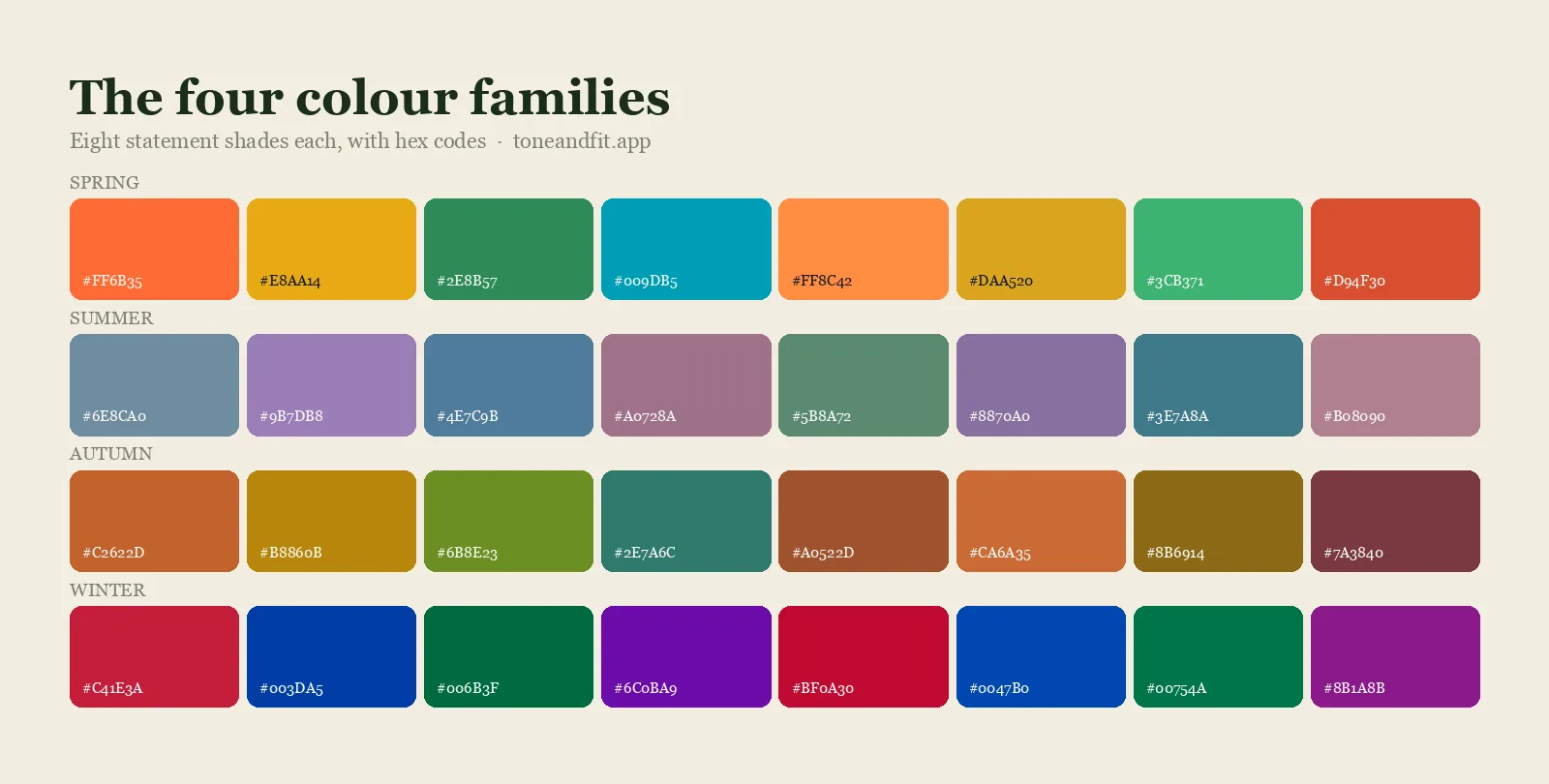
At its core, Korean personal color analysis uses four base types. Each type combines a season with a temperature, reinforcing that warm/cool distinction that Korean analysis prioritizes.
Spring Warm (봄웜 / Bom-Wom)
Bright, warm, and clear coloring. Spring Warm types look best in warm yellows, coral, peach, warm reds, camel, and ivory. Their skin tends to have a warm, golden undertone that lights up in warm, high-clarity colors. Think sunny, fresh, and youthful.
Best makeup tones: Coral lip, peach blush, warm brown eyeshadow, golden highlighter.
Summer Cool (여름쿨 / Yeoreum-Kul)
Soft, cool, and muted coloring. Summer Cool types are flattered by lavender, dusty rose, powder blue, soft mauve, and cool grays. Their skin has a pink or blue undertone and looks best in gentle, low-contrast colors rather than bold ones. Think elegant, airy, and refined.
Best makeup tones: Rose lip, pink blush, cool taupe eyeshadow, silver or pink highlighter.
Autumn Warm (가을웜 / Gaeul-Wom)
Deep, warm, and muted coloring. Autumn Warm types glow in earthy hues: olive, rust, terracotta, burnt orange, mustard, and chocolate brown. Their skin has a warm undertone but can handle richer, deeper shades than Spring types. Think grounded, sophisticated, and warm.
Best makeup tones: Brick-red lip, warm terracotta blush, olive or bronze eyeshadow, warm gold highlighter.
Winter Cool (겨울쿨 / Gyeoul-Kul)
High-contrast, cool, and vivid coloring. Winter Cool types command bold, saturated shades: true red, hot pink, cobalt blue, emerald green, pure black, and stark white. Their skin has a cool undertone and can handle sharp contrast that would overwhelm other types. Think dramatic, striking, and bold.
Best makeup tones: True red or berry lip, cool pink blush, charcoal or jewel-tone eyeshadow, icy silver highlighter.
Beyond four: the 10-type and 16-type expansions
While the four-type system is the most widely recognized, many Korean studios have expanded their classifications to capture more nuance, much like the Western world moved from 4 seasons to 12.
In a 10-type system, each season gets 2-3 sub-types based on secondary characteristics:
- Spring Warm: Bright Spring, Light Spring (some add True Spring)
- Summer Cool: Light Summer, Muted Summer (some add True Summer)
- Autumn Warm: Muted Autumn, Deep Autumn (some add True Autumn)
- Winter Cool: Bright Winter, Deep Winter (some add True Winter)
The most detailed studios use a 16-type system that adds even finer distinctions, including transitional types that sit between two seasons. This level of precision is especially useful for people whose coloring doesn't fit neatly into a single category, something that's common with the diverse skin tones found across East Asia, South Asia, and mixed-heritage individuals.
Regardless of how many sub-types a studio uses, the diagnostic process is the same: fabric draping, careful observation, and expert judgment. The more sub-types, the more fabrics the consultant uses and the longer the session takes.
Korean skin tone chart
A Korean skin tone chart lines up skin depth, from very fair to deep, against undertone, warm, cool, or neutral, to show which Korean personal color type people with that combination most often land in. It is a starting point for a guess, not a diagnosis: Korean analysis also weighs brightness and mutedness, which a depth-and-undertone grid alone cannot show.
Read down to the row that best matches how light or deep your skin looks in natural light, then across to the column for your warm, cool, or neutral undertone, and cross the two for the Korean types that typically show up in that cell. For the general-purpose version of this grid, with hex-coded shade swatches instead of color types, see our full skin tone chart.
| Skin depth | Warm undertone | Cool undertone | Neutral undertone |
|---|---|---|---|
| Very fair | Most often Spring Warm (Light), sometimes Bright | Most often Summer Cool (Light) | Typically leans Light Spring or Light Summer |
| Fair | Spring Warm (Light or True) | Summer Cool (Light or True) | Most often Summer Cool (Light), sometimes Spring Warm (Light) |
| Light-medium | Spring Warm (Bright or True) | Summer Cool (True or Muted) | Frequently Summer Cool (Muted), or a soft Autumn border case |
| Medium | Autumn Warm (True), sometimes Spring Warm (Bright) | Summer Cool (Muted), sometimes Winter Cool (Bright) | Most often Autumn Warm (Muted) or Summer Cool (Muted) |
| Tan | Autumn Warm (Muted or Deep) | Winter Cool (Bright or True) | Typically Autumn Warm (Deep) or Winter Cool (True), depending on contrast |
| Deep | Autumn Warm (Deep) | Winter Cool (Deep) | Usually Autumn Warm (Deep) or Winter Cool (Deep), confirmed by draping |
Neutral undertone and the mid-depth rows are where this chart is least reliable, since that is exactly where brightness and mutedness end up doing most of the sorting. If your depth and undertone sit between two cells, a skin tone analyzer or a full draping session is the more reliable next step, since both weigh contrast and chroma alongside depth and undertone.
Can You Do Korean-Style Color Analysis at Home?
Flying to Seoul for a professional draping session sounds wonderful, but it's not practical for most people. The good news is that the core principles behind Korean color analysis can be applied anywhere, and modern AI tools have made self-diagnosis remarkably accurate.
There are a few ways to approach it:
The DIY fabric test
Grab a few pieces of fabric or clothing in clearly warm (golden yellow, orange) and cool (blue-pink, silver) tones. In natural daylight, hold each piece near your face and look in a mirror. Notice which group makes your skin look clearer and more even, and which makes it look dull or sallow. This gives you your warm/cool baseline, the same first step Korean studios use.
AI-powered analysis
Apps like Tone & Fit use your phone's camera to analyze your skin tone, undertone, and contrast level, then classify you into one of 12 seasons. This maps directly to the Korean sub-type system (see the table below), giving you the same depth of insight that a 10-type Korean studio provides, in about 60 seconds, from your couch.
The advantage of AI analysis is consistency. Human consultants are skilled, but their assessments can be influenced by the lighting in the room, the specific fabrics they use, and their individual training. An AI model applies the same criteria every time, making results more reproducible.
Under the hood it is judging the same three properties a Seoul studio judges with drapes. Our guide sets out how undertone, value and chroma are read from one photo, and where that reading is weaker than a person in the room.
Apps differ in how finely they sort seasons, so it is worth knowing what to check before you download one. Our guide covers how the free iPhone options compare on season count, photo handling and privacy.
How Korean Types Map to the 12-Season System
If you already know your 12-season type from Tone & Fit or another source, here's how it translates to the Korean classification:
| Korean Type | Korean Term | Western 12-Season Equivalent |
|---|---|---|
| Spring Warm (Bright) | 봄웜 브라이트 | Bright Spring |
| Spring Warm (Light) | 봄웜 라이트 | Light Spring |
| Spring Warm (True) | 봄웜 트루 | True (Warm) Spring |
| Summer Cool (Light) | 여름쿨 라이트 | Light Summer |
| Summer Cool (True) | 여름쿨 트루 | True (Cool) Summer |
| Summer Cool (Muted) | 여름쿨 뮤트 | Soft Summer |
| Autumn Warm (True) | 가을웜 트루 | True (Warm) Autumn |
| Autumn Warm (Muted) | 가을웜 뮤트 | Soft Autumn |
| Autumn Warm (Deep) | 가을웜 딥 | Deep Autumn |
| Winter Cool (Bright) | 겨울쿨 브라이트 | Bright Winter |
| Winter Cool (True) | 겨울쿨 트루 | True (Cool) Winter |
| Winter Cool (Deep) | 겨울쿨 딥 | Deep Winter |
As you can see, the systems are remarkably compatible. The Korean framework just wraps them in a warm/cool-first hierarchy and pairs each type with specific K-beauty product recommendations. If you know your 12-season type, you already know your Korean personal color, and vice versa.
The Korean tone-on-tone technique, step by step
Tone-on-tone means building an outfit from a single hue family at different depths, light, medium, and dark versions of the same color, while keeping the undertone consistent throughout, rather than mixing several unrelated hues together. It is one of the most common ways Korean personal color consultants translate a season into an actual outfit.
- Confirm your undertone and season first. Tone-on-tone only works if every piece shares the same warm or cool lean, so start from your Korean type or 12-season result rather than guessing.
- Pick one hue family your season handles well. A Summer Cool type might choose blue or rose; an Autumn Warm type might choose olive or rust. Check your season's palette for hues that suit your undertone.
- Gather three or four depths of that hue. Aim for a visible light-to-dark range within the same family: powder blue through navy, or camel through chocolate.
- Anchor the look with a mid-depth piece. A mid-tone top or dress usually works better as the base than the lightest or darkest item in the set.
- Layer lighter and darker pieces around it. A darker jacket or bag and a lighter accessory or shoe read as intentional, not accidental, when everything shares the same hue and undertone.
- Check the undertone match in natural light. Two blues or two pinks can carry different undertones, so hold pieces together in daylight before committing to the combination.
- Add one neutral if the look needs a break. Cream, gray, black, or white, whichever your season pairs with, can stop a monochrome outfit from reading as flat.
- Repeat with a new hue family. Once one tone-on-tone combination feels natural, build a second around a different color in your palette.
Ready to find your season?
One selfie, your 12-season result, and the palette that goes with it. Free, no sign-up.
Find your season free ↗For the underlying reading, our skin tone analyzer explains what undertone, depth and contrast actually are.
Korean vs Western 12-season color analysis
Korean color analysis and the Western 12-season system share the same seasonal color theory, but they typically differ in how many types they use, how they weigh undertone against brightness, and where the actual session happens. The table below is a quick reference; the fuller comparison earlier in this article covers the reasoning behind each difference.
| Factor | Korean system | Western 12-season system |
|---|---|---|
| Number of types | 4 base types, most often expanded to 10; some studios use 16 | 12 types (4 seasons, 3 variants each) |
| How undertone is treated | The first and primary sort: warm versus cool comes before anything else | One of three factors, weighed alongside depth and saturation rather than first |
| How depth and brightness are handled | Applied as a second pass, using words like bright, light, muted, or deep within a warm or cool group | Built into the season itself; each of the 12 types encodes a specific depth and clarity level |
| Typical result format | A color booklet or card with makeup shade codes, hair color recommendations, and fabric swatches | A seasonal palette fan or swatch set, usually organized for wardrobe planning |
| Where draping happens | Dedicated personal color studios, common in most Korean cities and especially Seoul | Independent image consultants, stylists, or increasingly, photo-based apps |
| Typical use | Leans toward makeup and K-beauty product selection | Leans toward wardrobe and broader personal styling |
These are tendencies, not fixed rules: some Korean studios now issue full wardrobe guides, and some Western consultants borrow the Korean warm-cool-first question as a quick starting point before moving into value and chroma. Testing your own undertone at home is a reasonable first step either way.
Frequently Asked Questions
How much does Korean color analysis cost in Seoul?
A professional session in Seoul typically costs between 50,000 and 200,000 KRW (roughly several hundred dollars USD). Premium studios in Gangnam or Hongdae charge at the higher end and often include a detailed color booklet, fabric swatches, and specific makeup product recommendations. Some studios offer more affordable group sessions starting around 30,000 KRW, though these tend to be shorter and less personalized. Booking in advance is recommended, especially at popular studios that cater to international visitors.
Is Korean color analysis the same as seasonal color analysis?
They share the same foundation. Both systems are rooted in seasonal color theory, which classifies people based on their skin undertone, contrast, and natural coloring. The key difference is in how they organize and apply that information. Korean personal color analysis prioritizes the warm-vs.-cool distinction first and focuses heavily on makeup and K-beauty product selection. Western seasonal color analysis gives equal weight to undertone, value (lightness/darkness), and chroma (saturation), and tends to focus more on wardrobe building. Think of them as two dialects of the same language.
What K-pop idols have had color analysis done?
Many top K-pop idols have had their personal color publicly discussed or diagnosed. BTS's Jungkook and V are frequently identified as Autumn Warm types, while Jimin is considered a Summer Cool. BLACKPINK's Jennie is often typed as Winter Cool and Rosé as Summer Cool. TWICE's members have also shared their types on variety shows. It's worth noting that many of these typings come from fan analysis and stylist observations rather than confirmed studio visits, so take them as educated assessments rather than official diagnoses.
Can I do Korean color analysis online?
Yes, and the technology has gotten very good. While an in-person draping session with a trained consultant is still considered the gold standard, AI-powered apps like Tone & Fit can analyze your skin tone from a selfie and classify you into one of 12 seasons, which maps directly to the Korean sub-type system. The key advantage of online analysis is accessibility: you don't need to fly to Seoul, and you get results in about a minute. For best results, take your selfie in natural daylight without heavy makeup.
Does Korean color analysis work for all skin tones?
Absolutely. While Korean color analysis was developed primarily with East Asian skin tones in mind, the underlying color science is universal. Warm and cool undertones exist across every skin tone and ethnicity. Many studios in Seoul now work with international clients of all backgrounds, and the expanded 10-type and 16-type systems were developed partly to better accommodate the full spectrum of human coloring. Similarly, apps like Tone & Fit are trained on diverse skin tones and provide accurate results regardless of your background.
What is a Korean skin tone chart?
A Korean skin tone chart lines up skin depth, from very fair to deep, against undertone, warm, cool, or neutral, to show which Korean personal color type people with that combination most often fall into. It works as a starting hypothesis rather than a full diagnosis, since brightness and mutedness also factor into a complete personal color result.
What is the tone-on-tone technique?
Tone-on-tone is a dressing method used in Korean personal color practice where every piece in an outfit comes from one hue family at different depths, light, medium, and dark versions of the same color, rather than combining several unrelated hues. The undertone stays consistent throughout the look, which is what keeps a monochrome outfit from reading as flat.
Is Korean color analysis different from Western?
Yes, mainly in emphasis rather than foundation. Both systems classify people into seasons using the same underlying color theory, but Korean analysis sorts by warm versus cool first and leans toward makeup and K-beauty recommendations, while Western 12-season analysis weighs undertone, depth, and saturation together and leans toward wardrobe and styling.
How much does a color analysis cost in Korea?
It depends on the studio and the length of the session, and prices change often, so we do not print a figure here. Sessions in Seoul's beauty districts range from a short tone diagnosis to a full consultation with draping and a printed palette. A separate guide on what to expect and what drives the price is scheduled on this blog.
Is Korean color analysis different from Western color analysis?
Yes, in emphasis rather than in principle. Korean analysis leads with temperature and gives four tone types; the Western seasonal system adds depth and clarity for twelve. Both rest on the same idea: colours near your face either harmonise with your undertone or fight it. The mapping section below shows how the two line up.
Where can I get a free color analysis in Korea?
Studios in Korea are paid services. The free route is a photo-based analysis: the Tone & Fit browser tool and app read your undertone and season from a selfie at no cost, and the result includes the Korean tone type your season corresponds to.