Cool Winter: The Crisp, Icy Season with Maximum Clarity

Short answer: Cool Winter is the purest cool season: every flattering colour is blue-based, from icy pastels to royal blue and true red, and anything warm (coral, mustard, camel) turns your skin sallow. Silver beats gold decisively. The signs below tell it apart from True and Deep Winter.
Cool, clear, and quietly dramatic. Cool Winter is the season for people who look unstoppable in sapphire but inexplicably tired in beige.
What's in this guide
Looking for the colors themselves rather than the diagnosis? The full Cool Winter color palette lists every shade with hex codes, including the neutrals, the metals and the shades to avoid.
What is a Cool Winter?
Cool Winter is one of the 12 modern color seasons, a refinement of the original four-season system developed in the 1980s by analysts like Carole Jackson and later expanded by 12blueprints and the Sci\ART method. The three traits that define it:
- Undertone: Cool (pink, rose, or blue-based, never golden or peach)
- Value: Medium-deep (your overall coloring sits in the moderate-to-dark range, but not the deepest)
- Chroma: Mid-bright (saturated and clear, but not as icy as True Winter)
- Primary direction: Cool, every color in your palette leans blue
The "cool" in Cool Winter means temperature dominates. Where a True Winter is balanced equally between cool, deep, and bright, a Cool Winter leans hardest into the cool axis. That's the practical difference: a True Winter can wear pure icy pink or stark black-and-white better than almost anyone, but a Cool Winter shines in slightly softer cool tones, sapphire, fuchsia, deep berry, royal purple, that have a touch more pigment and warmth at the edges.
Cool Winter sits in the Winter family alongside True Winter and Deep Winter. Of the three, Cool Winter is the most temperature-driven. If you've ever wondered "am I a Cool Winter or something close?", the answer often comes down to how strongly your face rejects warmth.
The 7 tells of a Cool Winter
If you suspect you might be here, run through these seven signs. Three or more is a strong indicator. Five or more and you're almost certainly a Cool Winter.
1. Your hair is dark and cool
Cool brown, ash brown, dark espresso, or cool-toned black. The key tell: no warm shimmer. Hold a strand in sunlight, if it stays flat-cool or shows ash/silver glints rather than gold or copper, that's the Cool Winter signal. Naturally dyed black hair on warm-undertoned skin doesn't count; the natural color matters most.
2. Your eyes are cool and clear
Gray-blue, cool steel blue, deep blue, cool brown without gold flecks, or rare cool green (the kind that reads almost gray-green in shadow). The defining feature is a cool, clear iris with sharp boundaries, no hazel rings, no amber starbursts, no golden warmth around the pupil.
3. Your skin reads pink, rose, or cool deep
Pink-and-porcelain, beige-with-a-rose-cast, neutral-cool, or cool deep with red rather than golden undertones. South Asian and Middle Eastern Cool Winters often have skin that reads neutral but cools dramatically next to a warm shirt. East Asian Cool Winters often have a porcelain coolness with a subtle rose flush. Pale Northern European Cool Winters frequently burn rather than tan.
4. Your veins look blue or violet
Hold your wrist up in daylight near a window. Blue or purple-violet veins point to a cool undertone. Green veins point warm. If you can't tell, your veins read both, read our deeper guide on how to read warm vs cool skin undertone and try the white-paper test next.
5. Silver makes you glow; gold looks brassy
Hold a silver bracelet against your wrist. Then hold yellow gold. The silver should make your skin look smoother and more even. The gold often looks slightly off, brassy, dingy, or like it's borrowing a yellow cast from somewhere. Platinum and white gold are also winners. Rose gold sits in a complicated middle: workable for some Cool Winters, but never a first choice.
6. You look amazing in jewel tones, washed out in earth tones
This is the chroma test. Hold a sapphire-blue or fuchsia top to your face. Then hold a mustard or olive top. The jewel tone should make your eyes brighter and your skin clearer. The earth tone should drag your face down into something dull and tired-looking. If you've always felt drawn to royal blue and burgundy at the store but bought olive because it was on sale, that's the Cool Winter pattern.
7. Pure white works on you; cream feels off
This is one of the most reliable tells. A crisp white shirt should look fresh and sharp against your face. A cream or ivory shirt, the kind that flatters every Autumn, should look slightly muddy, like the wrong setting on a camera. Cool Winters and pure white are made for each other. If "I never look right in cream" sounds familiar, you may be home.
Your power palette
The Cool Winter palette is rich, cool, and clear. Think jewel-toned editorial winter fashion meets a city in moonlight. The unifying signal: every color carries a cool blue or violet undercurrent, and chroma stays mid-to-bright. Earthy and dusty are not your friends.
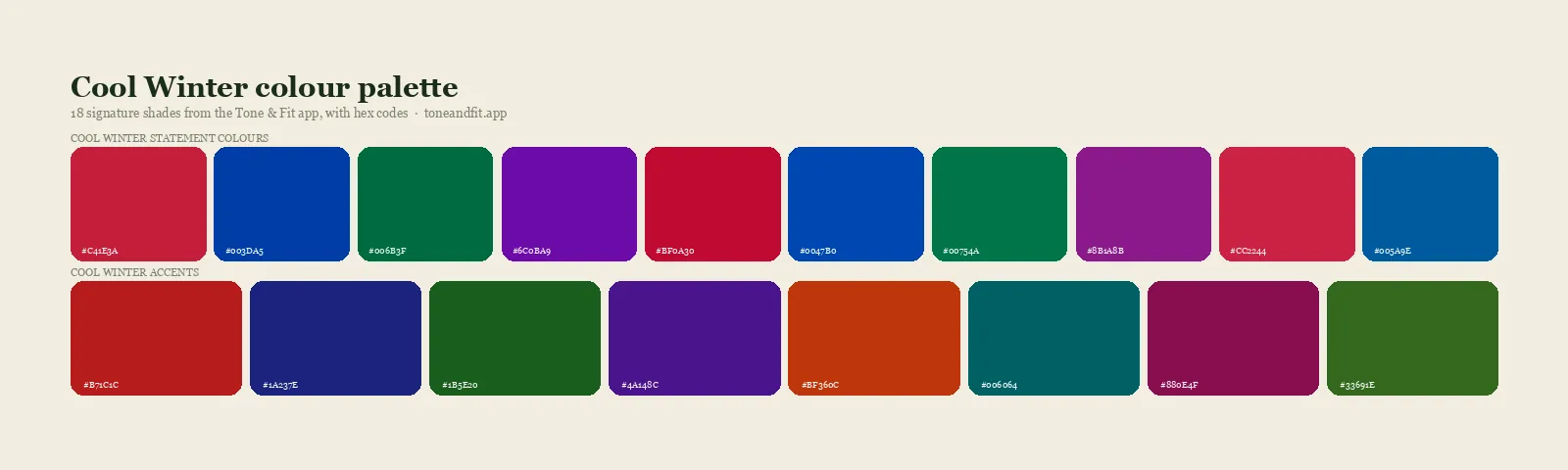
A taste of the Cool Winter palette: blue-red, fuchsia, sapphire, royal purple, navy, charcoal, icy lilac.
Wear more
- Reds: blue-red, true cherry, raspberry, cool burgundy
- Pinks: fuchsia, hot pink, magenta, cool berry
- Blues: sapphire, royal blue, icy blue, navy, midnight
- Purples: royal purple, plum, dusty plum, icy lilac
- Neutrals: pure white, true black, charcoal, cool gray, cool taupe
- Greens: cool emerald, pine (only as accents. Cool Winter is not a green-forward season)
Use as accents
- Cool emerald (for a pop of saturation against neutrals)
- Dusty plum (a softer evening tone)
- Cool gray (excellent for tailoring and outerwear)
Confirm your season in 60 seconds.
Tone & Fit's AI gives you your full Cool Winter palette + colors to avoid + matching makeup & hair shades.
Try the App ↗Colors that work against you
If you're a Cool Winter, these colors will fight your face:
- Earth tones, rust, olive, mustard, camel, terracotta. Too warm, too muddy. They drain you.
- Warm reds and oranges, tomato, coral, orange-red, pumpkin. They turn your skin sallow.
- Pure black on its own, black is a great Cool Winter neutral, but only paired with high contrast (pure white, fuchsia, icy blue). All-black with no contrast can flatten your features.
- Beige, ivory, and cream, your face needs cool-clear neutrals like pure white or charcoal, not warm soft ones.
- Golden yellow, marigold, mustard, the warmest yellows clash hardest with your cool undertone.
- Dusty muted tones, sage, dusty rose, mauve. These belong to the Soft seasons, not yours.
The acid test: any color that looks like it belongs in autumn leaves probably isn't yours. Any color that looks like it belongs in a snowstorm, ice, jewels, dramatic darks, almost certainly is.
Cool Winter vs True Winter vs Deep Winter
The three Winter sub-seasons share a cool undertone but differ on which axis they push hardest:
| Primary axis | Chroma | Signature | |
|---|---|---|---|
| True Winter | Cool + bright (balanced) | Bright | Icy pink, electric blue, stark black-and-white |
| Cool Winter | Cool-dominant | Mid-bright | Sapphire, fuchsia, blue-red, royal purple |
| Deep Winter | Deep-dominant | Mid-bright | Burgundy, deep navy, espresso, jewel tones |
If you're caught between Cool Winter and True Winter, the short answer is icy pastels: True Winters wear icy lilac and ice-blue comfortably, Cool Winters usually want a touch more saturation. Our full comparison of Cool Winter vs True Winter settles that one properly. If you're between Cool Winter and Deep Winter, the question is depth. Deep Winters can wear espresso and very dark plum without looking heavy, while Cool Winters look better in mid-deep colors with more clarity. For the broader 12-season landscape, see our overview of the 12 color seasons.
Celebrity Cool Winters (visual reference)
Looking at known Cool Winters can help calibrate your eye. Some commonly classified Cool Winters include Liv Tyler, Megan Fox, Cher, Anne Hathaway, Krysten Ritter, and Lily Collins. The shared signal: dark cool hair, cool-toned skin (often with a porcelain or rose cast), and eyes that read clear and cool rather than warm or hazy.
What's instructive: when these women are styled in deep jewel tones, sapphire, royal purple, fuchsia, blue-red, they look magnetic. When they're styled in beige, mustard, or coral, they often look subtly washed out, even when the styling is otherwise excellent. The colors aren't wrong on their own; they're just borrowed from a different season's wardrobe. (For more background on how the system originated, see color analysis on Wikipedia.)
Ready to find your season?
One selfie, your 12-season result, and the palette that goes with it. Free, no sign-up.
Find your season free ↗For the underlying reading, analyze your skin tone explains what undertone, depth and contrast actually are.
FAQ
Cool Winter vs Soft Summer, both are cool, what's the difference?
Chroma. Both seasons are cool, but Cool Winter sits in the bright/clear family while Soft Summer sits in the muted family. Hold up a clear sapphire next to a dusty-blue. If the sapphire makes you glow and the dusty-blue makes you look slightly tired, you're Cool Winter. If it's the opposite, you're Soft Summer. The cool undertone is the same; the saturation is opposite.
What's the best lipstick for a Cool Winter?
Blue-red, berry, plum, fuchsia, true cherry. Avoid orange-reds, brick, terracotta, and warm corals, they'll fight your undertone. The cool, blue-based reds will sing on you. For everyday wear, a cool berry stain is hard to beat.
Can a Cool Winter wear black?
Yes, better than almost any other season. Black is one of your strongest neutrals. The trick is to pair it with high-contrast accents (pure white, fuchsia, icy lilac, sapphire) so the black reads as deliberate drama rather than heaviness. All-black on a Cool Winter can occasionally tip into severe, especially if the cut is restrictive, adding a cool jewel-tone scarf or earring fixes it instantly.
What's the best hair color if I want to lighten?
Cool ash brown, soft black, blue-black, or a cool-toned dark chocolate. Avoid honey, caramel, copper, and warm balayage, these will work against your skin. If you want highlights, ash or icy tones only. Never gold. Most Cool Winters are at their best with their natural cool, dark hair.
What about gray hair when it grays in?
Cool Winters often age beautifully into silver and salt-and-pepper. The cool gray harmonizes with your skin's natural blue undertone in a way that warm-undertoned hair colors never quite did. Resist the urge to dye it warm, embrace the silver. Pair it with cool jewel tones and pure white to lean into the dramatic effect.
Is Cool Winter the same as True Winter?
No. True Winter is the more extreme of the two: higher contrast, icier chroma, very bright. Cool Winter is slightly less stark, with more tolerance for berry and plum over pure ice. Our full Cool Winter vs True Winter comparison runs the tests that settle it.
Does my season change with age or sun exposure?
No. Your season is set by your underlying genetic pigment, undertone, value, and chroma, not by your tan or hair dye. Tanning shifts surface skin color but not undertone, so a tanned Cool Winter is still a Cool Winter. Hair graying is the one shift that can move you slightly within the Winter family (most often deeper into Cool Winter or True Winter as warmth fades from your overall coloring).