Warm Spring Coloring: Do You Have These 7 Golden Traits?

Short answer: Warm Spring (also called True Spring) is warmth at its clearest: a golden undertone, light-to-medium depth and colouring that comes alive in coral, golden yellow and warm turquoise and looks sallow in cool or greyed colours. If gold beats silver decisively, you are here.
Sun-warmed, gold-flecked, and quietly luminous. Warm Spring is the season for people who look glowing in coral and inexplicably tired in cool gray.
What's in this guide
Looking for the colors themselves rather than the diagnosis? The full Warm Spring color palette lists every shade with hex codes, including the neutrals, the metals and the shades to avoid.
What is a Warm Spring?
Warm Spring is one of the 12 modern color seasons, a refinement of the original four-season system developed in the 1980s by analysts like Carole Jackson, and later expanded by 12blueprints and the Sci\ART method. It is the warmest member of the Spring family. The four traits that define it:
- Undertone: Warm, clearly golden, peachy, or honeyed (never sharply cool or pink)
- Value: Medium (your overall coloring sits squarely in the mid-range, neither very pale nor deep)
- Chroma: Medium-bright, saturated enough to glow, but a touch softer than a True Spring's electric clarity
- Primary direction: Warm, every color in your palette is dipped in honey
The "warm" in Warm Spring means temperature dominates. Where a True Spring is balanced equally between warm and bright, and a Light Spring leans into lightness, a Warm Spring leans hardest into the warm axis. That's the practical difference: a True Spring can wear a clear cool-leaning aqua without strain, but a Warm Spring usually needs that aqua warmer, closer to seafoam or warm teal. Every color looks like it's been kissed by sun before it touches the canvas. Ask "am I a warm spring?" and you're really asking whether warmth, more than anything else, is what your face wants.
Warm Spring sits in the Spring family alongside True Spring and Light Spring. Of the three, Warm Spring is the most temperature-driven, not the most chroma-driven. The Spring family overlaps on the warm side with Autumn, and that's where most mistakes happen, people see warmth and assume Autumn, when really their chroma is too high to be Autumn at all.
The 7 tells of a Warm Spring
If you suspect you might be a Warm Spring, run through these seven signs. Three or more is a strong indicator. Five or more and you're almost certainly home.
1. Your hair carries gold, copper, or honey
Strawberry blonde, golden chestnut, copper, warm chestnut-brown, honey-blonde, ginger, or deep auburn. The tell is visible warmth, when sunlight catches your hair, you see actual flecks of gold or copper, not ash. Even darker Warm Springs have a chocolate-honey richness to their brown rather than a cool, flat darkness. If you've ever been called "the redhead in the family" without being a true redhead, that's a Warm Spring signal.
2. Your eyes have warmth and gold flecks
Hazel with gold rays, warm green with amber, light brown with copper, or topaz. The defining feature is visible warm pigment, the iris reads like a polished gemstone with sun in it, not a cool stone. If your eyes change color depending on what you wear (greener in olive, browner in coral) and the warm versions feel more "you," that watercolor-but-warm quality is classic Warm Spring.
3. Your skin is golden, peachy, or warm-ivory
Golden beige, peachy ivory, light ivory with a honey cast, or warm caramel. South Asian Warm Springs often have skin that reads as a luminous golden-bronze. East Asian Warm Springs tend toward a warm honeyed beige. European Warm Springs frequently look freckled, with a peachy-ivory base that tans easily to a glow rather than a deep brown. The unifying signal: your skin looks like it's catching light, not sitting under it.
4. Your veins look green
Hold your wrist up in daylight near a window. Green veins point warm. For a Warm Spring, these veins often look a clear olive-green rather than a muddy or mixed shade, the warmth is unambiguous. If you can't quite tell because nothing pops, read our deeper guide on how to read warm vs cool skin undertone and try the white-paper test against your jawline next.
5. Yellow gold and bronze look magnificent; silver looks cold
This is one of the most reliable Warm Spring tells. Hold a yellow gold bracelet to your wrist. Then silver. Then rose gold. Yellow gold should look like it belongs there, almost disappearing into your skin. Silver, by contrast, will sit on your wrist like a foreign object, slightly blue, slightly cold, slightly disconnected from your face. Bronze and brass are equally flattering. If you've quietly preferred warm-metal jewelry your entire life, that's a strong tell.
6. Coral, peach, and golden yellow make you glow
This is the chroma-meets-temperature test. Hold a coral or peach top to your face. Then hold a dusty mauve or cool sapphire. The coral should make your features brighten, your eyes light up, and any blotchiness even out. The cool tone should drain you, make your skin look slightly gray and your features recede. A vivid golden yellow that would overwhelm most people often looks effortless on a Warm Spring; that's the chroma-loving warm side of the family announcing itself.
7. Cream is your white; pure white is too sharp
Try a pure white t-shirt under your chin. Then ivory or cream. The pure white likely feels harsh, almost surgical against your golden skin, draining your warmth. Cream and ivory feel infinitely more comfortable, like the color was made for your face. The defining Warm Spring experience is realizing the most "neutral" white in fashion is actually the hardest white for you to wear, you need warmth in every color, including the brightest ones.
Your power palette
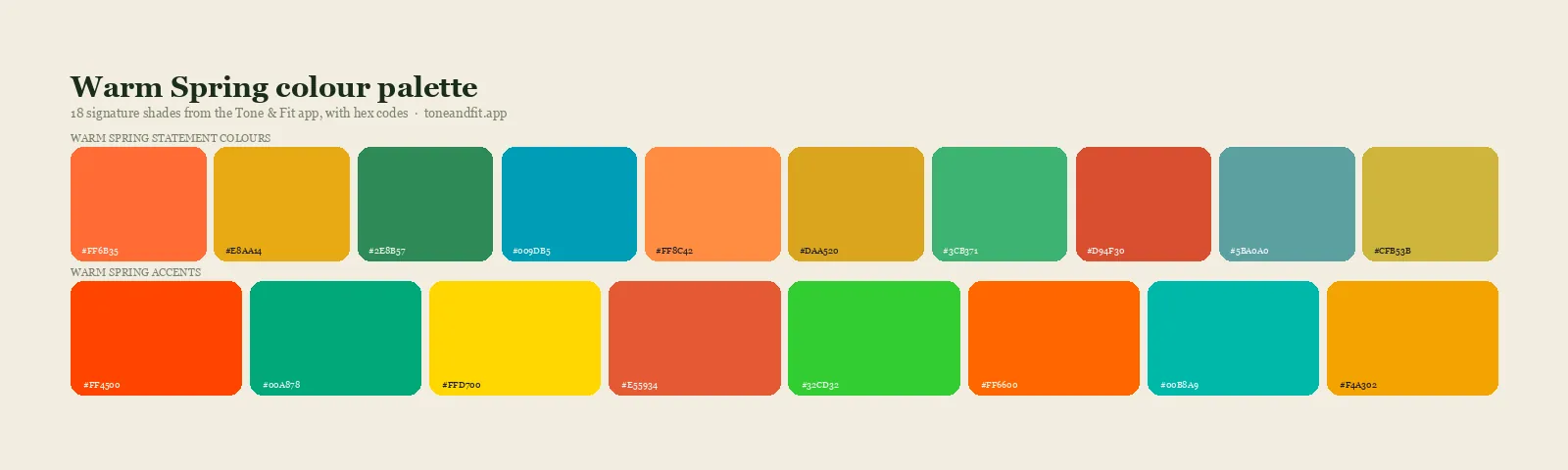
The Warm Spring palette is bright, warm, and unmistakably sunlit. Think Tuscan afternoon, peach orchard at golden hour, a Renaissance painting where the light is always honey-colored. The unifying signal: every color carries a warm undertone, chroma stays medium-bright, and the overall mood is luminous rather than dusty. Anything ashy or cool will gray you out.
A taste of the Warm Spring palette: terracotta-coral, warm peach, golden yellow, warm green, warm teal, copper, cream.
Wear more
- Reds and pinks: coral, terracotta, warm poppy, peachy-pink, warm salmon, tomato
- Yellows and oranges: golden yellow, marigold-light, warm peach, apricot, soft pumpkin
- Greens: warm green, leaf green, light olive, fresh moss, bright apple
- Blues: warm teal, turquoise, periwinkle-with-warmth, denim with a green lean
- Neutrals: cream, ivory, camel, warm beige, honey-tan, golden brown, warm chocolate
- Browns: caramel, copper, cinnamon, warm chestnut (the warmer the better)
Use as accents
- Rose gold (for a softer evening tone that still carries warmth)
- Warm teal (excellent for tailoring; flatters the Warm Spring face dramatically)
- Persimmon and bright coral (when you want the chroma turned all the way up)
Confirm your season in 60 seconds.
Tone & Fit's AI gives you your full Warm Spring palette + colors to avoid + matching makeup & hair shades.
Try the App ↗Colors that work against you
If you're a Warm Spring, these colors will fight your face:
- Cool blues and pinks, sapphire, ice blue, baby pink, cool fuchsia. Beautiful colors, but their cool cast will turn your golden skin slightly gray. The temperature mismatch is the issue, not the brightness.
- Pure white, too cool and stark for your warm chroma. Cream, ivory, or warm off-white do the same crisp role without flattening your glow.
- True black on its own, too heavy and cool, especially near your face. It can drain your warmth and add years. Warm chocolate, deep teal, or rich espresso are far better dark neutrals.
- Muted, gray-toned colors, dusty mauve, slate, charcoal, taupe-with-no-warmth. These belong to the Summer or Soft Autumn families and will dim a Warm Spring instantly.
- Cool-pink lipsticks, anything with a blue or fuchsia base. They'll fight your peachy mouth and make your teeth look duller. Stick to coral, peach, and warm berry.
- Anything ashy, ash blonde, ash brown, dusty lilac. The cool gray haze quietly fights your golden undertone in every photograph.
The acid test: any color that looks like it belongs in a foggy harbor probably isn't yours. Any color that looks like a citrus orchard or a sun-warmed terra-cotta tile almost certainly is.
Warm Spring vs True Spring vs Light Spring vs Warm Autumn
The three Spring sub-seasons share a tendency toward warmth and brightness but differ on which axis they push hardest. Warm Autumn. Spring's nearest neighbor across the wheel, is where most Warm Spring mis-typings happen.
| Primary axis | Chroma | Signature | |
|---|---|---|---|
| Light Spring | Light-dominant (warm) | Medium-bright | Peach, soft yellow, light coral, warm pastel |
| True Spring | Warm + bright (balanced) | Bright | Clear coral, leaf green, golden yellow, turquoise |
| Warm Spring | Warm-dominant (clear) | Medium-bright | Terracotta-coral, golden yellow, copper, warm teal |
| Warm Autumn | Warm-dominant (rich) | Muted-medium | Rust, mustard, olive, deep moss, pumpkin |
If you're caught between Warm Spring and True Spring, the question is whether truly clear bright colors work for you. True Springs can wear an almost-neon coral or a clean primary yellow; Warm Springs need them slightly richer and more golden. If you're between Warm Spring and Warm Autumn, the question is chroma. Warm Autumns look best in muted earthy tones (rust, olive, mustard); Warm Springs look best in clearer, brighter versions of those same warm hues. For the broader 12-season landscape, see our overview of the 12 color seasons. And if you want to dive deeper into temperature alone, the warm vs cool skin undertone guide is the foundation. People wondering "am I a warm spring or a Warm Autumn?" usually find the answer in a single drape: terracotta-coral vs rust.
Celebrity Warm Springs (visual reference)
Looking at known Warm Springs can help calibrate your eye. Some commonly classified Warm Springs (in their natural coloring phases) include Jessica Chastain, Amy Adams, Nicole Kidman in her natural strawberry-blonde state, and Isla Fisher. The shared signal: visibly warm hair (copper, strawberry, golden chestnut), peachy or golden skin, and warm-flecked eyes, usually with freckles and a tendency to glow rather than tan dark.
What's instructive: when these women are styled in coral, terracotta, golden yellow, warm green, or cream, they look effortlessly luminous. When they're pulled into stark black, cool fuchsia, ash blonde, or icy silver, they often look subtly washed out, even with otherwise excellent styling. The colors aren't wrong; they're just borrowed from someone else's palette. (For more background on how the seasonal system originated, see color analysis on Wikipedia.)
Ready to find your season?
One selfie, your 12-season result, and the palette that goes with it. Free, no sign-up.
Find your season free ↗For the underlying reading, analyze your skin tone explains what undertone, depth and contrast actually are.
FAQ
Warm Spring vs Warm Autumn, what's the difference?
Chroma. Both seasons share a warm undertone (that's the shared "Warm" axis), but Warm Spring is bright and clear while Warm Autumn is muted and earthy. Hold a clean coral against your face, then a rust. If coral makes you glow and rust drags you down, you're Warm Spring. If rust makes you look rich and coral feels too candy-bright, you're Warm Autumn. The temperature is identical; the saturation is opposite.
What's the best lipstick for a Warm Spring?
Coral, peachy nude, warm berry, terracotta-tinted reds, and clear poppy. Avoid blue-reds, plum, and any cool mauve, they'll fight your golden undertone and pull pink under your nose. A creamy coral or a warm peach gloss tends to be a Warm Spring's signature, day or night. For a more dressed-up look, a warm brick-red satin works beautifully without crossing into cool territory.
Best hair color if I want to lighten as a Warm Spring?
Honey, golden caramel, strawberry blonde, copper, or warm chestnut highlights. Stay away from ash, platinum, or any cool toner, it will turn brassy in the wrong direction and dim your face. The goal is a sunlit, warm dimension that echoes your natural golden glow. If you've been told your highlights "go brassy," that's almost always because you're naturally warm and the stylist toned them cool.
Can a Warm Spring wear navy?
Yes, but carefully. True navy is too cool and dark for your bright warm coloring, it can read like a uniform that's wearing you. A warm navy or denim-blue with a slight teal lean is wearable, especially with a warm coral or cream layer near your face. For a structured dark, warm chocolate or deep teal flatter you considerably more than classic navy.
Warm Spring vs True Spring, how do I tell?
True Spring is the brightest member of the Spring family, balanced equally between warm and bright. Warm Spring leans hardest into the warm axis with slightly less brightness and slightly more depth. True Springs glow in clear primary colors; Warm Springs glow in slightly richer, more golden versions of the same colors. Think honey vs lemon, or terracotta vs tomato.
Why does pure white look bad on me if I'm light enough to wear it?
Because pure white is a cool neutral. Warm Spring needs warmth in every color, even the brightest neutrals. Cream, ivory, and warm off-white read as "white" in everyday life but carry the golden undertone your face actually wants. Try a soft cream tee next time and notice the difference under your chin, your skin will look more luminous and less washed-out.
Does my season change if I dye my hair or get a tan?
No. Your season is fixed by your genetic pigment, undertone, value, and chroma, not by tan or hair dye. A Warm Spring with a deep summer tan is still a Warm Spring; the underlying skin warmth doesn't change. Hair color is the same. The only real shift comes with significant graying, which can pull a Warm Spring's overall coloring slightly cooler and softer over decades, sometimes drifting toward Soft Autumn.