Is Color Analysis Real or Just a Trend? Here's What the Science Says
Short answer: colour analysis is not a scam, but parts of the industry oversell it. The optics are real: a colour near your face reflects onto your skin and either evens out or exaggerates its undertone, which is why some shades make you look rested and others tired. The precision claims, rigid labels and fear-based upsells are marketing. The rest of this guide separates the two and lists the red flags.
Color analysis is not a scam, but parts of the industry sell it badly. The underlying claim, that colors near your face either harmonize with or fight your skin's undertone and contrast, is ordinary optics; the astrology-flavored certainty some sellers attach to it is the part to be skeptical of.
Color analysis has an astrology-adjacent reputation in some corners of the internet. That's a fair criticism to examine. Here's what optical science, dermatology, and practical evidence actually say, and how to tell a useful tool from a genuine scam.
In this article
- Why People Ask This Question
- Personal, Seasonal, or Color Season Analysis: Same Thing?
- The Science That Supports Color Analysis
- What IS Scientifically Valid
- What's NOT Scientifically Valid
- The Real Test: Does It Work?
- Common Scam Red Flags to Watch For
- Is a Free Quiz as Good as a Paid Consultant?
- Why Tone & Fit Is Free
- Frequently Asked Questions
Why People Ask This Question
If you've ever scrolled past a video of someone holding colored fabric against their face and declaring themselves a "Deep Winter," you've probably had the same reaction a lot of people have: this looks made up.
It's a completely reasonable response. The language of color analysis (seasons, sub-seasons, "warm autumn energy") sounds like it belongs in the same category as crystal healing and mercury retrograde. When someone tells you that you should avoid wearing a particular shade of blue because of your "undertone," it can feel arbitrary. Especially when they're charging several hundred dollars for the advice.
The skepticism intensifies when you see inconsistency. One consultant types you as a Soft Summer, another says you're a Light Summer, and an app gives you Cool Summer. If this were real science, shouldn't the answer be the same every time?
That inconsistency has a mundane explanation, and we unpack it in this guide to what a color season quiz actually measures: most quizzes ask about your hair and eyes, which are the least stable signals, and skip the one trait that separates the seasons cleanly.
These are fair points. And the honest answer is: color analysis is partly science and partly heuristic. Understanding which parts are which is the key to knowing whether it's useful for you, and whether the person selling it to you is being straight with you.
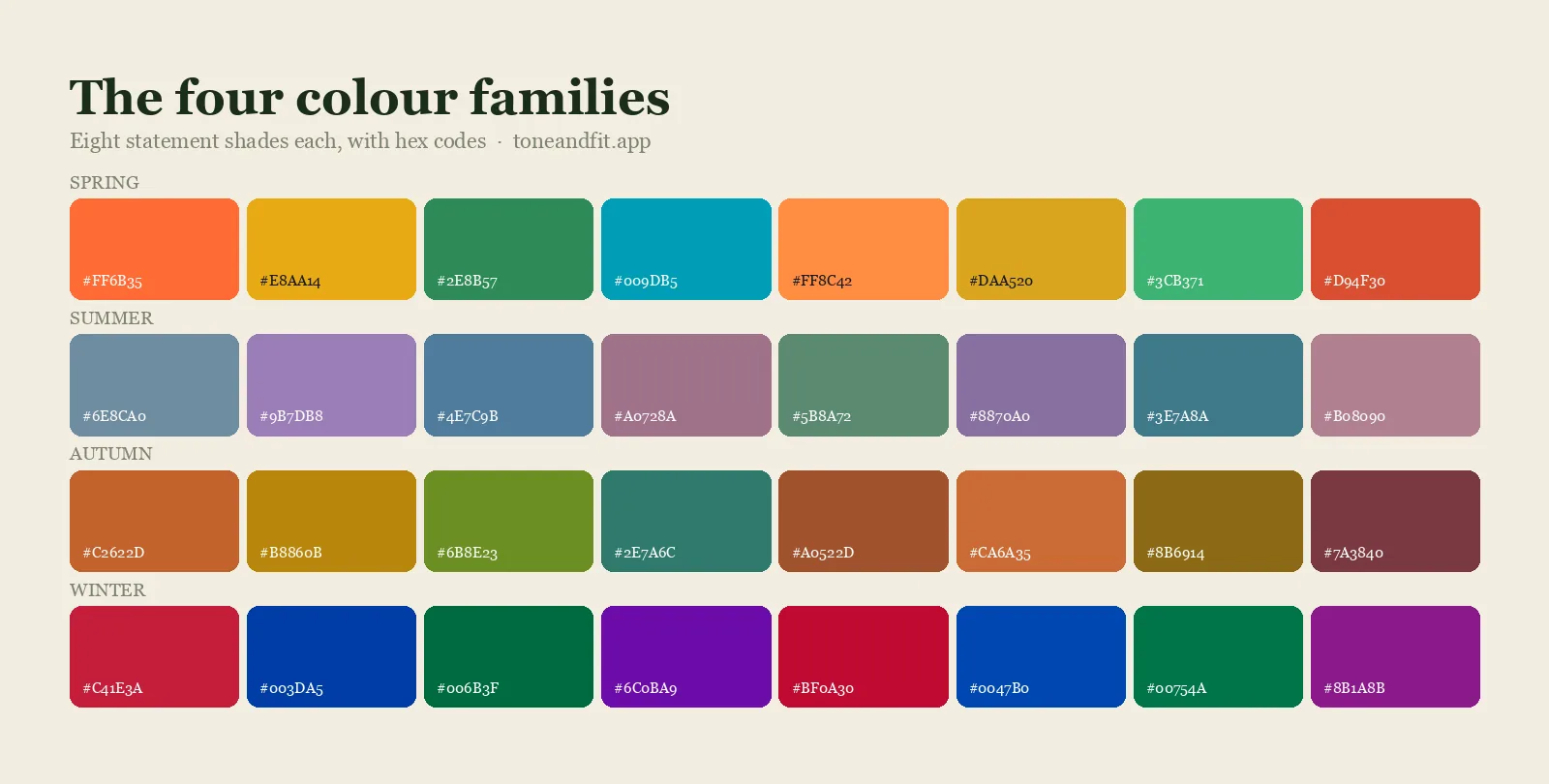
Personal, seasonal, or color season analysis: is it the same thing?
Personal color analysis, seasonal color analysis, and color season analysis describe the same underlying method under different marketing labels, not three competing systems, so a new name on a website is not by itself a warning sign. "Seasonal color analysis" is the older branding tied to the four-season model that later expanded to 12 seasons. "Personal color analysis" is the broader umbrella term, used more often by consultants who want to sound less tied to one specific framework. "Color season analysis" and "color palette analysis" are just alternate phrasings searchers use for the same request: read undertone, contrast, and chroma from your face, then hand back a palette.
What is worth being skeptical of is a change in the underlying method, not the name. If a service skips one of the three traits entirely, or types you purely from your birth month, star sign, or a mood questionnaire instead of your actual coloring, that is a different and much weaker product than genuine color analysis, whatever it calls itself. Judge the inputs it measures, not the label on the homepage.
The Science That Supports Color Analysis
The foundation of color analysis isn't astrology. It's optics, specifically how adjacent colors influence each other when seen together. This is well-established physics and perceptual science with over 180 years of research behind it.
Simultaneous contrast
In 1839, the French chemist Michel Eugène Chevreul published The Law of Simultaneous Contrast of Colors after studying why certain dyed fabrics looked different depending on what was placed next to them. His finding: the human eye doesn't perceive colors in isolation. Every color is influenced by the colors around it. A gray square looks warmer next to a blue background and cooler next to an orange one. The gray hasn't changed, but your perception of it has.
This isn't a theory or an opinion. It's a documented perceptual phenomenon that has been replicated in countless studies and forms the basis of color theory taught in every art and design school in the world.
Color analysis applies this principle to the human face. Your skin is a color. The clothing and makeup you wear are adjacent colors. Certain combinations create harmony (your skin looks clearer, more even, more alive), and others create discord (your skin looks sallow, washed out, or unevenly toned). That interaction is real and observable.
Metamerism and color context
A related phenomenon is metamerism, the well-documented fact that the same object can appear to be different colors under different lighting conditions. Your skin tone isn't a single fixed color; it's a spectral reflectance curve that your brain interprets differently depending on the surrounding colors and lighting. This is why you can look healthy and vibrant in one outfit and tired in another, even when nothing else has changed. Interior designers, photographers, and cinematographers rely on this science every day.
Color analysis isn't mysticism. It's the same applied optics that painters, designers, and cinematographers have used for centuries. The question isn't whether adjacent colors affect perception. They do. The question is how precisely we can categorize that effect.
What IS Scientifically Valid
Let's separate the measurable from the interpretive. Several aspects of color analysis rest on solid biological and optical ground.
Undertone is real
Your skin tone is produced by a combination of melanin (which ranges from yellow-red pheomelanin to brown-black eumelanin) and hemoglobin (which adds red and blue tones from blood vessels beneath the skin). The ratio and distribution of these pigments creates your undertone, the underlying warmth or coolness of your skin that doesn't change with tanning, flushing, or aging.
This isn't subjective. Spectrophotometric studies have measured skin reflectance across wavelengths and confirmed that people genuinely fall along a warm-to-cool spectrum. Dermatologists use this when matching foundation shades, and cosmetic scientists use it when formulating products. Undertone is a biological fact.
Contrast between features is measurable
The difference in lightness between your skin, hair, and eyes (what color analysts call "contrast level") is also objectively measurable. Someone with very dark hair, light skin, and bright eyes has high contrast. Someone whose skin, hair, and eyes are all similar in value has low contrast. This dimension directly affects which color palettes create visual harmony around your face, for the same reason that a high-contrast photograph needs different color grading than a low-contrast one.
Color temperature affects perception
Warm colors (yellow-based, golden) and cool colors (blue-based, rosy) interact differently with warm and cool skin undertones. Placing a warm gold next to warm-toned skin reinforces that warmth harmoniously. Placing the same gold next to cool-toned skin can create a clash that makes the skin appear sallow or greenish. This is simultaneous contrast in action, and it's as predictable as any other optical phenomenon.
These three pillars (undertone, contrast, and color temperature interaction) are the scientific core of color analysis. They're measurable, reproducible, and grounded in physics and biology.
They are also the parts a camera can capture, which is why a model can measure undertone, value and chroma from a single well-lit photo rather than relying on one analyst's eye.
What's NOT Scientifically Valid
Here's where intellectual honesty matters. Not everything in color analysis is hard science, and any practitioner who claims otherwise is overstating their case.
The 12-season taxonomy is a heuristic
The system of dividing people into 12 seasons (Light Spring, True Summer, Soft Autumn, Deep Winter, and so on) is a classification framework, not a natural law. It was created by expanding the original four-season model (developed by color consultants in the 1980s) to capture more nuance. The three dimensions it maps (undertone, value, chroma) are real, but the 12 boxes placed along those dimensions are human constructs.
Think of it like the Beaufort wind scale. Wind speed is a continuous physical measurement, but "Force 7: Near Gale" is a human-created category meant to make that measurement practically useful. The categories are real enough to be useful. They're not real in the sense that nature drew hard lines between them.
This means that plenty of people sit between two seasons. If you've been typed as Soft Autumn but feel like some Soft Summer colors also work for you, that's not a failure of the system. It's the system working exactly as a heuristic should, giving you a useful starting region on a continuous spectrum.
Season assignments aren't medical diagnoses
"You're a Bright Spring" is more like "you're a size Medium" than "you have Type 2 diabetes." It's an approximate classification that's useful for shopping, not a precise clinical measurement. Treat it that way and you'll get a lot of value from it. Treat it as cosmic truth and you'll be disappointed when reality doesn't fit neatly into the box.
Subjective judgment is involved
In-person color analysis involves a consultant observing how your skin responds to different colored drapes. That observation is inherently subjective. It depends on the consultant's training, the lighting in the room, the specific drape colors they use, and even their visual acuity. This is why two consultants might give you slightly different results. It doesn't mean the underlying science is invalid. It means the measurement tool (human observation) has variability, just like any measurement tool.
Color analysis is like a nutrition framework: the biology is real, the practical advice works for most people, and the specific categories are useful simplifications rather than iron laws. That makes it a tool, not a scam, as long as nobody pretends it's more precise than it is.
See the Science for Yourself
Tone & Fit analyzes your skin tone, undertone, and contrast from a selfie and gives you a personalized color palette, free, no signup required.
Try Tone & Fit Free ↗The Real Test: Does It Work?
Science establishes plausibility. But the real question for most people is practical: will this actually help me look better?
The evidence suggests yes, for the overwhelming majority of people.
Practical evidence at scale
Millions of people have used color analysis (through professional consultations, apps, or self-diagnosis) and the consistent feedback is that it works. People report looking healthier, more vibrant, and more put-together when they wear their palette's colors. This isn't a controlled clinical trial, but the sheer volume and consistency of the feedback is meaningful.
Professional validation
Personal stylists, image consultants, makeup artists, and costume designers use color analysis principles daily. These are professionals whose livelihoods depend on making people look good. If color analysis didn't produce visible results, these industries wouldn't have adopted it as a standard practice.
The K-beauty test
South Korea's beauty industry, arguably the most sophisticated and results-driven in the world, has built an entire infrastructure around personal color analysis. Major retailers organize products by warm and cool tone. Studios in every major city offer draping sessions. An industry this competitive doesn't invest in something that doesn't produce visible outcomes for customers.
The before-and-after test
The simplest test is visual. Take a selfie wearing a color from your recommended palette, then another wearing a color from the opposite end of the spectrum. For most people, the difference is immediately visible, not because one color is "wrong," but because one creates more harmony with your natural coloring. Your skin looks clearer, your eyes look brighter, and the overall effect is more polished. This is the optical science in action, and you can see it with your own eyes.
Common Scam Red Flags to Watch For
Color analysis itself isn't a scam. But like any industry that touches personal appearance and self-improvement, it attracts people who exploit insecurity. Here's what to watch out for.
The same caution is worth applying to software. We wrote a separate guide on vetting a color analysis app before you install it, because the warning signs in the App Store look different from the ones in a consultant's studio.
Rigid rules and fear-based advice
"You must NEVER wear black." "This color will make you look sick." Anyone who frames color analysis as a set of absolute prohibitions is either poorly trained or trying to make you dependent on their guidance. A good analyst gives you a palette and explains why those colors tend to work well. They don't tell you that wearing the wrong shade of blue will ruin your face.
Overpriced consultations with artificial scarcity
Some consultants charge several hundred dollars for a one-hour draping session, then upsell you on seasonal palette fans, color-coded wardrobe plans, and follow-up appointments. Color analysis is a useful service, and skilled consultants deserve fair compensation. But if the pricing feels designed to extract maximum money through FOMO and exclusivity, that's a red flag.
Gatekeeping and mystification
Be wary of anyone who treats their method as proprietary secret knowledge that only they can decode. The principles behind color analysis are well-documented and publicly available. A trustworthy practitioner is happy to explain their reasoning, not hide behind jargon.
Extreme upselling
If a color analysis session turns into a sales pitch for an entire new wardrobe, specific product lines, or ongoing coaching packages, the analyst's incentives aren't aligned with your interests. The output of good color analysis is information: a palette and an understanding of why it works. What you do with that information should be entirely up to you.
The best color analysis empowers you to make your own choices. The worst kind creates dependency and insecurity. The difference is easy to spot: one gives you a tool, the other sells you a crutch.
Is a free color analysis quiz as good as a paid consultant?
A free tool built around a real photo of your face can match a paid consultant on the two traits that matter most, undertone and contrast, because both are reading the same optical signal from your skin. Where a free quiz genuinely falls short is the version that only asks you to recall your hair color, eye color, and how you tan, since memory is a much weaker input than a direct reading.
| Method | What it actually reads | Typical cost | Where it tends to go wrong |
|---|---|---|---|
| In-person draping | A trained eye against physical fabric swatches held at your face | several hundred dollars or more | Consultant training and studio lighting vary session to session |
| Multiple-choice memory quiz | Your own description of your hair, eyes, and how your skin reacts to sun | Usually free | Self-report is unreliable, and hair and eye color change over time |
| Photo-based analysis | Pixel values sampled directly from your face in a photo | Usually free | Photo quality, lighting and filters, is the main limitation |
None of these methods needs to cost money to be legitimate, and none is automatically trustworthy just because someone charged for it. What actually decides quality is whether the method measures your face directly or works from things you remember about yourself. If you want the difference spelled out further, our guide to free color analysis quizzes covers what a good one asks, and app vs in-person consultant lays out the tradeoffs in full. The mechanics behind the photo method specifically are in how AI color analysis works.
Why Tone & Fit Is Free
We built Tone & Fit because we believe color analysis is genuinely useful information that shouldn't be locked behind a several hundred dollars paywall.
The core insight of color analysis, that certain colors harmonize with your natural coloring better than others, is too practical and too well-supported to remain a luxury service. AI makes it possible to deliver that insight from a single selfie, in about 60 seconds, at no cost to the user.
We're transparent about what the app does and what it doesn't do. It analyzes your skin tone, undertone, and contrast to classify you into one of 12 seasons. It gives you a palette of colors that are likely to flatter you, along with recommendations for makeup, wardrobe, and hair color. It doesn't claim medical-grade precision, it doesn't tell you that you can never wear certain colors, and it doesn't try to upsell you into a subscription you don't need.
The 12-season result is a starting point, a well-informed suggestion based on optical science and your individual coloring. Use it as a guide when you're shopping, experiment with the palette, and adjust based on what you like. That's how color analysis is supposed to work.
Ready to find your season?
One selfie, your 12-season result, and the palette that goes with it. Free, no sign-up.
Find your season free ↗Frequently Asked Questions
Is the 12-season system made up?
The 12-season system is a classification framework, not a natural law. It was built by expanding the original 4-season model to capture more nuance in undertone, contrast, and color saturation. The dimensions it measures (warm vs. cool undertone, high vs. low contrast, muted vs. clear chroma) are real and observable. The labels (Soft Autumn, Bright Winter, etc.) are human-created categories placed along those dimensions. Think of it like clothing sizes: S, M, and L aren't laws of physics, but they're based on real body measurements and they genuinely help you find clothes that fit.
Can two people get different results from different apps?
Yes, and that doesn't mean color analysis is broken. Different apps use different algorithms, lighting compensation methods, and classification thresholds. Small differences in photo lighting, camera white balance, or makeup can shift results, especially for people who sit near the boundary between two seasons. If you get Soft Autumn from one app and True Autumn from another, you're likely somewhere between the two, and colors from both palettes will probably work for you. The seasons are regions on a spectrum, not hard-edged boxes.
Is AI color analysis accurate?
Modern AI color analysis is quite accurate when given a good-quality photo in natural lighting. The AI measures the same things a human consultant does (skin undertone, contrast between features, and color saturation) but it does so with mathematical consistency rather than subjective judgment. The main limitation is input quality: a photo taken in harsh artificial lighting or with heavy makeup will produce less reliable results. For best accuracy, use a selfie taken in natural daylight, with minimal makeup, against a neutral background.
What if I don't like my season's colors?
Wear whatever you want. Color analysis is a tool, not a rulebook. Your season's palette tells you which colors are most likely to make your skin look its best: brighter, clearer, more even-toned. But personal style, cultural context, and mood all matter too. If you're a Warm Autumn who loves wearing black, wear black. You might choose to add a warm-toned scarf near your face, or you might not. The point of color analysis is to give you information, not to restrict you. Use it when it's helpful. Ignore it when it's not.
Is color analysis just marketing?
Some of the presentation is marketing, especially the astrology-flavored language and the urgency some sellers use, but the underlying claim is not: colors next to your face really do interact with your skin's undertone and contrast, and that part is optics and biology, not a sales script. Judge a specific provider on whether they measure your face directly and explain their reasoning, not on the industry's worst marketing.
Is a free color analysis quiz trustworthy?
It can be, if it is reading your actual coloring rather than asking you to recall your hair and eye color from memory. A free quiz or app built around a real photo measures the same undertone and contrast signals a paid consultant does. Price is not the signal to trust. What the tool actually measures is.
Is personal color analysis different from seasonal color analysis?
No. They are names for the same method: reading your undertone, contrast, and chroma to place you in a season with a matching palette. "Personal color analysis" is simply the more common umbrella term, used especially in Korea. "Seasonal color analysis" emphasizes the season labels themselves.