Personal Color Analysis: Everything You Need to Know About Finding Your Colors
Personal color analysis is the process of working out which colours flatter your natural colouring, by measuring your undertone, depth and contrast and matching you to one of 12 seasonal palettes. Done well, it replaces a closet of near misses with a set of colours you can buy with confidence. This guide covers what it is, how the three measurements work, how the 4 and 12 season systems fit together, and how to get your own result, free or paid.
The complete guide
- What is personal color analysis?
- The three measurements that decide your season
- How color theory explains your skin tone
- The 4 seasons (the parent system)
- The 12 sub-seasons (the modern system)
- What is your personal color palette?
- How to find your color season
- The 6 most common mistakes
- What does color analysis actually change?
- FAQ
- Get analyzed (free, 60 seconds)
You have probably noticed it without putting a name to it. There are colors that make people lean in and say "you look great today," and there are colors that make the same people quietly ask if you slept. The difference is rarely the cut of the shirt or how expensive it was. It is the hue.
Personal color analysis is the framework that explains which colors do which thing to your specific face. It is not a personality quiz, it is not astrology, and it is not a fad that flared up on TikTok. It is a 90-year-old discipline built on color theory, contrast, and the chemistry of melanin and hemoglobin in your skin. Once you understand the three measurements behind it, the entire system clicks into place in about 20 minutes.
This guide is the standalone reference. If you read only one piece on Tone & Fit, read this one. You will leave with a working knowledge of the 12 color seasons, the three traits that decide yours, how to find your own season in four different ways (one of which takes a literal 60 seconds), and the six mistakes that almost everyone makes the first time they try.
What is personal color analysis?
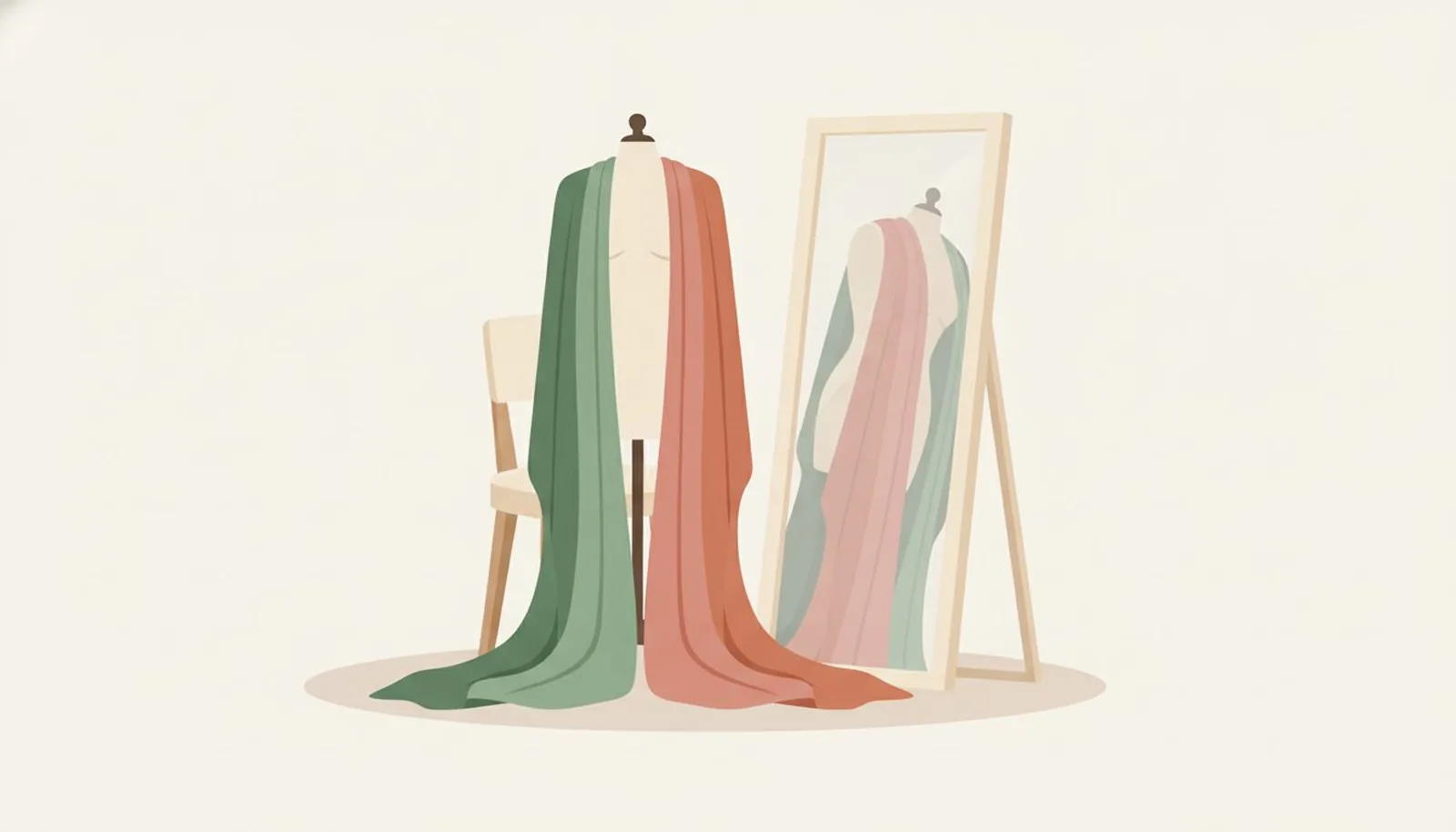
Personal color analysis is the practice of identifying which colors flatter you based on the natural pigments in your skin, hair, and eyes. The output is a palette, usually 30 to 50 specific colors, that harmonize with your features. Wear those colors near your face and your skin looks brighter, your eyes pop, your jawline reads sharper. Wear colors from outside that palette and you look duller, more tired, or slightly "off" in a way most people can sense without being able to name.
The discipline has its roots in early-20th-century color theory. Painters like Johannes Itten and Albert Munsell built systems for organizing color by hue, value, and saturation. In the 1940s, Hollywood costumers and Suzanne Caygill applied those systems to faces, sorting actors by which palettes the camera loved on them. The work stayed mostly in fashion and theater circles until 1980, when Carole Jackson published Color Me Beautiful, a paperback that sold more than 25 million copies and put "having your colors done" into ordinary suburban living rooms.
Jackson's framework had four buckets: Spring, Summer, Autumn, Winter. It was easy to remember and easier still to misapply. By the late 1990s, professional colorists had refined the model into 12 sub-seasons, which is the system most consultants and apps use today. Tone & Fit uses the 12-season system because four buckets is too coarse for a real human face. If you want the full history, the Wikipedia entry on color analysis is the best free starting point.
The thing to understand is this: color analysis is just contrast theory applied to your face. Painters have known for 600 years that warm colors next to warm skin glow, and cool colors next to warm skin clash. Your face is a canvas with fixed pigments. Your wardrobe is the part you get to choose.
One framing helps newcomers. Personal color analysis is not about telling you which colors are "good" in some absolute sense, because no color is. Forest green is gorgeous on a Deep Autumn and dreadful on a Light Summer; the green is the same physical wavelength in both cases. The framework is purely relational: it predicts how a given color will interact with the specific pigment chemistry of your skin. Once that clicks, the system stops sounding like a personality test and starts sounding like what it actually is, applied optics for clothing.
The reason the discipline has survived 80 years of fashion churn is that the underlying physics has not changed. Skin reflects and absorbs light in ways that are completely measurable. Your iPhone camera already does color analysis every time it adjusts white balance for your face. The 12-season system is a human-readable summary of what the math is doing under the hood.
The three measurements that decide your season
The whole framework rests on three independent traits. Once you can read these three on yourself, you can place yourself on the 12-season map. They are not a vibe check, they are physical properties of your face that a camera can measure.
Undertone (warm versus cool)
Undertone is the pigment underneath your skin's surface. It is decided by the relative proportion of melanin (yellow-brown) and hemoglobin (blue-red) in your skin, plus a trace of carotene. Warm undertones lean golden, peachy, or yellow. Cool undertones lean pink, red, or blue. Neutral undertones sit in the middle and lean slightly toward one side depending on the lighting.
Quick at-home tests: look at the veins on the inside of your wrist in natural daylight (blue or purple is cool, green is warm), check whether silver or gold jewelry makes your skin look healthier, and hold a sheet of pure white paper next to your bare face (if your skin reads pinkish, you are cool; if it reads yellow or peach, you are warm). For a longer breakdown, see the guide on how to find your skin undertone at home or the dedicated explainer on warm versus cool skin undertone.
Value (light versus deep)
Value is how light or dark your overall coloring reads. It is not about your race, ethnicity, or how tan you are this week. It is about the level your features sit at when you look at a black-and-white photograph of yourself. Light value people have pale skin, light blonde or light brown hair, and light eyes. Deep value people have richer skin, darker hair, and darker eyes. Most people sit somewhere in the middle and lean one way.
The fast trick: take a phone photo of yourself, drop it into any photo editor, and convert to grayscale. If your hair and eyes both fade close to your skin, you are likely a light. If your hair and eyes read as distinctly darker than your skin, you are likely a deep. If everything reads similar, you are medium with one of the other two axes doing more of the work.
Chroma (clear versus muted)
Chroma is the intensity, the saturation, the brightness of your features. A clear person has sharp eyes, defined eyebrows, and high contrast between skin and hair. They look great in jewel tones, true reds, and crisp whites. A muted person has soft, tawny, blended features with no single trait dominating. They look great in oatmeal, terracotta, dusty rose, and sage. The mistake here is reading "muted" as "bland." Muted just means the contrast between skin, hair, and eyes is lower; the person is not less attractive, the palette just lives in a different neighborhood.
| Axis | One end | Other end | What it measures |
|---|---|---|---|
| Undertone | Warm (gold, peach) | Cool (pink, blue) | Pigment chemistry of the skin |
| Value | Light | Deep | How dark you read in grayscale |
| Chroma | Clear (bright) | Muted (soft) | Saturation and contrast of features |
Take those three readings, plot yourself on the resulting 3D map, and you land in one of 12 cells. Each cell is a season.
How does color theory explain your skin tone?
Color theory explains your skin tone through one principle: any color placed next to your face either agrees with the warmth or coolness already in your skin, or fights it, and a skin tone analysis is simply measuring which one happens. This is the same color wheel logic painters have used for centuries, applied to a face instead of a canvas.
Your skin sits on one half of the color wheel or the other, per the undertone trait above. Put a color from the same half next to it and the two reinforce each other, your skin looks more even and more lit from within. Put a color from the opposite half next to it and the contrast fights your natural pigment instead of working with it.
| Your undertone | Harmonizes with | Tends to clash with |
|---|---|---|
| Warm | Gold-based, peachy, and earthy colors | Icy, blue-based colors, stark white |
| Cool | Blue-based, rosy, and silvery colors | Orange-based, mustard, warm browns |
| Neutral | Both families, in muted or balanced versions | The most extreme version of either family |
This is why the same shirt can look expensive on one person and cheap on another: the color has not changed, but its relationship to that specific skin has. Once you have your own undertone, value and chroma from the three measurements above, reading your full color analysis result is just applying this same harmonize-or-clash logic across your entire palette rather than one shirt at a time.
The 4 seasons (the parent system)
Before the 12-season expansion, every face was sorted into one of four parent groups. The parents are still useful as shorthand, and most people can guess their family without too much effort even before learning the sub-types.
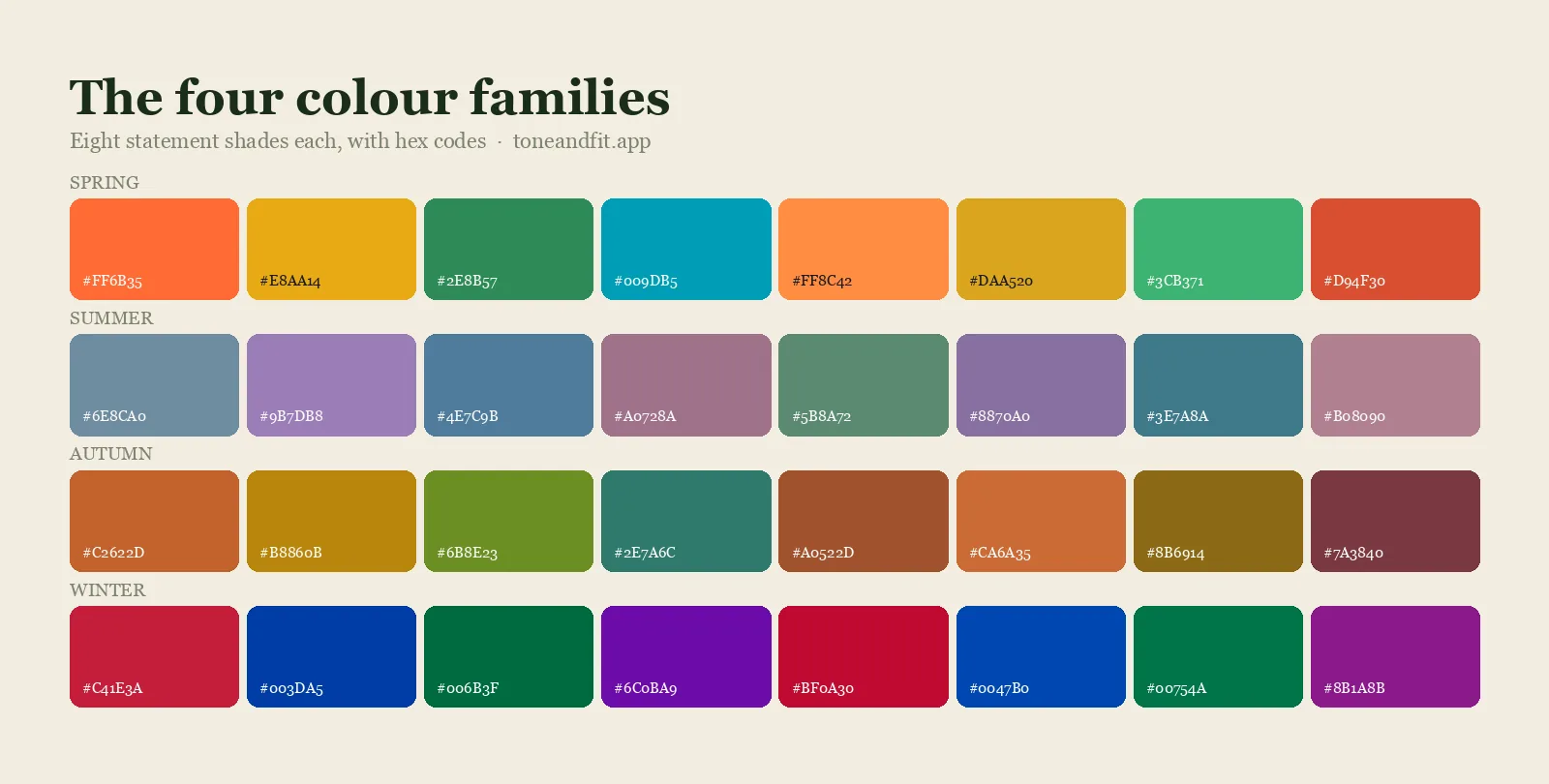
- Spring. Warm and light or clear. Sunny, vivid, fresh. Think peach, coral, periwinkle, ivory, leaf green. A clear day in April.
- Summer. Cool and light or muted. Powdery, soft, watercolor. Think rose, lavender, soft navy, dove gray, raspberry. A misty morning on a beach.
- Autumn. Warm and deep or muted. Earthy, golden, rich. Think rust, olive, mustard, camel, terracotta. A field at harvest time.
- Winter. Cool and deep or clear. Icy, dramatic, jewel. Think true black, snow white, ruby, sapphire, emerald. A snowstorm at night.
If you stop here, you will be roughly right and frequently wrong. The 4-season model treats "warm" as a single bucket, but a Light Spring and a Deep Autumn are both warm and they would look terrible in each other's palettes. The model also has no place for a face whose dominant trait is "muted" rather than warm or cool. That gap is exactly what the 12-season system was built to close.
Get your season in 60 seconds.
Free · No account · One selfie · A full 16-color palette + comparison shots
Download Tone & Fit ↗The 12 sub-seasons (the modern system)
Each of the four parents splits into three sub-types, based on which of the three traits is most dominant. The naming convention is consistent: the modifier comes first (Light, True, Bright, Soft, Deep, Cool, Warm), then the parent season. Twelve names, twelve cells, one of them is yours.
1. True Spring
Warm dominant, medium value, clear chroma. Golden skin, honey hair, warm eyes. Best in coral, sunny gold, leaf green.
Read the True Spring guide →2. Light Spring
Light value dominant, warm bias, soft to clear. Pale warm skin, light blonde hair, pale eyes. Best in peach, butter yellow, sky blue.
See Light Spring details →3. Bright Spring
Clear chroma dominant, warm bias. Vivid eye color, high contrast features. Best in tomato red, kelly green, sapphire.
See Bright Spring details →4. Light Summer
Light value, cool bias, soft chroma. Cool pale skin, ash blonde hair, soft eyes. Best in powder pink, soft blue, lavender.
Read the Light Summer guide →5. True Summer
Cool dominant, medium value, soft chroma. Cool neutral skin, ash hair, soft cool eyes. Best in rose, soft navy, slate.
Read the True Summer guide →6. Soft Summer
Muted dominant, cool bias, medium value. Low-contrast features, ashy coloring. Best in mauve, sage, dusty teal.
Read the Soft Summer guide →7. Soft Autumn
Muted dominant, warm bias, medium value. Soft neutral coloring, hazel eyes. Best in oatmeal, sage, soft brick.
Read the Soft Autumn guide →8. True Autumn
Warm dominant, medium to deep value, muted chroma. Golden warm skin, auburn hair. Best in pumpkin, mustard, forest.
Read the True Autumn guide →9. Deep Autumn
Deep value dominant, warm bias. Rich warm skin, dark hair, dark warm eyes. Best in mahogany, bronze, forest, terracotta.
Read the Deep Autumn guide →10. Deep Winter
Deep value dominant, cool bias. Rich cool skin, very dark hair, dark cool eyes. Best in true black, burgundy, deep navy.
Read the Deep Winter guide →11. True Winter
Cool dominant, medium to deep value, clear chroma. High contrast, sharp eyes, dark hair. Best in true red, royal blue, pure white.
Read the True Winter guide →12. Bright Winter
Clear chroma dominant, cool bias. Jewel-bright eyes, very high contrast. Best in fuchsia, electric blue, icy white.
See Bright and Cool Winter details →If you want a side-by-side decision tree of all 12, the 12 Color Seasons guide walks through them with comparison shots. The "Am I a [season]?" posts linked above are deeper dives, each with seven specific tells, palette breakdowns, and the most common mis-diagnoses for that season.
What is your personal color palette?
Your personal color palette is the specific set of colors, drawn from your season, that consistently harmonizes with your undertone, value and chroma rather than a list someone guessed at. It typically groups into neutrals you can wear head to toe, accent colors for pops near your face, and a handful of colors to avoid because they sit on the wrong side of your undertone. For the full method, from a fit test for any single color through to base neutrals, main colors, accents and metals in usable proportions, see how to build your personal color palette.
A palette is more useful as a shopping filter than as a rulebook. Instead of evaluating every item in a store, you are scanning for items inside your palette family and skipping the rest, which is most of what makes color analysis save time rather than add a new decision to every purchase. Our guide to shopping your color palette covers how to use it at the racks, and building a capsule wardrobe around your season shows how to turn it into a working closet rather than a list you never open again.
The palette is not fixed the way your undertone is. Value can shift slightly with age or hair color and chroma preferences can shift with makeup and styling choices, so most people treat their full palette as a strong default and their power colors, the few shades that test best on camera and in person, as the ones they reach for when it counts.
How to find your color season
There are four working methods, ranked here by how reliable they are in practice. You can use them in any order, and most people end up combining two.
Method 1. AI photo analysis (most accurate at scale, 60 seconds)
An AI model trained on thousands of color profiles reads your selfie. It samples your skin RGB values across the cheekbone, jaw, and forehead, reads your hair tone from the part line, picks out your iris color, and computes the contrast ratio between skin, hair, and eyes. Then it places you in the 12-season space and returns your dominant season plus the neighbor season as a fallback.
This is what Tone & Fit does. On a well-lit photo, the read is consistent with what an experienced human colorist would call from the same image. The cases that most often need a second look are mixed-ethnicity coloring and unusual contrast patterns, which is where comparing against your neighbor season helps. The whole process takes 60 seconds and is free.
Method 2. Professional in-person color drape
The classic method. A certified colorist drapes around 150 fabric swatches against your face under controlled north-light, watching for which ones brighten your skin and which mute it. You walk out with a printed palette and a verbal explanation of why you landed where you did. The accuracy is excellent because the colorist sees you in 3D, can ask you to turn your head, and can compare similar colors against each other.
The catches: it costs 200 to 500 dollars, it takes one to two hours, and you have to live within driving distance of a certified colorist. Look for someone trained in the House of Colour or 12 Blueprints methods. The 12 Blueprints network is the most rigorous on the modern 12-season system and lists certified colorists by city.
Method 3. Self-analysis with the home tests
Combine three things: the vein, jewelry, and white-paper tests for undertone (covered in the undertone guide), a grayscale photo of yourself for value, and a side-by-side of you in three different color shirts for chroma. Do it in natural daylight from a north window, no makeup, no filter.
Self-analysis is free and surprisingly accurate if you are honest with yourself. The risk is confirmation bias. People who love bright cobalt blue talk themselves into being Bright Winter even when every test says Soft Autumn. If you suspect yourself of motivated reasoning, run the AI as a tiebreaker.
Method 4. Online quizzes (least reliable)
The free "What season are you?" quizzes on Pinterest and BuzzFeed work by asking you to self-categorize your own features. The problem is that humans are notoriously bad at categorizing their own coloring. People with light brown hair routinely call themselves "dark," and people with hazel eyes call themselves "green." Quizzes are useful as a starting hypothesis to test, not a final verdict.
The 6 most common mistakes
After tens of thousands of analyses, the same handful of errors come up over and over. If you can dodge these six, you will land in the right ballpark on the first pass.
1. Confusing warm and cool with light and dark
These are two independent axes. Pale skin can be warm (Light Spring) or cool (Light Summer). Dark skin can be warm (Deep Autumn) or cool (Deep Winter). Treating "warm" and "dark" as the same thing is the single most common mistake.
2. Trusting a tan
Your surface skin tone changes with sun exposure. Your underlying undertone does not. A summer tan can shift you a value level for a few weeks, but it cannot turn a cool person into a warm person. Analyze yourself in winter or do the wrist test in the shade.
3. Looking at hair color first
Hair is the easiest variable to change and contributes the least to your season. Dyed hair, highlights, and gray growing in all distract from the part of you that matters: your skin's undertone. Analyze yourself as if your hair were your natural color, then adjust the palette slightly to your current shade.
4. Picking a season because you like the palette
People want to be Bright Winter or Warm Spring because those palettes are visually exciting. Wanting to be a Soft Summer is rarer, but Soft Summers exist and they have a real palette that flatters them. Match the markers on your face, not the aspirational colors on Pinterest.
5. Skipping value or chroma
Many people get undertone right and then stop there. If you only check undertone, you can land in the right family but the wrong sub-type. A cool person who is also deep and high-contrast is True Winter, not True Summer. Run all three axes every time.
6. Inconsistent lighting
Comparing two color tops against your face in golden-hour sunlight and then again under a fluorescent bathroom light will give you contradictory results. Use the same north-facing daylight window for every comparison, every time. Phone cameras with skin-smoothing filters also distort contrast and should be turned off.
What does color analysis actually change?
Honest answer, with no woo. Knowing your season does five concrete things, and there are two things it does not do that people sometimes hope for.
What it does
- Saves you money. You stop buying clothes that look wrong and then quietly hate-wear or donate them six months later. Even if the savings only run a few hundred dollars a year, it compounds quickly.
- Speeds up shopping. When you walk into a store, you are looking for a specific 30-color subset of the racks. You scan past 80% of the floor without thinking. The decision fatigue drops dramatically.
- Improves photographs immediately. Color near your face is the single biggest variable in how a phone camera renders your skin. Wear a color from your palette and your snapshots stop needing filters.
- Increases compliments. Specifically, the kind of compliment where people cannot articulate why you look good, only that you do. That is the signal that the framework is working as designed.
- Reduces the gap between good days and bad days. If your worst outfit still flatters you, your visual baseline is higher. You stop needing makeup, hair, and outfit to all land on the same day to feel like you look good.
What it does not do
- It does not change your features. It will not make you taller, sharper, or differently shaped.
- It does not override personal style. Color analysis tells you which version of any aesthetic flatters you, not which aesthetic you should adopt. Cottagecore Soft Autumns, minimalist True Winters, and avant-garde Bright Springs are all fully supported.
Ready to find your season?
One selfie, your 12-season result, and the palette that goes with it. Free, no sign-up.
Find your season free ↗Prefer to have it measured? Try the free photo color analysis and get your season with a confidence score.
FAQ
Does color analysis change as I age?
Your underlying undertone never changes, but your overall value can shift slightly as your hair greys or your skin loses pigment. Most people stay in the same season for life, with small palette tweaks for hair-color changes. A Deep Winter who goes silver-grey may shift toward Cool Winter; the underlying cool bias stays put.
Can I be two color seasons?
Most people are one dominant season with a "neighbor" season as backup. The 12-season system was specifically designed to capture the in-betweens, so you almost never need to claim two full seasons at once. Pick the one that captures more of your markers and treat the neighbor as a source of accent colors.
Is color analysis Eurocentric or only for white skin?
The original 1980 framework was developed mostly with white women in mind, and many older books still show overwhelmingly pale models. The modern 12-season framework, especially as practiced by colorists rebuilding palettes for all skin tones, has been actively diversified. Tone & Fit's training data was specifically diversified across skin tones, undertones, and contrast levels, and the model is recalibrated quarterly against representative samples.
How long does AI color analysis actually take?
About 60 seconds with one well-lit selfie. The Tone & Fit app reads your skin, undertone, contrast, and chroma simultaneously, returns a dominant season plus a neighbor season, and renders a personalized 16-color palette. The whole loop fits inside a coffee break.
What if I am in between seasons?
Normal. Pick your dominant season, then borrow accent colors from your neighbor. The 12-season system already accounts for boundary cases, so you should not need to fight the framework. If two seasons feel equally right, try wearing tops from each for a week and notice which set draws more compliments.
Will my season change if I dye my hair?
No. Hair is the easiest variable to change but contributes the least to your season. Your skin undertone is what matters most, and that does not move when you change hair color. You may want to tweak which colors in your palette you wear most often (a cool-toned silver hair pairs differently than a warm honey blonde), but you are still the same season.
What is the difference between color analysis and a color personality quiz?
Color analysis is based on measurable physical traits: undertone, value, and chroma. A color personality quiz is a vibe and aesthetic exercise. They answer different questions. Color personality asks "which palette suits your mood?" Color analysis asks "which palette suits your face?" Both can be useful, but only one is grounded in your actual pigment.
Is the season the same as my "best color"?
Not quite. Your season is a palette of 30 to 50 colors, all of which flatter you. Within that palette there are usually two or three "power colors" that suit you better than the rest. The full palette gives you variety; the power colors are what you wear for important interviews and big photos.
What's my color?
Your color is not one shade. It is a season built from three traits: your undertone (warm, cool, or neutral), your value (light or deep), and your chroma (clear or muted). Once those three are placed, you get a full palette rather than a single color, which is why the honest answer to "what's my color" is always a season, not a hex code.
What is a color reading?
A color reading is another name for a color analysis session, the same practice this guide covers, whether it happens with a consultant draping fabric against your face, with an app reading a selfie, or with the home tests above. The name changes by region and by practitioner more often than the method does.
What is my color analysis based on?
Your color analysis result is based on three measurable traits read from your face: undertone, value and chroma, not a personality quiz, your favorite colors, or your star sign. That is also why two honest analyses of the same face tend to agree, even when the language used to describe the result differs.
Get your color season analysis, free.
One selfie · 60 seconds · Dominant season + neighbor · Full 16-color palette · Wardrobe + makeup recommendations · Privacy-first, no account needed
Download Tone & Fit on the App Store ↗If you found this guide useful, the daily Tone & Fit blog covers each season in depth, plus the practical questions (lipstick, foundation, jewelry, hair, wardrobe building) that follow once you know your season. Bookmark the blog index for new posts on weekdays.
Last updated: September 5, 2026