What Color Season Am I? Find Your Season Step by Step

Your color season comes down to three measurable things: undertone, value, and chroma. This guide shows you how to test all three at home, combine them into one of the 12 seasons, and confirm the result with draping.
Want a starting point before you work through the method? The free color analysis tool estimates your season from one photo, in your browser.
What's in this guide
- What is a color season?
- What color season am I? The fast answer
- Color season finder: the three-question shortcut
- Step 1: Test your undertone
- Step 2: Judge your value
- Step 3: Judge your chroma
- Step 4: The 12-season matrix
- Step 5: Verify with draping
- Common mistakes to avoid
- How to find your skin tone
- The AI shortcut
- FAQ
What is a color season?
If you have ever typed "what season am I" into a search bar at midnight, you know the frustrating part: every quiz gives a different answer, and none of them explains why. So before the steps, here is a one-minute primer on what the system actually measures. (For the full theory and its history, read seasonal color analysis explained.)
A color season is shorthand for how three properties of your natural coloring combine:
- Undertone (temperature): whether your skin leans warm (golden, peachy, yellow) or cool (pink, rosy, blue) beneath its surface color.
- Value (depth): how light or dark your overall coloring reads when you take hair, eyes, and skin together.
- Chroma (clarity): whether your coloring looks bright and clear or soft and muted.
Colors that match you on all three settings harmonize with your face: skin looks smoother, eyes look brighter, and the color seems to belong to you. Colors that clash on even one setting do the opposite, which is why a friend's favorite sweater can make you look like you are coming down with something.
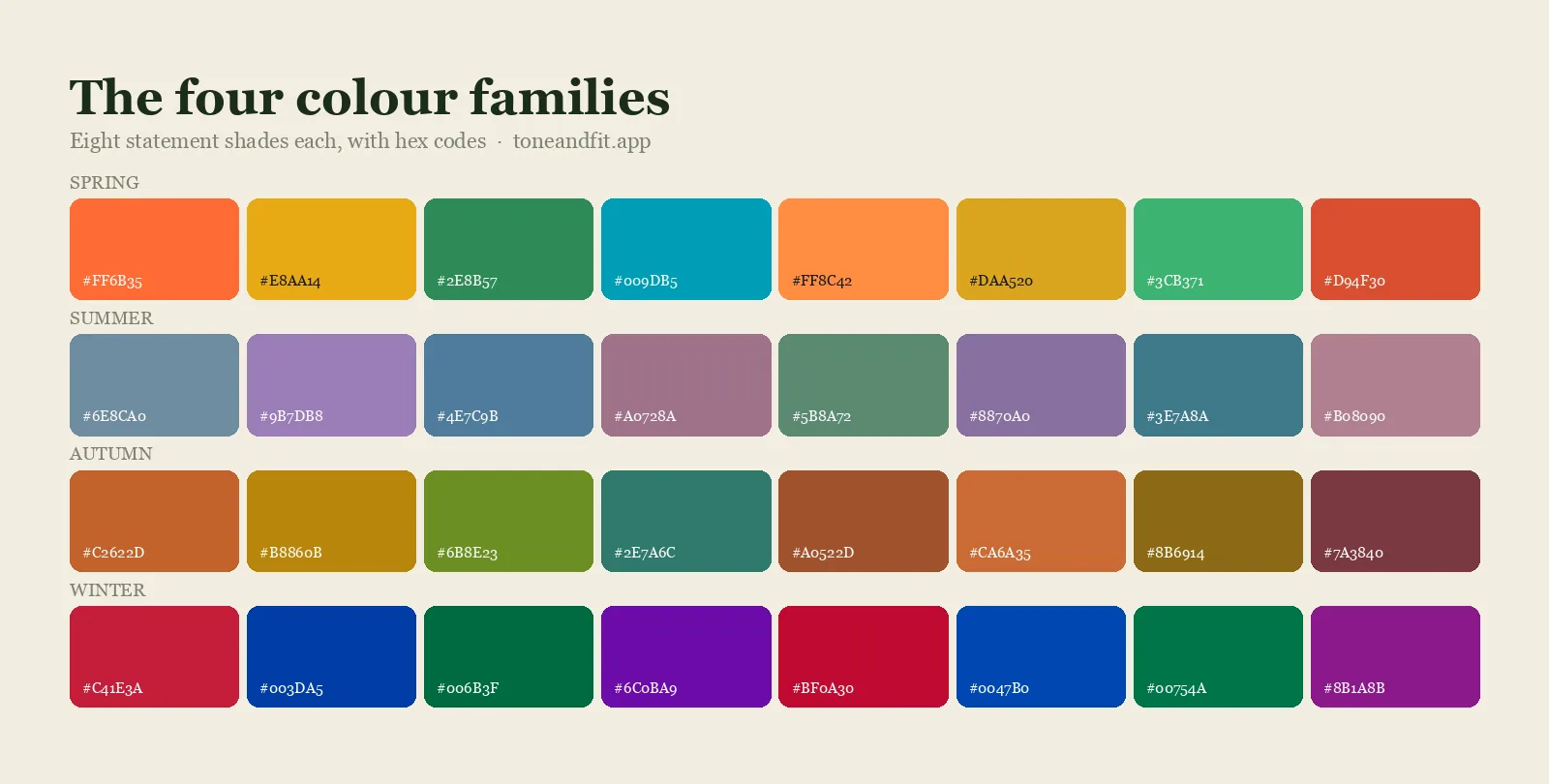
The four classic seasons (Spring, Summer, Autumn, Winter) describe broad combinations of warm or cool with bright or muted. The modern 12-season system splits each into three variants so that people between categories still get an accurate palette. Everyone fits somewhere, including neutral and olive undertones. To find your color season, you measure each property, look up the combination, and verify it with fabric. Budget 20 to 30 minutes, a mirror, daylight, and clothes you already own.
What color season am I? The fast answer
Your color season is whichever of the 12 combinations matches your undertone, value, and chroma together, and you can get a rough answer before running the full method below by comparing yourself against a few quick signals.
A shortcut table
Gold jewelry flatters more than silver: warm, so Spring or Autumn.
Silver flatters more than gold: cool, so Summer or Winter.
Hair, skin, and eyes are all light with little contrast: a Light season, either Spring or Summer.
Dark hair against fair skin, high contrast: a Winter, likely True or Deep.
Nothing about your coloring reads stark or saturated: a Soft season, Summer or Autumn.
Your coloring reads rich and clear rather than muted: a Bright or True season.
None of these signals alone is definitive, which is why Steps 1 through 5 below test undertone, value, and chroma individually rather than guessing from a single impression. If you would rather skip straight to a measured answer, the AI shortcut further down does the same three checks from one photo.
Color season finder: the three-question shortcut
If you want the fast version before the step-by-step, answer these three questions in daylight and read the result off the table.
- Temperature: does gold or silver jewelry make your skin look clearer? Gold points warm, silver points cool, "both" points neutral.
- Depth: is your natural hair light (blonde to light brown), medium, or dark (dark brown to black)?
- Clarity: do your features look crisp and high contrast against each other, or soft and blended?
| Temperature | Depth | Clarity | Most likely season |
|---|---|---|---|
| Warm | Light | Soft | Light Spring |
| Warm | Light to medium | Crisp | Bright Spring |
| Warm | Medium | Soft | Warm Spring or Soft Autumn |
| Warm | Medium to dark | Rich | Warm Autumn |
| Warm or neutral | Dark | Soft to rich | Deep Autumn |
| Cool | Light | Soft | Light Summer |
| Cool | Medium | Soft | Cool Summer or Soft Summer |
| Cool | Medium to dark | Crisp | Cool Winter |
| Cool or neutral | Dark | Crisp | Deep Winter |
| Cool | Any | Very crisp, high contrast | Bright Winter |
Treat the result as a shortlist of one or two, then confirm it with the steps below. The three questions catch most people; the exceptions are usually neutral undertones, which is where the undertone test in Step 1 earns its place.
Step 1: Test your undertone (temperature)
Undertone is the warm or cool cast that sits underneath your surface color, and it never changes, no matter how pale or tan you get. It is the most important measurement because it decides whether you belong on the Spring and Autumn side of the matrix or the Summer and Winter side. Run all three tests below in natural daylight with no makeup, then take the majority verdict.
The vein test
Look at the veins on the inside of your wrist near a window. Green or olive-looking veins suggest a warm undertone. Blue or purple veins suggest cool. If you see a mix, or genuinely cannot decide, you may be neutral or olive, which is common and simply means the next two steps will do more of the work.
The jewelry test
Hold yellow gold next to one side of your face and silver next to the other. Warm undertones light up next to gold and look slightly gray next to silver; cool undertones do the reverse. Rose gold flatters almost everyone, so it does not count as evidence.
The white vs cream test
Hold a pure, optic-white shirt under your chin, then swap it for cream or ivory. Pure white flatters cool undertones and makes warm skin look sallow. Cream flatters warm undertones and can make cool skin look dull. Many people find this the most decisive test of the three.
Score yourself warm, cool, or neutral. Two out of three tests agreeing is enough. If all three disagree, treat yourself as neutral for now and let draping break the tie in Step 5. For photos of each test plus extra checks like sun reaction, see the full guide to finding your skin undertone at home.
Step 2: Judge your value (depth)
Value is how light or dark your coloring is overall. Ignore temperature for a moment and look only at depth.
The fastest method: take a selfie in soft, indirect daylight and switch it to grayscale. Removing color makes depth far easier to judge honestly. Then place yourself on a simple scale:
- Light: blonde to light brown hair, light eyes, and features that blur together softly in the grayscale photo.
- Medium: the broad middle; medium brown hair, hazel to brown eyes, no single feature dramatically darker than the rest.
- Deep: dark brown to black hair and deep eyes; in grayscale, your hair and eyes read clearly darker than your skin.
While you have the grayscale photo open, note your contrast level, meaning the gap between your darkest feature and your lightest. High contrast, like dark hair against light skin, points toward Winter. Low contrast with light coloring points toward the Light seasons. One warning we will repeat later: judge value by your natural hair color. If you dye your hair, use your roots or childhood photos, or weight your eyes and skin more heavily.
Step 3: Judge your chroma (clarity)
Chroma, sometimes called clarity, is the setting most people skip, and it is the reason so many self-diagnoses land one season off. It asks a simple question: do you look better in pure, saturated color or in softened, grayed color?
- The saturation drape: hold something intensely bright near your face (fuchsia, cobalt, or true red), then something muted (dusty rose, slate blue, or sage). One will look intentional; the other will look like the color is wearing you. If bright shades overwhelm your face, your chroma is muted. If muted shades make you look faded, your chroma is bright.
- The eye check: look at your iris in daylight. Clear, jewel-like eyes with a crisp edge between iris and white usually accompany bright chroma. Softly blended, smoky, or grayish eyes usually accompany muted chroma.
Score yourself bright, muted, or somewhere in between. Bright chroma pushes you toward Spring and Winter; muted chroma pushes you toward Summer and Autumn.
Step 4: Combine your results in the 12-season matrix
Now put the three scores together. The four season families are defined by temperature plus chroma:
| Family | Temperature | Chroma | The three variants |
|---|---|---|---|
| Spring | Warm | Bright | Light, True, Bright |
| Summer | Cool | Muted | Light, True, Soft |
| Autumn | Warm | Muted | Soft, True, Deep |
| Winter | Cool | Bright | Deep, True, Bright |
Your value score then picks the variant inside the family. A quick sketch of all 12:
- Springs (warm and fresh): Light Spring is warm and delicate; True Spring is golden and sunny; Bright Spring is warm with high, sparkling contrast.
- Summers (cool and gentle): Light Summer is cool and airy; True Summer is cool and softly muted; Soft Summer is the most muted, with a gentle, misty quality.
- Autumns (warm and earthy): Soft Autumn is muted warmth; True Autumn is rich gold and rust; Deep Autumn is dark, warm, and high in contrast.
- Winters (cool and striking): Deep Winter is dark and cool; True Winter is icy with strong contrast; Bright Winter is cool with maximum brilliance.
Two rules make the lookup easier. First, lead with your most obvious trait: if the first thing anyone notices about your coloring is its depth, start with the Deep seasons and let temperature decide between Deep Autumn and Deep Winter. Second, remember the neighbors: sister seasons share two of your three traits, so a near miss is still a useful answer. For fuller portraits of each season, read the 12 color seasons and which one you are, or work through the guided color analysis quiz if you prefer questions to self-scoring. And once a season name comes back, this walkthrough of what a result actually means covers how to sanity check it and what to do first.
Stuck between two boxes?
Tone & Fit's AI measures undertone, value, and chroma from one selfie and matches you to one of the 12 seasons in about 30 seconds. Free scan, no quiz, no account.
Scan Your Selfie ↗Step 5: Verify with draping
Whatever the matrix says, verify it against your own face. Draping is the classic confirmation method, and it requires nothing but clothes you already own. For the full sitting, including lighting setup and the order to run the tests in, follow our step-by-step walkthrough of running a color analysis at home.
Set up honestly: sit facing a window in daylight, no makeup, hair pulled back, plain background. Gather items in your candidate season's key colors plus a few from its nearest rival. If you tested as Deep Autumn, for example, pull rust, olive, and espresso, then add black and cobalt to test against Deep Winter. Hold each color under your chin for a few seconds and take a phone photo of every drape. Compare the photos side by side and look at your face, not the fabric:
- Right colors: skin looks even, under-eye shadows soften, eyes look brighter, the jawline looks more defined.
- Wrong colors: skin turns gray, yellow, or blotchy, shadows deepen, and the color grabs attention while your face recedes.
Run winners against winners until one family clearly leads. If two adjacent seasons keep tying, wear the overlap between their palettes while you gather more evidence; sister seasons share dozens of colors, so you cannot go far wrong.
Common mistakes that skew your result
Five errors cause most misdiagnoses, and all of them are fixable:
- Testing under indoor lighting. Warm household bulbs throw yellow over everything and can make a cool undertone read warm; cool white LEDs do the reverse. Every test in this guide assumes natural, indirect daylight near a window, never bathroom lighting.
- Judging by dyed hair. Hair is a huge part of perceived value and temperature, and dye can shift you a full season. Judge by your natural color at the roots or in old photos, or let your skin and eyes carry more of the decision.
- Testing while tanned. A tan darkens and warms your surface color, but your undertone does not change. If you test in August, check the inside of your upper arm, where skin stays closest to its natural state.
- Letting favorite colors vote. The question is never whether you love emerald green; it is what emerald green does to your face. Let the photos decide, not the attachment.
- Relying on a single test. Vein color alone misleads constantly, especially for neutral and olive undertones. The method works as a stack: three undertone tests, a grayscale value check, a chroma drape, then verification.
Finding your season is the first step. Once you have it, the complete personal color analysis guide covers what to do with it, from building a palette to shopping and makeup.
How to find your skin tone
Skin tone and undertone get used interchangeably online, but they answer different questions: skin tone is how light or deep your surface color reads, roughly fair, light, medium, tan, or deep, while undertone is the warm or cool cast beneath it. Two people can share a skin tone and sit in completely different seasons because their undertones differ, which is exactly why Step 1 tests undertone separately from Step 2's value check.
The fastest way to place your skin tone is the same grayscale photo from Step 2, compared against a plain reference: a paint chip strip or a foundation shade card held next to your bare face in daylight works well, since both are built on a consistent light-to-dark scale. If you wear foundation, the shade that vanishes on your jawline is a good proxy for your skin tone, and our guide to finding your foundation undertone covers matching both properties at once. For a fuller depth-and-undertone reference chart with named tones side by side, see what is my skin tone.
Or skip the guesswork: let AI measure all three
Everything above is a manual version of what a trained analyst does with drapes and daylight: estimate undertone, value, and chroma, then map them to a season. It works, but it takes half an hour, honest lighting, and some self-trust.
Tone & Fit compresses the whole process into one selfie. The app's AI measures your undertone, value, and chroma directly from the photo and matches the combination against all 12 seasonal profiles in about 30 seconds. The scan is free, with no account to create, no quiz to answer, and no subscription. Your photo is analyzed and then discarded; it is never stored. (Curious how selfie analysis works under the hood? See the skin tone analyzer guide.)
The result goes further than a season name. You get a palette of up to 20 curated colors with more than 40 named shades, your power shades alongside the colors to avoid, and hair color, makeup, and jewelry metal recommendations matched to your season. A color draping preview lets you see yourself across all 12 seasons, which is the digital version of Step 5, and outfit formulas plus an AI Style Assistant help you actually wear the palette. The full toolkit is a one-time unlock, never a subscription.
The app is new. It requires iOS 15.1 or later, and the free scan will either confirm the season you worked out above or tell you exactly which neighbor to test next.
Find your color season in 30 seconds.
One selfie. Your season, your undertone, and a palette of up to 20 colors. Free scan, no account, photo never stored.
Get Tone & Fit ↗Frequently Asked Questions
Can my color season change?
Your undertone is genetic and stays the same for life, but the other two measurements can drift. Hair grays, skin loses pigment and contrast with age, and chroma often softens over time. Someone analyzed as a Bright Winter in their twenties may test closer to Soft Summer decades later. If your last result came from years-old photos, retest with your current coloring.
What if I'm between two seasons?
Border cases are normal, and the 12-season system exists precisely for them. Neighboring seasons share two of their three traits, so identify the one trait that differs and drape for it specifically. Between Soft Autumn and Soft Summer, for example, the tiebreaker is temperature: compare olive green against slate blue and watch your skin. When in doubt, wear the overlap; colors that appear in both palettes are safe either way.
How does Tone & Fit find my season from a photo?
The app's AI measures the same three variables this guide covers, undertone, value, and chroma, directly from one selfie, then matches that combination against all 12 seasonal profiles. The scan takes about 30 seconds and needs no account, no quiz, and no subscription. Your photo is analyzed and then discarded, never stored. You get your season plus a palette of up to 20 curated colors, over 40 named shades, and your power shades alongside the colors to avoid.
Do I need a professional consultation?
Not necessarily. In-person draping with a trained analyst is the traditional gold standard, but sessions are expensive and quality varies by analyst. The five steps in this guide get most people to the right season or its immediate neighbor, and a free AI scan like Tone & Fit's adds an objective measurement without the price tag. Book a consultation if you want the full studio experience or a second opinion on a genuinely tricky case.
What season am I if I have olive skin?
Olive skin reads as neutral with a subtle green cast, which is why the vein test often comes back inconclusive. Olive complexions usually lean muted rather than bright, so the most common landing spots are Soft Autumn, Soft Summer, Deep Autumn, and Deep Winter. Lean on the value and chroma steps, then let draping settle temperature: if warm olive and cream flatter you more than cobalt and pure white, start on the Autumn side.
How do I find my skin tone?
Compare your bare face in daylight against a plain reference with a consistent light-to-dark scale, a paint chip strip or a foundation shade card both work, and note where you land: fair, light, medium, tan, or deep. This measures skin tone, which is depth, not undertone, which is temperature; the two are tested separately because two people can share a skin tone and still sit in different color seasons.
Is there a color palette quiz?
Yes. Our seasonal color analysis quiz and the free color analysis quiz both turn the undertone, value, and chroma steps in this guide into a question format if you would rather answer questions than self-score. Either one gets you to a season family; a photo analysis narrows it to the exact sub-season.
What if I do not want to do all 5 steps?
The fast-answer table near the top of this guide gets most people to a season family, warm or cool, light or deep, bright or muted, from a handful of quick signals. For an exact sub-season without any of the steps, Tone & Fit's AI measures the same three variables from one selfie in about 30 seconds. Either shortcut still benefits from a quick drape check against the result.