Color Analysis Quiz: What Season Am I?

Six questions, one honest caveat, and a way to settle it for good. Take the mini quiz below, then find out why the internet keeps handing you three different seasons.
A photo beats a quiz: the free color analysis tool measures your undertone instead of asking you to guess it.
In this guide
You took a color analysis quiz on one site and got Soft Summer. Another swore you were a Light Spring. A third called you a Winter, and now you trust nobody. This guide does two things about that. First, it gives you a clean six-question seasonal color analysis quiz you can take right now, built around the three attributes that actually define a color season. Second, it explains honestly why text quizzes contradict each other, how to pressure-test whatever result you get, and when to stop quizzing and start measuring.
What a color analysis quiz actually measures
Strip away the fonts and the celebrity examples, and every "what season am I" quiz is estimating the same three dials:
- Undertone (temperature): the tint of the pigment beneath your skin. Warm undertones lean golden, peachy, or olive-gold; cool undertones lean pink, rosy, or blue-based.
- Value (depth): how light or deep your overall coloring reads when you average hair, skin, and eyes together.
- Chroma (clarity): how much saturation your face can hold. Clear, bright coloring wants vivid color; soft, muted coloring wants dusty, gently grayed color.
Temperature splits you into the Spring and Autumn half or the Summer and Winter half. Depth and chroma then place you within a family, which is how the modern system gets from four seasons to twelve. If those twelve labels are new to you, our primer on the 12 color seasons walks through each one, and seasonal color analysis explained covers the theory behind the whole system.
A text quiz estimates those three dials by asking you to observe yourself and report back. Hold onto that sentence, because every strength and every failure of color quizzes comes from it: you are both the instrument and the person reading the instrument.
Take the color season quiz
Six questions, about two minutes, no photo and no email. Answer honestly rather than aspirationally: the quiz can only work with what you tell it.
What your answers mean
The quiz reads three things from your six answers. Temperature is whether your coloring leans warm or cool, and it comes mostly from the vein, metal and white-versus-cream questions. Depth is how light or deep your natural coloring is, which your childhood hair colour and your sun reaction carry. Clarity, sometimes called chroma, is whether your coloring is bright and jewel-like or soft and blended, and the eye question does most of that work.
Temperature picks the pair of families: warm coloring lands in Spring or Autumn, cool coloring in Summer or Winter. Depth and clarity then choose between them, and finally which of the three sub-seasons inside that family fits. That is the whole 12-season system in one paragraph.
If your answers sat near the middle on several questions, the result says so rather than pretending. Sitting between two neighbouring seasons is common and it is not a failure of the quiz. It is the point at which a photo beats more questions.
Why quizzes disagree (and why it is not your fault)
Take three well-made quizzes in one afternoon and you can still walk away with three different seasons. A color season quiz free of charge is easy to find; a consistent one is not. Here is what is actually going wrong, because it is usually not the questions themselves.
1. You are the least objective observer of your own face
Self-perception bias is the big one. People who tan easily tend to over-report warmth. People who flush easily read that surface redness as a cool pink undertone when it is not undertone at all. If you have worn black your whole adult life, you will describe yourself as someone who suits black, because your eye has normalized it. A quiz cannot correct for any of this; it faithfully processes your skewed inputs and hands back a skewed result.
2. Lighting rewrites your answers
The same wrist can show green veins under a warm evening bulb, blue veins in shade, and both at a bright window. Judging your own selfies is even worse, because you are really judging your phone's white balance and whatever automatic processing it applied. Two quiz attempts in two rooms are, functionally, two different people taking the quiz.
3. The questions are genuinely ambiguous
"Is your natural hair golden brown or ash brown?" assumes you can name a distinction that trained colorists verify with physical swatches. Continuous traits get chopped into three or four answer buckets, so everyone near a boundary gets rounded, sometimes up, sometimes down. Different quizzes also weight questions differently and break ties differently; some map to four seasons, others to twelve. The same honest answers can produce different labels on different sites.
None of this means the seasonal system is broken. If you are quietly wondering whether the whole thing is astrology with fabric swatches, we wrote an honest piece on whether color analysis is a scam. The theory holds up; the weak point is cheap measurement. A quiz result is a hypothesis, not a verdict.
The three reasons a quiz can only take you so far
Merged from our earlier quiz article, because it is the most honest thing either page said.
Here's the honest truth about any color analysis quiz, including this one: self-assessment has a ceiling. There are three reasons quizzes struggle to give a definitive answer.
You're biased. Most people see what they expect to see. If you've always thought you're warm-toned, you'll unconsciously lean toward warm answers. Confirmation bias is real, and it's invisible to the person experiencing it.
Lighting changes everything. Even with perfect natural light, the time of day, the color of your walls, and what you're wearing all shift how your skin reads. A professional color analyst controls these variables. A quiz in your bathroom mirror does not.
Boundary cases are common. If your coloring sits between two seasons (say Light Spring and Light Summer, or Soft Autumn and Soft Summer), a quiz will bounce you back and forth depending on the day. These transitional palettes need side-by-side draping to pin down, and a quiz can't do that. If you have taken two quizzes and been handed two different seasons, our breakdown of why color analysis quizzes disagree with each other explains which question is usually to blame.
This is why AI-powered color analysis is becoming the standard. Instead of relying on your subjective self-assessment, an AI tool like Tone & Fit reads your actual skin tone from a photo, measures undertone and contrast directly, and returns a result that isn't filtered through your biases. It's the closest thing to a professional draping session you can get from your phone.
A quiz tells you what you think your skin looks like. Color science tells you what your skin actually looks like. That's the gap Tone & Fit closes.
How to sanity-check a quiz result
Before you act on any quiz result, including ours, run it through three checks.
1. Retake it in honest light. North-facing window, bare face, middle of the day. If your answers change from your first attempt, trust the daylight version and throw the other one out.
Do this with the camera unassisted. A beauty filter or a color-matching effect rewrites the exact pixels you are trying to judge, which is why TikTok color analysis filters keep handing people different seasons on the same face.
2. Drape the extremes. Hold pure black near your face, then chocolate brown, and photograph both in identical light. Repeat with bright white versus cream, then fuchsia versus terracotta. Compare each pair for under-eye shadows, blotchiness, and how clearly your eyes read. Your quiz season should predict the winners. If it keeps losing, the hypothesis is wrong.
3. Audit your compliments. Think of the two or three garments that reliably earn "you look great today" rather than "nice shirt." That distinction matters: one is about your face, the other is about the clothes. If those garments all live inside your proposed palette, that is strong confirmation from years of accidental field testing.
A result that survives all three checks is probably right. A result that fails even one usually means you sit near a border, and borders are exactly where self-assessment runs out of resolution.
The AI upgrade: measured, not guessed
Everything shaky about a text quiz traces back to one design constraint: it has to estimate undertone, value, and chroma without ever looking at you. In-person analysts solve that by looking, with calibrated drapes and daylight, which is why studio draping remains the traditional gold standard. AI photo analysis solves it by measuring, and our guide to AI color analysis explains how that works under the hood.
Tone & Fit reads the same three attributes this quiz just asked you to guess, straight from one selfie, in about 30 seconds. Instead of asking whether your veins look green, it measures the undertone that makes them look green. Instead of asking how deep your hair reads, it measures value. Instead of trusting your bright-versus-muted hunch, it measures chroma. Then it places you in one of the 12 seasons, the same framework this whole guide runs on.
The parts that matter, given everything above:
- The scan is free, with no account, no quiz, and no subscription required.
- Your photo is analyzed and then discarded. It is never stored.
- A draping preview shows your face against all 12 season palettes, so you can see the neighbors you almost were instead of taking one label on faith.
- The full report is a one-time purchase rather than a subscription, priced on the App Store listing: your full palette, power shades versus avoid lists, hair, makeup, and jewelry recommendations, plus an AI Style Assistant for outfit questions.
- It runs on iOS 15.1 or later.
The honest framing: a quiz is a decent first pass that costs five minutes. The scan is the tiebreaker for anyone whose five minutes produced two contradictory answers, which, if you have read this far, may well include you.
Stop quizzing. Start measuring.
One selfie, about 30 seconds, and your season is settled: full palette, draping preview across all 12 seasons, photo never stored. Free to try.
Try Tone & Fit Free ↗Is this color analysis quiz really free?
Yes, and there is no email step. The quiz above scores your six answers in your browser and shows the result immediately, including the palette. Nothing is gated, nothing is emailed to you, and you do not need an account. We build a paid app, and the way we get anything out of this page is that some people who like the result go and try it, not by holding the answer hostage.
Seasonal color palette quiz: getting the colors, not just the label
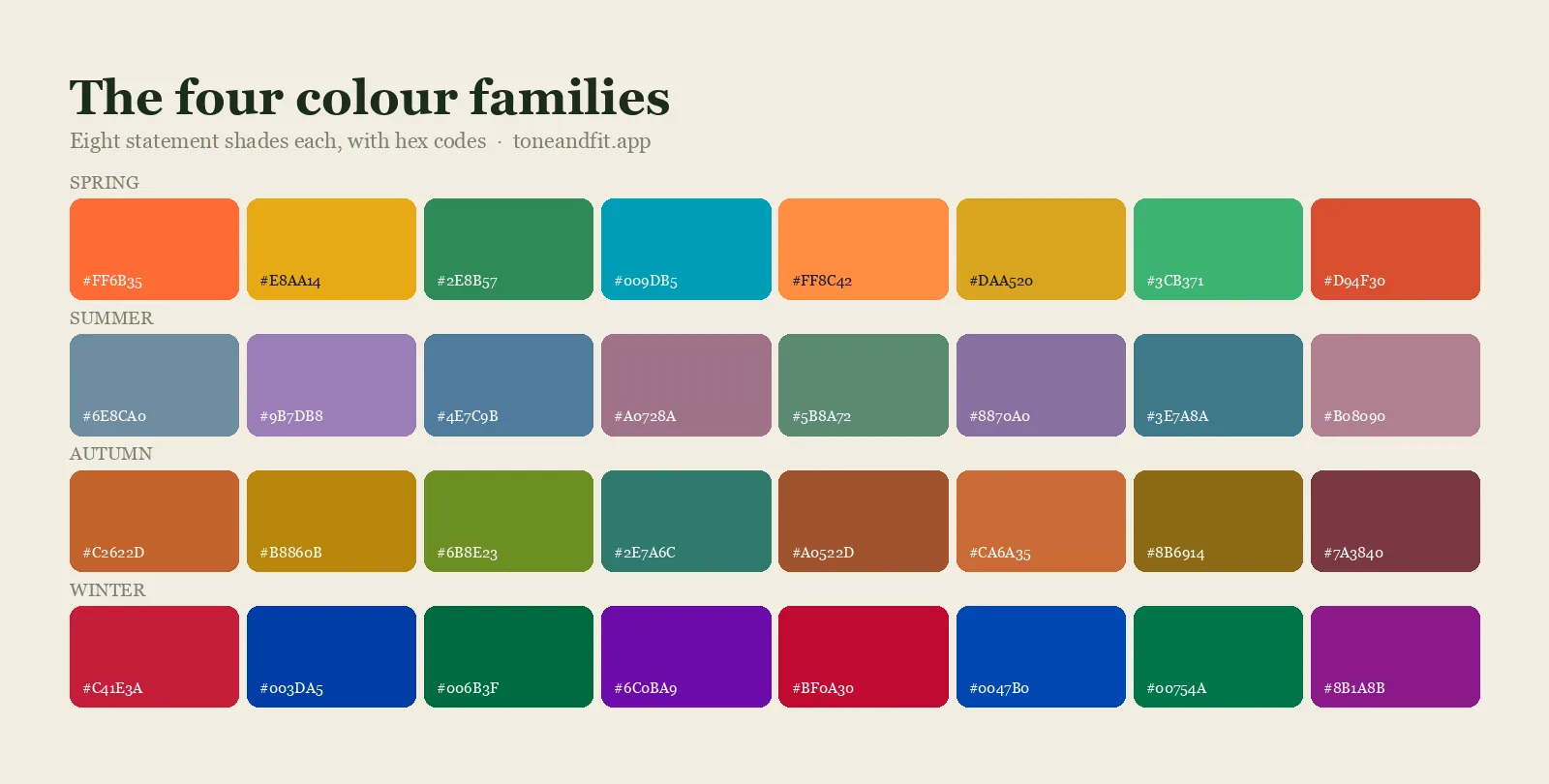
A season name on its own is not much use. What you actually want is the palette, so the result above shows your shades with their names as soon as it has scored you, and links through to the full family palette with hex codes. If you would rather browse the palettes first and work backwards, every one of the twelve is on the palette pages.
Which seasonal color palette should you check first?
Once the quiz above places you in a family, Spring, Summer, Autumn, or Winter, the fastest sanity check is to open that family's actual palette and see whether the colors read as yours at a glance, before worrying about which of the three sub-seasons inside it fits best.
| Family | General mood | Palette page |
|---|---|---|
| Spring | Warm, clear, fresh | The Spring color palette |
| Summer | Cool, soft, powdery | The Summer color palette |
| Autumn | Warm, rich, earthy | The Autumn color palette |
| Winter | Cool, deep or bright, dramatic | The Winter color palette |
If the family the quiz gave you looks obviously wrong at that first glance, the answers you gave were probably closer to a neighboring family than you realized, most often on the temperature question. Retake the six questions with that in mind before assuming the whole framework failed you.
Colour analysis quiz: a note on spelling
If you searched for a colour analysis quiz, this is the same quiz. The twelve-season system is identical in the UK, Ireland and Australia; only the spelling changes. The one thing that genuinely differs is your light: northern-hemisphere overcast daylight reads cooler than the bright daylight the system was originally described in, which is worth remembering when you answer the question about your veins. There is more on that in our colour analysis guide for UK and Australian readers.
Frequently Asked Questions
What is a color season quiz?
A color season quiz is a short self-assessment that places your natural coloring into one of the 12 seasons by asking about the things you can observe without special equipment: your vein colour, whether gold or silver suits you, how your skin reacts to sun, your childhood hair colour, how clear your eyes look, and whether pure white or cream is kinder on you. It scores those answers on three axes, temperature, depth and clarity, and names the season that fits the combination.
How accurate is a color analysis quiz?
A quiz is exactly as accurate as the answers you give it, which is its real limitation. It cannot see you; it is scoring your own judgement of your veins, your skin and your eyes, and those are the judgements people find hardest to make about themselves. It is very good at putting you in the right family and neighbourhood, and much weaker at separating neighbouring sub-seasons. Nobody can put a meaningful accuracy percentage on it, and anyone who quotes one is inventing it. If two seasons both feel plausible after the quiz, that is the moment to check it against a photo.
What is my color season?
It is the combination of three properties of your natural coloring: your undertone, whether your skin leans warm or cool; your depth, how light or deep your coloring is overall; and your clarity, whether your coloring is bright and jewel-like or soft and muted. Those three axes produce the 12 seasons, three inside each of Spring, Summer, Autumn and Winter. Take the quiz above for a read from your own answers, or run the free photo analysis to have those properties measured instead of estimated.
Is there a free color analysis test?
Yes, two on this site and neither needs an email address. The quiz above is free and instant, and works entirely from questions. The free color analysis from a photo goes further: it measures your undertone, depth and contrast from an actual image using the same AI engine as the Tone & Fit app, and gives you a confidence score alongside the result.
Why do color quizzes give me different answers?
Because quizzes depend on self-reported guesses, and your inputs change between attempts. Lighting shifts how your veins and skin read, words like golden or ash mean different things to different people, and each quiz weighs questions differently. If you sit near the border of two seasons, those small differences are enough to flip your result. A measured method, draping or a photo-based AI scan, keeps the inputs constant so the answer stops moving.
Is there a truly free color analysis quiz?
Yes. Text quizzes like the one on this page cost nothing, and the Tone & Fit scan is also free: you can download the app and get your season with no account, no quiz, and no subscription. The full report, with your full palette, avoid lists, and hair, makeup, and jewelry recommendations, is a one-time purchase rather than a subscription, priced on the App Store listing.
How is Tone & Fit different from a quiz?
A quiz asks you to estimate your undertone, value, and chroma by eye. Tone & Fit measures those same three attributes from one selfie using AI, in about 30 seconds, then places you in one of 12 seasons. There are no ambiguous questions to interpret, your photo is discarded after the analysis and never stored, and a draping preview lets you compare your face against all 12 season palettes instead of taking one label on faith.
Can I be two seasons?
You have one best season, but many people sit near a border. Neighboring seasons share two of their three defining traits, so both palettes will look reasonable on you, and quizzes will bounce between them. Pick the season that flatters you more in colors worn near your face, then borrow the overlapping shades from the neighbor season freely. The shared shades were always going to work.
How accurate are online color quizzes?
Decent ones get most people into the right family: warm or cool, light or deep. Precision at the 12-season level is where they wobble, because the deciding trait is usually chroma, and almost nobody can self-assess how bright or muted their own coloring is. Treat a quiz result as a strong hypothesis, then confirm it with a drape test or a measured analysis before rebuilding a wardrobe around it.
What season am I?
You are one of 12 color seasons, decided by three traits: whether your undertone is warm or cool, whether your overall coloring is light or deep, and whether your features are bright and clear or soft and muted. Take the quiz above for an estimate from your own answers, or run a photo-based analysis to have those three traits measured instead of guessed.
Does this quiz cover all 12 seasons, not just the 4 families?
Yes. The six questions above score all three traits, temperature, depth, and clarity, which is what places you in one of the 12 seasons rather than just one of the four families. A quiz that only asks about temperature can only ever get you to Spring, Summer, Autumn, or Winter, not the specific one of three seasons inside it.
What if the quiz says I'm an Autumn or a Winter?
Autumn and Winter are the two families people most often either love or doubt on sight, since Autumn leans warm and earthy while Winter leans cool and dramatic. If the result feels off, compare your actual coloring against the Autumn palette or Winter palette directly rather than trusting the label alone.