Skin Tone Analyzer: How to Find Your Undertone (At Home or With AI)
Short answer: a skin tone analyzer measures two different things: your depth (fair to deep) and your undertone (warm, cool, neutral or olive). Undertone decides your best colours and is the harder one to judge by eye, which is why a photo-based analyzer helps. The undertone finder below reads it from a selfie; the manual tests follow.
Two people can share the exact same foundation depth and still suit completely different colors. The difference is undertone, and finding yours is what a skin tone analyzer is really for.
Try it now: the free color analysis tool reads your skin tone from one photo, over an encrypted connection, and never stores it.
If a foundation has ever matched your arm in the store and turned pink or orange at home, you have met the gap between what skin looks like and what skin is. The visible part, your surface tone, is easy to name. The part that decides your best colors, your undertone, hides underneath it.
This guide covers both halves of skin tone analysis: the classic at-home undertone tests (veins, jewelry, white fabric, sun reaction), how each can mislead you, and what an AI skin tone analyzer measures that your eyes physically cannot.
What's in this guide
- Skin tone vs undertone: the crucial distinction
- The three undertones, plus the olive special case
- The four at-home tests, and how each misleads
- What an analyzer measures that eyes miss
- How undertone feeds the 12-season system
- What undertone means for makeup and foundation
- How Tone & Fit's skin tone analyzer works
- FAQ
Analyze your undertone from a photo
Upload a selfie taken in daylight and the analyzer reads the colour under your skin: warm, cool or neutral, plus how light or deep your skin is and which metals follow from that. It takes a few seconds and needs no account.
Skin tone vs undertone: two different facts about your skin
Everything in color analysis rests on one distinction, and most mistyping happens when the two halves of it get mixed up.
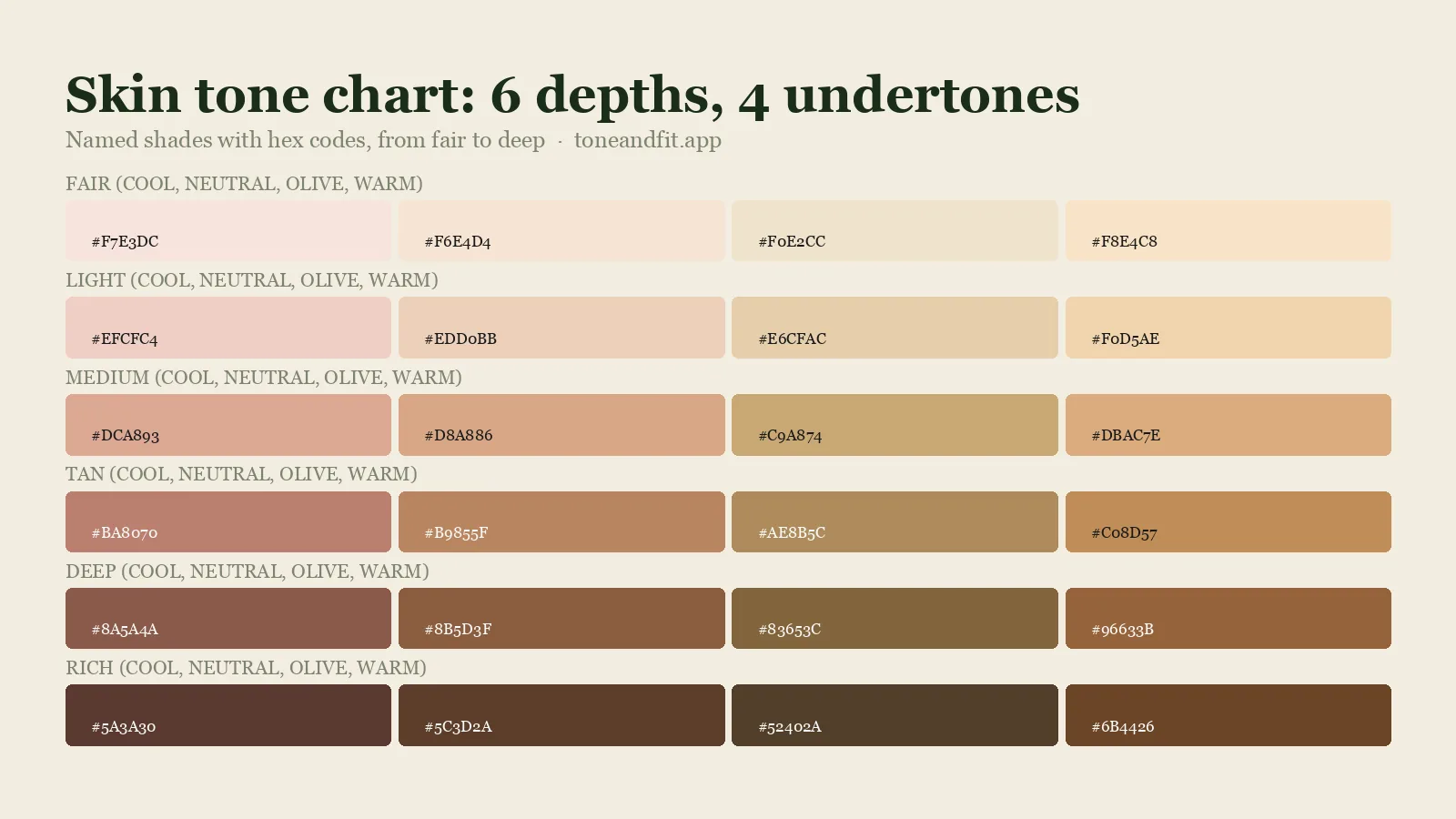
Your skin tone (surface tone) is the depth of your skin: fair, light, medium, tan, or deep. It is what a foundation shade number describes, and it changes with every tan and every winter. It is real and useful, but it is not what decides whether mustard yellow makes you glow.
Your undertone is the subtle hue underneath that surface: golden, peachy, pink, rosy-blue, or a green-leaning olive. It comes from how melanin, carotene, and hemoglobin show through your skin, and it is genetically fixed. Tans fade, redness calms, undertone stays put for life.
The two are fully independent. Fair skin can be warm (golden ivory) or cool (porcelain pink); deep skin can be cool (blue-based espresso) or warm (golden bronze). That is why matching foundation by depth alone fails so often, and why, when people search for a skin tone analyzer, undertone is almost always what they actually need analyzed.
The three undertones, plus the olive special case
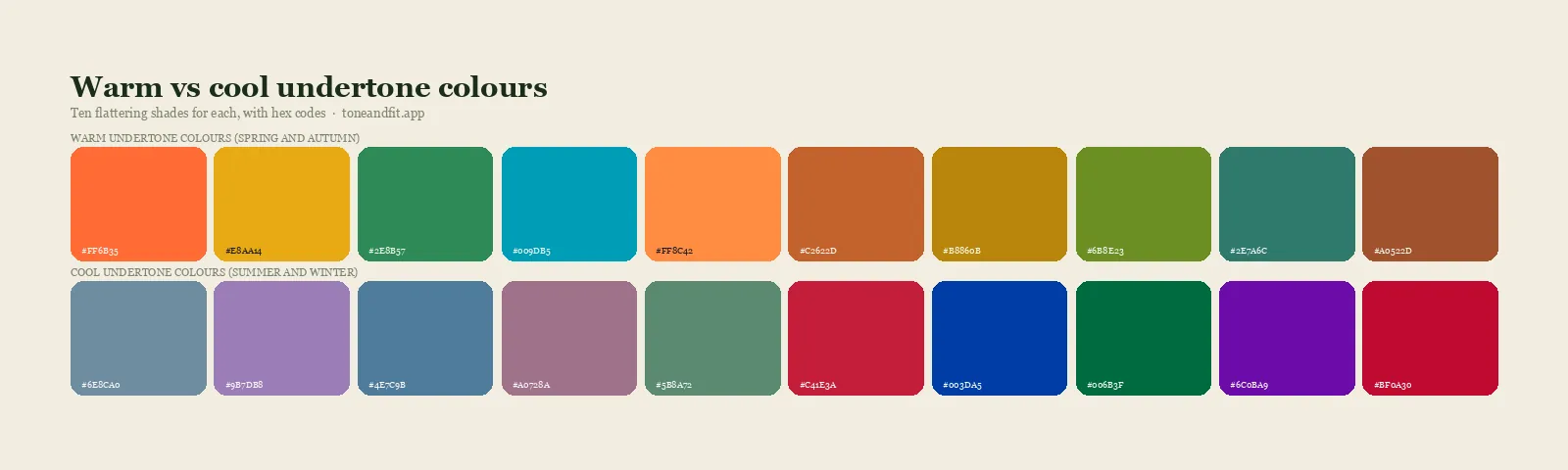
Warm undertones read golden, peachy, or yellow. Gold jewelry melts into the skin, ivory flatters more than stark white, and camel, rust, coral, and olive green feel harmonious near the face.
Cool undertones read pink, rosy, or faintly blue. Silver looks natural, true white looks crisp, and fuchsia, emerald, and icy blue bring the face to life. The full comparison lives in our guide to warm vs cool skin undertones.
Neutral undertones sit near the middle: neither golden nor pink dominates. Both metals pass, and most colors work at moderate intensity. True neutrals are rarer than quizzes suggest; many people who test neutral are actually olive. Our neutral undertone guide covers how to tell the two apart.
Olive is the special case that breaks most tests: a faint green-gray cast produced by golden pigment under a cooler, slightly ashy quality. Olive can lean warm or cool, and it routinely fools the vein test (olive veins almost always read green) and the jewelry test (both metals pass). If foundations always run too orange or too pink on you, start with our guide to color analysis for olive skin tones, or read the signs in olive undertone explained.
| Undertone | Skin cast | Best metals | Fast tell |
|---|---|---|---|
| Warm | Golden, peachy, yellow | Gold, brass, copper | Ivory beats bright white |
| Cool | Pink, rosy, bluish | Silver, platinum | True white looks crisp |
| Neutral | Balanced, no clear lean | Both | Most colors pass at medium intensity |
| Olive | Green-gray over warmth | Both, finish matters | Foundations run too orange or too pink |
The four at-home undertone tests, and how each can mislead you
You can get a decent first read on your undertone with nothing but daylight and a mirror. Each of these tests is a real signal; each is also a noisy one. Run at least three, and treat any single result as a hint rather than a verdict. For step-by-step versions, see how to find your skin undertone at home.
1. The vein test
Look at the veins on the inside of your wrist in natural daylight. Green suggests warm, blue or purple suggests cool, a mix suggests neutral. Where it misleads: you view veins through your skin, so the skin itself tints the answer. Medium, tan, and deep skin makes veins read green regardless of undertone, an olive cast does the same, and indoor bulbs shift every color in the frame.
2. The jewelry test
Hold gold, then silver, against your inner wrist or beside your face and judge which blends into the skin rather than gleaming on top of it. Gold winning suggests warm; silver suggests cool; a tie suggests neutral or olive. Where it misleads: we tend to crown the metal we already own and love, a fresh tan flatters gold on nearly everyone, and the finish of the specific piece (bright polish vs brushed satin) changes the outcome.
3. The white vs cream test
Hold a pure white cloth under your chin in daylight with a clean face, then swap in cream or ivory. If white looks crisp and cream looks dingy, you lean cool. If white washes you out and cream softens your face, you lean warm. Where it misleads: it demands strict conditions: indirect daylight, no makeup, a neutral wall behind you. "White" fabrics vary wildly (optical brighteners push some whites blue), and judging your own face objectively is genuinely hard.
4. The sun reaction test
Recall how your skin responds to sun. Burning quickly then fading suggests cool; tanning easily to golden brown suggests warm. Where it misleads: sun response mostly tracks melanin level, not undertone. Plenty of deep, cool-toned skin tans effortlessly, some fair warm skin burns first every time, and sunscreen habits plus climate blur the memory you are drawing on.
Notice the shared weakness. Every manual test asks your eyes to judge a subtle color difference through a filter: skin depth, lighting, memory, personal preference. When three or four tests agree, trust them. When they contradict each other, and for olive and neutral skin they usually do, you need a measurement rather than an impression.
Skip the guesswork: scan your undertone free.
Tone & Fit's AI reads undertone, value, and chroma from one selfie in about 30 seconds. No quiz, no account, and your photo is discarded after analysis.
Try the Free Analyzer ↗What a skin tone analyzer measures that your eyes miss
Your eyes are brilliant at recognizing faces and terrible at measuring color. The brain constantly white-balances whatever scene it sees, a reflex called chromatic adaptation, so your face under warm bathroom bulbs and the same face by a north-facing window look "the same" to you even though the actual colors reaching your eye are completely different. Add mirror lighting, memory, and a little wishful thinking, and self-assessment gets noisy fast.
Software has none of those instincts, which is precisely its advantage. A good skin tone analyzer app works roughly like this:
- Pixel-level sampling. Instead of one overall impression, it samples skin across many regions of the face (cheeks, jawline, forehead) and works from hundreds of measurements, so a blemish, a flush, or a shadow does not skew the read.
- Lighting compensation. It estimates the color cast of the light in your photo and corrects for it, then reads the hue that remains: the actual undertone signal rather than the lamp's opinion.
- Undertone as a number. Rather than "sort of golden, maybe?", it places your skin's hue on a warm-to-cool axis. That is how olive, the in-between, green-leaning zone, gets detected instead of being forced into warm or cool.
- Value and contrast. It measures how light or deep your overall coloring is and how strongly your hair, skin, and eyes contrast with one another, dimensions the wrist tests never touch.
- Chroma. It reads whether your natural coloring is clear and saturated or soft and muted, which decides whether jewel tones or dusty tones will flatter you.
One honest caveat: any analysis is only as good as the photo. A selfie taken in harsh mixed lighting, under heavy filters, or over a full face of makeup will degrade any tool's accuracy. Indirect daylight and a bare face give the algorithm the same fair conditions a professional analyst would insist on.
How undertone feeds the 12-season color system
Undertone answers one question: warm or cool. A full personal palette needs three answers. Modern seasonal color analysis classifies natural coloring along three axes:
- Hue (undertone): warm, cool, or somewhere between.
- Value: how light or deep your overall coloring is.
- Chroma: how clear and saturated, or soft and muted, your coloring is.
Cross those three and you get the 12 seasons: four families (Spring, Summer, Autumn, Winter), each split three ways. Warm undertone with deep value points to Deep Autumn. Warm with light value points to Light Spring. Cool and muted points to Soft Summer. Cool, deep, and clear points to Deep Winter, and so on around the wheel.
This is why undertone alone cannot pick your palette. Two warm-toned people, one fair and low-contrast, one deep and high-contrast, share a temperature but need very different colors. Undertone is the entrance; season is the destination. To walk the whole path, see our guide to finding your color season, then browse what colors look good on me for the practical wardrobe side.
What your undertone means for makeup and foundation
Undertone mistakes are most expensive at the makeup counter, because shade systems assume you know yours. The practical implications:
- Foundation: match the letter, not just the number. Most brands encode undertone as W (warm), C (cool), or N (neutral) alongside a depth number. The right depth with the wrong undertone reads mask-like: too pink turns grayish on warm skin, too yellow turns sallow on cool skin. Olive skin often does best with olive-tagged or golden-neutral shades.
- Blush and lipstick temperature. Warm undertones glow in peach, coral, and brick; cool undertones in rose, berry, and blue-based reds. The identical red can look expensive on one person and costume-like on another purely because of temperature.
- Jewelry metals. Warm favors gold, brass, and copper; cool favors silver, platinum, and white gold; neutral and olive can wear both, with the finish mattering more than the metal.
- Hair color. Staying within your temperature (golden vs ash, chocolate vs blue-black) is the biggest single factor in a dye job looking natural. Our guide to the best hair color for your skin tone maps the options.
Add up a few returned foundations, one regrettable dye job, and a drawer of almost-right lipsticks, and knowing your undertone quietly pays for itself many times over.
How Tone & Fit's skin tone analyzer works
Tone & Fit is our AI color analysis app for iPhone, and undertone detection is the heart of it. Here is exactly what it does, and what it does not:
- One selfie, about 30 seconds. The AI reads your undertone, value, and chroma at the pixel level, then maps them to one of the 12 color seasons.
- Free to scan, no strings. No account to create, no long quiz, no subscription. The full results are an optional upgrade priced in the app.
- Private by design. Your photo is analyzed and then discarded. It is never stored.
- A palette you can actually use. 40+ named shades, your power shades next to a clear avoid list, plus hair color, makeup, and jewelry metal recommendations tuned to your result.
- Tools that keep it useful. An AI Style Assistant for outfit and shopping questions, and a color draping preview so you can see palette shades against your own photo before you buy anything.
It requires iOS 15.1 or later. If the wrist tests left you stuck between two answers, this is the 30-second way to settle it.
Find your undertone in one selfie.
Free scan. Undertone, season, and 40+ palette shades in about 30 seconds. Photo never stored.
Get Tone & Fit Free ↗Undertone finder: what it does and what it cannot do
An undertone finder tells you whether the colour beneath your skin's surface leans warm, cool or neutral, and that single fact decides more of your wardrobe than your actual skin depth does. The one above measures it from the pixels of your photo after correcting for the light you took it in, which is the part the mirror cannot do for you. What it cannot do is pick your season on its own: that needs depth and contrast as well, which is why the full color analysis exists as a separate step.
AI undertone detector vs the manual tests
An AI undertone detector measures your skin's hue angle in a standard colour space instead of asking you to judge whether your veins look "more green or more blue". That matters because the manual tests all share one weakness: they ask a person who is unsure of their undertone to make a colour judgement about their own skin. The four at-home undertone tests are still worth running, because they teach you what to look for, but when they disagree with each other the measured read is the tiebreaker, not another glance at your wrist. Photo quality matters too: why your phone camera lies about your skin tone explains what skews a selfie and how to avoid it.
Skin tone checker: depth is a different question from undertone
A skin tone checker answers how light or deep your skin is, which is what a foundation shade number describes and what changes every summer (see what is my skin tone and the full list of skin tone names). Undertone does not change. The widget reports both because people search for one and need the other: depth tells you which foundation row to stand in front of, undertone tells you which shade in that row will not turn orange or grey on you by lunchtime.
Frequently Asked Questions
What is an undertone finder?
An undertone finder tells you whether the colour beneath your skin leans warm, cool or neutral. The one on this page measures it from a photo after correcting for the lighting, rather than asking you to judge your own veins or jewellery.
Is an AI undertone detector more accurate than the vein test?
It is more consistent. The vein test asks you to make a colour judgement about your own skin, which is exactly the judgement people struggle with. A measured read gives the same answer for the same photo every time, though poor lighting still degrades it, which is why the widget flags low confidence.
What is the difference between a skin tone checker and an undertone finder?
A skin tone checker reads depth, how light or deep your skin is, which changes with sun. An undertone finder reads the hue beneath the surface, which does not change. You need both for foundation and undertone alone for most clothing colour decisions.
What is the difference between skin tone and undertone?
Skin tone is the surface depth of your skin: fair, light, medium, tan, or deep. It shifts with sun exposure and season. Undertone is the subtle hue beneath the surface: warm (golden or peachy), cool (pink or rosy), neutral, or olive. Undertone is fixed for life, and it, not surface depth, determines your most flattering colors, foundation match, and jewelry metals.
Can my undertone change?
No. Undertone is genetic and stays the same for life. Your surface tone can tan in summer, fade in winter, or grow more muted with age, and temporary redness can shift how skin looks, but the underlying hue does not move. If a new test gives you a different answer, the test conditions changed, not your undertone.
How does Tone & Fit detect my undertone?
Tone & Fit's AI analyzes one selfie at the pixel level, measuring your skin's undertone along with the value (how light or deep your coloring is) and chroma (how clear or muted it is) of your overall coloring, then maps all three to one of the 12 color seasons in about 30 seconds. The scan is free, there is no account or quiz, and your photo is discarded after analysis, never stored.
What undertone is olive skin?
Olive is its own category, not simply warm or cool. It carries a subtle green-gray cast created by golden pigment layered under a cooler, slightly ashy quality, so olive skin can lean warm-olive or cool-olive. It is the undertone manual tests mistype most often: veins usually read green even when the undertone leans cool, and many foundations run too orange or too pink on olive skin.
Is the vein test reliable?
Only as a rough first hint. Green-looking veins suggest warm and blue or purple veins suggest cool, but you view veins through your skin, so skin depth and any olive cast tint the answer. Medium, tan, and deep skin often reads green regardless of undertone, and indoor lighting skews it further. Treat the vein test as one data point and confirm with draping or an AI skin tone analyzer.