Color Analysis Tools: Quiz, Photo, Draping
Color analysis tools fall into three categories: a self answered quiz, a photo based AI tool, and an in person draping session with a consultant. All three aim at the same three measurements, undertone, value, and chroma, but they differ sharply in how directly they measure your actual coloring versus relying on your own perception of it.
Type "color analysis" into any search bar and you will land on a quiz, an app, and an ad for an in-person consultant, often within the same page of results. They are not competing versions of the same thing. Here is what each one actually measures, where each one tends to go wrong, and how to use more than one together to get a result you can trust.
What's in this guide
What are color analysis tools?
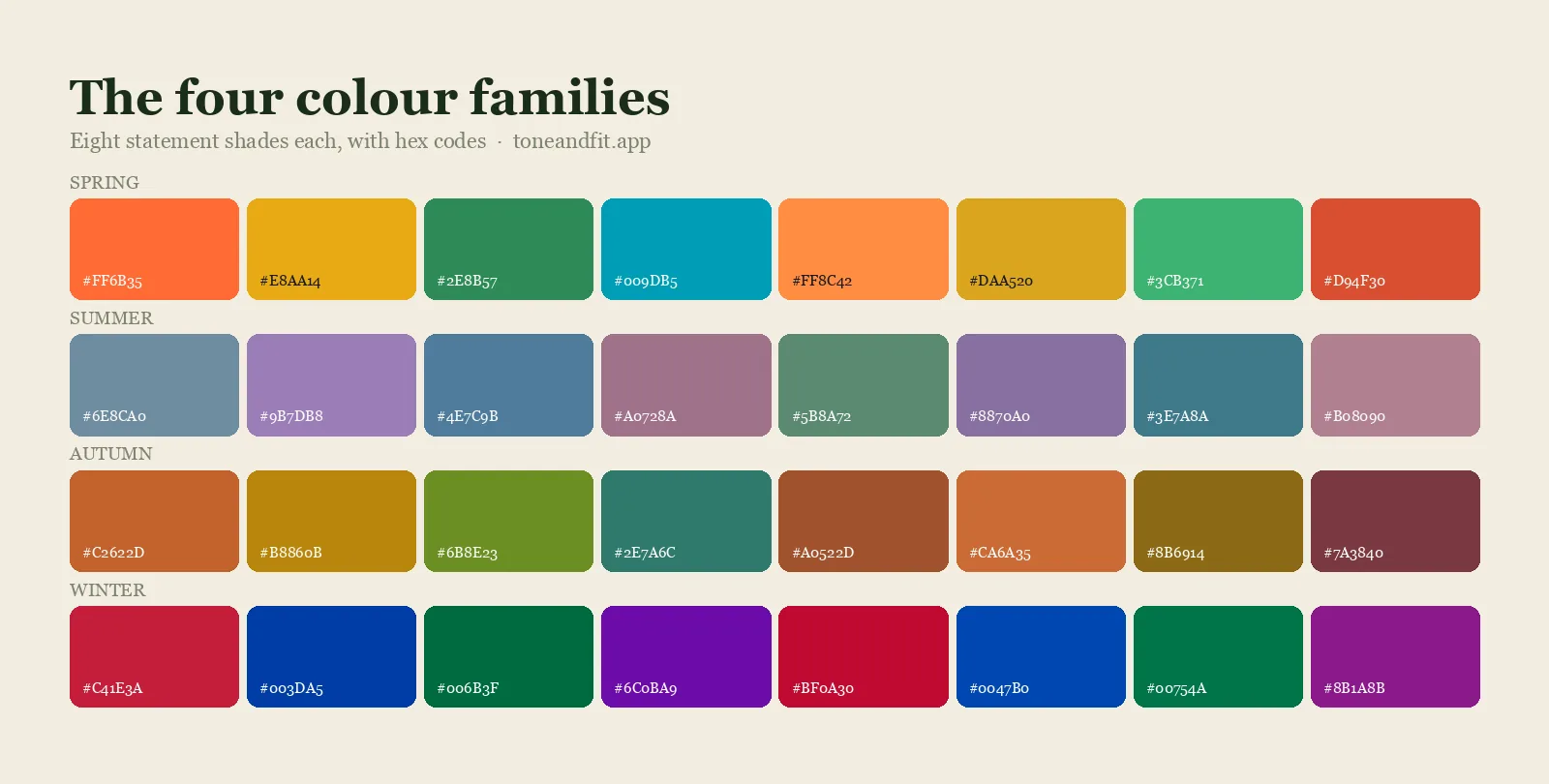
Color analysis tools are the practical ways people put a name on their seasonal color palette, and in 2026 nearly all of them fall into three categories: a self answered quiz, a photo based AI tool, and an in person draping session with a trained consultant. Every one of the three is trying to answer the same underlying question, whether your coloring is warm or cool, light or deep, and bright or muted, the three variables that decide which of the twelve seasons you belong to. Our seasonal color analysis explainer covers where that three-variable system came from if it is new to you.
Where the three tool categories genuinely differ is in how they get their information. A quiz asks you to describe yourself. A photo tool measures pixels directly from a picture of you. Draping skips both and holds real fabric against your actual face under controlled light. That difference in how the data reaches the tool is the single biggest reason two people can run the same quiz, the same app, and a professional drape and get three slightly different answers.
The quiz: what it actually measures
A color analysis quiz measures your own perception of your coloring, not your coloring itself. It asks you to describe your skin, hair, and eyes, or to pick which of several swatches you think flatters you, then maps your answers onto the seasonal system. Our own color analysis quiz works this way: six questions, no photo, no email, with a season and a starter palette at the end.
The strength of a quiz is speed and zero friction, nothing to upload, nothing to book. The weakness is built into the format: it is only as accurate as your own self-perception, and undertone in particular is notoriously hard to judge about yourself. Most people who get an unexpected quiz result have been misjudging their own undertone for years, not answering carelessly. Treat a quiz result as a strong hypothesis to test, not a final answer.
Photo and AI tools: what they actually measure
A photo based AI tool measures the actual color values in a picture of your face, the real pixel color of your skin, hair, and eyes after the model corrects for the lighting in the shot, rather than asking you to describe yourself. That correction step matters enormously, since a warm indoor bulb or an overcast sky can shift the raw colors in a photo before any analysis even begins. Our own free color analysis tool works this way: one photo returns your season, your undertone, and the jewelry metals that suit you, with your photo never stored afterward.
The strength of a photo tool is objectivity, it is measuring your face rather than your opinion of your face, which sidesteps the self-perception problem that limits a quiz. The tradeoff is that the result is only as good as the photo. Filters, makeup, dyed hair, and mixed indoor lighting all distort the reading, which is why photo quality matters more to the outcome than which specific app you use. Our deeper look at how AI color analysis works walks through the full pipeline behind that single-photo result.
Professional draping: what it actually measures
Professional draping measures your coloring by holding physical fabric swatches against your bare face under controlled, neutral light and watching, in real time, how each one changes your apparent skin tone, the shadows under your eyes, and the overall vibrancy of your face. A trained consultant runs through dozens of swatches across the color wheel, narrowing steadily from a broad family down to a specific season.
The strength of draping is that it is the only method with a live feedback loop, the consultant sees the actual change on your actual face and can cross-check borderline calls immediately by reaching for one more swatch. The tradeoff is cost and access: draping is a paid, in-person service that means booking a consultant's time, traveling to a session, and paying meaningfully more than a quiz or an app, which is exactly why quizzes and photo tools exist and why so many people try one of those first. Our comparison of an app versus a professional consultant goes deeper on when the extra cost is worth it.
Quiz vs photo tool vs draping, side by side
Here is the same comparison as a quick reference. None of the three is strictly "better," they trade cost and effort for directness of measurement.
| Quiz | Photo / AI tool | Professional draping | |
|---|---|---|---|
| Needs a photo | No | Yes | No, uses fabric swatches |
| Time | A couple of minutes | About a minute | An hour or more, plus booking |
| Cost | Free | Free to low cost | The most expensive option, paid per session |
| What it measures | Your own answers about your coloring | Actual pixel values from your skin, hair, and eyes | A trained eye reading real fabric against your face |
| Best for | A fast first guess | An objective read without leaving home | Deep, personalized wardrobe guidance |
Most people who care about getting this right end up using more than one row in that table, not just one. A common path: take the quiz out of curiosity, run the free photo tool to confirm it with something more objective, and book a professional drape only if a full wardrobe overhaul is the actual goal. For a wider view of how the underlying apps stack up against each other rather than against draping, see our roundup of the best color analysis apps.
Mistakes that throw off any tool
The same handful of mistakes undermine a quiz, a photo tool, and even a drape, because they all corrupt the input rather than the method. Watch for these regardless of which tool you choose:
- Judging undertone from a tan or a flash photo. Sun exposure changes surface shade, not undertone, and a flash photo washes out the subtle warm or cool cast that actually decides your season.
- Wearing makeup during a photo or a drape. Foundation and bronzer sit on top of your real skin color, so any reading taken through them is measuring your makeup, not your skin.
- Filters and beauty modes. These do not just smooth skin, they shift its color, almost always cooler and lighter than reality, which quietly moves a photo tool's result toward the wrong season.
- Answering a quiz based on what you wish were true. People who love how they look in black tend to answer quiz questions in a way that confirms it, even when their actual coloring says otherwise.
- Mixed or colored lighting. A window on one side and a warm lamp on the other can push a photo, or even a drape, toward an inaccurate read that no tool can fully correct for.
How to check this on yourself
The fastest, lowest-effort path is to start with the color analysis quiz, six questions with no photo and no email, which takes under two minutes and gives you a season plus a starter palette to test against. From there, confirm or challenge that result with the free photo based color analysis tool, which uses the same engine behind the Tone & Fit app to return your season, your undertone, and the metals that suit you from a single selfie, with your photo never stored.
Before you take that photo, spend two minutes getting the input right, since it decides the result more than the tool itself does: face a window in indirect daylight rather than an indoor bulb, remove makeup, skip filters and beauty modes, and pull dyed hair back if it no longer reflects your natural color. If your quiz answer and your photo result agree, you can be reasonably confident in the season. If they disagree, that disagreement is itself useful information, and it is usually a sign you are close to a border between two seasons, worth reading about in our guide to personal color analysis before booking a professional drape to settle it.
Ready to find your season?
One selfie, your 12-season result, and the palette that goes with it. Free, no sign-up.
Find your season free ↗FAQ
What is the most accurate color analysis tool?
There is no single answer, since accuracy depends on the input each tool gets. A photo based AI tool and professional draping both measure your actual coloring directly, so they tend to agree with each other more often than either agrees with a self answered quiz, which depends on how well you already know your own undertone. Photo quality matters more to the result than which tool you pick.
Is a color analysis quiz accurate without a photo?
A quiz gives a reasonable starting signal, but it depends on you correctly judging your own undertone and contrast, which is exactly the thing most people get wrong when they try it alone. Use it to narrow down a family of seasons, then confirm with a photo based tool or a professional drape before you commit to a wardrobe.
Do I need to pay for a color analysis tool?
Not necessarily. Our color analysis quiz and our photo based color analysis tool are both free to use. Professional draping is a paid, in-person service, since it involves booking a trained consultant's time rather than running an automated tool.
Can I use more than one color analysis tool?
Yes, and many people do. A common path is to take the quiz out of curiosity, confirm the result with a photo based tool for a more objective read, and book a professional drape later if a full wardrobe overhaul is the goal. Each tool answers the same question with a different level of confidence and effort.
Do color analysis apps and web based tools use different technology?
Usually not. Tone & Fit's free web tool and its iOS app run on the same underlying analysis engine, so the season and undertone reading is consistent between them. The app adds more depth on top of that shared engine: your full palette, lip and blush shades, hair color matching, jewelry metals, and access to a stylist, features that go beyond a single quick result.
How do I get the most accurate result from a photo based tool?
Use indirect natural daylight, remove makeup, skip filters and beauty modes, and face the camera straight on against a neutral background. Photo quality affects the result more than which app or tool you choose, since every photo based tool is measuring the pixels you actually give it.