Deep Autumn or Warm Autumn? How to Finally Tell Them Apart
Short answer: Deep Autumn and Warm Autumn share a warm undertone; the difference is depth. Warm Autumn is medium in value and the purest warm of the three Autumns, so it wears rust and mustard at full brightness. Deep Autumn is darker and higher in contrast, so the same hues work best pushed toward chocolate, deep olive and burgundy. Four tests below settle which one you are.
Both love a rust sweater, both glow in golden brown, both reject anything icy or pastel. The difference is one measurement most people never think to check, and once you know it, the two stop looking alike.
What's in this guide
What both Autumns share
Deep Autumn and Warm Autumn are two of the three Autumn sub-seasons in the modern 12-season system, sitting alongside Soft Autumn. They have so much in common that people flip between them for months. Both have a warm undertone, meaning every flattering color leans golden rather than blue. Both live in the muted, earthy half of the color world, so the colors that suit them carry a little brown or gray in them rather than the pure, icy clarity a Winter wants. And both look their best in the rich, roasted shades of a autumn landscape, rust, olive, terracotta, mustard, and warm brown, colors that make cool pastels look thin and lifeless by comparison.
If you have already read our guide to whether you are a Deep Autumn and walked away thinking "this is me, but I could also be Warm Autumn," you are in exactly the right place. The overlap is genuine. Both seasons reject cool and both reject bright, so the two big signals, warm skin and muted coloring, point the same direction for each of them. That is why the surface read looks identical.
To understand why they still land in different palettes, it helps to remember the three measurements that define every season: undertone (warm or cool), value (light or deep), and chroma (bright or muted). If those words are new, our primer on seasonal color analysis walks through all three. Deep Autumn and Warm Autumn agree on undertone, and they agree, broadly, on chroma. They part ways on value, how light or dark the coloring runs, and that is the whole story.
The one difference that matters
Here is the cleanest way to hold it in your head. Warm Autumn is defined by warmth. Deep Autumn is defined by depth.
Warm Autumn sits at the very center of the warm axis. It is the most purely, unapologetically warm of the three Autumns, with no cool influence pulling at it from any direction. Its coloring runs in a medium range, not especially light, not especially dark, and its warmth is golden and glowing. A Warm Autumn is the person who looks lit from within in camel, honey, warm olive, and soft gold, colors that have real warmth but stay at a comfortable middle depth.
Deep Autumn takes that same warm, muted foundation and adds darkness. It borrows a little from Winter, its neighbor on the seasonal wheel, which pulls its value down into the deepest, richest, most shadowed corner of the Autumn family. A Deep Autumn is still clearly warm, but the defining trait is not warmth, it is depth. This is the Autumn that can wear espresso brown, dark chocolate, deep forest, and near-black without being swallowed by them, because the darkness in the color matches the darkness in their own coloring.
That single distinction, medium golden warmth versus warm darkness, is what separates the two. Everything else in this guide is just a way of detecting it. For the bigger picture of how all twelve seasons relate to one another, our overview of the 12 color seasons maps the full grid and shows exactly where Deep Autumn and Warm Autumn sit on it.
Deep Autumn vs Warm Autumn side by side
A quick reference before we get into testing. Notice how much agrees and how little actually differs.
| Warm Autumn | Deep Autumn | |
|---|---|---|
| Undertone | Warm, the purest Autumn | Warm, slightly tempered by depth |
| Primary axis | Warm-dominant | Deep + warm, depth first |
| Value | Medium | Deep, the darkest Autumn |
| Contrast | Low to medium, blended | Medium to high |
| Near-black tones | Can overwhelm | Excellent, wears espresso and forest |
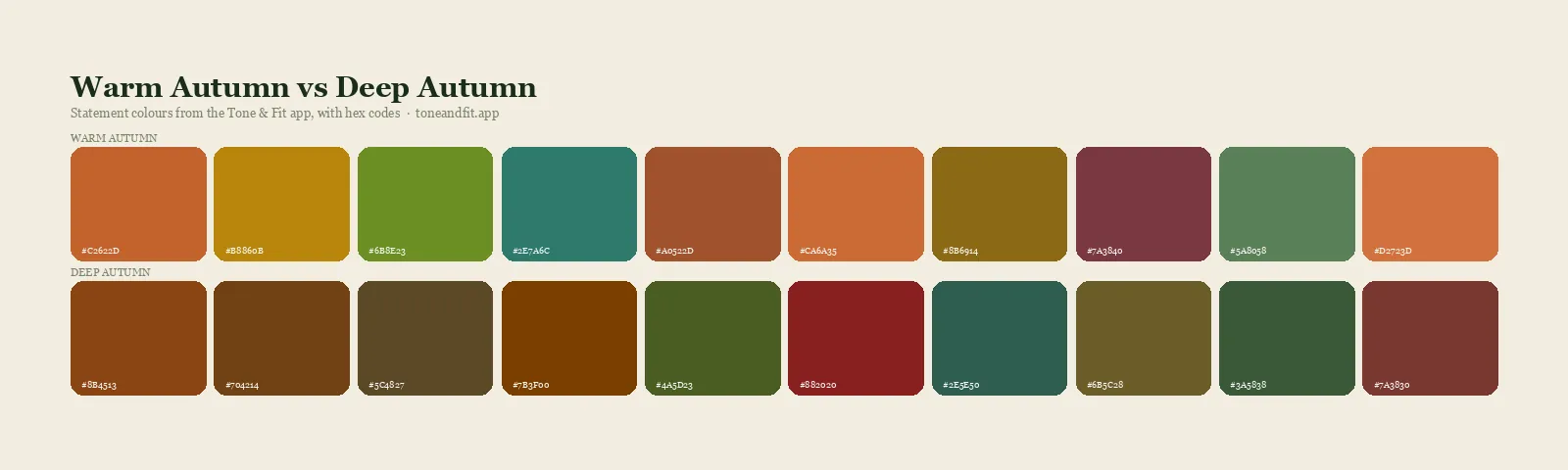
| Signature colors | Camel, honey, warm olive, salmon, soft gold | Espresso, rust, dark teal, aubergine, deep olive |
| Best metal | Warm gold, soft brass | Antique gold, rich bronze, copper |
4 tests to settle it
You will rarely tell these apart by description alone. You need to put fabric or paper next to your face in good daylight and watch your skin react. Run all four of these, then count which season wins more rounds. Daylight near a window, no makeup, hair pulled back.
1. The depth test (the decider)
This is the single fastest way to separate the two. Hold a rich espresso or dark chocolate brown right up to your face, then swap it for a medium camel or honey. A Deep Autumn will look defined and luminous next to the dark shade, with eyes and features that stand out sharply. A Warm Autumn often looks a little weighed down or shadowed by the darkest browns, and instead comes alive in the medium camel. Whichever depth makes your face look clear rather than muddy is pointing you to your season.
2. The grayscale contrast test
Take a photo of yourself and convert it to black and white. Deep Autumns tend to show medium-to-high contrast, with hair and eyes that stay clearly darker than the skin. Warm Autumns show a softer, more blended pattern where hair, skin, and eyes sit closer together in value with no dramatic jumps. If your grayscale photo looks gently graded and low-key, you lean Warm Autumn. If it shows clear dark-against-light separation, you lean Deep Autumn.
3. The bright-jewel test
Put a saturated dark teal or deep aubergine next to a soft, dusty olive or muted salmon. Deep Autumns can carry the richer, more pigmented jewel tones without being overwhelmed, because their own depth supports them. Warm Autumns usually look more harmonious in the softer, dustier earth shades, and the darkest jewels can feel a touch heavy. Whichever side makes your skin look even and warm rather than sallow is pulling you toward that season.
4. The black test
Drape a true black next to your face, then a warm dark brown like espresso. Deep Autumn is the Autumn most able to wear a soft black near the face without looking drained, though even it usually prefers espresso. Warm Autumn tends to look noticeably better in the warm brown than in true black, which can flatten a medium-depth season and cool it down. If black feels harsh and brown feels natural, that is a strong Warm Autumn signal.
If you are not confident reading your own undertone in the first place, start with the foundational step of finding your skin undertone at home and our explainer on warm versus cool undertones. Both Autumns are firmly warm, so if your tests keep pointing cool, the answer may be that you belong to a different season family entirely.
Stop guessing which Autumn you are.
Tone & Fit's AI measures your undertone, value, and chroma from a selfie and tells you whether you're Deep Autumn, Warm Autumn, or something else, with your full palette in 60 seconds.
Try the App ↗How the palettes diverge
Once you know which Autumn you are, the wardrobe payoff is real. The palettes overlap heavily in the warm, roasted mid-tones and split apart at the light and dark ends.
Where they agree
Both Autumns look wonderful in rust, terracotta, warm olive, mustard, pumpkin, and golden brown. These are the shared core of the Autumn family. If a color is warm and muted and sits in the middle depth, it almost certainly works on both. This is why the two seasons are so easy to confuse, most of a typical autumn wardrobe suits both.
The shared Autumn core: rust, ochre, warm olive, mustard, golden brown, terracotta.
Where Warm Autumn pulls ahead
Warm Autumn owns the glowing, medium golden range. Camel, honey, soft gold, warm salmon, buttery yellow, and light warm olive are where Warm Autumn has no equal. These medium-value colors need pure warmth without heavy darkness to look rich, and only Warm Autumn carries them effortlessly. On a Deep Autumn the same shades can read a little washed and understated.
Warm Autumn favorites: camel, honey, soft gold, warm salmon, light olive.
Where Deep Autumn pulls ahead
Deep Autumn owns the dark, saturated end. Espresso, dark chocolate, deep forest, dark teal, aubergine, and deep brick are where Deep Autumn has no equal. These colors need real depth in the wearer to look rich rather than overwhelming, and only Deep Autumn delivers it. For the full palette in detail, see our dedicated Deep Autumn color palette guide, and the Deep Autumn makeup guide for lips, eyes, and cheeks.
Deep Autumn exclusives: espresso, dark chocolate, deep forest, dark teal, aubergine.
The same logic carries into hair and makeup. Both Autumns want warm, golden-to-copper hair rather than anything ashy, covered in depth in our guide to the best hair color for your skin tone. For lips, both reach for warm brick, terracotta, and copper, but Deep Autumn can also carry a deep, dark wine that would read too heavy on a medium-depth Warm Autumn.
Common mistakes and look-alikes
A few traps catch people when they try to choose between these two.
Assuming darker hair means Deep Autumn. Hair color alone does not decide it. A Warm Autumn can have quite dark auburn hair, and a Deep Autumn's defining trait is overall depth across hair, skin, and eyes together, not just one dark feature. Read the whole face, not a single trait.
Confusing Deep Autumn with Deep Winter. Both are deep, but they split on undertone. Deep Autumn is warm and muted; Deep Winter is cool and bright. If a rich espresso flatters you but a warm rust looks slightly off and a cool berry looks great, you may be a Deep Winter rather than a Deep Autumn. Undertone is the fork here, not depth.
Mistaking a Soft Autumn for a Warm Autumn. Soft Autumns share the muted quality but are gentler and less warm, sitting between Autumn and Summer. If even the medium golden earth tones feel a little strong on you and the softest, dustiest shades flatter most, you may be a Soft Autumn. Our Soft Autumn guide covers that neighbor.
Trusting one test in bad light. Indoor bulbs throw warm or cool casts that can flip your result. Always test in indirect daylight, and run more than one test before you commit. The whole system rests on accurately reading undertone, value, and chroma, which is exactly why so many people prefer a tool or a professional to do the measuring. If you are weighing those options, our comparison of a color analysis app versus a consultant lays out the tradeoffs, and the full personal color analysis guide ties everything together.
The honest truth is that Deep Autumn and Warm Autumn are close enough that even careful self-testing leaves some people unsure. That is not a failure on your part. It is a genuinely fine distinction that comes down to a value measurement the human eye is bad at judging in a mirror. When the four tests split two and two, measuring directly is the fastest way to a confident answer.
Ready to find your season?
One selfie, your 12-season result, and the palette that goes with it. Free, no sign-up.
Find your season free ↗For the underlying reading, the skin tone analyzer explains what undertone, depth and contrast actually are.
FAQ
What is the main difference between Deep Autumn and Warm Autumn?
Depth. Warm Autumn is the most purely warm of the Autumn seasons, sitting in a medium, golden, earthy range. Deep Autumn takes that warmth and adds darkness, so it carries the richest, most saturated and shadowed colors of the Autumn family. They share a warm undertone; they differ on how light or deep the coloring runs.
Which season is warmer, Deep Autumn or Warm Autumn?
Warm Autumn is warmer. It sits at the center of the warm axis with no cool influence at all. Deep Autumn is still warm but borrows a little depth from Winter, so its warmth is slightly tempered by darkness. If pure golden warmth flatters you most, you lean Warm Autumn.
Can I wear black if I am a Deep Autumn?
Deep Autumn handles near-black tones like espresso, deep chocolate, and dark forest better than any other Autumn, so a soft black can work near the face. Warm Autumn usually looks better in warm dark browns than in true black, which can drain a medium-depth Warm Autumn and cool the face down.
What colors flatter Warm Autumn but not Deep Autumn?
Warm Autumn glows in medium, golden earth tones like camel, honey, warm olive, salmon, and soft gold. On a Deep Autumn these mid-value colors can look a little washed and lack the richness the season wants. Deep Autumn prefers to take the same hues deeper into espresso, dark teal, and aubergine.
How do I know if I have enough depth to be a Deep Autumn?
Convert a photo of yourself to black and white. Deep Autumns show strong contrast with dark hair and eyes that stay clearly dark against lighter skin. Warm Autumns show softer, medium contrast where hair, skin, and eyes sit closer together in value with no dramatic separation.
What is the fastest way to tell Deep Autumn and Warm Autumn apart?
Hold a rich espresso brown next to a medium camel. If the espresso makes your features look defined and luminous, you lean Deep Autumn. If camel makes you glow and espresso feels heavy, you lean Warm Autumn. An AI color analysis app or a professional drape can confirm it by measuring value and chroma directly rather than asking your eye to judge a subtle difference.