Soft Autumn vs Soft Summer: The Difference
Soft Autumn and Soft Summer are the two most muted seasons in the entire twelve-season system, so they already agree on the trait most people notice first. What separates them is undertone: one is quietly warm, the other is quietly cool, and that is the whole axis this comes down to.
What's in this guide
Mutedness is what makes these two so easy to confuse. Every other pair of neighboring seasons splits on one obvious trait, warmth, depth, or brightness, but Soft Autumn and Soft Summer share the rare quality of being genuinely dialed down at the same time as they disagree on temperature. If you have already ruled out the brighter, clearer seasons and landed here, you are choosing between the quietest member of Autumn and the quietest member of Summer, and the deciding factor is smaller than it looks.
Soft Autumn vs Soft Summer Side by Side
Here is every dimension compared at once. Chroma and contrast barely move between the columns. Undertone is where the real gap is.
| Soft Autumn | Soft Summer | |
|---|---|---|
| Undertone | Warm, golden underneath the haze | Cool, grey underneath the haze |
| Chroma (mutedness) | The most muted Autumn | The most muted Summer |
| Value (depth) | Light to medium | Light to medium |
| Contrast | Low, blended features | Low, blended features |
| Best colors | Sage, soft gold, toasted coral, dusty peach | Dusty mauve, smoky teal, denim blue, rosewood |
| Colors to avoid | Bright orange, electric blue, stark white | Electric blue, true fuchsia, stark white |
| Best metals | Brushed gold, antique bronze | Brushed silver, pewter |
| Often-cited celebrities | Drew Barrymore is a name often cited as a Soft Autumn example | Most analysts place Jennifer Aniston in Soft Summer |
The Tell
Undertone is the tell, and it hides in plain sight because both seasons are already so quiet. Soft Autumn's mutedness sits on top of a warm, golden base, so even its greyest neutrals carry a whisper of gold. Soft Summer's mutedness sits on top of a cool, ash base, so even its warmest-looking neutrals carry a whisper of blue-grey. Neither season is ever going to look dusty by accident; the question is only which direction the dust leans.
The two palettes get close enough that they can share a color name and still not share a color. Both have a shade they call soft burgundy: Soft Autumn's version, at #7E4B4B, carries a touch more red-brown warmth, while Soft Summer's version, at #7C4A54, leans a shade more toward wine and violet. Side by side they read as nearly the same color. Held against two different faces, one will look rich and the other will look muddy, and that reaction is the entire test in miniature.
Where the Palettes Agree, and Where They Split
They agree on temperature the least and on mood the most. Both wardrobes avoid anything shiny, saturated, or high-contrast, and both build around colors that look like they have been left out in soft light for a season. Below is the real Soft Autumn palette, pulled from the full Autumn palette guide, the season's own answer to where it pulls ahead: sage, soft gold, and dusty peach all need a warm base to look nourished rather than flat.
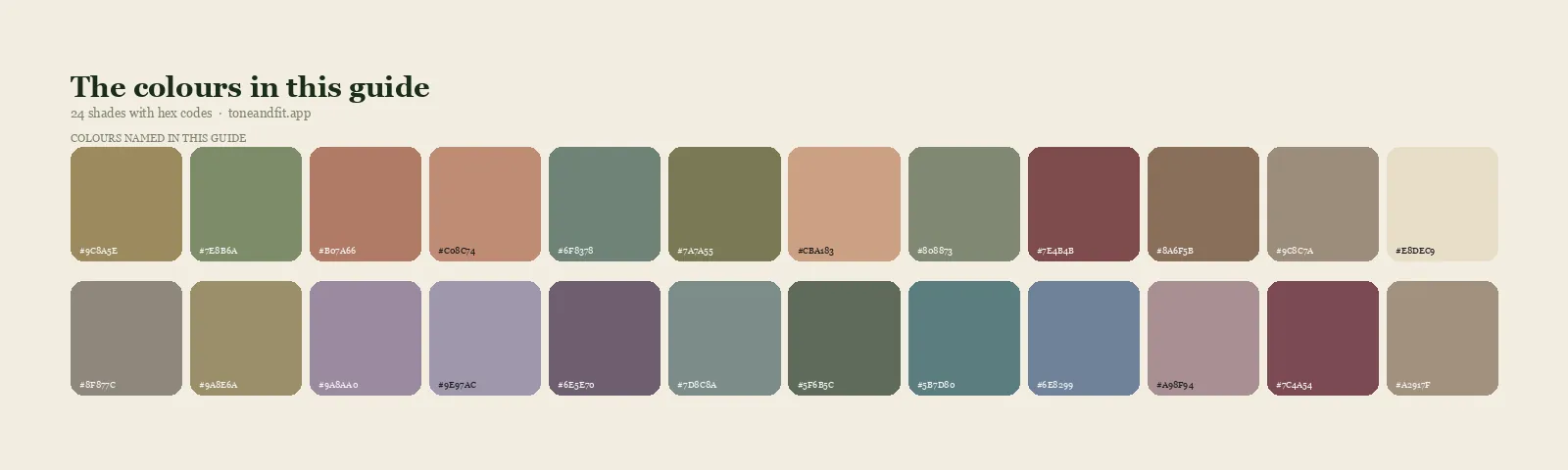
- Soft Gold#9C8A5E
- Sage#7E8B6A
- Toasted Coral#B07A66
- Salmon#C08C74
- Muted Teal#6F8378
- Soft Olive#7A7A55
- Dusty Peach#CBA183
- Warm Grey-Green#808873
- Soft Burgundy#7E4B4B
- Warm Taupe#8A6F5B
- Mushroom#9C8C7A
- Soft Cream#E8DEC9
- Warm Grey#8F877C
- Muted Khaki#9A8E6A
Soft Autumn neutrals & anchors. See every shade in the Soft Autumn color palette guide.
Soft Summer keeps the same low, blended volume but cools every one of those undertones down. Dusty mauve, smoky teal, denim blue and rosewood belong to Soft Summer's side of the fence, and on a warm-toned Soft Autumn they can read a shade flat rather than flattering. The Soft Summer color palette guide breaks down the full set, and if you want the mirror image of this comparison, Soft Summer vs Soft Autumn covers the same ground from the other side.
- Dusty Mauve#9A8AA0
- Greyed Lavender#9E97AC
- Soft Plum#6E5E70
- Sage Grey#7D8C8A
- Muted Spruce#5F6B5C
- Smoky Teal#5B7D80
- Denim Blue#6E8299
- Rosewood#A98F94
- Soft Burgundy#7C4A54
- Cool Taupe#A2917F
- Greige#B7AB9C
- Mushroom#9C8E82
- Warm-Grey Taupe#98897B
- Pewter#8C8F91
- Muted Navy#414B5C
- Soft Charcoal#4E5157
Soft Summer neutrals & anchors.
4 Tests to Settle It
Because both seasons are muted, this comparison rewards a side-by-side more than any other pairing in the system. Run all four in daylight near a window, no makeup, hair pulled back.
1. The two-burgundies test
Hold Soft Autumn's soft burgundy next to your face, then Soft Summer's soft burgundy. The two hexes sit a few points apart, warm-red against wine-violet, and most faces show a clear preference even though the swatches look nearly twin from across the room. Whichever one looks rich rather than muddy is doing the telling.
2. The jewelry test
Try brushed gold against your skin, then brushed silver or pewter. Soft Autumn tends to look warmer and more alive next to gold, where silver can sit a little flat. Soft Summer tends to do the opposite, with silver reading clean and gold occasionally looking slightly heavy or dulling. This is one of the fastest undertone checks that does not require any special lighting.
3. The two-whites test
Compare a warm ivory to a cool, slightly blue-based white near your jawline. Soft Autumn's skin tends to look most awake next to the ivory, while the cool white can look a touch chalky against it. Soft Summer usually flips this, looking cleaner next to the cool white while the ivory reads faintly yellow rather than warm.
4. The inner-wrist vein test
Check the veins on the inside of your wrist in natural daylight. Green-toned veins point to a warm undertone and lean Soft Autumn. Blue or purple-toned veins point to a cool undertone and lean Soft Summer. If the color is genuinely hard to call, that is itself useful information, since it usually means your undertone sits close to neutral and either muted palette will read reasonably well.
If You Sit Between Them
Because Soft Autumn and Soft Summer already share chroma, value and contrast, a person who sits between them is really describing a neutral undertone rather than an unresolved season. If your vein test comes back genuinely ambiguous and the jewelry test is a near tie, lean toward whichever palette matches colors you already reach for without thinking, since a wardrobe pattern built over years is a data point too. It also helps to rule out one common mistake: assuming that because a color looks soft, it must be cool. Soft Autumn is proof that mutedness and warmth are not opposites, so do not let a color's quietness stand in for its temperature when you are testing.
If your undertone reads clearly warm but the tests above still feel inconclusive, it is worth double-checking you are in the right family at all before splitting these two hairs further; our guides to Am I a Soft Autumn and Am I a Soft Summer both cover the fuller set of signals, including hair and eye color, that this comparison assumes you have already checked.
Stop guessing which soft season you are.
Tone & Fit's AI measures your undertone, value and chroma from a selfie and tells you whether you are Soft Autumn, Soft Summer, or something else, with your full palette in 60 seconds.
Try the App ↗FAQ
What is the difference between Soft Autumn and Soft Summer?
Undertone. Soft Autumn and Soft Summer are the two most muted seasons in the whole twelve-season system, so they agree on mutedness. What splits them is warmth: Soft Autumn is warm and golden underneath the haze, Soft Summer is cool and grey underneath it.
Is Soft Autumn the same as Soft Summer?
No, though they are the closest neighbors on the seasonal wheel and share more than any other pair. Both are dominated by soft, greyed-down chroma at a light-to-medium value. They differ on the one axis that decides undertone: Soft Autumn leans warm, Soft Summer leans cool, which is why a color that flatters one can look slightly off on the other.
Which season is warmer, Soft Autumn or Soft Summer?
Soft Autumn is warmer. It carries a golden, earthy cast under the mutedness. Soft Summer carries a cooler, greyer cast instead, closer to ash than to gold, even though both seasons are equally soft in how saturated their colors are.
Can a Soft Autumn wear grey?
Yes, but a warm grey rather than a cool one. Mushroom, warm taupe, and greige all read as soft, wearable neutrals on a Soft Autumn. A cooler, blue-based grey tends to look slightly chalky against Soft Autumn's golden undertone, which is where a Soft Summer takes over.
What colors flatter Soft Summer but not Soft Autumn?
Dusty mauve, smoky teal, denim blue, and rosewood. These colors carry the same soft, greyed-down quality as Soft Autumn's palette, but with a cool base that a Soft Autumn's warm skin does not need. On a Soft Autumn they can read a touch flat rather than flattering.
What is the fastest way to tell Soft Autumn and Soft Summer apart?
Hold a warm mushroom taupe next to your face, then a cool dove grey. If the mushroom looks natural and the grey looks slightly chalky, you lean Soft Autumn. If the grey looks clean and the mushroom looks a touch dull, you lean Soft Summer. An AI color analysis app or a professional drape can confirm it by measuring undertone directly.