Soft Summer vs Soft Autumn: The Difference
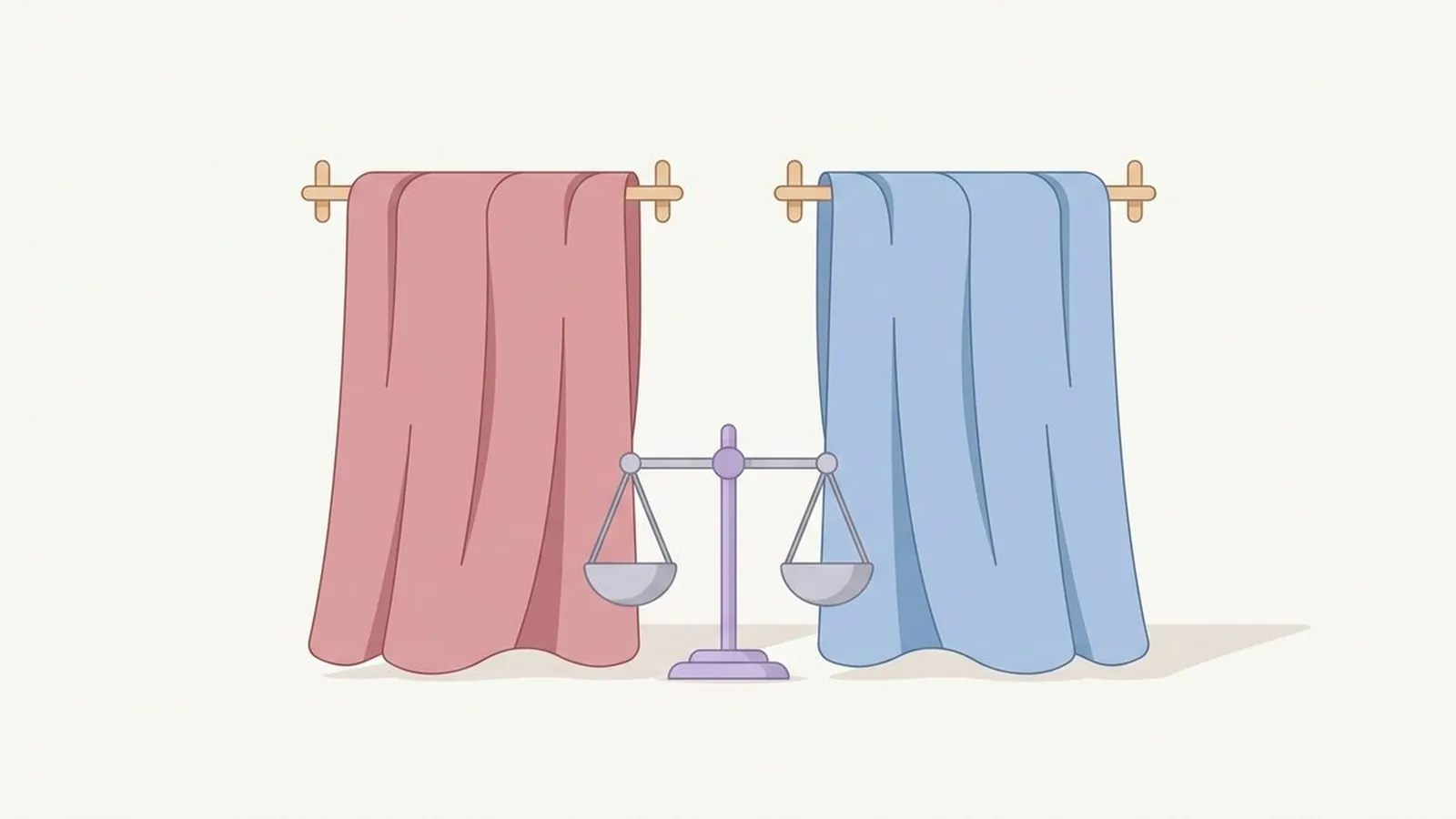
Soft Summer and Soft Autumn are the two most muted seasons in the whole 12-season system, and they differ on exactly one axis: temperature. Soft Summer is the cool half of that softness, Soft Autumn is the warm half, and once you know where to look, the two stop blurring together.
What's in this guide
Soft Summer vs Soft Autumn side by side
Soft Summer and Soft Autumn are each the most muted, lowest contrast member of their own family, Summer and Autumn respectively. That shared mutedness is exactly why they get confused so often: two people can have almost identical contrast levels and almost identical softness, and still belong to opposite seasons because their undertone runs in opposite directions.
| Soft Summer | Soft Autumn | |
|---|---|---|
| Undertone | Cool, neutral-cool | Warm, neutral-warm |
| Value (depth) | Medium | Light to medium |
| Chroma | Low, the most muted Summer | Low, the most muted Autumn |
| Contrast level | Low | Low |
| Best colors | Dusty mauve, sage grey, denim blue, smoky teal, cool taupe | Soft gold, sage, dusty peach, toasted coral, warm taupe |
| Colors to avoid | Electric blue, true fuchsia, pure white, anything saturated | Pure orange, true fuchsia, electric blue, stark white |
| Best metals | Brushed silver, pewter | Soft brushed gold, bronze |
| Celebrities | Most analysts place Kristen Stewart or Jennifer Garner here | Most analysts place Sienna Miller or Jennifer Lopez here |
Look at how much of that table repeats itself. Chroma: low on both sides. Contrast: low on both sides. The only row that actually flips is undertone, and that single flip is what determines everything else in the two lists below.
If that column looks like you, confirm it with our Soft Summer guide, then bookmark the Soft Summer color palette for shopping. These are the ten core shades, straight off the Summer palette page.
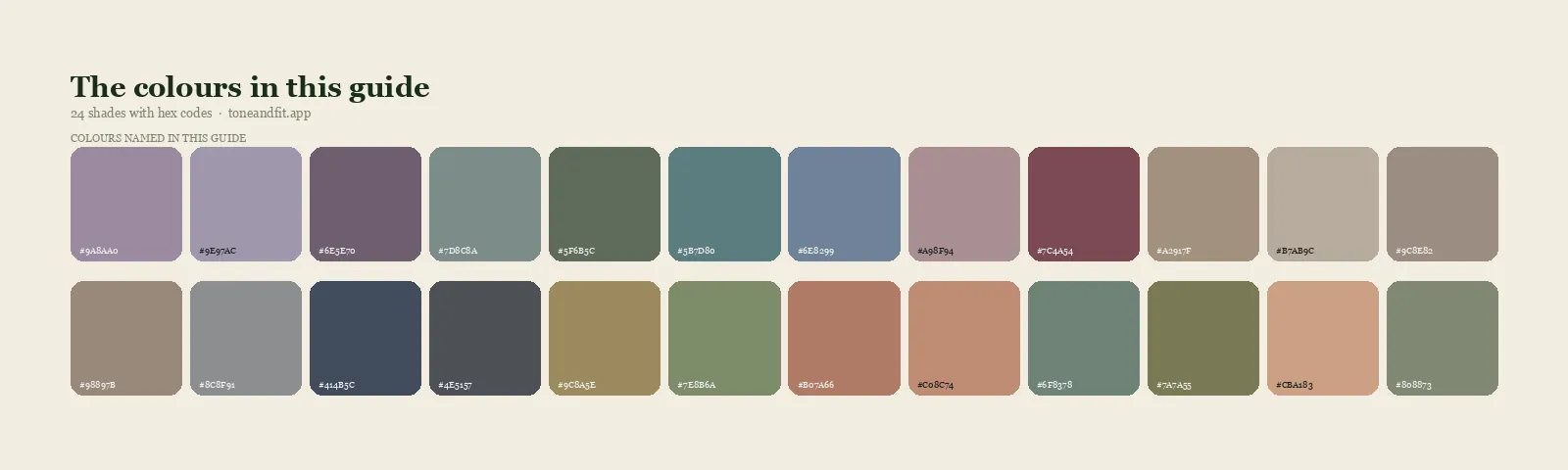
- Dusty Mauve#9A8AA0
- Greyed Lavender#9E97AC
- Soft Plum#6E5E70
- Sage Grey#7D8C8A
- Muted Spruce#5F6B5C
- Smoky Teal#5B7D80
- Denim Blue#6E8299
- Rosewood#A98F94
- Soft Burgundy#7C4A54
- Cool Taupe#A2917F
- Greige#B7AB9C
- Mushroom#9C8E82
- Warm-Grey Taupe#98897B
- Pewter#8C8F91
- Muted Navy#414B5C
- Soft Charcoal#4E5157
Soft Summer neutrals & anchors, straight from the Summer palette page.
Now the warm side. This is the full Soft Autumn palette, pulled from the Autumn palette page.
- Soft Gold#9C8A5E
- Sage#7E8B6A
- Toasted Coral#B07A66
- Salmon#C08C74
- Muted Teal#6F8378
- Soft Olive#7A7A55
- Dusty Peach#CBA183
- Warm Grey-Green#808873
- Soft Burgundy#7E4B4B
- Warm Taupe#8A6F5B
- Mushroom#9C8C7A
- Soft Cream#E8DEC9
- Warm Grey#8F877C
- Muted Khaki#9A8E6A
Soft Autumn neutrals & anchors, straight from the Autumn palette page.
Put the two neutral rows next to each other and something jumps out: both palettes have a color called Mushroom, and the hex values sit only a few points apart, #9C8E82 for Soft Summer, #9C8C7A for Soft Autumn. That is not a coincidence. It is the clearest possible illustration of what "the most muted member of each family" actually means: at the neutral end, cool-muted and warm-muted nearly meet.
The tell
The tell is undertone, and the fastest way to read it is a single color swap. Soft Summer glows next to a dusty, blue-based color and dims next to a golden one. Soft Autumn does the reverse.
Everything else about these two seasons, the low contrast, the aversion to anything shiny or saturated, the way both look better in a slightly foggy version of every color rather than the clear one, is identical. That similarity is precisely why so many people spend months unsure which one they are: the two big signals most people check first, contrast and clarity, agree completely. Undertone is the only signal left, and it happens to be the one people are worst at reading on themselves, because a lifetime of looking at your own skin trains you to see it as "my color," not as warm or cool.
If you already suspect you are muted but have not pinned down the temperature, the foundational step is finding your undertone at home, and the broader framework of how undertone, value and chroma combine into all 12 seasons is covered in seasonal color analysis explained. Soft Summer and Soft Autumn agree on the last two of those three measurements. They split on the first.
4 tests to settle it
Run these in indirect daylight, bare face, hair pulled back. None of them require special equipment, just two contrasting fabrics or objects and a mirror.
1. The teal versus mustard test
Hold a dusty, greyed teal next to your jaw, then swap it for a soft, muted mustard. Soft Summer skin tends to look clearer and calmer next to the teal, while the mustard sits slightly oddly, almost dirty, against it. Soft Autumn skin does the opposite: the mustard warms and evens the skin, while the teal can look a touch cold and flat. This single swap isolates temperature while holding the muted quality constant on both sides, which is exactly why it is the fastest of the four tests.
2. The metal test
Hold a piece of brushed silver or pewter jewelry against your skin, then a piece of soft, antiqued gold. Soft Summer skin generally looks best against the cooler metal, brushed silver or pewter rather than anything bright. Soft Autumn skin leans the other way, toward a soft, brushed gold or bronze rather than a sharp yellow gold. Neither season wants a high-shine, high-saturation metal, which is worth remembering: this test is about which muted metal wins, not whether metal should be bright.
3. The white test
Drape a cool, slightly greyed white next to your face, then a warm, creamy ivory. Soft Summer looks fresher in the cool white, or often does best avoiding stark white altogether in favor of a soft off white with a grey cast. Soft Autumn looks fresher in the warm ivory or a soft cream, and can look slightly washed by anything that reads as blue-white. Since both seasons avoid pure, optic white regardless, this test is really about which direction of "off white" your skin prefers.
4. The vein and paper cross-check
This is the universal undertone test, and it is worth running as a second opinion after the first three. Check the veins on the inside of your wrist in natural light: a blue or purple cast points cool, a green cast points warm. Then hold a plain white sheet of paper under your jaw and notice whether your skin looks pink or sallow against it, pink points cool, sallow or golden points warm. If all four tests point the same direction, you have your answer. If they split, the muted quality of both seasons means you may be sitting close to the border, which the next section covers.
Stop testing swatches in your bathroom mirror.
Tone & Fit measures your undertone, value, and chroma directly from a selfie and tells you whether you are Soft Summer, Soft Autumn, or something else, with your full palette attached.
Try the App ↗If you sit between them
If you sit between them, the honest answer is that your undertone is close to neutral, and Soft Summer and Soft Autumn are the one pair of seasons in the whole system where that is most likely to happen, precisely because they already share so much neutral ground. Look back at the Mushroom swatches above: a hex code that close is not a rounding error, it reflects two palettes converging from opposite temperatures toward the same muted middle.
This overlap shows up in real people, not just swatches. Public figures are sometimes discussed under one of these seasons in an earlier, cooler-toned styling era and the other once their coloring warms or their hair changes, a pattern that gets mentioned in both our Soft Summer guide and our Soft Autumn guide. That is not the system failing. It is what a genuine border case looks like when a person's own coloring shifts slightly over time or under different light.
If your four tests genuinely split, three practical moves help. First, lean on the shared neutrals, taupe, mushroom, sage, and a soft grey-brown work on both palettes almost interchangeably, so you can build a wardrobe foundation before you settle the exact season. Second, retest with a completely bare face in the same north-facing window at the same time of day, since a recent tan or a dyed-hair phase can nudge a borderline reading. Third, use a measurement that reads pixel values directly rather than asking your own eye to judge a subtle temperature difference on skin you look at every day. The full reasoning behind why AI measurement helps most exactly at these close calls is in how AI color analysis works.
Ready to find your season?
One selfie, your 12-season result, and the palette that goes with it. Free, no sign-up.
Find your season free ↗For the underlying reading, the skin tone analyzer explains what undertone, depth and contrast actually are.
FAQ
Is Soft Summer the same as Soft Autumn?
No, though they are the two closest seasons in the entire 12-season system. Both sit at the most muted, lowest contrast point of their family, which is why they share so many neutrals. The difference that keeps them separate is undertone: Soft Summer is cool-neutral and Soft Autumn is warm-neutral. Every other trait, the softness, the gentle contrast, the instinct to avoid anything bright or shiny, is shared.
What is the fastest way to tell Soft Summer from Soft Autumn?
Hold a dusty teal next to your face, then a soft mustard. If the teal makes your skin look clear and the mustard looks slightly dirty against you, you are Soft Summer. If the mustard warms you up and the teal looks a little cold and flat on you, you are Soft Autumn. It is the single quickest test because it isolates temperature while keeping the muted quality constant on both sides.
Can a person be both Soft Summer and Soft Autumn?
Not at the same time, but the two seasons sit close enough that a genuinely neutral undertone can read as either depending on the photo, the season of the year, or how much sun the skin has seen recently. If your results keep flipping between the two, lean on the shared muted neutrals both palettes already agree on, and use a tool that measures the undertone directly rather than guessing from memory.
Do Soft Summer and Soft Autumn share any colors?
Yes, more than any other pair of neighboring seasons. Both palettes include a taupe, a mushroom grey-brown, and a soft sage, and the hex values for some of these neutrals are only a few points apart. Where the two diverge is in the saturated or signature colors nearer the edge of each palette, dusty rose and slate blue for Summer, dusty olive and antique gold for Autumn.
What is the best lipstick for Soft Summer vs Soft Autumn?
Soft Summer leans toward dusty rose, muted mauve, and a cool-toned soft berry. Soft Autumn leans toward muted rose-brown, soft terracotta, and dusty mauve with a warmer base. The two can look deceptively close in the tube; the difference shows up once the color is actually on the lips and reads slightly pink versus slightly peachy.
Can either season wear black?
Not comfortably near the face. Both are low-contrast, low-saturation seasons, and true black is the opposite of both qualities. Soft Summer can sometimes carry a muted charcoal-black blended with the palette's dusty colors, while Soft Autumn generally does better swapping black for espresso, dark olive, or a warm deep taupe. In both cases, keeping true black away from the collar and closer to shoes or trousers is the safer move.