Warm Spring or Warm Autumn? The Brightness Test That Settles It

Both are golden, both love a camel coat, both glow in warm coral. The difference is one quality your eye keeps confusing with undertone, and once you separate the two, the right palette finally clicks.
What's in this guide
What both warm seasons share
Warm Spring and Warm Autumn are the two seasons that sit most firmly on the warm axis of the modern 12-season system. They have so much in common that people who clearly look good in gold still get stuck choosing between them. Both have a warm, golden undertone, meaning every flattering color leans toward yellow rather than blue. Both reject cool, icy shades, which is why a stark blue-red or an icy pastel tends to drain them. And both look most natural in colors that feel borrowed from the earth and the sun rather than from ice and steel.
If you have already read our guide to whether you are a Warm Spring and walked away thinking "this sounds like me, but Warm Autumn also fits," you are in the right place. The overlap is genuine. Both seasons share a warm direction and a love of natural, sun-touched color, so the surface signals, golden skin, warm hair with red or copper in it, eyes flecked with amber or green, look very similar at a glance.
To understand why they still land in different palettes, it helps to remember the three measurements that define every season: undertone (warm or cool), value (light or deep), and chroma (bright or muted). If those words are new, our primer on seasonal color analysis walks through all three. Warm Spring and Warm Autumn agree completely on undertone. They part ways on value and chroma, and that is the whole story.
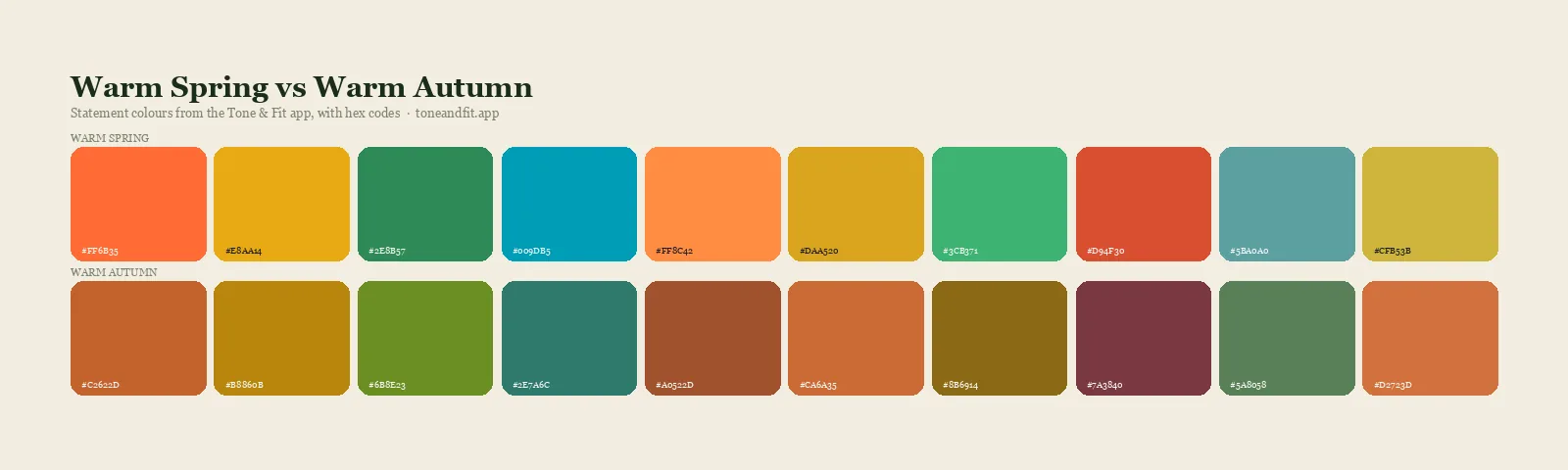
The one difference that matters
Here is the cleanest way to hold it in your head. Warm Spring is bright and clear. Warm Autumn is deep and muted.
Warm Spring lives at the fresh, light-filled corner of the warm family. Its colors are saturated and clear, the warmth of early sunshine rather than late afternoon. A Warm Spring looks alive in clear coral, golden yellow, warm turquoise, and bright apple green, because nothing in their coloring asks the color to settle down. Their natural contrast is light to medium, and clarity is everything. Add gray to a Spring color and it goes flat almost immediately.
Warm Autumn takes the same golden undertone and pushes it toward depth and softness instead of brightness. Its colors are rich, earthy, and slightly dusty, the warmth of turning leaves and spice. A Warm Autumn glows in rust, mustard, olive, and deep teal, colors that have body and a touch of muting built in. Put a clear, bright Spring color on a Warm Autumn and it can look loud or thin. Put a soft, deep Autumn color on a Warm Spring and it can look heavy and aging.
That single distinction, bright and clear versus deep and muted, is what separates the two. Everything else in this guide is a way of detecting it. For the bigger picture of how all twelve seasons relate to one another, our overview of the 12 color seasons maps the full grid, and you can see exactly where Warm Spring and Warm Autumn sit on the warm side.
Warm Spring vs Warm Autumn side by side
A quick reference before we get into testing. Notice how much agrees and how cleanly the differences fall along brightness and depth.
| Warm Spring | Warm Autumn | |
|---|---|---|
| Undertone | Warm, golden | Warm, golden |
| Primary axis | Warm + bright | Warm + deep, muted |
| Chroma | Bright and clear | Muted and rich |
| Value | Light to medium | Medium to deep |
| Contrast | Low to medium | Medium, blended |
| Signature colors | Coral, golden yellow, warm turquoise, apple green | Rust, mustard, olive, deep teal, brick |
| Best metal | Bright gold, light warm gold | Antique gold, copper, bronze |
4 tests to settle it
You will rarely tell these apart by description alone. You need to put fabric or paper next to your face in good daylight and watch your skin react. Run all four of these, then count which season wins more rounds. Daylight near a window, no makeup, hair pulled back.
1. The bright-versus-muted test (the decider)
This is the single fastest way to separate the two. Hold a clear, bright coral up to your face, then swap it for a soft, dusty terracotta. A Warm Spring will look fresh and lit by the bright coral, while the muted terracotta can make them look tired or sallow. A Warm Autumn shows the reverse: the terracotta evens out their skin and brings warmth to their eyes, while the bright coral feels loud and sits on top of the skin. Whichever clarity level flatters you is your season.
2. The contrast test
Take a photo of yourself and convert it to black and white. Warm Springs usually show low to medium contrast, with hair, skin, and eyes that are fairly close in value and a light, airy overall feel. Warm Autumns show a bit more depth and a blended, medium contrast, with richer hair against medium skin. If your grayscale photo looks soft and bright, that points to Spring. If it looks deeper and more grounded, that points to Autumn.
3. The gold test
Both seasons wear gold beautifully, but a different gold. Hold bright, shiny yellow gold next to your face, then antique gold, copper, or bronze. Warm Spring tends to come alive next to clear bright gold, while heavy antique metals can dull them. Warm Autumn usually looks richer beside copper and bronze, while bright shiny gold can look a little flashy against their deeper coloring. The metal that makes your skin look smooth and lit is pointing to your season.
4. The yellow test
Put a clear lemony golden yellow next to a deep mustard or ochre. Warm Springs handle the bright, almost sherbet yellow without being washed out, and it makes them sparkle. Warm Autumns look more at home in the deep, earthy mustard, while the bright yellow can feel harsh. This test isolates brightness inside the warm family, which is exactly the line that divides these two seasons.
If you are not confident reading your own undertone in the first place, start with the foundational step of finding your skin undertone at home and our explainer on warm versus cool undertones. Both seasons are firmly warm, so if your tests keep pointing cool, the answer may be that you belong to a different family entirely, and you can take our quick what season am I quiz to reorient.
Stop guessing which warm season you are.
Tone & Fit's AI measures your undertone, value, and chroma from a selfie and tells you whether you're Warm Spring, Warm Autumn, or something else, with your full palette in 60 seconds.
Try the App ↗How the palettes diverge
Once you know which warm season you are, the wardrobe payoff is real. The palettes overlap heavily in their warm, golden middle and split apart at the bright and the deep ends.
Where they agree
Both warm seasons look wonderful in camel, warm ivory, golden brown, warm coral-red, peachy tones, and a warm teal. These are the shared core. If a color is clearly warm and sits in the medium range, neither too icy-bright nor too darkly muted, it tends to work on both.
The shared warm core: camel, warm ivory, golden brown, warm coral-red, teal, warm green.
Where Warm Spring pulls ahead
Warm Spring owns the bright, clear, light-filled corner. Clear coral, golden sherbet yellow, warm turquoise, fresh apple green, and bright peach are where Spring has no equal. These colors need clarity and light to look fresh rather than chalky, and only the bright warm seasons deliver it. For the full set, our Spring color palette guide walks through the wardrobe in detail.
Warm Spring exclusives: clear coral, golden yellow, warm turquoise, apple green, bright peach.
Where Warm Autumn pulls ahead
Warm Autumn shines in the deep, earthy, muted tones that have body and spice. Rust, mustard, olive, deep teal, and pumpkin sit perfectly here. These give Warm Autumn the richness of a harvest palette with enough muting that the color never looks loud. Our Autumn color palette guide covers the full earthy range and how to build outfits around it.
Warm Autumn favorites: rust, mustard, olive, deep teal, pumpkin.
The same logic carries into hair and makeup. Both seasons want warm hair with gold, copper, or auburn in it, never an ashy or blue-black tone, covered in depth in our guide to the best hair color for your skin tone. For lips, both reach for warm tones, but Spring leans toward clear coral and peachy pink while Autumn leans toward terracotta, brick, and brownish reds.
Common mistakes and look-alikes
A few traps catch people when they try to choose between these two.
Assuming warmer skin means Autumn. Both seasons have warm, golden skin. Depth of skin alone does not decide it; the brightness and value balance does. A Warm Spring and a Warm Autumn can have nearly identical undertones and still belong to different seasons.
Confusing Warm Autumn with Soft Autumn. If your tests keep pulling toward muting rather than warmth, you may not be choosing between Spring and Autumn at all. You may be a Soft Autumn, the sub-season defined by gentle muting rather than strong warmth. Reading our Warm Autumn guide next to a Soft Autumn description usually clears that fork quickly.
Mistaking a Light Spring for a Warm Spring. Light Springs share the brightness but live in the lightest, most delicate range. If saturated warm colors feel a touch heavy and the palest fresh tones flatter you most, you may be a Light Spring rather than a Warm Spring. Value is the dividing line here, not undertone.
Trusting one test in bad light. Indoor bulbs throw warm or cool casts that can flip your result. Always test in indirect daylight, and run more than one test before you commit. The whole system rests on accurately reading undertone, value, and chroma, which is exactly why so many people prefer a tool or a professional to do the measuring. If you are weighing those options, our comparison of a color analysis app versus a consultant lays out the tradeoffs, and the full personal color analysis guide ties everything together.
The honest truth is that Warm Spring and Warm Autumn are close enough that even careful self-testing leaves some people unsure. That is not a failure on your part. It is a genuinely fine distinction that comes down to a chroma and value reading the human eye is bad at judging under everyday light. When the four tests split two and two, measuring directly is the fastest way to a confident answer.
Ready to find your season?
One selfie, your 12-season result, and the palette that goes with it. Free, no sign-up.
Find your season free ↗FAQ
What is the main difference between Warm Spring and Warm Autumn?
Brightness. Both are golden and warm, but Warm Spring is bright and clear while Warm Autumn is deep and muted. Spring loves fresh, saturated, light-filled color. Autumn loves rich, earthy, slightly dusty color. They share an undertone and differ on chroma and value.
Can one test separate Warm Spring from Warm Autumn?
Yes, the bright-versus-muted test is the fastest. Hold a clear bright coral next to a soft terracotta in daylight. If the clear bright color makes your skin look fresh and lit, you lean Warm Spring. If the muted earthy color makes your skin look even and the bright one feels harsh, you lean Warm Autumn.
Do Warm Spring and Warm Autumn share any colors?
Yes. Both glow in warm golds, camel, peachy and coral reds, warm teal, and olive-adjacent greens. The overlap sits in the medium-warm middle. They split at the extremes: Spring owns the bright clear end, Autumn owns the deep muted end.
Which warm season can wear bright colors?
Warm Spring. It is the bright, clear member of the warm family and looks alive in saturated coral, golden yellow, and warm turquoise. Warm Autumn looks best in those same hues toned down into rust, mustard, and teal, where the muting suits its deeper coloring.
What lipstick suits each warm season?
Warm Spring shines in coral, peachy pink, and clear warm red. Warm Autumn shines in terracotta, brick, and brownish warm red. Both should avoid cool blue-reds and icy pinks, which fight a golden undertone. When in doubt, a warm coral works on Spring and a soft brick works on Autumn.
How can I be sure which warm season I am?
Run the bright-versus-muted test, the contrast test, and the metals test together. If two or three point the same way, that is your answer. If they split, an AI color analysis app or a professional drape removes the guesswork by measuring undertone, value, and chroma directly rather than asking your eye to judge a subtle chroma difference.