Cool Winter Celebrities: Who Has This Striking Color Season?

Famous faces are the fastest way to learn a color season. When you can picture the cool, crisp, high-contrast look that defines a Cool Winter, you start to recognize it everywhere, including in the mirror.
What's in this guide
What a Cool Winter actually is
Cool Winter is one of the three Winter seasons in the modern 12-season system, sitting between True Winter and Cool Summer. Every season is defined by three measurements: undertone (warm or cool), value (light or deep), and chroma (clear or muted). A Cool Winter scores cool on undertone, tends toward deep on value, and clear on chroma. The result is coloring that looks crisp, contrasted, and a little icy, the kind of face that can wear a true blue-red lip or a charcoal coat and look completely at home. If those three terms are new to you, the complete personal color analysis guide defines each one, and the seasonal color analysis explainer shows how the twelve seasons are organized around them.
The everyday picture of a Cool Winter is some version of cool, deep, and high-contrast. Skin usually reads cool or neutral, with a rosy, pink, or slightly bluish cast rather than a golden or peachy one. Hair tends to be dark, from cool brown to near-black, often with ashy rather than warm tones. Eyes are frequently clear and cool: icy blue, cool grey, cool green, or a deep, dark brown that contrasts sharply with the whites. The signature is the gap between light and dark. A Cool Winter rarely melts into a soft, hazy blend the way a Summer or an Autumn does. The features stand apart, and that built-in drama is exactly what makes the season easy to spot once you know what you are looking at. Our deeper breakdown of whether you are a Cool Winter walks through every tell.
How to read a celebrity's season
Before naming any famous faces, it helps to know what you are actually looking for, because color analysis is not about whether someone is conventionally attractive or even about their natural hair color in isolation. It is about the relationship between their features. When color analysts assign a season to a public figure, they are reading the same three things every drape measures.
Undertone: does the skin lean cool?
Cool Winter skin has a blue, pink, or rosy undertone rather than a golden or peachy one. A quick read is whether silver jewelry looks more natural than gold against the skin, and whether the person glows in pure white rather than cream. This is the same cool-versus-warm judgment covered in our warm vs cool skin undertone guide, and it is the single most important call.
Value and contrast: how big is the gap?
Cool Winters have high contrast. Dark hair against light or cool skin, with clear, defined eyes, creates a strong difference between the lightest and darkest points of the face. If a black-and-white photo of the person still shows sharp light-and-dark separation, that is a Winter signal.
Chroma: clear, not muted
Winter coloring is the most saturated of the four families. A Cool Winter looks best surrounded by clear, vivid color and tends to look drained in dusty, greyed-down shades. If a person comes alive in jewel tones and looks tired in muted earth tones, that points away from Autumn and Summer and toward Winter.
Put those together and the Cool Winter read is consistent: cool undertone, high contrast, and a face that carries clear, saturated color with ease. None of the three on its own is enough. It is the combination that makes the season.
The Cool Winter pattern in famous faces
In color analysis communities, the people most often cited as Cool Winter examples share a recognizable look: deep, cool-toned hair, cool or neutral skin, and clear eyes that contrast strongly with their features. Think of the classic image of dark hair, fair or cool skin, and bright eyes, the combination sometimes described as a wintry or porcelain look. It is the coloring that wears crisp white, true red, and icy blue better than almost anyone, and that looks slightly washed out in warm camel or rust.
It is worth being honest about what these examples are. When you see a name listed as a Cool Winter online, that is an interpretation based on the person's visible coloring, not a confirmed professional drape. Different analysts often disagree, especially at the borders between Winter seasons, and the same celebrity can be filed under Cool Winter on one site and True Winter on another. That disagreement is not a flaw in the system so much as a reminder that real human coloring lives on a spectrum, and that lighting, makeup, and dyed hair can push a public image one way or the other. So rather than treat a celebrity name as proof, treat it as a memory aid: a vivid mental picture of the cool, deep, high-contrast pattern.
The useful thing about studying famous faces is that you can compare them. Put a commonly cited Cool Winter next to a commonly cited Warm Autumn and the difference in undertone is obvious even to a beginner. The Autumn glows in golden and rust tones and looks slightly grey in icy blue, while the Cool Winter does the exact reverse. Training your eye on those contrasts is far more valuable than memorizing a list of names, because it teaches you to see undertone and contrast directly.
Four Cool Winter archetypes
Rather than a list of names, it is more practical to think in archetypes, the recurring coloring combinations that read as Cool Winter regardless of who is wearing them. Most famous Cool Winters fall into one of these four pictures.
The porcelain-and-jet look
Very fair, cool skin paired with deep cool brown or black hair. This is the highest-contrast Cool Winter of all, the snow-white-and-raven-hair image from fairy tales. The eyes are often a clear, cool blue or grey, and the face can carry a bold blue-red lip with nothing else on it. This archetype looks dramatic in pure white and black and slightly ghostly in warm beige.
The cool-brunette look
Medium, neutral-to-cool skin with rich dark brown hair and deep brown or cool green eyes. The contrast is still high, but the overall impression is a little softer than the porcelain version. This is probably the most common Cool Winter coloring and the one most likely to be mistaken for a warmer season until you notice that gold jewelry and warm browns quietly dull the face.
The cool deep look
Deeper skin with cool or neutral undertones, dark hair, and dark eyes, where the contrast lives in the clarity and coolness of the coloring rather than in a stark light-dark split. This archetype often shines in cool jewel tones like emerald, magenta, and true blue, and can look muddied by warm orange-based shades. Deeper Cool Winters are frequently and wrongly pushed toward Autumn, when their undertone is actually cool.
The icy-eyed look
Cool skin with strikingly light, clear eyes against darker hair, so the eyes themselves become the focal point of the contrast. Bright icy blue or cool grey eyes set against cool brown or black hair are a strong Winter signal. This archetype tends to look best when clothing and makeup echo that clarity rather than softening it.
If you recognize yourself in one of these pictures, that is a good sign you may be a Cool Winter, but it is still only a starting point. The next step is to actually test your undertone, which you can do at home with our walkthrough on how to find your skin undertone at home.
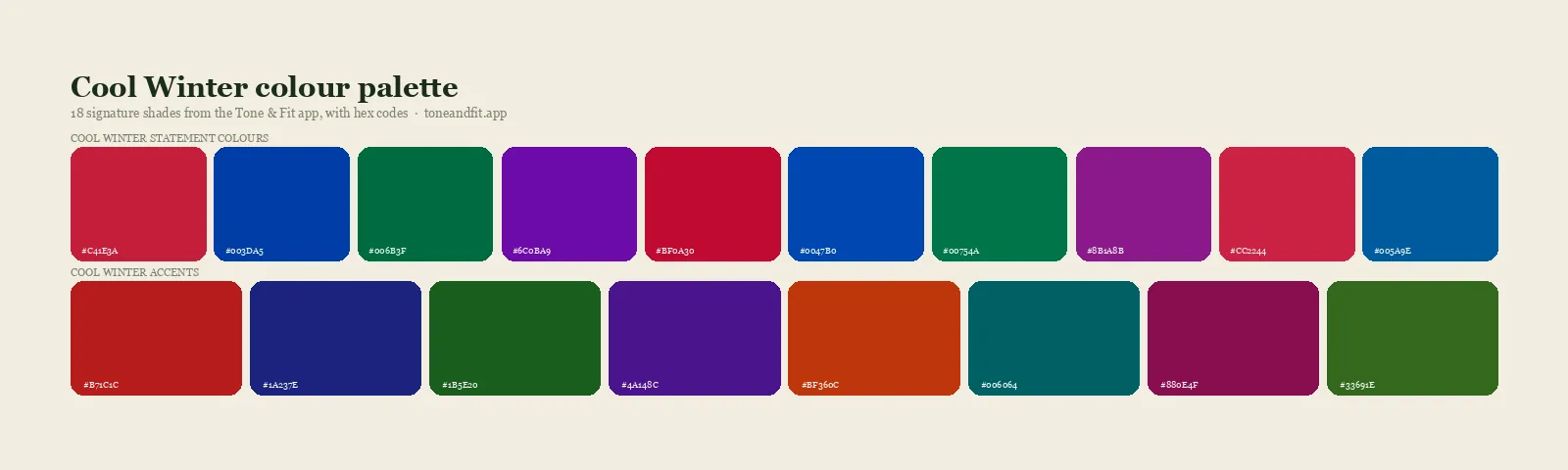
The colors that flatter every Cool Winter archetype: blue-red, berry, navy, emerald, icy silver, and near-black.
Think you might be a Cool Winter? Find out in 60 seconds.
Free · No account · Photo never stored
Download Tone & Fit ↗Why celebrity examples can mislead
Famous faces are a brilliant teaching tool, but they come with three traps worth naming, because more people get their season wrong by copying a celebrity than almost any other way.
The first trap is editing. Celebrity images are color-graded, retouched, and lit by professionals whose entire job is to make the subject look flawless. A magazine cover may warm the skin, cool the shadows, or boost saturation, all of which change the very signals you are trying to read. The same person can look like a different season in two different shoots. That is why analysts rely on consistent, neutral lighting and bare skin, not press photos.
The second trap is dyed hair. Hair color is one of the easiest features to change and one of the most influential on the overall impression. A natural Cool Summer with jet-black dyed hair can look like a Cool Winter in photos, and a true Winter who has gone warm blonde can read as a Spring. Because hair is so changeable, analysts weight skin undertone and the eyes more heavily than hair color. If you are choosing a new shade yourself, our guide to the best hair color for your skin tone explains how to keep it in your cool family.
The third trap is resemblance bias. It is tempting to decide you must be a Cool Winter because you think you look like a particular Cool Winter celebrity. But facial resemblance and color season are different things. Two people can have similar features and opposite undertones, and you can share a season with someone who looks nothing like you. Matching faces feels intuitive, but it skips the actual measurements that define a season.
A celebrity example is a picture of the pattern, not a substitute for your own analysis. Use famous faces to learn what cool, deep, and clear look like, then confirm those qualities on your own face.
Cool Winter versus its neighbors
The most common mix-ups happen at the borders, where a Cool Winter shades into True Winter on one side and Cool Summer on the other. Celebrity comparisons make those borders easier to see, so it helps to know what separates them.
Against a True Winter, the difference is subtlety: True Winter is the most saturated and dramatic of the twelve, while a Cool Winter leans more purely cool and can be a shade softer. It is the hardest line to call, which is exactly why the same celebrity gets filed under both. Our detailed comparison of Cool Winter versus True Winter walks through how to tell which one fits you.
Against a Cool Summer, the difference is clarity and depth. Both seasons are cool, so they share the same undertone, but Summer is muted and lighter while Winter is clear and deep. A Cool Summer celebrity glows in soft, dusty, cool shades and can look slightly overpowered by a stark blue-red, while a Cool Winter looks fantastic in that same blue-red and a touch washed out in the muted version. If your bright colors ever feel like they are wearing you, you may sit closer to Cool Summer. The 12 color seasons overview shows where each cool season sits relative to the others, which makes these neighbor relationships much easier to hold in your head.
| Season | Undertone | Defining quality |
|---|---|---|
| Cool Summer | Cool | Soft, muted, lighter |
| Cool Winter | Cool | Clear, deep, high contrast |
| True Winter | Neutral-cool | Most saturated and dramatic |
How to use this on yourself
Studying Cool Winter celebrities is genuinely useful, but only as a way to train your eye. The goal is to internalize the pattern, cool undertone, high contrast, clear color, so you can look for it on your own face under honest conditions. Here is how to translate the celebrity study into a real answer about your own season.
Start with bare skin in natural daylight, near a window and away from colored walls. Pull your hair back so it does not influence the read. Hold a piece of pure silver and a piece of gold near your face and notice which one makes your skin look clearer. Do the same with a true white cloth and a cream one. Then drape a clear, cool color like a blue-red or magenta against your face, and compare it to a soft, dusty version of the same color. A Cool Winter typically brightens in silver, pure white, and the clear cool shade, and dulls in gold, cream, and the muted shade. If you want the full palette to test against, our Cool Winter color palette guide lays out the exact colors, and the Cool Winter makeup guide shows how the same logic plays out in lipstick and blush.
The honest truth is that this is hard to judge on yourself, because undertone and contrast are precisely the things our eyes assess poorly in our own reflection. We are too familiar with our own faces to see them neutrally. That is why two reliable options exist: a professional consultant who can drape you in person, and an AI app that measures undertone, value, and contrast from a selfie in about a minute. Both remove the guesswork that makes celebrity matching so unreliable. Our comparison of a color analysis app versus a consultant lays out the tradeoffs so you can pick the route that suits you. Either way, the principle is the same one this whole guide rests on: stop guessing from resemblance, and measure the actual coloring.
Ready to find your season?
One selfie, your 12-season result, and the palette that goes with it. Free, no sign-up.
Find your season free ↗For the underlying reading, the skin tone analyzer explains what undertone, depth and contrast actually are.
FAQ
Which celebrities are Cool Winters?
Names frequently cited in color analysis discussions as Cool Winter examples include people with cool, high-contrast coloring such as deep cool brown or black hair, cool or neutral skin, and clear eyes. These are interpretations based on visible coloring rather than confirmed drapes, and analysts often disagree at the borders. The value of the examples is the pattern they share, not the specific names.
What do Cool Winter celebrities have in common?
Three things: a cool undertone that leans blue or rosy rather than golden, high contrast between hair, skin, and eyes, and coloring that can carry clear, saturated color without being overwhelmed. Together those qualities read as crisp and striking rather than soft or warm.
Can I tell my season by matching myself to a celebrity?
It is a useful starting point but not a reliable test. Celebrity images are edited, color-graded, and lit, and hair color is often dyed, so they can mislead. Matching yourself to a famous face you resemble can point you in the right direction, but confirming your own undertone, value, and contrast through an analysis is far more accurate.
What is the difference between a Cool Winter and a True Winter celebrity?
Both are cool and high contrast. A True Winter is the most saturated and dramatic of the Winters and sits at neutral-cool, while a Cool Winter leans more purely cool and can be a touch softer. In practice the line is subtle, which is why analysts often disagree on which Winter a given person is.
How do I find out if I am a Cool Winter?
Check three things: whether your undertone is cool, whether you have high contrast between your features, and whether clear, saturated colors flatter you more than soft, muted ones. The fastest way to confirm is an AI color analysis app or a professional drape, which measures undertone, value, and contrast directly instead of relying on guesswork.