What Color Season Is Emma Stone? A Deep Dive
Emma Stone has spent two decades cycling through nearly every hair color a person can wear, natural blonde, fiery movie-set red, and deep brunette, all on top of the same skin and eyes. That makes her an unusually good case study in seasonal color analysis, and a useful lesson in how much a stylist's choices can hide or reveal a real undertone.
In This Article
Why is Emma Stone a useful color analysis case study?
Emma Stone is useful because her stylists have run the same experiment on her for twenty years without meaning to: they keep reaching for the same warm red family of hair colors across wildly different films, directors and eras, which is exactly the kind of repeated, independent signal that makes a color season easier to call with confidence. A single red carpet photo tells you very little on its own. A decade of consistent styling choices tells you a great deal.
She is also, by any measure, one of the most photographed working actresses alive, with two Best Actress Academy Awards, for La La Land in 2017 and Poor Things in 2024, and a filmography that runs from Superbad and Easy A through Cruella and The Favourite. That volume of documented public appearances, across award seasons, press tours and campaigns, gives a colorist far more data to work with than almost any private individual could ever generate about themselves.
Emma Stone's color features: the evidence
Before assigning a season, the same four things get evaluated as with any subject: skin undertone, natural hair color, eye color, and overall contrast. As always, the operative word is natural: what genetics supplied, not what a colorist on a film set chose for a specific role.
Skin Undertone
Emma Stone's skin has a fair, warm-peachy base, visible alongside the light freckling across her nose and cheeks that is a common tell in warm and neutral-warm skin. In candid daylight photographs, away from warm studio lighting that flatters almost anyone, her skin still reads golden rather than pink or ashy, which is the more reliable signal colorists look for.
Natural Hair Color
By her own account in interviews, Stone's hair grows out blonde, not the red most audiences associate with her. That red, worn for Easy A, Zombieland, The Amazing Spider-Man films, La La Land, and Crazy, Stupid, Love, is a dye job. The detail that matters for color analysis is not which shade is "real" but how convincingly the red reads on her: a genuinely cool-undertoned face tends to look better in an ashier, cooler red or avoids red almost entirely, while a warm undertone can carry a rich, coppery red the way Stone consistently has for two decades.
Eye Color
Her eyes are green, frequently described with warm golden or hazel flecks rather than a cool, icy tone. Warm-flecked green is one of the more common eye colors across the warm seasons, and it reads differently from the cooler blue-green more typical of a Summer-family season.
Contrast Level
Contrast, the gap between her lightest feature (skin) and darkest (hair or eyes), sits low to medium. Her skin is light, her natural hair is light-to-medium, and her eyes read medium. Nothing in that range produces the stark, high-contrast combination typical of a Winter season, which points toward the lighter, clearer end of the warm seasons rather than the deep or muted end.
What is the case for Emma Stone being a Warm Spring?
Most analysts who have written about Emma Stone's coloring place her in Warm Spring, the season defined by a warm undertone, light-to-medium value, and clear rather than muted chroma. Here is how her features map to each of the three dimensions.
| Dimension | Warm Spring Definition | Emma Stone |
|---|---|---|
| Undertone | Warm (golden, peachy, freckled) | Warm-peachy skin, visible freckling, hair that takes a rich rather than ashy red |
| Value | Light to medium | Fair skin, naturally light-to-medium hair, medium-toned eyes |
| Chroma | Clear (bright, not muted) | Distinct green eyes with warm flecks, hair that reads vivid rather than muddy when dyed |
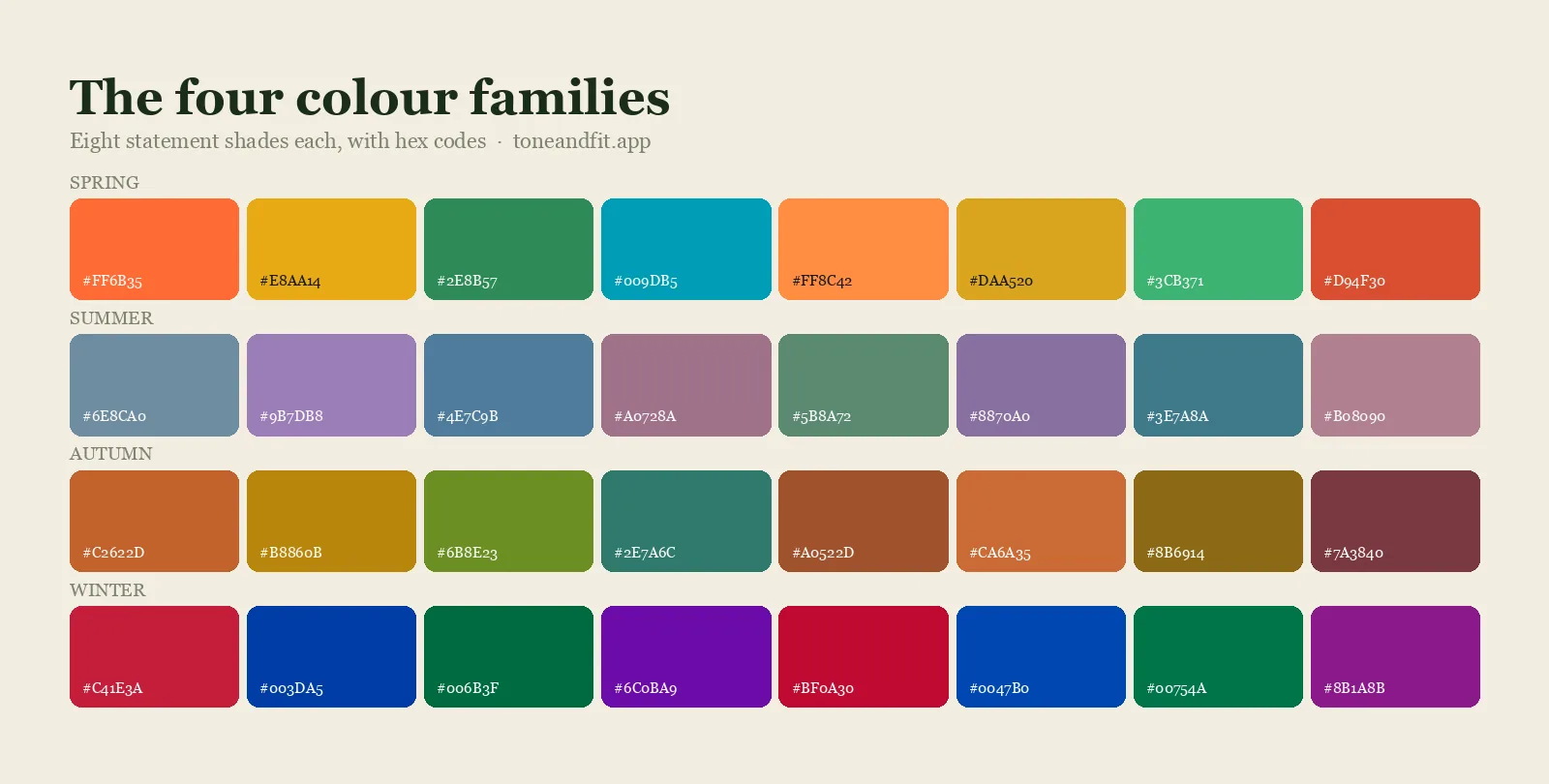
All three line up reasonably well. The Warm Spring palette runs coral, warm peach, apricot, golden yellow, warm turquoise and leaf green, colors that echo the same freckled, golden-warm quality already visible in her skin. When she wears warm metallics and clear, golden-warm shades, the effect reads as lit-from-within rather than costumed, which is the whole point of a correct season match.
Why do some analysts place her in Warm Autumn instead?
A smaller group of colorists place Emma Stone in Warm Autumn instead, and the disagreement is a useful lesson in how similar two neighboring warm seasons can look from a single photograph. Warm Autumn shares her warm undertone but sits deeper and more muted than Warm Spring, and the case for it usually rests on how convincingly she wears rich terracotta, olive and warm brown on the red carpet, deeper colors than a textbook Warm Spring palette calls for.
The trouble with that argument is the same one this framework keeps running into: professional lighting, contouring and a stylist's confidence can make almost any saturated color look intentional on camera, which is exactly why colorists prefer natural daylight and an unretouched face over a single red carpet photo when typing a season. Weighed against her light overall value and the clear, un-muted quality of her natural green eyes, more analysts land on Warm Spring than Warm Autumn. She plausibly sits close enough to that border that pieces from both palettes work reasonably well on her, which is common for anyone near a seasonal boundary.
What Season Are You?
Skip the guesswork. Tone & Fit uses your selfie to analyze your undertone, contrast, and color season in seconds, the same framework used above, applied to you.
Find Your Season Free ↗What are Emma Stone's best and worst color moments?
Emma Stone's most-praised red carpet look by color-analysis logic is the gold Givenchy gown she wore to the 2017 Academy Awards, where she won Best Actress for La La Land. Warm metallic gold is close to a guaranteed win for a Warm Spring or Warm Autumn, and that dress is still frequently cited among her strongest looks, which is exactly the kind of outcome you would expect if the underlying undertone read is correct.
Her long red-hair era, especially around Easy A and the Amazing Spider-Man films, is another data point in the same direction: a true ash-blonde or platinum shade, closer to a cool Summer's natural coloring, has essentially never been part of her public look. Multiple stylists across more than a decade independently reaching for the same warm red family is itself indirect evidence for how consistently her coloring reads as warm.
Where her color choices work against her, by the same logic, are the occasional stark, icy-cool gown, the kind of chalky pastel or cold jewel tone that sits furthest from a warm, clear palette. Those looks tend to read as competent rather than radiant, the same gap this site's other celebrity breakdowns describe when a strong stylist puts a strong dress on the wrong season.
What can you learn from Emma Stone's color journey?
Two decades of public styling choices, across dozens of films and red carpets, offer a few practical takeaways for your own wardrobe.
1. Consistency across independent stylists is a real tell
No single stylist has worked with Stone for her entire career, yet the same warm red family keeps reappearing. When multiple people, working independently, keep making the same color choice on the same face, that pattern is worth more than any one outfit.
2. Freckles are a fast warm-undertone signal
Visible freckling, especially on fair skin, leans warm far more often than cool. It is not a guarantee on its own, but it is one of the easier tells to check in a mirror without any special lighting.
3. How a dye "takes" tells you something real
A color that reads rich and intentional, the way Stone's red does, is doing different work than a color that reads flat or muddy on the same head of hair. If you have ever dyed your own hair and had a color look strangely dull no matter the brand, that flatness is data about your undertone, not a fluke of the product.
4. Your most iconic look is not always your best color match
Red is inseparable from Stone's public image, but it is a deepened, saturated version of her warmth rather than the lightest, clearest expression of it. There is nothing wrong with wearing an iconic color you love. It is still worth knowing that an even better match might exist one shade lighter or brighter.
5. Lighting will always editorialize a single photo
Every comparison above leans on patterns across many images, not one. A single golden-hour red carpet shot or a single flash photo will always exaggerate warmth or coolness. When you analyze your own coloring, natural daylight near a window, on more than one day, is the only reliable substitute for that kind of repeated evidence.
How do you check your own season?
The fastest way to check your own season is to stop relying on a single photo the way casual celebrity analysis often does, and instead compare your undertone, hair and eyes against real reference points in consistent daylight.
Prefer to have it measured? Try free color analysis from a photo and get your season with a confidence score, or take the seasonal color analysis quiz for a faster starting hypothesis. If Warm Spring sounds like it might be your family too, our Warm Spring vs Warm Autumn comparison and the roundup of other Warm Spring celebrities are good next reads.
Ready to find your season?
One selfie, your 12-season result, and the palette that goes with it. Free, no sign-up.
Find your season free ↗Frequently Asked Questions
What color season is Emma Stone?
Most analysts who have written about her coloring place Emma Stone in Warm Spring. Her fair, warm-peachy skin, light freckling, green eyes with warm golden flecks, and low-to-medium contrast all point to a warm undertone with light value and clear rather than muted chroma, the three defining traits of Warm Spring.
Is Emma Stone a Warm Spring or Warm Autumn?
This is genuinely debated. Both seasons share her warm undertone. The disagreement is about depth and clarity: Warm Spring is light and clear, Warm Autumn is deeper and more muted. Her natural blonde hair and the light-to-medium contrast across her features tip the weight of evidence toward Warm Spring, though a Warm Autumn read is not unreasonable given how well she wears deeper terracotta and olive tones on the red carpet.
What are Emma Stone's best colors to wear?
Based on a Warm Spring typing, her most flattering colors include coral, warm peach, apricot, golden yellow, warm turquoise, and leaf green. These warm, clear, light-to-medium shades echo the freckled, golden-warm quality of her natural coloring. Gold jewelry and warm metallics, like the gown from her first Oscar win, tend to photograph especially well on her.
Is Emma Stone's red hair her natural color?
No. Emma Stone has said in interviews that her hair grows out blonde. The coppery red most people associate with her, worn for films including Easy A, Zombieland, The Amazing Spider-Man and La La Land, is a dye job, not her natural shade, though the fact that red suits her so consistently is itself a useful clue about her underlying warm undertone.
Can I use celebrity color analysis to find my own season?
Celebrity analysis is a good learning tool, but it should not replace your own analysis. Celebrities are photographed under professional lighting and styling that can shift how their coloring reads from picture to picture. Use examples like this one to understand the framework and train your eye, then analyze your own features in natural daylight, or use an app like Tone & Fit for a personalized result.