Hair Color by Season: The Full Chart
Hair color by season means choosing a dye shade whose warmth and depth match your skin's undertone, value, and clarity, the same three measurements that decide your best lipstick or your best sweater. The chart below covers all 12 seasons: the hair colors that read as natural on each one, and the ones that fight it.
What's in this guide
- What "hair color by season" actually means
- The full hair color by season chart
- Best hair colors for the three Spring seasons
- Best hair colors for the three Summer seasons
- Best hair colors for the three Autumn seasons
- Best hair colors for the three Winter seasons
- What to do if you want a color outside your season
- How to check your season before you book the chair
- FAQ
What "hair color by season" actually means
Hair color by season means matching your dye choice to the same three measurements that define your color season: undertone (warm or cool), value (how light or deep your natural coloring runs), and chroma (how bright and clear versus soft and muted it is). It is a more precise version of matching hair color to skin tone, because skin tone alone only tells you the temperature, while your season also tells you the depth and the clarity that make a shade look expensive rather than accidental.
Hair sits closer to your face than almost anything else you choose, which is why a mismatch shows up fast. A cool-undertone person in a golden, honey-warm dye often develops a faint sallow cast in the skin within days. A warm-undertone person in a flat ash shade can look tired even when they are not. The seasonal system exists because "warm or cool" is only half the story: a Light Spring and a Deep Autumn are both warm, but they need completely different depths of color to look intentional.
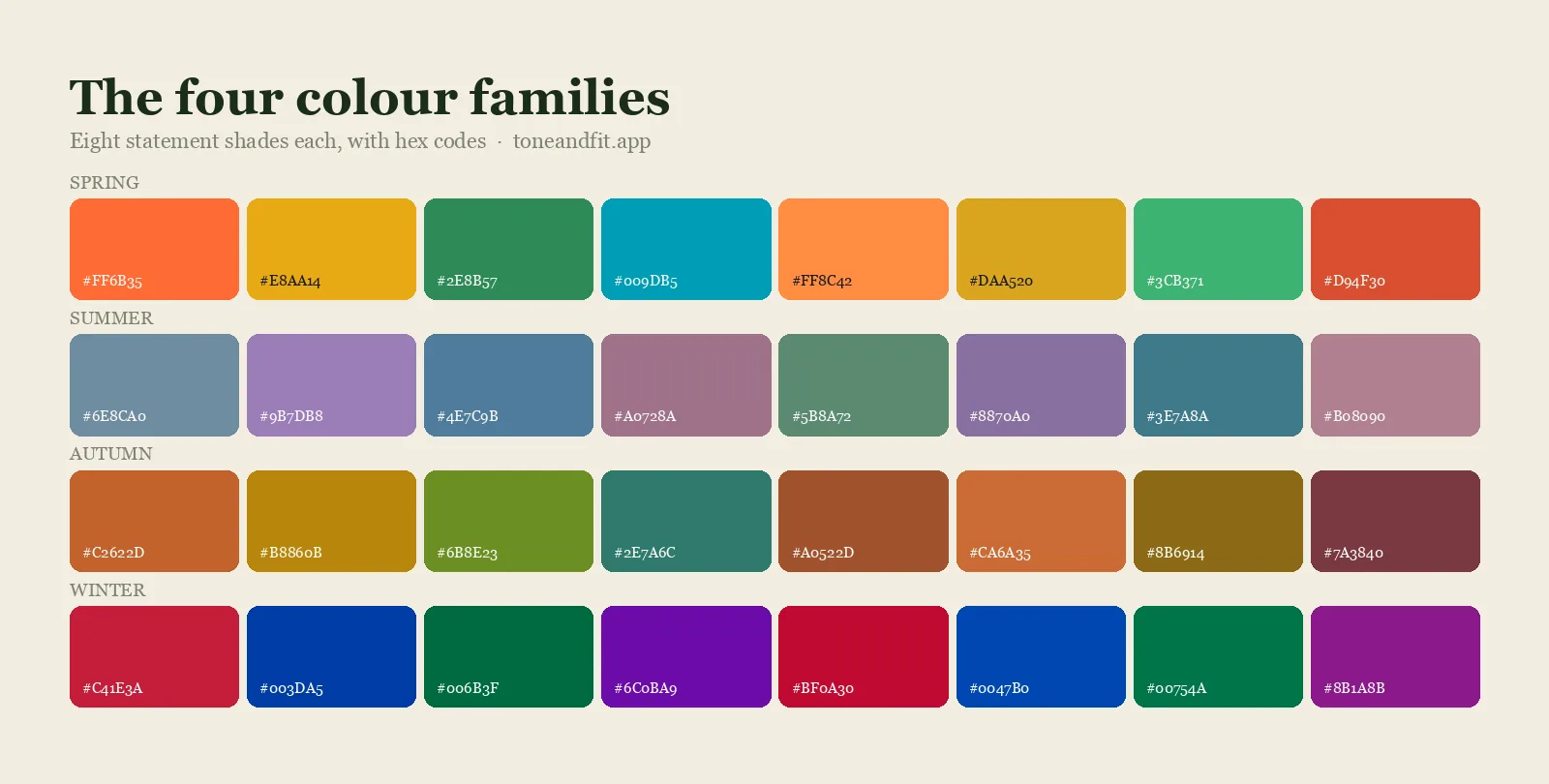
If you have not confirmed your season yet, our best hair color for your skin tone guide covers the simpler four-family version of this chart, organized by undertone alone, and the 12 color seasons overview explains where all 12 names in the chart below come from. Depth and contrast matter here too, so if that concept is new, how to find your contrast level is worth reading alongside this chart.
The full hair color by season chart
The chart below lists the strongest hair color direction for each of the 12 seasons and the single most common mistake for that season, so you can scan straight to your row.
| Season | Best hair color direction | Watch out for |
|---|---|---|
| Light Spring | Light golden blonde, buttery blonde, pale honey brown, light strawberry blonde | Ash blonde or jet black, both too heavy for this light, low-contrast coloring |
| True Spring | Warm honey blonde, golden brown, warm chestnut, vivid copper | Any ash tone, cool burgundy, or platinum without gold mixed in |
| Bright Spring | Bright copper, golden brown with dimension, warm caramel, rich honey blonde | Flat, matte shades like dull mushroom brown, which mute this season's natural clarity |
| Light Summer | Ash blonde, cool light brown, dove-grey blonde, soft rose-brown | Golden blonde or warm caramel, both too warm for this light, cool coloring |
| True Summer | Cool medium ash brown, smoky blonde, cool taupe brown | Golden or honey tones, warm copper, orange-toned red |
| Soft Summer | Mushroom brown, cool greige, muted ash brown, cool dark blonde | Anything bright or high-shine, like vivid copper or icy platinum |
| Warm Autumn | Auburn, copper, warm chestnut, chocolate brown with red glints | Ash tones, platinum, blue-black |
| Soft Autumn | Soft warm brown, muted caramel, dark blonde with a warm-neutral cast | Bright copper or jet black, both too stark for this gentle, blended coloring |
| Deep Autumn | Espresso, warm black-brown, deep auburn, mahogany | Platinum, ash brown, blue-black |
| Cool Winter | Blue-black, cool espresso, cool ash brown, icy platinum for lighter Cool Winters | Golden or honey tones, warm copper |
| Deep Winter | Jet black, near-black brown, cool espresso | Honey blonde, warm caramel, or any light shade that erodes this season's depth |
| True Winter | High-contrast blue-black or cool dark brown; clean icy platinum for those starting light | Muted, flat shades like ashy mushroom brown, which dull this season's clarity |
The rest of this guide walks through each family in more depth, including the tell that separates the sub-seasons within it.
Best hair colors for the three Spring seasons
Spring hair color stays warm across all three sub-seasons, and the sub-season decides how light, how saturated, and how much shine the shade should carry. All three share a golden or peachy undertone that ash and cool-toned dyes fight.
Light Spring is the lightest and softest of the three, with low natural contrast between skin, hair, and eyes. Light golden blonde, buttery blonde, and pale honey brown keep that softness intact. Because contrast is naturally low here, anything too dark, including jet black or deep espresso, creates a harsh line that the face was not built to carry.
True Spring, sometimes called Warm Spring, is the purest expression of warmth in the Spring family. It carries slightly more saturation than Light Spring and can hold richer golden and copper tones without losing its glow. Our dedicated Warm Spring hair color guide covers this sub-season's rules in full, including highlight placement and what to do as it goes gray.
Bright Spring is the most saturated Spring, with medium value and the highest chroma of the three. It wants hair color with visible shine and dimension, like bright copper or honey blonde with warm balayage, since flat single-process color tends to look duller on this coloring than the person actually is.
Best hair colors for the three Summer seasons
Summer hair color stays cool across all three sub-seasons, and the sub-season decides how light, how blended, and how much contrast the color should sit at. Warm, golden dyes are the near-universal mistake in this family, since they fight the pink or blue undertone underneath.
Light Summer is the lightest and gentlest Summer, with low contrast between skin and hair. Ash blonde, dove-grey blonde, and soft rose-brown keep that gentleness intact, while anything golden or overly dark overwhelms the delicate coloring.
True Summer, also called Cool Summer, is the purest expression of coolness in this family. It sits at light-to-medium value and wants unmistakably blue-based color: cool ash brown, smoky blonde, and cool taupe brown all read as natural rather than dyed.
Soft Summer is the most muted season on the entire wheel. It wants the most blended hair color available: mushroom brown, cool greige, and muted ash brown. Bright or high-shine color, even in a technically cool shade like icy platinum, can look artificial against Soft Summer's naturally soft coloring, which is the opposite problem from most other seasons.
Best hair colors for the three Autumn seasons
Autumn hair color stays warm and rich across all three sub-seasons, and the sub-season decides how muted, how deep, and how much red the shade should carry. Ash and cool-based color are the consistent mismatch here.
Warm Autumn is the purest, most saturated warm season in this family, and it carries auburn, copper, and warm chestnut better than almost any other season on the wheel.
Soft Autumn is the most muted Autumn, with lighter value than Warm or Deep Autumn and the lowest natural contrast in the family. Soft warm brown, muted caramel, and dark blonde with a warm-neutral cast suit it, while anything as saturated as bright copper reads as too loud against its gentle, blended coloring.
Deep Autumn carries the most depth of the three. Espresso, warm black-brown, and deep auburn all work because the season can hold color that would overwhelm a lighter Autumn. Our full Deep Autumn hair color guide breaks down exactly which reds and browns hold that depth without turning cool.
Best hair colors for the three Winter seasons
Winter hair color stays cool and clear across all three sub-seasons, and the sub-season decides whether temperature, depth, or clarity is doing the most work. Warm, golden tones are the universal mismatch across this entire family.
Cool Winter is led by temperature rather than depth, which is why its range runs wider than the other two Winters, from icy platinum on the lightest Cool Winters down to blue-black. Every shade in that range shares one thing: zero warmth. Our Cool Winter hair color guide goes through the full range, including how to keep highlights cool rather than brassy.
Deep Winter is led by depth. Jet black, near-black brown, and cool espresso let this season's natural richness read clearly, while anything light, even a technically cool ash blonde, flattens the effect that makes Deep Winter striking.
True Winter, sometimes called Bright or Clear Winter, is led by clarity rather than either temperature or depth alone. High-contrast blue-black or cool dark brown is the safest choice, and clean icy platinum can work for a True Winter who is naturally lighter, as long as the shade stays crisp rather than muddy. What actually fails this season is not warmth so much as flatness: a muted, low-shine color dulls the clear quality that defines it.
What to do if you want a color outside your season
You can usually still wear a color outside your season if you change how it is placed, toned, and positioned relative to your face, the same bridging techniques colorists already use for gray coverage and trend colors. The color itself is rarely the actual problem, proximity and saturation next to your skin usually are.
- Keep it away from your face. Face-framing pieces read the strongest against your skin. If you want a color outside your season, push it into lower layers or the ends rather than an all-over or money-piece placement.
- Add a root shadow. A darker, more natural root blurs the line between your real coloring and the new color, softening the contrast between the two.
- Ask for a corrective toner. A warm-season client going platinum usually needs a gold or beige toner mixed in. A cool-season client going warm can ask for an ash-based glaze over the top to knock back some of the heat.
- Use it as a small dose first. A single face-framing highlight or an under-layer peekaboo lets you test an out-of-season color at low risk before committing to it all over.
None of this changes your season, and it does not need to. It just means hair color, unlike a shirt you can take off, benefits from a bit more engineering when you want to step outside your natural range.
See it on your own hair first. Our sister app HairGlam puts any hair color on a photo of you in a few seconds, free, so you can check a shade against your skin tone before you book the salon.
Confirm your season before you commit to a color.
Tone & Fit reads your undertone, depth, and chroma from one selfie in about 30 seconds. Free scan, no account, and your photo is never stored.
Get Your Colors Free ↗How to check your season before you book the chair
The fastest way to confirm your season before a permanent color change is a two-step check: a quick undertone test at home, then a faster confirmation from a proper season tool. Guessing from a single trait, like assuming pink cheeks mean cool, misses the value and chroma half of the picture, which is exactly where this hair color chart lives.
Start with our full color analysis quiz if you want to work through the traits yourself in a few minutes, question by question. If you would rather skip straight to a result, the free color analysis tool reads your undertone, value, and chroma from a single photo and returns your season along with the palette that goes with it. Either way, do the check before you sit in the chair, since a colorist working from your confirmed season can mix the exact right level of warmth or coolness into your formula instead of guessing from your current, possibly already-dyed hair.
See your season before your next appointment.
One selfie gives you your season, your undertone, and the hair colors, makeup, and wardrobe shades that go with it. Free to scan, no account needed.
Download Tone & Fit ↗FAQ
What is the best hair color for my season?
It depends on which of the 12 seasons you are, but the shortcut is this: warm seasons (the Springs and Autumns) want gold, honey, copper or chestnut bases, and cool seasons (the Summers and Winters) want ash, cool brown or blue-black bases. Depth follows value, light seasons stay lighter, deep seasons carry darker color, and chroma follows clarity, bright seasons want shine and clean color, soft and muted seasons want blended, low-shine shades. The full chart above breaks all 12 down individually.
Can I dye my hair a color outside my season?
Yes, and plenty of people do it successfully. The trick is placement and tone rather than avoiding the color entirely: keep the boldest version of an out-of-season color away from your face using lowlights or a darker root shadow, and ask your colorist to add a toner that nudges the shade toward your own undertone. A warm-undertone person going platinum, for example, usually needs a gold or beige toner mixed in so the result does not read icy against warm skin.
Does dyeing my hair change my color season?
No. Your season is decided by your skin's undertone, your natural depth, and your natural contrast and clarity, not by whatever color is currently on your head. Dyed hair can make it harder to read your season by eye, which is why colorists and AI tools both try to look past hair color to the skin and eyes underneath, but the underlying season does not move.
How do I know if my current hair color is fighting my season?
Look at your skin, not your hair. If your complexion looks flat, grayish, or slightly tired since your last color, and it did not look that way before, the shade is probably pulling the wrong temperature or sitting at the wrong depth for you. Roots that grow in looking noticeably more flattering than the dyed lengths are another common tell, since roots usually sit closer to your natural, season-appropriate color.
What is the difference between hair color by season and hair color by skin tone?
Hair color by skin tone usually stops at warm versus cool undertone. Hair color by season adds two more variables: value (how light or deep your natural coloring runs) and chroma (how bright and clear versus soft and muted it is). That is why two people who are both warm undertone, a Warm Spring and a Deep Autumn, can want very different depths of hair color even though they share the same temperature.
Should I match my hair to my sub-season or just my macro season?
Your sub-season gives a more precise answer. Knowing you are in the Autumn family tells a colorist to stay warm, but knowing you are specifically a Soft Autumn rather than a Deep Autumn tells them how warm, how deep, and how much shine the color should have. If you only know your macro season so far, the four-family breakdown in our hair color by skin tone guide is the right starting point before you narrow further.
Can I check my color season from a photo?
Yes. The free Tone & Fit web tool reads your color season from one selfie in about 30 seconds, with no sign-up and no photo stored by us. The Tone & Fit app for iPhone and Android then builds your full palette of 38 named shades.