Is Color Analysis Real? The Science Behind It
Yes, in the sense that matters: personal color analysis is built on measurable facts about your skin's undertone, your overall contrast, and basic color theory, the same physics a painter or a camera relies on. What is not settled is whether twelve named categories are the correct number, or just a convenient way to talk about a continuous spectrum.
What's in this guide
- Is color analysis real, or is it made up?
- What does color analysis actually measure?
- Is the color theory behind it real science?
- Which part of color analysis is not hard science?
- Has personal color analysis been studied by researchers?
- Why do two colorists sometimes disagree on the same face?
- Is AI color analysis more reliable than a human colorist?
- Does color analysis actually make you look better?
- How to check this on your own face
- FAQ
Search "is color analysis real" and you will find two camps talking past each other. One side treats the twelve color seasons like a fixed law of nature. The other side dismisses the whole idea as a fortune-telling app with a nicer font. Neither camp is being precise. The actual answer sits in between, closer to real than most skeptics expect, with a few soft spots that a fair review has to name honestly.
This is not a marketing page dressed up as a science page. It is a plain accounting of which parts of color analysis rest on measurable physics and which parts rest on a judgment call, so you can decide for yourself how much weight to put on your own result.
Is color analysis real, or is it made up?
Color analysis is real in the sense that it measures three physical traits, your skin's undertone, its overall value, and its chroma, and predicts how a given color will interact with them, which is a testable claim rather than a belief system. "Warm skin looks better next to gold-based colors than icy blue-based ones" is a statement you can check against your own face in an afternoon. It either holds up or it does not.
What would make it "made up" is a claim that cannot be checked at all, the way a horoscope cannot be checked. Color analysis does not do that. It names a mechanism, undertone plus value plus chroma, and it makes a prediction you can test with two fabrics and a mirror. The parts of the marketing around color analysis that feel exaggerated, like claiming it will transform your entire life, are a separate problem from whether the underlying mechanism is real. The mechanism is real. The marketing sometimes overreaches, which is true of nearly every wellness or style category.
What does color analysis actually measure?
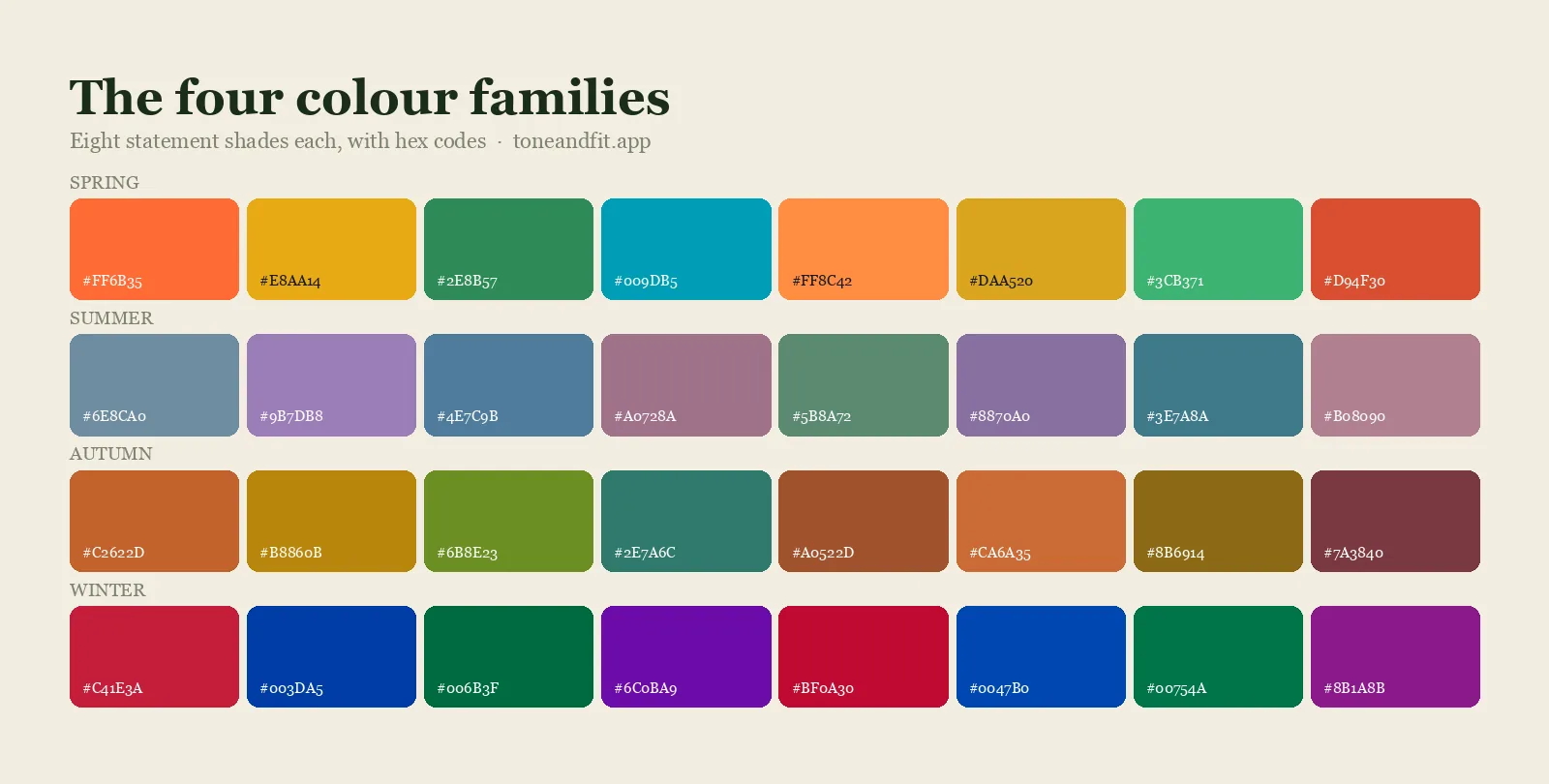
Color analysis measures three things you can point to on your own face: undertone, whether your skin leans warm and gold-based or cool and pink-based; value, how light or deep your overall coloring reads; and chroma, how saturated or muted your features look against each other. None of these are personality traits, favorite colors, or vibes. They are observable properties of pigment and contrast.
| Trait | What it measures | How you can check it yourself |
|---|---|---|
| Undertone | The balance of melanin and hemoglobin under the skin's surface | Compare gold and silver jewelry against bare skin in daylight, or see the warm vs cool undertone guide |
| Value | How light or dark your skin, hair, and eyes read together | Convert a daylight photo of your face to grayscale and see how close your hair and eyes sit to your skin tone |
| Chroma | How saturated or muted your natural coloring looks, the gap between your lightest and darkest features | Compare a clear jewel-tone top and a dusty, greyed-down top of the same hue against your face |
Undertone is the one people get wrong most often, because a suntan or studio lighting can make skin look warmer or cooler than its resting state. The seasonal color analysis explainer walks through how these three traits combine into the twelve named seasons once you have a reading on each one.
Is the color theory behind it real science?
Yes: the underlying color theory is old and uncontroversial, the same principle painters have used since the Renaissance, that colors from the same temperature family reinforce each other and colors from opposite families create visual tension. Johannes Itten and Albert Munsell formalized this into working color systems in the early 20th century, organizing color by hue, value, and saturation, the exact three axes color analysis borrows for skin instead of paint.
Skin itself is a measurable surface. It reflects and absorbs light based on the concentration of melanin, hemoglobin, and carotene sitting under it, which is why a dermatologist can describe skin tone in physical terms and why a spectrophotometer can record a numeric reading of anyone's undertone. Your own phone camera performs a version of this calculation every time it adjusts white balance for a face in the frame. None of that is controversial. It is applied optics, redirected at a person instead of a canvas.
Which part of color analysis is not hard science?
The part that is a judgment call, not a law of physics, is where you draw the lines between categories, whether there should be four seasons, twelve, or a continuous dial with no categories at all. Undertone, value, and chroma are each a spectrum, not an on-off switch, so any system that sorts continuous traits into named buckets will always produce edge cases near the borders.
That is not unique to color analysis. Arguing about whether a face is Soft Summer or Soft Autumn is structurally the same problem as arguing about where "warm" weather ends and "hot" weather begins: a real, measurable gradient, forced into labeled ranges for convenience. Different schools of color analysis do not fully agree on names or boundary placement, and that disagreement is itself informative. It is the signature of a practical taxonomy layered on top of real measurements, not a sign that the measurements themselves are invented.
- Where science ends and convention begins: that undertone exists is measurable; that it splits into exactly "warm, cool, neutral" rather than five finer bands is a naming choice.
- Where convention becomes disagreement: two consultants can measure the same face accurately and still file it under different neighboring season names.
Has personal color analysis been studied by researchers?
Not in the way a new medication or diet gets studied: there is no large controlled trial that tested the twelve-season system end to end and published a peer-reviewed result, and this guide will not pretend one exists. What does have a long, well-documented research history is the component science underneath it: colorimetry as an engineering discipline, contrast perception in vision science, and the physical description of skin pigment in dermatology.
The twelve-season framework itself grew out of a commercial book, Carole Jackson's 1980 Color Me Beautiful, refined over decades by working colorists comparing notes on which fabrics photographed and flattered which faces. That is pooled professional observation, not a laboratory result. Pooled observation is a real, useful form of evidence, the same kind that built most of typography and garment fit before either field had formal studies, but it is a different kind of evidence than a clinical trial, and it is worth being honest about which one you are getting.
Why do two colorists sometimes disagree on the same face?
Two trained colorists disagree most often at the borders between neighboring seasons, because undertone and chroma are continuous traits and a face sitting near the middle can honestly read either way depending on lighting, hair color, and the specific fabrics each colorist has on hand that day. A face that is warm but only slightly warm is the hardest kind of face to sort, not because either colorist is wrong, but because the underlying trait itself is close to the midpoint.
Lighting is the single biggest source of disagreement in practice. Warm tungsten light, cool fluorescent light, and neutral daylight can each nudge the same face toward a different undertone reading, which is why every serious method insists on natural daylight from a north-facing window. Dyed hair is the second biggest source, since hair is the feature people change most often and the one that contributes least to the underlying season.
Is AI color analysis more reliable than a human colorist?
Neither is inherently more reliable, they are reliable in different ways. An AI model reads the same pixel values from a photo the same way every single time, which removes the day-to-day variation a human judge can introduce depending on mood, fatigue, or the exact angle of a lamp in the room. A human colorist, in exchange, can turn your head, hold two nearly identical fabrics side by side and watch the difference in real time, and notice a detail a flat photo misses entirely, like how a color behaves against your skin as you move.
Both approaches hit the same underlying boundary-case problem discussed above, because both are reading the same three continuous traits. What changes is where the uncertainty comes from: a human's uncertainty is mood and lighting, an AI model's uncertainty is photo quality and unusual lighting in the single frame it was given. For a deeper comparison of how the two methods actually differ, see how accurate AI color analysis really is and the side-by-side breakdown in color analysis tools compared.
Does color analysis actually make you look better?
It changes something real and visible: how much a color's reflected light competes with or complements the light already bouncing off your skin, which is why the effect shows up in something as ordinary as a phone photo taken five minutes apart in two different shirts under the same lighting. That is a mechanistic, optics-based effect, not a mood or a placebo.
What color analysis does not have is a clean, universal number attached to "looking better," because "looking better" is not a single measurable quantity the way undertone is. No credible source can honestly hand you an accuracy score for that outcome, and any page that does is inventing a number it cannot support. What you can trust is the mechanism: harmonizing colors reduce visual competition with your natural pigment, clashing colors increase it, and you can see the difference yourself in gray daylight with a mirror.
How to check this on your own face
You do not need to take anyone's word for it. Hold a warm gold fabric and a cool silver fabric next to your bare face in daylight and watch which one makes your skin look clearer and less tired. Then repeat the comparison with two tops in the same style but on opposite sides of warm and cool, and notice which one makes your under-eye area look brighter rather than shadowed.
If you want a faster starting point before running your own tests, the free seasonal color analysis quiz gives you a hypothesis to check against the mirror test above, and the free photo color analysis tool measures your undertone, value, and chroma directly from a selfie so you have a specific season to test rather than starting from nothing.
See your own three measurements, free.
One selfie · 60 seconds · Dominant season + neighbor season · No account needed
Download Tone & Fit ↗FAQ
Is color analysis backed by science?
The three traits it measures, undertone, value, and chroma, are real physical properties of skin, hair, and eyes that a camera or a colorist can observe consistently. The claim that everyone sorts neatly into one of twelve named seasons has not been tested in a formal clinical study, so treat the underlying measurement as solid and the exact category count as a practical convention built on top of it.
Is personal color analysis just a TikTok trend?
No. The practice traces back to color theory from the early 20th century and was popularized commercially in 1980 with the book Color Me Beautiful, decades before social media existed. TikTok and Instagram brought a new wave of attention starting around 2020, but the underlying framework is closer to 80 years old than it is new.
Do professional colorists always agree with each other?
No, and the disagreements cluster in predictable places: the borders between two neighboring seasons, where a real face can honestly read either way depending on lighting, hair color, and which fabrics a particular colorist happens to own. Two colorists rarely disagree about whether someone is warm or cool. They occasionally disagree about which of two warm, or two cool, seasons fits best.
Is AI color analysis trustworthy?
It is consistent, in the sense that the same photo produces the same measurement every time, which removes a source of variation a human judge can introduce on a different day or under different lighting. We have not benchmarked a formal accuracy percentage against professional colorists and will not put a number here that we cannot support, so judge it the way you would judge any single measurement: useful, not infallible, and worth confirming if a result surprises you.
Is the twelve season system the only classification that exists?
No. The four season model, Spring, Summer, Autumn, Winter, came first and is still used as shorthand. Some consultants work with sixteen or more micro seasons, and others describe undertone, value and chroma on a continuous scale with no named categories at all. Different naming schemes are a taxonomy choice, not evidence that the underlying measurements are wrong.
Can I check my color season from a photo?
Yes. The free Tone & Fit web tool reads your color season from one selfie in about 30 seconds, with no sign-up and no photo stored by us. The Tone & Fit app for iPhone and Android then builds your full palette of 38 named shades.
Published: November 6, 2026