Light Summer vs Soft Summer: The Difference
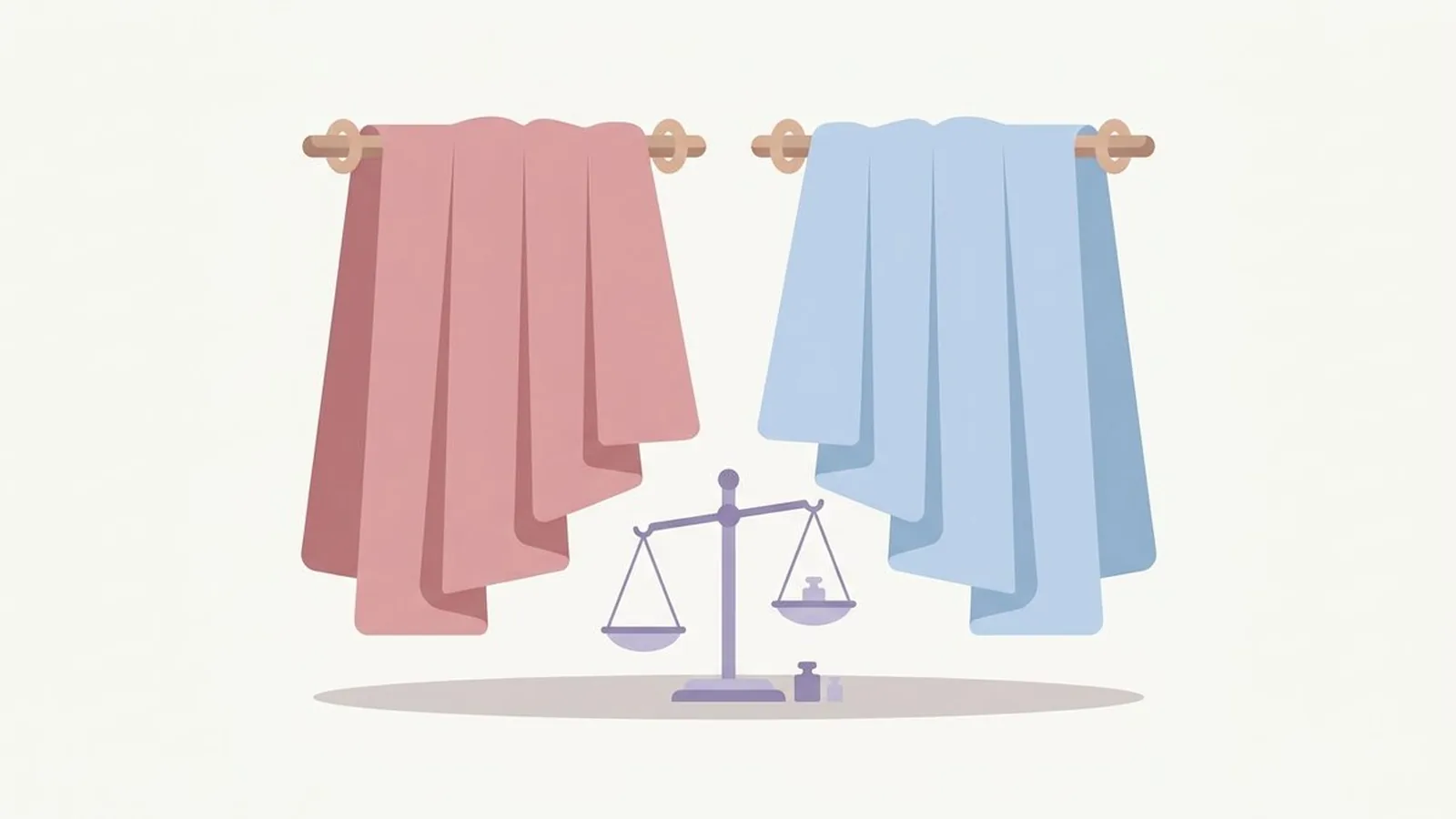
Light Summer and Soft Summer share the same cool, gentle undertone family, and the axis that actually separates them is not temperature but volume: Light Summer is built around lightness, the palest, airiest version of cool, while Soft Summer is built around mutedness, the greyest, most subdued version of cool. Once you know which of those two words describes your coloring, the rest of the comparison falls into place.
What's in this guide
What do Light Summer and Soft Summer have in common?
Light Summer and Soft Summer share almost everything except one dial: both carry a cool, neutral-cool undertone, both sit at a low contrast level, and both belong to the gentle, non-bright half of the Summer family, which is exactly why the two get confused so often. Neither one wears a saturated, clear color well, and neither one wants warmth anywhere near the face.
If you have already read our guide to whether you are a Light Summer and thought "this sounds like me, but I could also be Soft Summer," you are in exactly the right place. The overlap is real. Both seasons reject warmth and both reject high saturation, so the two big signals, a cool cast and a gentle palette, point the same direction for each of them, which is why the surface read looks identical.
To see why they still land in different palettes, it helps to name the three measurements behind every season: undertone, warm or cool, value, light or deep, and chroma, bright or muted. Light Summer and Soft Summer agree on undertone and broadly agree on contrast. They part ways on value and chroma, and that is the whole story: Light Summer is defined by how light it is, and Soft Summer is defined by how muted it is.
Light Summer vs Soft Summer side by side
A quick reference before the testing starts. Notice how much of this table agrees and how little actually differs.
| Light Summer | Soft Summer | |
|---|---|---|
| Undertone | Cool, neutral-cool | Cool, neutral-cool |
| Value (depth) | Light, the lightest Summer | Medium |
| Chroma | Medium-low | Low, the most muted Summer |
| Contrast | Low | Low |
| Best colors | Ballet pink, powder blue, soft lavender, seafoam | Dusty mauve, sage grey-green, denim blue, rosewood |
| Worst colors | Black, pure white, tomato red, mustard | Electric blue, true fuchsia, pure white, anything saturated |
| Metals | Light silver, white gold | Brushed silver, pewter |
| Celebrities | Most often placed here: Naomi Watts, Cate Blanchett, Reese Witherspoon | Most often placed here: Jennifer Aniston, Drew Barrymore, Jennifer Garner |
Undertone and contrast barely move between the two. Value and chroma are where the whole comparison lives.
The tell
The tell is how a color behaves at its palest versus its greyest. Hold the lightest, most washed-out pastel you own next to your face, then hold a medium, deliberately greyed-down shade of a similar hue. A Light Summer lights up next to the pale pastel and can look slightly flat next to the muted mid-tone. A Soft Summer does the opposite: the pale pastel can look thin or slightly too delicate, while the greyed mid-tone makes the face look clear and settled.
Put another way, Light Summer's palette is built from tints, colors mixed with white. Soft Summer's palette is built from tones, colors mixed with grey. Both avoid pure, saturated hues, but they arrive there by two different routes, and that route is the entire difference between the seasons.
4 tests to settle it
Description alone rarely settles this one. Run all four tests in daylight, without makeup, and count which season wins more rounds.
1. The lightness test (the decider)
Hold the palest tint you own, a ballet pink or a soft sky blue, next to your face, then swap it for a medium, greyed-down shade like dusty mauve or slate blue. A Light Summer looks brightest and clearest next to the pale tint and can look slightly swallowed by the deeper, greyer shade. A Soft Summer looks most alive next to the muted mid-tone and can look washed out by the very palest tint. Whichever version clears up your face, not the fabric, is the answer.
2. The grayscale contrast test
Take a photo of yourself and convert it to black and white. Light Summers show the lowest contrast of any Summer, with light, ashy hair sitting close in value to fair skin. Soft Summers show a similarly low contrast, but the overall value reads a shade or two deeper, medium ash or mousy brown rather than light blonde, with everything still gently blended. A pale, airy grayscale points to Light Summer; a soft but slightly deeper one points to Soft Summer. Our guide to finding your contrast level walks through this test in more detail.
3. The brightness test
Hold a saturated, clear color, a vivid royal blue works well, up to your face. If your features seem to disappear behind it and the color takes over completely, you are very likely Soft Summer, the sub-season that needs the most muted palette of the three. If you can carry a bit more clarity without vanishing, even if it is still not your best look, you lean Light Summer.
4. The metal finish test
Both seasons wear silver over gold, so a plain silver-versus-gold test will not separate them. Instead, compare a bright, polished silver to a brushed or pewter-finish silver. Light Summer tends to prefer the cleaner, brighter finish, matching its light, clear coloring. Soft Summer tends to prefer the brushed, matte finish, matching its quieter, greyed-down coloring. If you own jewelry in both finishes, this is a fast way to double-check the first three tests.
How the two palettes actually diverge
Once you know which Summer you are, the wardrobe payoff is real. Here is Light Summer's core palette in full, with hex codes so you can match it exactly when you shop.
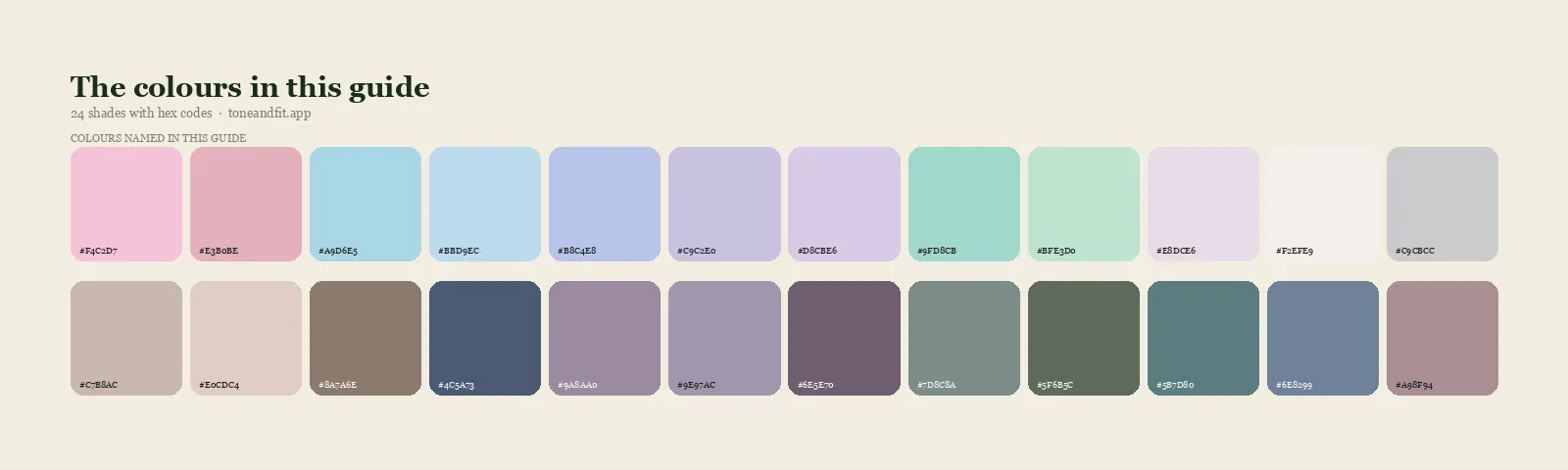
- Ballet Pink#F4C2D7
- Dusty Rose#E3B0BE
- Powder Blue#A9D6E5
- Soft Sky#BBD9EC
- Periwinkle#B8C4E8
- Soft Lavender#C9C2E0
- Pale Lilac#D8CBE6
- Seafoam#9FD8CB
- Cool Mint#BFE3D0
- Misty Mauve#E8DCE6
- Soft White#F2EFE9
- Dove Grey#C9CBCC
- Light Taupe#C7B8AC
- Rose Beige#E0CDC4
- Cocoa#8A7A6E
- Soft Navy#4C5A73
Light Summer's core palette and neutrals. Full write-up: the Light Summer color palette.
Soft Summer's palette uses the same cool base but greys every shade down a step further:
- Dusty Mauve#9A8AA0
- Greyed Lavender#9E97AC
- Soft Plum#6E5E70
- Sage Grey#7D8C8A
- Muted Spruce#5F6B5C
- Smoky Teal#5B7D80
- Denim Blue#6E8299
- Rosewood#A98F94
- Soft Burgundy#7C4A54
- Cool Taupe#A2917F
- Greige#B7AB9C
- Mushroom#9C8E82
- Warm-Grey Taupe#98897B
- Pewter#8C8F91
- Muted Navy#414B5C
- Soft Charcoal#4E5157
Soft Summer's core palette and neutrals. Full write-up: the Soft Summer color palette.
Lay the two grids side by side and the pattern is obvious: Light Summer's chips are lighter in every column, while Soft Summer's chips are greyer in every column, even where the underlying hue, a pink, a blue, a green, is basically the same. For the complete Summer family including True Summer, see the full Summer color palette.
Stop guessing which Summer you are.
Tone & Fit's AI measures your undertone, value, and chroma from a selfie and tells you whether you're Light Summer, Soft Summer, or something else, with your full palette in about a minute.
Try the App ↗If you sit between them
If you sit between Light Summer and Soft Summer, wear the colors that already overlap and avoid the extremes of each palette. Powder blue, soft sage, and a gentle dusty rose sit close enough to the middle that both seasons wear them well, while the very palest ballet pink at one edge and the darkest muted plum at the other are the shades most likely to feel slightly wrong on someone genuinely in between.
This in-between position is common enough that it is not a failure of self-testing, it is a genuinely fine distinction that comes down to a value-and-chroma reading the eye is bad at making unassisted in a mirror. If your four tests keep splitting evenly, the fastest way to a confident answer is a direct measurement rather than more draping: the seasonal color analysis quiz or the free color analysis tool reads value and chroma from a photo instead of asking your eye to judge a subtle difference.
Ready to find your season?
One selfie, your 12-season result, and the palette that goes with it. Free, no sign-up.
Find your season free ↗FAQ
Is Light Summer the same as Soft Summer?
No, though they are close enough to be mistaken for each other constantly. Both are cool and gentle, but Light Summer is defined by lightness, a pale, airy value, while Soft Summer is defined by mutedness, a greyed-down, low chroma. They share an undertone and a contrast level, and differ on how light versus how grey the coloring actually is.
Which is cooler, Light Summer or Soft Summer?
Neither is meaningfully cooler than the other; both sit in the neutral-cool range rather than the purest cool undertone, which belongs to True Summer. The difference between Light and Soft Summer is not temperature at all, it is value and chroma, so a cool-versus-cool test will not separate them the way it would separate a Summer from an Autumn.
Can a Light Summer wear Soft Summer colors, or vice versa?
In the middle of both palettes, yes. Colors like soft sage, powder blue, and gentle dusty rose sit close enough to the overlap zone that either season wears them comfortably. At the extremes, a Light Summer's palest ballet pink can look slightly flat on a Soft Summer, and a Soft Summer's darkest muted plum can overwhelm a Light Summer, so the safest swaps stay away from each season's most extreme shades.
Why do Light Summer and Soft Summer both avoid black?
Because both seasons are built on low contrast, and pure black creates more contrast than either coloring can support near the face. Light Summer softens it to soft navy, dove grey, or soft charcoal; Soft Summer does much the same with muted navy or soft charcoal, keeping the same low-drama effect without the harsh jump straight to black.
What is the fastest way to tell Light Summer and Soft Summer apart?
Hold the palest pastel you own next to a medium, deliberately greyed shade of a similar color. If the pale version makes your face look clearest, you lean Light Summer. If the greyed, medium shade makes your face look clearest and the pale version feels thin, you lean Soft Summer. A color analysis app or a professional drape can confirm it by measuring value and chroma directly.