Light Spring vs Light Summer: The Difference

Both are the lightest, gentlest members of their seasonal families. Both wear pastels effortlessly and both fade next to true black. The one place they part ways is undertone: Light Spring is warm, Light Summer is cool, and that single axis is the whole difference this guide exists to settle.
What's in this guide
What Light Spring and Light Summer share
What Light Spring and Light Summer share is the lightness and softness that puts them both at the gentlest end of the 12-season wheel. Both have hair that sits in the blonde-to-light-brown range rather than anything deep. Both have eyes that read as light and soft rather than dark and dramatic. Both have low to medium contrast between skin, hair and eyes, the hallmark of every Light season, which is why heavy black or a jewel-bright color can overwhelm either one the same way.
The overlap runs deep enough that these two seasons are among the most commonly confused pairs in the entire system. If you have read our guide to whether you are a Light Spring and thought "this sounds like me, but the cool version also sounds like me," you are in exactly the right place. Both seasons reject depth and both reject high saturation, so the two big signals, lightness and softness, point the same direction for each of them. That is why the surface read looks identical from a distance.
The three measurements that define every season are undertone (warm or cool), value (light or deep), and chroma (bright or muted). Light Spring and Light Summer agree on value: both light. They mostly agree on chroma too: both soft rather than saturated, though Light Spring leans a touch clearer and Light Summer leans a touch mistier. Where they flatly disagree is undertone, and that single disagreement is the entire story.
The tell
The tell is undertone, and the fastest way to see it is a metal test. Hold a light, polished gold chain against your collarbone in daylight, then swap it for a silver one. If the gold looks like it belongs there and the silver looks faintly blue and disconnected, warmth is confirmed and you are looking at Light Spring. If the silver brightens your skin while the gold looks slightly heavy or borrowed, coolness is confirmed and you are looking at Light Summer.
Everything else in this guide flows from that one temperature call. Light Spring's hair carries visible gold or copper, honey blonde, strawberry blonde, light golden brown, and its skin reads peach or golden ivory. Light Summer's hair carries no warmth at all, ash blonde, platinum, dishwater blonde, and its skin reads rosy or porcelain pink. Even the eyes follow the same rule: Light Spring eyes look warm even when they are blue, with a golden ring around the iris, while Light Summer eyes look cool even when they are green, with no amber or gold anywhere in them.
Light Spring vs Light Summer side by side
A quick reference before the tests. Notice that only one row actually flips between the two.
| Light Spring | Light Summer | |
|---|---|---|
| Undertone | Warm, golden or peachy | Cool, pink or rosy |
| Depth (value) | Light | Light |
| Chroma | Light and clear, not muddy | Light and soft, slightly greyed |
| Contrast | Low to medium | Low to medium |
| Best colors | Peach, apricot, coral pink, warm aqua | Ballet pink, powder blue, periwinkle, seafoam |
| Worst colors | Black, fuchsia, icy blue, neon | Black, orange, mustard, true fuchsia |
| Best metal | Light gold, rose gold | Silver, white gold, platinum |
| Celebrities often cited | Blake Lively, Scarlett Johansson | Reese Witherspoon, Kirsten Dunst |
4 tests to settle it
Descriptions only go so far. Run these four in daylight, no makeup, hair pulled back, and count which season wins more rounds.
1. The vein test
Turn your wrist toward a window and look at the veins on the inside. Green or olive veins point to a warm undertone and Light Spring. Blue or purple veins point to a cool undertone and Light Summer. If you genuinely see an even mix, you may sit on the neutral border between the two, which the next section covers.
2. The peach vs powder pink test
Hold a warm peach or coral swatch under your chin, then swap it for a cool powder pink or lavender one. Whichever makes your skin look brighter, smoother and more awake is your undertone talking. If peach wins, that is a clean Light Spring signal. If powder pink wins and the peach looks faintly muddy or sallow by comparison, that is Light Summer.
3. The ivory vs soft white test
Try a warm ivory or cream top, then a cool soft white or pearl grey one. Light Springs look most alive in the ivory, since a cooler white can flatten their warm glow. Light Summers look most alive in the soft, cool white, since ivory can read as slightly dingy against their pink undertone. Neither season wants a stark, bright white close to the face.
4. The hair-in-sunlight test
Step outside and look at a strand of your hair in direct sun. If you catch actual flecks of gold or copper, that confirms warmth and Light Spring, even if your hair looks fairly neutral indoors. If it stays flat, ashy or takes on a silvery sheen with zero gold, that confirms coolness and Light Summer. Dyed hair can mislead this test, so check your natural roots if you can.
If you sit between them
If you sit between Light Spring and Light Summer, the most likely explanation is a genuinely neutral undertone rather than a mistake on your part. A small number of people have skin, hair and eyes that carry close to equal warm and cool signals, and for them, the four tests above will split roughly two and two instead of landing cleanly on one side. That is a real, common outcome, not a sign you did the tests wrong.
Lighting is the other usual culprit. Warm indoor bulbs push everyone toward looking golden, and overcast daylight through a north-facing window can push everyone toward looking cooler than they are. Before concluding you are neutral, repeat the vein test and the peach-versus-pink test on a bright, cloudless day near a window, since that is the lighting every professional drape and every AI photo tool is calibrated around. Hair dye and self-tanner are worth ruling out too: a warm balayage or a golden self-tanner can make a true Light Summer look temporarily warmer than their natural skin and hair actually are.
If two independent checks still disagree after controlling for light and dye, the honest answer is that you likely sit close to the border, and you can borrow safely from both palettes as long as you keep everything else light and soft. A measured reading settles it faster than more guessing: an AI color analysis app or a professional drape reads the actual undertone directly rather than asking your eye to judge a subtle difference in a mirror.
Stop guessing which light season you are.
Tone & Fit's AI measures your undertone, value, and chroma from a selfie and tells you whether you're Light Spring, Light Summer, or something else, with your full palette in 60 seconds.
Try the App ↗How the palettes diverge
How the palettes diverge comes down to one rule: everything Light Spring wears warm, Light Summer wears cool, at the same light, soft intensity. Because the two seasons sit on opposite sides of the undertone line, there is very little literal color overlap between them, unlike warm-versus-deep pairs where a shared undertone leaves a wide middle ground. Here, the family resemblance is in mood and intensity, not in the actual hex codes.
Light Spring's palette
These ten shades are copied directly from the Tone & Fit Spring palette guide, so the names and hex codes match exactly what a professional drape or an AI color scan will hand you.
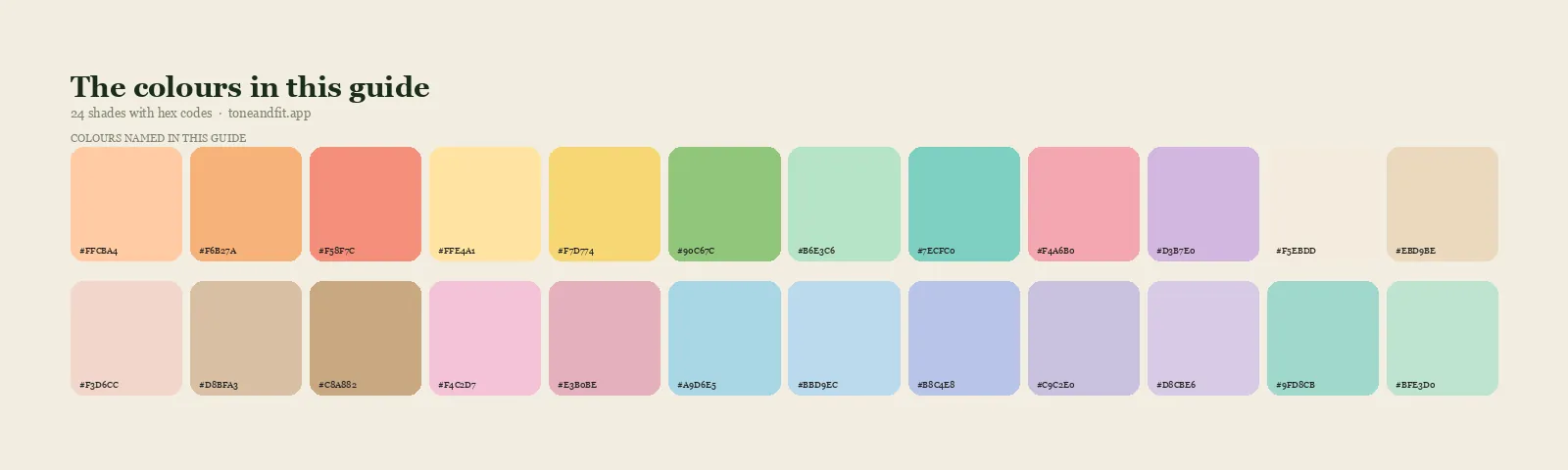
- Peach#FFCBA4
- Apricot#F6B27A
- Coral Pink#F58F7C
- Buttercream#FFE4A1
- Light Golden Yellow#F7D774
- Spring Green#90C67C
- Soft Mint#B6E3C6
- Warm Aqua#7ECFC0
- Warm Pink#F4A6B0
- Warm Lilac#D3B7E0
- Warm Ivory#F5EBDD
- Champagne#EBD9BE
- Shell Pink#F3D6CC
- Soft Tan#D8BFA3
- Light Camel#C8A882
Neutrals
Light Summer's palette
These ten shades are copied from the Light Summer color palette guide. Notice how every warm name on the Light Spring side above has a cool counterpart here at the same pale intensity: peach becomes ballet pink, warm aqua becomes seafoam.
- Ballet Pink#F4C2D7
- Dusty Rose#E3B0BE
- Powder Blue#A9D6E5
- Soft Sky#BBD9EC
- Periwinkle#B8C4E8
- Soft Lavender#C9C2E0
- Pale Lilac#D8CBE6
- Seafoam#9FD8CB
- Cool Mint#BFE3D0
- Misty Mauve#E8DCE6
The practical upshot for a shared closet, a shared wardrobe with someone in the other season, or a gift you are not sure about: reach for the palest, most washed-out version of any color and it has a fair shot of working for both. Reach for anything with real saturation and the wrong undertone will fight it immediately. For the full breakdown of value and chroma as concepts, seasonal color analysis explained and the 12 color seasons cover the whole wheel these two sit on. If your hair or eyes lean more toward the muted, blended end rather than the light-and-clear end described here, it is worth checking the neighboring Light Summer vs Soft Summer comparison as well.
Ready to find your season?
One selfie, your 12-season result, and the palette that goes with it. Free, no sign-up.
Find your season free ↗For the underlying reading, the skin tone analyzer explains what undertone, depth and contrast actually are.
FAQ
What is the main difference between Light Spring and Light Summer?
Undertone. Both seasons are light in value and soft rather than bright in chroma, but Light Spring is warm, golden hair and peachy skin, while Light Summer is cool, ash hair and rosy skin. Once you find the undertone, you have found the season.
Is Light Spring the same as Light Summer?
No. They are neighbors on the seasonal wheel and share lightness and softness, but they sit on opposite sides of the undertone line. Light Spring is warm and Light Summer is cool, which changes the metals, the neutrals, and nearly every color each one wears best.
Can a Light Spring wear silver, or a Light Summer wear gold?
Both can wear a small amount as an accent, but neither is the flattering choice near the face. Light Spring skin glows next to light gold and rose gold, while silver can look slightly flat by comparison. Light Summer skin glows next to silver, white gold, and platinum, while yellow gold can look heavy or faintly sallow.
What is the fastest way to tell Light Spring and Light Summer apart?
Hold a warm peach and a cool powder pink to your face in daylight. If the peach makes your skin look clearer and brighter, you lean Light Spring. If the powder pink does that instead and the peach looks slightly muddy, you lean Light Summer. Confirm it with the vein test: green veins are warm, blue veins are cool.
What colors do both Light Spring and Light Summer avoid?
Both seasons struggle with the same two things: true black and heavily saturated, neon brights. Both are light, low contrast seasons, so a stark black top or an electric, jewel-toned color creates more contrast and intensity than either one's delicate coloring can support, regardless of undertone.