True Summer vs Soft Summer: The Difference
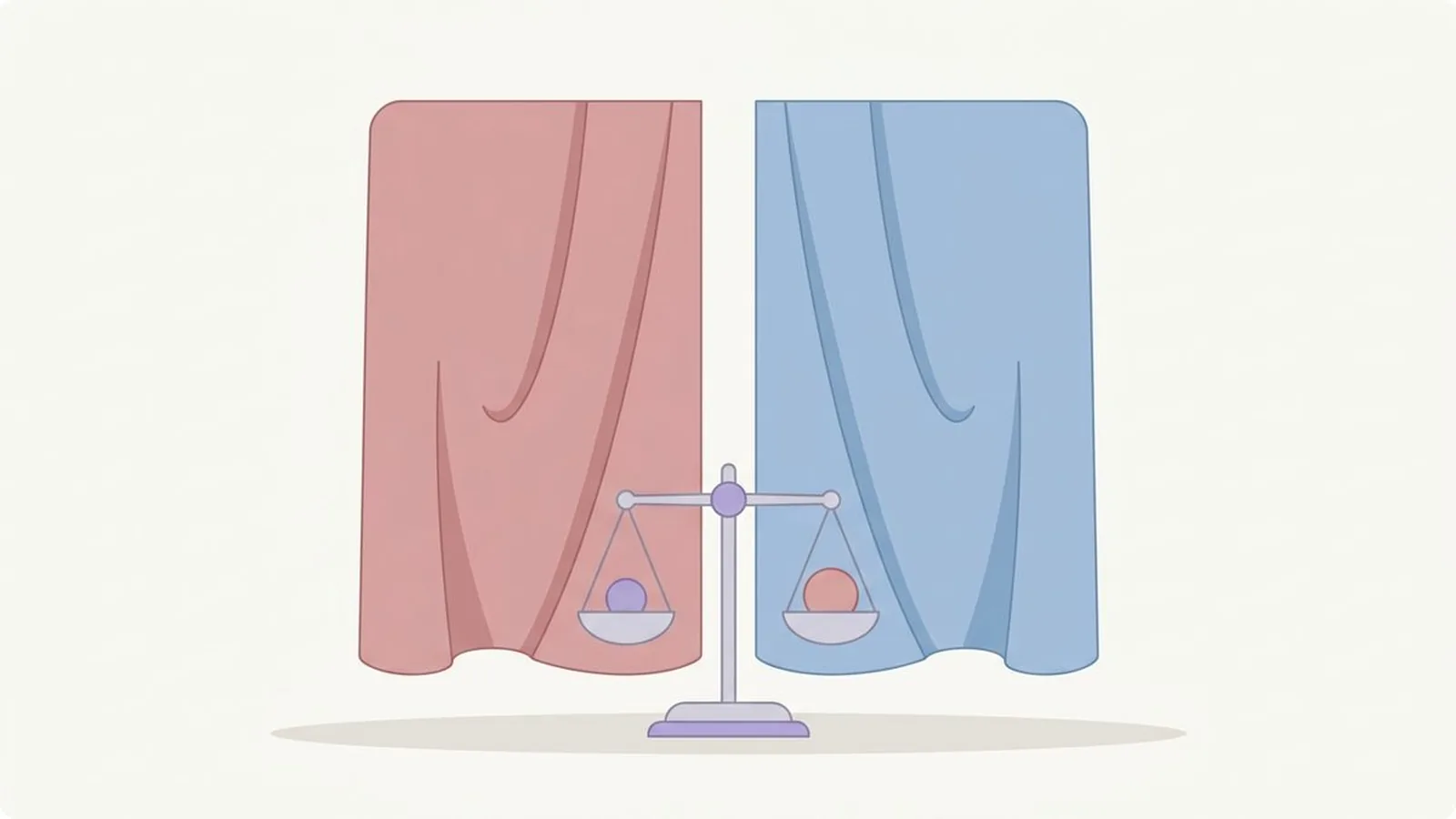
The one axis True Summer and Soft Summer actually differ on is chroma, not temperature. Both are cool. True Summer carries a touch more clarity and can hold a slightly more saturated blue-based color, while Soft Summer is defined by how thoroughly every shade gets muted and greyed down, sometimes until the undertone itself starts to read almost neutral.
What's in this guide
What both Summers share
True Summer and Soft Summer share a cool undertone, a medium value, and a home in the same Summer family alongside Light Summer. Neither wears gold particularly well, neither glows in a warm golden-yellow or a burnt orange, and both look better in a color that has been softened rather than one that shouts. If you already suspect you are cool but the exact shade of "cool" keeps eluding you, you are in the right place.
The overlap is real enough that most people who land near this border spend months unsure which side they are on. Both seasons agree on undertone. Both live in the softer half of the color wheel rather than the clear, bright half a Winter would want. The confusion is not a sign you are doing anything wrong, it is a sign the two seasons genuinely sit close together, separated by one measurement rather than two.
For the underlying framework, our primer on seasonal color analysis covers the three measurements, undertone, value and chroma, that every season is built from. True Summer and Soft Summer agree on the first two and part ways on the third.
The one difference that matters
Chroma is the one difference that matters here. True Summer is defined by clarity within coolness. Soft Summer is defined by mutedness above everything else.
True Summer sits at the center of the Summer family: cool, medium in depth, and carrying just enough saturation that a clean slate blue or a cool raspberry reads as alive rather than loud. It is often called Cool Summer instead, the two names describe the same season, and that name is the more useful one to remember: coolness, not brightness, is what True Summer is actually built around.
Soft Summer takes that same cool foundation and mutes it further than any other Summer sub-season. It borders Soft Autumn, borrowing that neighbor's gentle, blended quality while keeping its own undertone firmly cool. Every color in a Soft Summer's palette has been greyed down, as if a thin layer of fog sits over it, and that mutedness is strong enough that the underlying coolness can occasionally read as closer to neutral.
That single distinction, clarity versus mutedness, decides almost everything else in this guide. For the bigger picture of how all twelve seasons relate, the 12 color seasons overview maps the full grid.
True Summer vs Soft Summer side by side
A quick reference before the tests. Notice how much the two seasons agree on and how narrowly they actually split.
| True Summer | Soft Summer | |
|---|---|---|
| Undertone | Cool, the purest cool of the Summer family | Cool, muted enough to soften toward neutral |
| Value | Medium | Medium |
| Chroma | Soft but clear, the most saturated Summer | The most muted of the three Summers |
| Contrast | Low to medium, soft but defined | Low, the flattest of the three Summers |
| Best colors | Slate blue, cool teal, cool raspberry, soft plum, blue-based burgundy, soft navy | Dusty mauve, sage grey-green, denim blue, rosewood, muted spruce, cool taupe |
| Colors to avoid | Warm earth tones, orange, golden yellow, warm browns, pure black or white | Bright, clear or icy tones: electric blue, true fuchsia, pure white |
| Best metal | Silver, brushed silver | Brushed silver, pewter |
| Celebrities sometimes cited | Jacqueline Kennedy Onassis in her later years, Courteney Cox at her ash-brown peak | Jennifer Aniston and Drew Barrymore in their softer, mid-coloring phases |
The celebrity row is worth a caveat: these are the names that come up most often in informal color-typing discussions, not confirmed personal analyses, and lighting, styling and hair color at the time of any given photo all shift the read.
The tell
The tell that separates True Summer from Soft Summer is how a color behaves when you make it more saturated. Push a True Summer's blue-based hue toward more clarity, a clean slate blue instead of a hazy one, a cool raspberry instead of a dusty rose, and their face gets brighter and more defined, not harsher. Run the same push on a Soft Summer and clarity works against them: the same hue has to be pulled back toward something muted, like dusty mauve or smoky teal, before it settles rather than shouts over their features.
If you are not yet confident reading your own undertone at all, start with the foundational step in finding your skin undertone at home. Both Summers are firmly cool, so if your tests keep pointing warm, you are looking at a different family altogether.
4 tests to settle it
Descriptions only get you so far. Put fabric or paper next to your face in good daylight and watch how your skin reacts. Run all four, then count which season wins more rounds.
1. The saturation test (the decider)
Hold a clear, jewel-leaning cool color, cool emerald or cool raspberry, next to your face. Then swap it for a deliberately greyed-down version of a similar hue, like dusty mauve or muted spruce. A True Summer looks more alive and lit up next to the clearer shade. A Soft Summer looks calmer and more flattered by the greyed one, and can look slightly harsh or costume-like next to the clear jewel tone.
2. The grayscale contrast test
Convert a photo of yourself to black and white. True Summer typically shows a touch more definition between hair, skin and eyes, even at a soft, cool medium value. Soft Summer shows the flattest, most blended grayscale of the three Summer sub-seasons, with no single feature reading as dramatically lighter or darker than the rest.
3. The metal test
Try a bright, polished silver or platinum piece against your skin, then a brushed, matte silver or pewter piece. True Summer's extra clarity can hold the mirror-bright metal without it looking harsh. Soft Summer's mutedness usually prefers the quieter brushed finish, since a high-shine metal can look like it is fighting the face rather than sitting on it.
4. The neutral test
Hold a pure cool color, a true navy, next to your face, then a soft, warm-neutral greige or taupe. Soft Summer's undertone is muted enough that it can sit surprisingly well against the gentle neutral, since little in their coloring is fighting for attention. True Summer's coolness is more assertive and usually looks better in the true navy outright than in the neutral.
How the palettes diverge
Once you know which Summer you are, the wardrobe payoff is immediate. Here is True Summer's full palette, copied straight from our Summer palette guide, followed by how Soft Summer's compares.
True Summer's palette
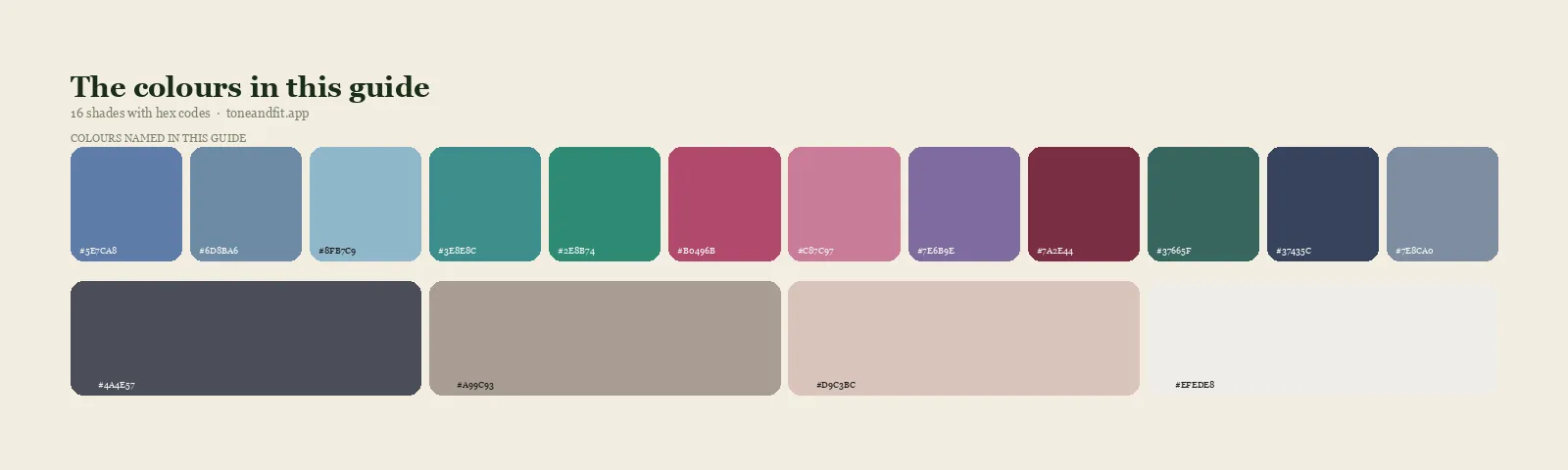
- Slate Blue#5E7CA8
- Grey Blue#6D8BA6
- Dusty Blue#8FB7C9
- Cool Teal#3E8E8C
- Cool Emerald#2E8B74
- Cool Raspberry#B0496B
- Rose Pink#C87C97
- Soft Plum#7E6B9E
- Blue Burgundy#7A2E44
- Spruce Green#37665F
- Soft Navy#37435C
- Blue-Grey#7E8CA0
- Soft Charcoal#4A4E57
- Cool Taupe#A99C93
- Rose Beige#D9C3BC
- Soft White#EFEDE8
Neutrals & anchors. See the full breakdown, outfit formulas and colors to avoid in the True Summer color palette guide or at the Summer palette hub.
Where Soft Summer pulls away
Soft Summer's palette overlaps with True Summer in the soft blues and plums, then pulls toward the greyest, most blended end of the family: dusty mauve, greyed lavender, sage grey, muted spruce, smoky teal, denim blue, rosewood, and cool taupe. Neutrals lean greige, mushroom, pewter and muted navy rather than True Summer's cleaner soft charcoal and soft white. The full breakdown lives in the Soft Summer guide and the Soft Summer color palette.
Stop guessing which Summer you are.
Tone & Fit's AI measures your undertone, value and chroma from a selfie and tells you whether you're True Summer, Soft Summer, or something else, with your full palette in 60 seconds.
Try the App ↗If you sit between them
If you sit between True Summer and Soft Summer, the honest answer is that this is a genuinely fine distinction, closer than most season pairs, because both of you already agree on undertone and value. The whole question comes down to how much clarity your face can carry before a color starts to look like it belongs to someone else.
A few practical moves help when the saturation test keeps splitting evenly. Run it more than once, on different days and in different daylight, since a single overcast afternoon can make anyone read a shade more muted than usual. If you are still unsure, default toward the more muted reading: wearing a slightly-too-clear color on genuinely muted coloring is more noticeable than the reverse, and a Soft Summer palette worn by a True Summer still looks pleasant, just quieter than it needs to be.
It is also worth checking that you have not drifted one family over by accident. A muted cool read that still leans distinctly blue rather than green-grey is Soft Summer, not Soft Autumn, which shares the mutedness but flips the undertone to warm. If a measured second opinion would settle it faster than another round of fabric swatches, that is exactly what an AI reading is for.
FAQ
What is the main difference between True Summer and Soft Summer?
Chroma. True Summer is the clearest, most saturated of the three Summer seasons, cool and defined without ever tipping into brightness. Soft Summer is the most muted and low-contrast, with every color greyed down until the undertone itself can start to read almost neutral.
Is True Summer the same as Cool Summer?
Yes. True Summer and Cool Summer name the same season in the 12-season system; different colorists and different apps use the two terms interchangeably for the cool, medium-value, medium-chroma member of the Summer family.
Is True Summer the same as Soft Summer?
No. They share a cool undertone and a similar medium value, but they are separated by chroma. True Summer carries more clarity and can wear a slightly more saturated cool color. Soft Summer needs everything muted down and looks better in a greyed, blended version of the same hue.
Which season is more muted, True Summer or Soft Summer?
Soft Summer. It is the most muted and lowest-contrast of the three Summer sub-seasons, bordering Soft Autumn in how gentle and blended its coloring reads. True Summer sits closer to the center of the Summer family, cool and soft but with more definition.
What is the fastest way to tell True Summer and Soft Summer apart?
Hold a clear, jewel-leaning cool color like cool raspberry or cool emerald next to your face, then hold a deliberately greyed-down version like dusty mauve or muted spruce. True Summer looks more alive next to the clearer shade. Soft Summer looks calmer and more flattered by the greyed one, and can look slightly harsh next to the clear jewel tone.
Do True Summer and Soft Summer wear the same jewelry metal?
Both lean cool and silver rather than gold, but the finish differs. True Summer's extra clarity can hold a polished silver or platinum. Soft Summer's mutedness usually prefers a brushed silver or pewter finish, since a mirror-bright metal can look like it is fighting the face.
Ready to find your season?
One selfie, your 12-season result, and the palette that goes with it. Free, no sign-up.
Find your season free ↗For the underlying reading, the skin tone analyzer explains what undertone, depth and contrast actually are.