What Is My Skin Tone? Depth vs Undertone

Your skin tone is really two separate measurements: depth, how light or dark your skin reads, and undertone, whether it leans warm, cool, olive or neutral beneath the surface. Most confusing quiz results and bad foundation matches come from answering only one of these two questions and assuming it covers both.
Quick answer
Depth is your position on a fair to rich scale and it can shift with a tan or the season. Undertone is your fixed warm, cool, olive or neutral cast and it never changes. "What is my skin tone" usually means depth, but the color and foundation decisions people actually struggle with almost always come down to undertone.
What's in this guide
- What Is My Skin Tone, Exactly?
- What Is Skin Depth?
- What Is Skin Undertone?
- Why Depth and Undertone Are Not the Same Thing
- What Do Names Like Olive or Tan Actually Mean?
- How to Find Your Depth at Home
- How to Find Your Undertone at Home
- How Depth and Undertone Combine Into Your Color Season
- How to Check Both With a Photo
- FAQ
What Is My Skin Tone, Exactly?
Your skin tone is the combination of two independent measurements: depth, how much melanin your skin carries, and undertone, the warm, cool, olive or neutral cast sitting underneath that depth. When someone asks "what is my skin tone," they are usually asking about depth, fair, medium, tan, deep, because that is the trait you notice first in a mirror. But undertone is the one that actually decides which foundation shade, jewelry metal, and clothing colors work for you, which is why answering only the depth question leaves half the puzzle unsolved.
These two traits are measured completely separately. Depth answers "how much" and undertone answers "what kind." A person can be light in depth and warm in undertone, light and cool, light and olive, or light and neutral, and the same four combinations repeat at every depth from fair to rich. Treating "skin tone" as a single word for both is exactly where most confusion starts.
What Is Skin Depth?
Skin depth is how much melanin your skin carries at rest, and it is what most people mean the first time they ask what their skin tone is. The common scale runs across six bands, and they match how most foundation lines and colorists slice the spectrum:
- Fair. Burns easily, little visible melanin, often with visible capillaries near the surface.
- Light. A step more pigment than fair. May tan slowly rather than burn.
- Medium. Moderate melanin with visible warmth or rosiness. Tans in a fairly predictable way.
- Tan. Naturally sun kissed even at rest. Rarely burns without heavy exposure.
- Deep. Rich melanin with clear depth. Almost never burns casually.
- Rich. The deepest band, where undertone differences become the most visible part of the equation.
Depth moves. A summer tan pushes you down a band, winter fades you back up, and both are normal, which is exactly why a single foundation shade rarely lasts a person all year. What never moves is undertone, and mixing the two up is behind most of the color and foundation mistakes people make.
What Is Skin Undertone?
Skin undertone is the fixed warm, cool, olive or neutral cast beneath your skin's surface, and unlike depth, it does not shift with a tan, the season, or age. It comes from the balance of melanin and blood vessels in your dermis, the layer below the surface skin you can see and touch, and that balance is set for life.
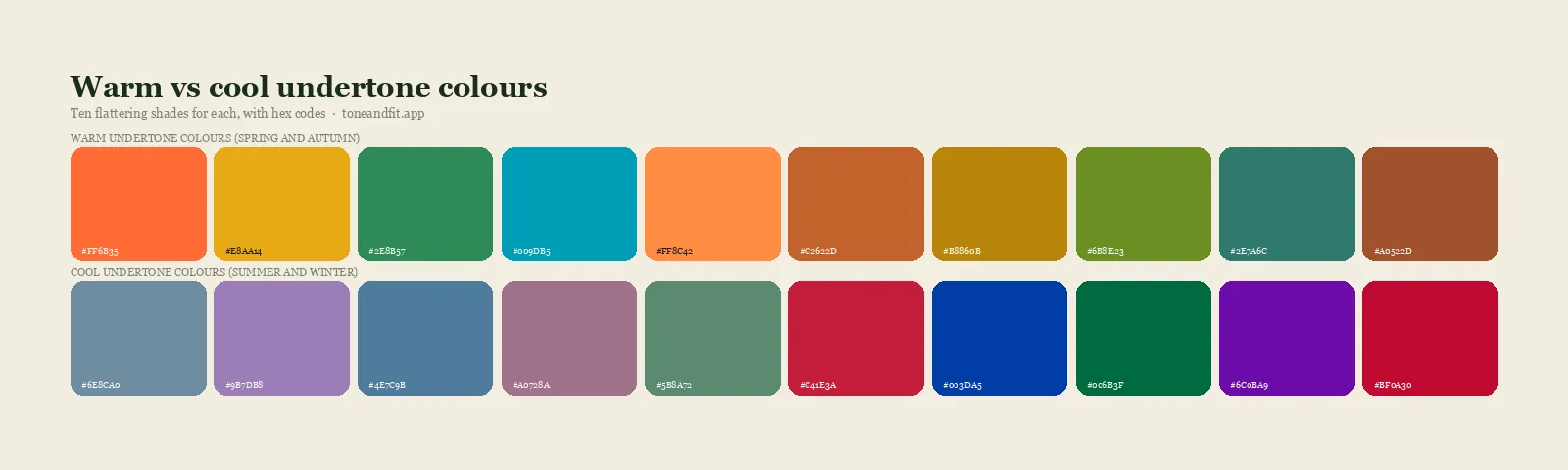
- Cool. Pink, rosy, or faintly blue beneath the surface. Silver and platinum flatter more than gold, and blue based colors light the face up.
- Warm. Golden, peachy, or yellow beneath the surface. Gold and copper flatter more than silver, and earthy, orange based colors feel harmonious.
- Neutral. Neither pink nor golden clearly dominates. Both metals pass and most colors work at a moderate intensity. Genuine neutral is less common than online quizzes suggest.
- Olive. Golden pigment sitting under a cool, faintly gray-green cast. It can show up at any depth and often gets mistaken for neutral or warm.
Once you know your undertone, you have answered the harder half of the "what is my skin tone" question. Our companion guide on warm vs cool skin undertone goes deeper into how the warm and cool categories actually behave in daylight.
Why Depth and Undertone Are Not the Same Thing
Depth and undertone are not the same thing because one measures how much pigment you have and the other measures what temperature that pigment reads as, and two people can share one without sharing the other. A fair, cool skin and a fair, warm skin are both "fair" in depth, but they need different foundation formulas and completely different clothing colors. A deep, cool skin and a deep, warm skin share the same depth for the same reason and still sit in opposite color families.
| Depth band | Cool undertone example | Warm undertone example |
|---|---|---|
| Fair | Porcelain Rose | Golden Ivory |
| Rich | Espresso | Golden Mahogany |
Notice that the two columns never trade places: cool stays cool from fair to rich, and warm stays warm from fair to rich. Only the depth changes as you move down the table. Our full skin tone chart maps out the complete grid, all six depth bands crossed with all four undertone columns, if you want to see where your own combination lands.
What Do Names Like Olive or Tan Actually Mean?
Names like olive, tan, fair and deep get used inconsistently because some of them describe depth and others describe undertone, and olive is the one word that genuinely names an undertone rather than a depth. "Tan" is a depth band: it says nothing about whether the skin underneath reads warm, cool, or olive. "Olive," by contrast, is an undertone: it can appear at any depth from fair to rich, and it is frequently mistaken for neutral or warm on simple tests because its cool, gray-green cast sits on top of genuinely golden pigment.
This mismatch is the single biggest source of confusion in "what is my skin tone" searches. Someone with olive undertone and medium depth might describe themselves as "olive skinned," which mixes a depth-sounding phrase with an undertone fact. Keeping the two questions separate, how much pigment, and what temperature, clears up most of the confusion immediately.
How to Find Your Depth at Home
The fastest way to find your depth band is to compare your inner forearm, which sees the least sun exposure, against the six bands above in natural daylight. Stand near a window, avoid direct sun or indoor bulbs, and judge only how much pigment you see, not the color underneath it. If you are between two bands, which is common, note both; depth is a spectrum, not six hard boxes.
How to Find Your Undertone at Home
The white paper test
Hold a sheet of pure white paper next to your bare, makeup free face in daylight.
The white paper test is the fastest single check, but it is only one of several signals, and olive undertones in particular can confuse it. Our full guide to finding your skin undertone at home walks through the vein test and the jewelry test as well, and explains what to do when the tests disagree with each other.
How Depth and Undertone Combine Into Your Color Season
Depth and undertone are two of the three inputs that decide your color season, and the third is chroma, how soft or bright your overall coloring reads. Undertone sorts you into the warm seasons (Spring and Autumn) or the cool seasons (Summer and Winter). Depth then narrows that down further: a light, warm reading points toward Spring, while a deep, warm reading points toward Autumn. Chroma makes the final call between neighboring sub-seasons within that family.
This is why two people with the same undertone can still need completely different palettes. A light, cool, soft complexion and a deep, cool, bright complexion are both undeniably cool, but one wears dusty lavender well and the other wears true red, because depth and chroma pulled them into different corners of the cool half of the system.
How to Check Both With a Photo
The fastest way to check both depth and undertone at once is a direct measurement from a photo instead of two separate mirror tests that are each easy to get wrong on your own. The skin tone analyzer reads both traits from a single daylight photo and tells you where you land, warm or cool, olive or neutral, and how deep, without you having to eyeball a swatch card against your jawline.
If you want the full picture rather than just depth and undertone, the seasonal color analysis quiz adds the third input, chroma, and gives you a complete 12 season result in a couple of minutes.
Ready to find your season?
One selfie, your 12-season result, and the palette that goes with it. Free, no sign-up.
Find your season free ↗FAQ
What is my skin tone?
Your skin tone is the combination of two separate things: depth, how much melanin your skin carries, described from fair through rich, and undertone, the warm, cool, olive or neutral cast underneath that stays fixed. Most quizzes and mirror checks answer only one of these, which is why people often walk away with a confusing or contradictory result.
What is the difference between skin tone and undertone?
Skin tone usually refers to depth, how light or dark your skin is at a glance, while undertone refers to the warm, cool, olive or neutral cast underneath that depth. Two people can share the same skin tone and have opposite undertones, or share the same undertone at completely different depths.
Can my skin tone change?
Your depth can change with a tan, the season, or age, since it is driven by how much melanin is currently active in your skin. Your undertone does not change. It is set by the fixed proportion of pigments in your dermis and stays the same whether you are pale in January or tanned in July.
What is olive skin tone?
Olive is an undertone, not a depth. It describes golden pigment sitting under a cool, faintly gray-green cast, and it can show up at any depth from fair to rich. Olive skin often reads as neutral or warm on simple tests while behaving like neither, which is why it gets misclassified so often.
How do I find my undertone without a mirror test?
A photo based reading is the most direct way. An AI color analysis app samples pixel values across your skin, hair and eyes in a photo and computes undertone, depth and chroma together instead of relying on a single mirror trick that can be thrown off by lighting.
Does skin tone depth affect my color season?
Yes. Depth is one of the three inputs, alongside undertone and chroma, that decide which of the 12 color seasons you fall into. Two people with the same undertone can land in different seasons if one reads light overall and the other reads deep.