Skin Tone Chart: Find Your Exact Shade and Undertone
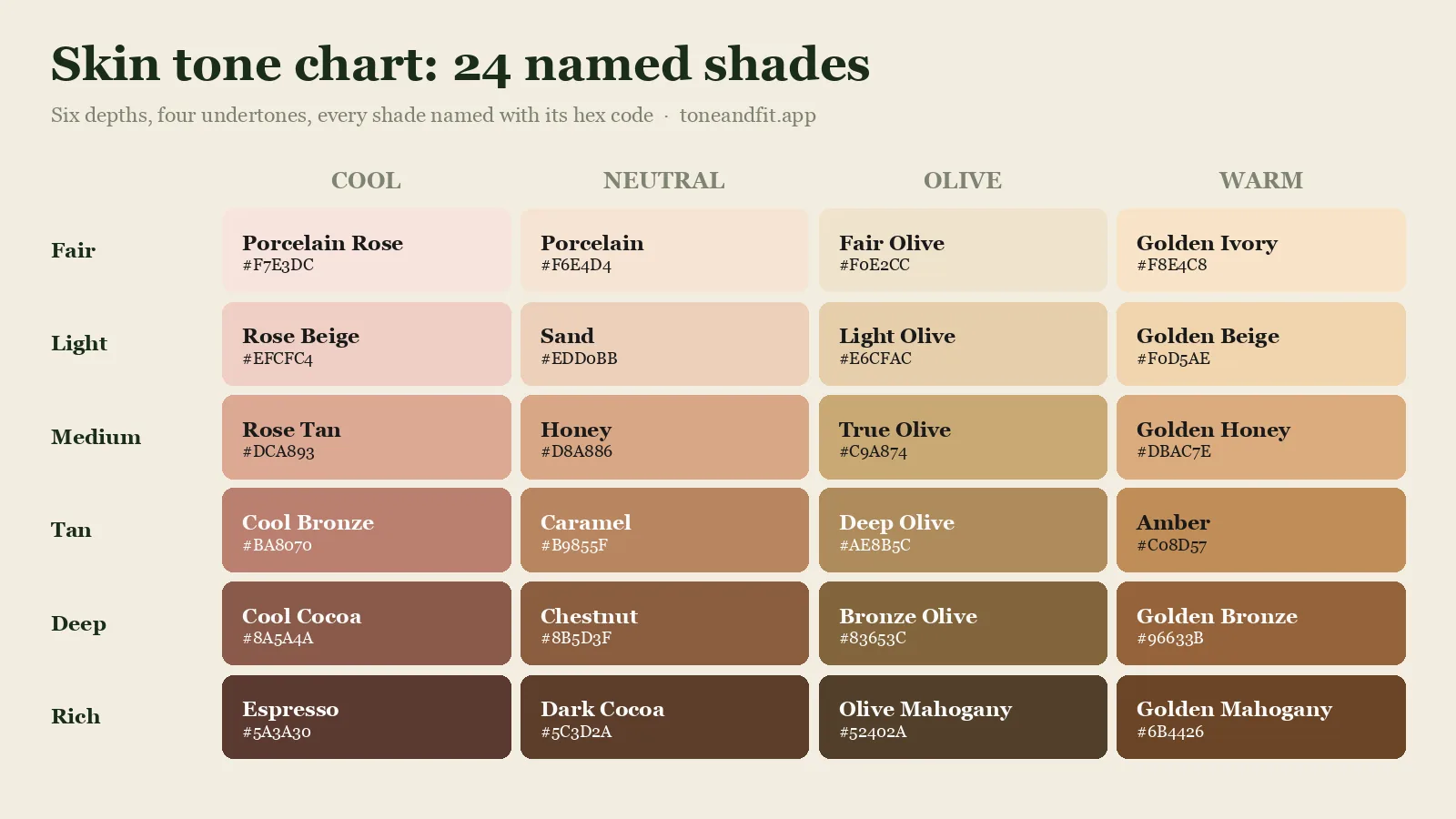
A useful skin tone chart needs two axes, because your skin has two separate facts to name: how deep it is, and what hue runs underneath. Most charts only show you the first one. This one shows both.
Your skin tone is a coordinate, not a single word. The first axis is depth, the fair-to-rich scale that foundation numbers describe and tans move. The second is undertone: warm, cool, neutral, or olive, the fixed hue beneath the surface that decides which colors, metals, and foundation letters suit you. The chart below crosses 6 depths with 4 undertones into 24 named shades with hex codes. Find your row with a mirror, find your column with the undertone tests linked below, and the cell where they meet is your skin tone, named and usable.
What's in this guide
The skin tone chart: 6 depths × 4 undertones
Depth runs down the side, undertone runs across the top. Every cell shows a representative shade name and its hex code. Skin is a continuous spectrum, so treat each swatch as the center of a neighborhood rather than a boundary line.
| Cool | Neutral | Olive | Warm | |
|---|---|---|---|---|
| Fair | Porcelain Rose#F7E3DC | Porcelain#F6E4D4 | Fair Olive#F0E2CC | Golden Ivory#F8E4C8 |
| Light | Rose Beige#EFCFC4 | Sand#EDD0BB | Light Olive#E6CFAC | Golden Beige#F0D5AE |
| Medium | Rose Tan#DCA893 | Honey#D8A886 | True Olive#C9A874 | Golden Honey#DBAC7E |
| Tan | Cool Bronze#BA8070 | Caramel#B9855F | Deep Olive#AE8B5C | Amber#C08D57 |
| Deep | Cool Cocoa#8A5A4A | Chestnut#8B5D3F | Bronze Olive#83653C | Golden Bronze#96633B |
| Rich | Espresso#5A3A30 | Dark Cocoa#5C3D2A | Olive Mahogany#52402A | Golden Mahogany#6B4426 |
Swatches are screen approximations of real skin averages. Your monitor's brightness and color temperature shift them slightly, which is one more reason to confirm undertone with tests rather than by eye alone.
Two things this chart makes visible that single-axis charts hide. First, depth and undertone are fully independent: there is fair cool skin and fair warm skin, deep cool skin and deep warm skin, and every combination between. Second, olive is a full column, not a footnote. Olive skin exists at every depth and is the category most often mislabeled as neutral, which our guide to color analysis for olive skin covers in depth.
Skin tone names, fair to rich
These are the skin tone names people actually search for and match at a counter, from porcelain at the fair end to golden mahogany at the rich end. Every name below is a cell in the chart above, so the name and the hex code always agree.
Read them as depths, not seasons. A name tells you how light or deep the skin is and which way the undertone leans. It does not settle your palette on its own, because contrast between hair, eyes and skin still gets a vote: two people on the same honey row can land in different seasons.
-
Fair Fitzpatrick I to IIPorcelain Rose, Porcelain, Fair Olive, Golden IvoryUsually Light Spring and Light Summer
-
Light Fitzpatrick IIRose Beige, Sand, Light Olive, Golden BeigeUsually Light Summer, Cool Summer or Light Spring
-
Medium Fitzpatrick IIIRose Tan, Honey, True Olive, Golden HoneyUsually Soft Autumn and Warm Spring
-
Tan Fitzpatrick IVCool Bronze, Caramel, Deep Olive, AmberUsually Warm Autumn and Deep Autumn
-
Deep Fitzpatrick VCool Cocoa, Chestnut, Bronze Olive, Golden BronzeUsually Deep Autumn and Deep Winter
-
Rich Fitzpatrick V to VIEspresso, Dark Cocoa, Olive Mahogany, Golden MahoganyUsually Deep Winter and Deep Autumn
Regional and descriptive names map onto these same rows rather than adding new ones. Wheatish sits around Medium to Tan, dusky covers Tan through Deep, and ebony is the deepest, coolest end of Rich. Olive is not a depth at all: it is one of the four undertone columns, and it can appear on any row. The full skin tone names list takes each one in turn.
How to find your cell in 3 steps
Step 1: find your row (depth)
In indirect daylight with no makeup, compare your jawline, not your hand or arm, to the depth scale. Your jaw is the depth foundation should match and it tans less than hands and forearms do. Be honest about season: if you are tanned right now, your resting row is probably one step lighter. Depth is the easy half; most people land on their row within one step on the first try.
Step 2: find your column (undertone)
Undertone hides under the surface, so you find it by its effects. Check your wrist veins (green suggests warm, blue or purple suggests cool), compare gold against silver jewelry, hold pure white then cream fabric under your chin, and drape a warm and cool version of the same color against your face. Our step-by-step skin undertone test guide walks through all five tests and how to score them, and the at-home draping version lives in how to find your skin undertone at home. If the tests split, read the neutral and olive notes below before deciding.
Step 3: cross them
Where your row and column meet is your named skin tone: Golden Honey, Cool Cocoa, Light Olive, and so on. That cell is shorthand for everything downstream: your foundation depth and letter, your better metal, and the temperature half of your color season. The rest of this guide translates the cell into each of those.
The depth scale, row by row
Depth is how much melanin your skin carries at rest. The six bands used here match how makeup lines and analysts commonly slice the spectrum:
- Fair: burns easily, little visible melanin, often with visible capillaries. Foundation ranges usually label this 100 to 150 or "porcelain" and "ivory".
- Light: a step more pigment, may tan slowly. The "beige" band in most shade systems.
- Medium: visible warmth or rosiness with moderate melanin, tans predictably. The most crowded band in foundation lines.
- Tan: naturally sun-kissed at rest, rarely burns. Often labeled "caramel" or numbered in the 300s.
- Deep: rich melanin with clear depth, never burns casually. "Chestnut" and "mocha" territory.
- Rich: the deepest band, where undertone differences are most visible as blue-based versus golden-based depth.
The two ends of the scale each have their own reading quirks. On the fair and light rows the undertone signal is quieter, which we cover in pale skin undertone; on the deep and rich rows several of the classic tests stop working altogether, which is the subject of deep skin undertone.
Depth moves. Summer sun pushes you down a row, winter pulls you back up, and that is normal: it is why foundation wardrobes exist and why your chart cell is a home base rather than a prison. What never moves is your column, and mixing the two up is the root of most bad matches. The pair is explained head-on in our warm vs cool undertone guide.
The four undertone columns
Cool: pink, rosy, or faintly blue beneath the surface. Silver and platinum blend in, pure white looks crisp, and blue-based colors like fuchsia, emerald, and icy blue light the face up. Cool runs from Porcelain Rose at fair all the way to Espresso at rich.
Neutral: neither pink nor golden dominates. Both metals pass, most colors work at moderate intensity, and extremes in either temperature feel slightly off. True neutral is rarer than online quizzes suggest; many self-diagnosed neutrals are actually olive. The full picture is in our guide to neutral undertone skin.
Olive: golden pigment under a cool, faintly gray-green cast, present at every depth. Olive passes both metal tests, reads green in the vein test regardless of its true lean, and makes standard foundations run too orange or too pink. If that pattern sounds familiar, your column is olive even if every quiz has called you neutral or warm.
Warm: golden, peachy, or yellow beneath the surface. Gold, brass, and copper blend in, ivory flatters more than optic white, and colors like camel, rust, coral, and olive green feel harmonious. Warm runs from Golden Ivory at fair to Golden Mahogany at rich.
Placing yourself in a column comes down to the same handful of at-home checks, and how to determine your skin undertone runs through each one with a note on how much weight to give it. If you prefer seeing the same information arranged as a circle rather than a grid, the skin tone color wheel covers the wheel layout and how to read your position on it.
Skip the squinting: get your cell measured.
Tone & Fit's AI reads your depth and undertone from one selfie at the pixel level, corrects for your lighting, and maps you to your season in about 30 seconds. Free scan, no account, photo discarded after analysis.
Find My Skin Tone Free ↗From chart cell to foundation shade
Foundation systems encode this exact chart in their shade names: a depth number plus an undertone letter. Your row predicts the number range; your column predicts the letter. Warm columns match W or G shades, cool columns match C or R, the neutral column matches N, and olive usually does best in olive-tagged or golden-neutral formulas because most lines still under-serve that column.
Three matching rules that save returns. Test on the jawline in daylight, never on the wrist, because wrists sit rows away from faces. Judge the shade after an hour of wear, since oxidation pushes many formulas warmer. And when you are between two shades, match the undertone letter first and adjust depth second: a slightly light shade with the right letter disappears, while the right depth with the wrong letter reads like a mask. The letter decoding by brand, MAC's NC and NW included, is covered in how to find your foundation undertone.
From chart cell to color season
Color analysts use the same two axes as this chart under different names, value for depth and hue for undertone, then add a third: chroma, how clear or muted your coloring is. Cross all three and you get the 12 color seasons. Your chart cell narrows the map before you ever take a quiz:
| Your cell | Likely season families |
|---|---|
| Fair or Light + Warm | Light Spring, True Spring |
| Fair or Light + Cool | Light Summer, True Summer, Cool Winter |
| Medium or Tan + Warm | True Spring, Warm Autumn, Soft Autumn |
| Medium or Tan + Cool | True Summer, Soft Summer, True Winter |
| Deep or Rich + Warm | Deep Autumn, Warm Autumn |
| Deep or Rich + Cool | Deep Winter, Cool Winter |
| Any depth + Neutral or Olive | Soft seasons most often; chroma decides |
The chart gets you to the neighborhood; chroma picks the house. Two Medium Warm people can be a bright True Spring and a muted Soft Autumn, and only the clarity of their coloring separates them. How the three measurements interlock is the subject of seasonal color analysis explained, and the full route from chart cell to final palette is in our personal color analysis guide. If you want the shortcut, our find my color season guide compares every method.
Where every skin tone chart hits its limit
A printed chart, including this one, has three honest limits. Your screen shifts the swatches: brightness, night mode, and panel calibration all nudge hues warmer or cooler. Your eyes white-balance whatever they see, so you literally cannot see your own undertone the way a measurement can. And a chart cannot weigh a split verdict: it can show you the olive column, but it cannot tell you whether your skin belongs there or in neutral.
That is why the reliable order of operations is chart first, tests second, measurement third. The chart names the possibilities, the undertone tests narrow them, and when the tests disagree, software settles it. An AI skin tone analyzer samples hundreds of points across a selfie, corrects for the photo's lighting, and places your skin on both axes as numbers rather than impressions. Tone & Fit does exactly that in about 30 seconds, free, and then goes one step further than any chart can: it reads your chroma too, names your season, and hands you the palette. Your photo is discarded after analysis, and the result includes 40+ named shades with an avoid list, plus hair color guidance that pairs with our best hair color for your skin tone guide.
From chart to palette in one selfie.
Free scan reads your depth, undertone, and chroma, then names your season and 40+ shades. About 30 seconds. Photo never stored.
Get Tone & Fit Free ↗Skin tone charts by complexion
The chart above is the general reference. These go deeper on one row or one column of it.
- Skin tone names listEvery named shade in turn, and what each one means.
- Olive skin toneThe green-gold undertone column, and the colors it takes.
- Deep and dark skin tonesCocoa through mahogany, split by temperature.
- Korean skin tone chartThe four Korean tone types, mapped to the 12 seasons.
- Foundation by undertoneDepth first, then the undertone letter, on the jaw.
- What is my skin tone?If you are not sure which row you are on, start here.
Frequently Asked Questions
What are the 4 types of skin undertone?
Warm (golden, peachy, or yellow), cool (pink, rosy, or bluish), neutral (no clear lean either way), and olive (golden pigment under a cool, faintly green-gray cast). Every surface depth from fair to rich can carry any of the four, which is why a complete skin tone chart needs both axes: depth down one side and undertone across the top.
How do I find my exact skin tone?
Work in two steps. First find your depth row by matching bare, makeup-free skin on your jawline to the fair-to-rich scale in indirect daylight. Then find your undertone column with at-home tests: vein color, gold vs silver jewelry, pure white vs cream fabric, and draping warm against cool versions of the same color. Where the row and column cross is your cell. An AI scan can do both steps from one selfie.
How many skin tones are there?
Real skin is a continuous spectrum, so any count is a simplification. Most practical charts group depth into 5 or 6 bands (fair, light, medium, tan, deep, rich) and undertone into 4 families (warm, cool, neutral, olive), giving around 24 workable categories. Foundation lines slice the same spectrum much finer, often into 40 or more shades, but they are subdividing the same two axes.
Is olive a skin tone or an undertone?
Olive is an undertone, not a depth. It appears at every depth from fair to rich and describes a faint green-gray cast created by golden pigment under a cooler, slightly ashy quality. Olive is the column manual tests misread most often: veins read green even when the skin leans cool, both jewelry metals pass, and standard foundations run too orange or too pink.
How do I match foundation using a skin tone chart?
Your chart row gives your foundation depth number and your column gives the letter. Warm undertones suit shades tagged W or G (golden), cool undertones suit C or R (rosy), neutrals suit N, and olive skin usually does best in olive-tagged or golden-neutral shades. Test the candidate shade on your jawline in daylight, not on your wrist, and judge it after it has worn for an hour.
What skin tone chart do color analysts use?
Professional analysts work with the same two axes as this chart, depth and undertone, then add a third measurement: chroma, how clear or muted your coloring is. Depth becomes value, undertone becomes hue, and the three together map to the 12 seasonal palettes. So a chart cell like deep warm points toward Deep Autumn, while light cool points toward Light Summer.