Best Coat Color for Your Season
The best coat color for you is whichever shade matches your season's undertone, depth, and contrast, not whatever color the mannequins are wearing this year. A coat frames your face for half the year and costs more per item than almost anything else you own, so it is the one wardrobe decision worth getting right before you shop rather than after.
What's in this guide
What decides your best coat color
What decides your best coat color are the same three measurements behind every color season result: undertone, depth, and contrast. Undertone sorts colors into a warm half and a cool half and rules out roughly half of every rack before you even look at depth. Depth decides how dark a coat can go without swallowing your face, and contrast, the gap between your lightest and darkest features, decides whether black specifically works or fights you. For the full reasoning behind each of those three factors, our companion guide to the best coat colors for your skin tone walks through undertone, depth, and contrast in detail. This guide starts from the season itself and moves faster to the answer.
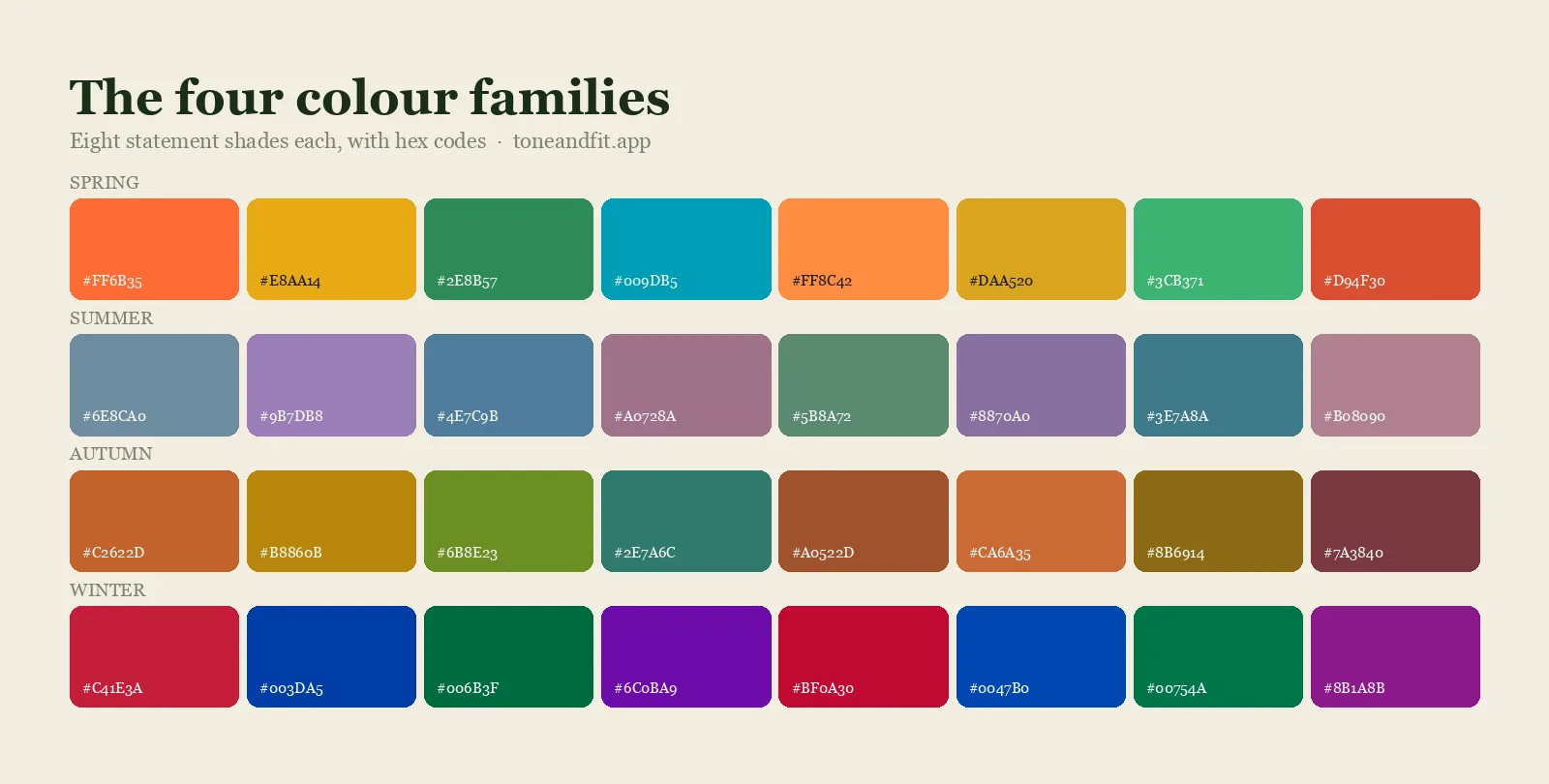
Best coat color by season: the full chart
If you already know your 12-season type, this table is the fastest route to an answer. If you do not, the 12 color seasons guide will place you in about five minutes.
| Season | Reach for | Leave on the rack |
|---|---|---|
| True Winter | Black, true navy, charcoal | Camel, mustard, rust |
| Cool Winter | Charcoal, cool navy, burgundy | Camel, warm beige, olive |
| Deep Winter | Black, deep pine, aubergine | Pale beige, pastels |
| True Spring | Camel, warm ivory, bright navy | Black, cool grey |
| Warm Spring | Camel, warm cream, light olive | Black, icy blue, charcoal |
| Light Spring | Light camel, buttermilk, denim blue | Black, deep burgundy |
| True Summer | Soft navy, dove grey, cool taupe | Rust, mustard, black |
| Cool Summer | Slate blue, cool grey, plum | Camel, orange rust |
| Soft Summer | Mushroom grey, dusty teal, muted plum | Bright white, hard black |
| True Autumn | Chocolate, warm camel, olive | Black, icy pastels |
| Warm Autumn | Camel, bronze, terracotta | Cool grey, pure white |
| Deep Autumn | Espresso, deep teal, oxblood | Pale beige, pastels |
A pattern worth noticing: every Winter can wear black, no Autumn or Spring should build a coat wardrobe around it, and Summer sits in between, occasionally able to carry a muted near-black but never a true one. That single row does more to explain "can I wear a black coat" than any amount of general styling advice, because it is really a contrast question dressed up as a color question. If you want the full breakdown of that specific question, the Winter palette page covers why Winter owns black so completely, and how True, Cool, and Deep Winter each wear it slightly differently.
Does the fabric change the rule?
Does the fabric change the rule? Not the undertone rule, but it changes how forgiving a color is. A matte wool absorbs light and shows a color close to how it looks in the shade, which is why wool is the safest fabric for testing a new coat color against your face. A shiny fabric, a technical shell, a glossy trench, or a high-shine puffer reflects more light back at your skin, which effectively pushes the color brighter and more saturated than the same shade in a dull finish.
That matters most for muted seasons. A Soft Summer or Soft Autumn in a matte mushroom-grey wool coat is working with the palette; the identical color in a glossy puffer shell can read closer to a plain grey or beige and lose the softness that made it flattering in the first place. High-contrast, high-clarity Winters have more room here, since their palette already tolerates shine, which is part of why so many Winter-friendly puffer colors, true red, black, cobalt, look great in a reflective shell. If your coat budget is going toward a puffer or a technical shell rather than wool, lean slightly more muted than your first instinct, since the fabric itself will add brightness back.
Neutral coat or accent coat: which to buy first
Neutral coat or accent coat, in that order, is the right sequence for almost everyone. A coat is a Tier 1 neutral in the 60/30/10 structure behind any color season capsule wardrobe, which means its whole job is to sit underneath and behind everything else without a fight. Your first coat should be your season's most versatile dark or mid neutral, the color from the chart above, so it works over every other piece you own before you spend a purchase on personality.
Once that first coat is in place, a second coat is the better home for a signature or accent color than a scarf is, simply because a coat gets seen for hours at a time and a scarf gets seen in glimpses. A Warm Autumn's second coat in rust or a Cool Winter's second coat in burgundy does more to make an outfit memorable than the same color in an accessory, precisely because there is so much more of it. Buy the neutral first regardless. It is the piece that makes everything else in the closet look considered.
The one coat that works across every season of the year
The one coat that works across every season of the year is not a specific color, it is a specific idea: a mid-weight neutral in your best temperature that is neither your heaviest winter piece nor your lightest transitional layer. For most seasons that lands on a mid-tone wool or wool-blend topcoat rather than a full-length heavy overcoat or a thin trench, since a mid-weight piece layers over a sweater in January and works alone in October or April.
Color does the rest of the transitional work. A single camel or chocolate topcoat, for a warm season, or a soft navy or charcoal one for a cool season, moves from a crisp fall morning to a light winter afternoon without ever looking like the wrong piece for the weather, because the color reads as considered in every season rather than seasonal in the calendar sense. This is the piece worth spending the most on, since it earns the most wears per year of anything in the coat rotation.
Coat colors that photograph well
Coat colors that photograph well are not always the ones that look best in the store, because store lighting and camera lighting disagree more than people expect. A phone camera's flash flattens texture and pushes warm colors toward orange, which is unkind to a camel or rust coat and can make even a well-chosen warm neutral look muddy in a photo taken at night. Overcast daylight does the opposite: it cools everything down and can drain a true black of the depth that made it look sharp in the mirror, leaving it as a flat, shapeless silhouette in a photo.
The practical takeaway is to test a coat in the light you will actually be photographed in most, which for most people is overcast daylight rather than a studio. A mid-depth neutral, camel, chocolate, soft navy, charcoal, tends to hold its color and its shape across more lighting conditions than either a very light coat, which can blow out in flash, or a very dark one, which can lose all definition in flat daylight. If a coat you love keeps disappearing in your own photos, the fix is often depth, not color family.
How to check this on yourself
How to check this on yourself starts with knowing your season before you start comparing coat colors, since every recommendation on this page assumes that starting point. The seasonal color analysis quiz is a fast way in if you would rather answer questions than take a photo, and the free photo analysis tool reads your undertone, value, and chroma directly from a selfie if you would rather skip the guesswork entirely.
Once you know your season, take the chart above into the store with you rather than trusting memory, and test any coat you are considering the same way: put it on properly, walk to a window, and check your under-eye area, the skin around your mouth, and your jawline for a grey or sallow cast. The full store-testing method, including what to look for at each of those three spots, is in the coat color guide for your skin tone, and the broader shopping method behind all of it is in how to shop your color palette without losing your mind.
Know your season before you shop for a coat.
Snap a selfie. Get your color season, best neutrals, and coat colors in about a minute.
Download Tone & Fit free ↗FAQ
What is the single best coat color for most seasons?
There is no color that works for every season, which is exactly why this guide is organized by season rather than around one universal pick. The closest thing to a universal answer is that a mid to dark neutral in your own temperature, navy for cool seasons, camel or chocolate for warm ones, outperforms whatever color is trending that year.
Does a puffer jacket follow the same color rules as a wool coat?
Yes, the underlying undertone and depth rules stay the same, but a shiny puffer shell reads brighter and more saturated than a matte wool in the identical color, so it can push a muted season's color slightly too vivid. Muted seasons generally do better in a matte-finish puffer, while high-contrast Winters can carry a bit more shine near the face.
Should my coat match my other neutrals or stand out?
Either can work, and it depends on how many coats you own. A single coat should be your best neutral so it pairs with everything underneath. A second coat is the better place to spend one of your season's signature or accent colors, since it gets far more airtime than a scarf and does more to make an outfit memorable.
Why does my coat look like a different color in photos than in the mirror?
Phone camera flash and overcast daylight both shift color differently than the warm, dim lighting most stores and hallway mirrors use. A camel coat can look flat and muddy under a phone flash, and a true black can lose all its detail and read as a shapeless block on an overcast day. Testing a coat in daylight, with a plain daylight photo and no flash, is the most reliable way to see the color you will actually be photographed in most often.
How do I know my season before buying a coat?
A selfie-based scan is the fastest way, since it measures your undertone, depth, and contrast directly rather than asking you to guess. The seasonal color analysis quiz is a reasonable second option if you would rather answer questions than take a photo. Either approach beats buying the color that happens to be on the mannequin.
Can I wear a coat color outside my season occasionally?
Of course, personal style is not a rulebook. The practical fix if you love a color outside your palette is to keep it away from your face, a colorful coat lining or a bag rather than the shell, or to put your best neutral scarf between the coat collar and your jaw so the color doing the work near your skin still comes from your own palette.