Best Lipstick by Color Season: 12 Picks
The best lipstick for your color season matches two things at once: your undertone, warm, cool or neutral, and your season's intensity, bright, soft, muted or deep. Below is one confident pick for each of the 12 color seasons, with the reasoning, so you can find a close substitute in whatever you already own.
What's in this guide
- What is the best lipstick for each color season?
- The 12 picks, one per season
- Best lipstick for the three Spring seasons
- Best lipstick for the three Summer seasons
- Best lipstick for the three Autumn seasons
- Best lipstick for the three Winter seasons
- What if I only know my undertone?
- How to check your color season before you buy
- FAQ
What is the best lipstick for each color season?
The fastest answer is to match your undertone first and your season's intensity second: a bright season wants a clear, saturated version of its undertone's best hue, while a soft or muted season wants the same hue toned down a shade or two. Undertone alone gets you most of the way there; if you have not pinned down warm, cool or neutral yet, our warm vs cool skin undertone guide covers the fastest at-home checks. Our full guide to the best lipstick colors for your undertone is worth reading first if you want the undertone logic in more depth. Color season then refines that further by telling you how bright, soft or deep the actual shade should sit.
The 12 picks, one per season
Here is one confident lipstick pick for each of the twelve color seasons, with the reasoning behind it. Treat the shade family as the takeaway rather than a single exact product, since pigmentation varies from one lipstick line to the next.
| Color season | The pick | Why it works |
|---|---|---|
| Light Spring | Peach pink | Warm and clear but kept light, so it never overpowers delicate coloring. |
| True Spring | Warm coral | The purest warm, clear lip color, with no blue or grey in it anywhere. |
| Bright Spring | Poppy red | Warm and the most saturated of the three, built to match high natural clarity. |
| Light Summer | Sheer cool pink | Cool and soft at a low pigment load, so it stays gentle rather than flat. |
| True Summer | Cool raspberry | Cool with a bit more depth, the clearest of the three Summer lips. |
| Soft Summer | Rosewood | Cool but greyed down, blending into the skin instead of sitting on top of it. |
| Warm Autumn | Terracotta | The purest warm, rich Autumn lip, neither muted nor pushed to full depth. |
| Soft Autumn | Toasted coral | Warm but muted, so it reads soft rather than costume-bright. |
| Deep Autumn | Mahogany | Warm and the deepest of the three, holding its own against dark, rich coloring. |
| Cool Winter | Blue red | Unmistakably blue-based, the purest expression of Winter's coolness. |
| True Winter | True red | Cool and the clearest, most vivid red in the entire twelve. |
| Deep Winter | Deep berry | Cool and the deepest, with enough pigment to match high natural contrast. |
Two people in the same season can still have different natural lip color and different skin depth, so the shade family above matters more than the exact product name. The four sections below break all twelve down by macro-season with more named alternates for each.
Best lipstick for the three Spring seasons
All three Spring seasons share a warm, clear base, and the differences come down to how light or how saturated that clarity gets. Light Spring keeps everything pale and warm: peach pink, warm apricot and a sheer coral wear best, while anything too dark or too muted flattens the season's delicate clarity. True Spring is the purest warm-and-clear Spring, so a warm coral or a clean watermelon pink is the definitive choice, and it can carry more pigment than Light Spring without losing its lightness. Bright Spring is the most saturated of the three and wants the volume turned up rather than down: poppy red, vivid coral-orange and a warm fuchsia-adjacent pink all work, because a muted or pale shade disappears against Bright Spring's naturally high clarity. Across all three, avoid anything with a blue or plum base; a cool lipstick on warm Spring coloring reads chalky rather than flattering.
Best lipstick for the three Summer seasons
All three Summer seasons share a cool, soft base, and the differences come down to depth and how muted the color should be. Light Summer wants the least pigment of the three: a sheer cool pink or a soft petal shade keeps the look airy, and anything saturated or dark overwhelms its gentle coloring. True Summer is the clearest of the three Summers, so a cool raspberry or a rose pink at medium strength is the definitive pick, since it can carry more color than Light Summer without tipping into Winter's high contrast. Soft Summer is the most muted Summer, and rosewood or a greyed mauve works because the color blends into the skin rather than standing apart from it, the opposite effect a bright pink would create. Across all three, avoid warm bases: coral, brick and anything golden-orange will make cool Summer skin look flushed or slightly off.
Best lipstick for the three Autumn seasons
All three Autumn seasons share a warm, rich base, and the differences come down to how muted or how deep that richness gets. Warm Autumn is the purest expression of the family, so a terracotta or brick shade at medium strength is the definitive pick, warm and rich without being pushed toward either muted or deep. Soft Autumn wants the same warmth toned down: a toasted coral or a muted brownish rose works because it reads soft rather than costume-bright, matching the season's gentle, blended coloring. Deep Autumn can carry the most pigment of the three, and a mahogany or deep brick red holds its own against dark hair and high natural depth, where a lighter shade would simply vanish. Across all three, avoid icy or blue-based pinks; they fight the warm undertone and tend to look markedly cool against Autumn's earthy coloring.
Not sure which of the 12 seasons you are?
Tone & Fit reads your undertone, depth, and chroma from one selfie in about 30 seconds. Free scan, no account, no quiz, and your photo is never stored.
Get Your Colors Free ↗Best lipstick for the three Winter seasons
All three Winter seasons share a cool, high-contrast base, and the differences come down to temperature versus clarity versus depth. Cool Winter is the purest expression of coolness, so a blue red or a cool berry with no warmth at all is the definitive pick, chosen for temperature over anything else. True Winter is the clearest and most vivid of the three, and a true red, the kind that looks neither orange nor purple, matches its archetypal Winter brightness better than anything muted. Deep Winter can carry the most pigment of the three, and a deep berry or a near-black wine holds up against the season's dark hair and high contrast, where a lighter red would look faded by comparison. Across all three, avoid anything orange-based or muted; warmth and softness both fight Winter's cool clarity.
What if I only know my undertone, not my season?
If you have not confirmed your full color season yet, undertone alone gets you most of the way to a flattering lipstick. Warm undertones do well in coral, brick, terracotta and warm nude, and cool undertones do well in berry, raspberry, plum and rose. Our full breakdown of the best lipstick colors for your undertone covers warm, cool, neutral and olive in detail, including how to test a lipstick's base before you buy it. Once undertone is settled, the season-specific picks above simply tell you how bright, soft or deep to go within that undertone.
How to check your color season before you buy
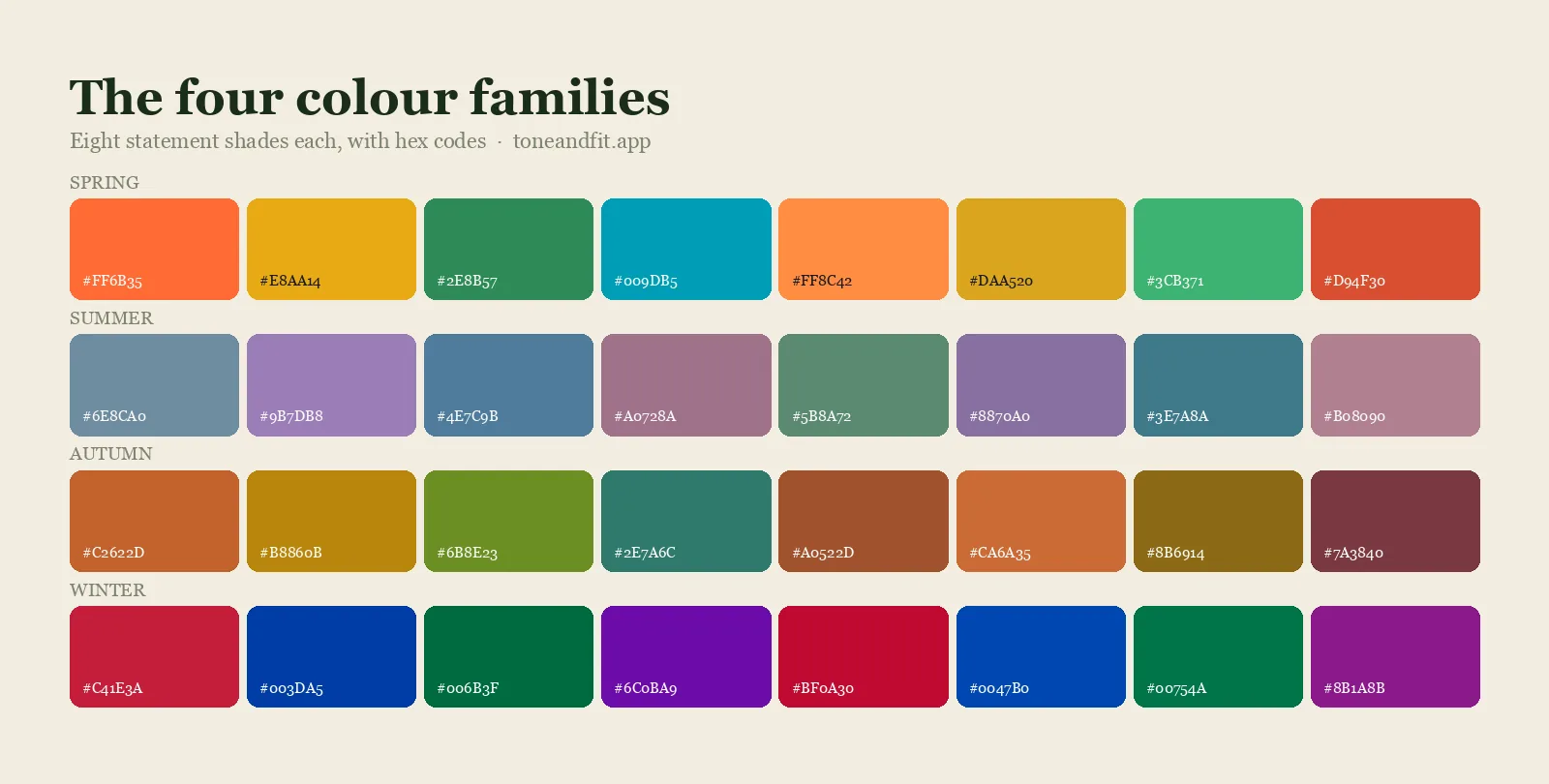
The fastest way to confirm your season is to measure undertone, depth and contrast directly rather than guess from a swatch under store lighting. The color analysis quiz is a quick starting point if you are new to the twelve-season system, and browsing the full color palette guides lets you compare your instinctive favorites against each season's actual named shades. If you are not sure which of the twelve you are yet, start with the 12 color seasons overview. For a more direct read, an AI color analysis app measures your real skin tone from a selfie and returns your season along with a full palette, which takes the guesswork out of matching a lipstick to a face rather than to a trend.
See your shades on your own face.
One selfie gives you your season, your undertone, and 40+ named shades including makeup guidance. Free to scan, no account needed, photo discarded after analysis.
Download Tone & Fit ↗FAQ
What is the best lipstick color for my color season?
Match your undertone first, warm, cool or neutral, then adjust the intensity to your season. Bright seasons wear a clear, saturated version of that undertone's best hue, soft and muted seasons wear the same hue toned down, and deep seasons can carry more pigment than light ones. The table above gives one confident pick for each of the twelve seasons.
Does my lipstick need to match my clothing color season exactly?
No. Lipstick sits much closer to your face than clothing does, so undertone matters more than an exact seasonal match. A True Summer can wear a slightly warmer neutral pink than her clothing palette would suggest, as long as the lipstick still leans cool rather than orange. Treat the picks above as a strong default, not a rule that overrides how a shade actually looks on you.
Can a Spring or Autumn wear a berry or plum lipstick?
Only in a warm-leaning version. A brownish berry or a warm brick-plum can work for Warm Autumn or Deep Autumn because the base still reads warm, but a true blue-based berry or plum belongs to Summer and Winter. If a berry lipstick looks slightly grey or chalky on warm skin, that is the blue base fighting the undertone.
Why does my season's lipstick pick look different on me than in the table?
Depth and personal pigmentation vary within every season. Two True Winters can have different natural lip color and different skin depth, so the exact shade that reads as true red may need to shift slightly darker or lighter to flatter each of them. Use the pick as a shade family to shop within, then test a few options against your own face rather than assuming one product is universal.
How is picking lipstick by season different from picking it by undertone alone?
Undertone tells you warm or cool, which rules out roughly half the color wheel immediately. Color season adds a second layer: how bright, soft, muted or deep the shade should be within that half. Two warm-undertone people, a Bright Spring and a Soft Autumn, both wear coral-adjacent shades well, but the Bright Spring wears it clear and saturated while the Soft Autumn wears a toned-down, greyed version of the same hue.