Best Lipstick Colors for Your Undertone: Warm, Cool, Neutral, and Olive

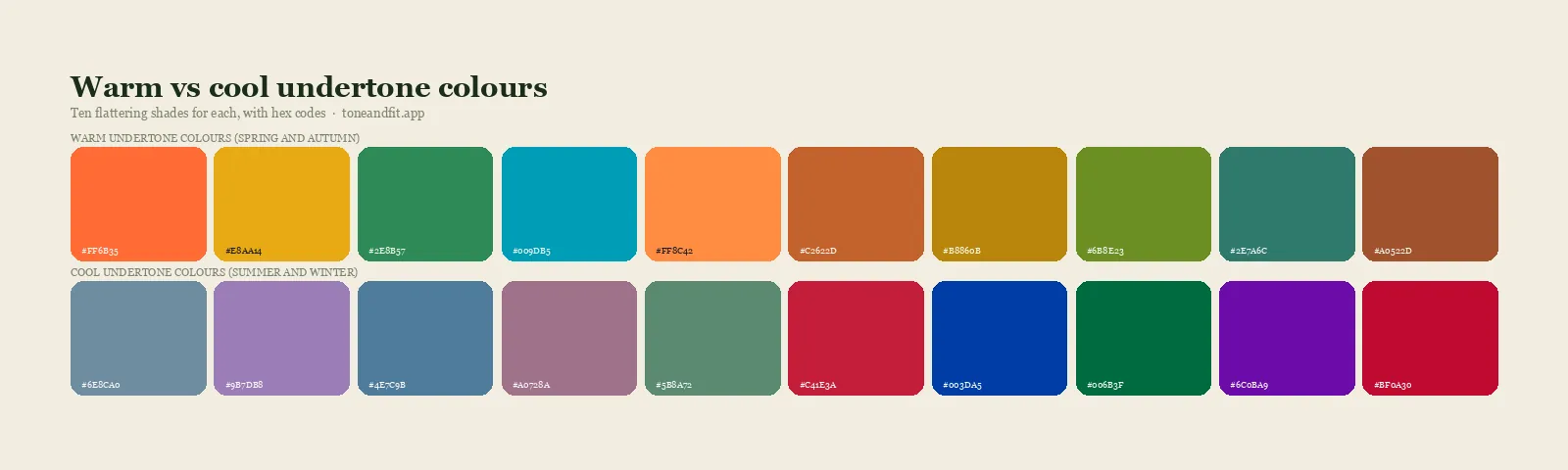
Warm undertones glow in lipsticks with a yellow or orange base: coral, brick, terracotta, warm nude, tomato red. Cool undertones glow in lipsticks with a blue or violet base: berry, raspberry, plum, mauve, cherry red. Neutral undertones can wear both and look best in true red and rosewood. Everything else in this article is detail on top of that one rule.
What's in this guide
- The rule: match the base, not the name
- Find your undertone in two minutes
- Best lipstick colors for warm undertones
- Best lipstick colors for cool undertones
- Best lipstick colors for neutral undertones
- Best lipstick colors for olive undertones
- The red question, settled
- Refining by color season
- Why your nude lipstick is not working
- How to test a lipstick before you buy it
- FAQ
The rule: match the base, not the name
Every lipstick, no matter what the shade is called, is built on either a warm base or a cool base. A red leans toward orange or toward blue. A pink leans toward peach or toward violet. A brown leans toward golden or toward mauve. That underlying lean is the only thing that decides whether the shade flatters your face, and it is almost never printed on the packaging.
When the base of the lipstick matches the undertone of your skin, the two harmonize. Your lips look like they belong to your face, your teeth read whiter by comparison, and any redness around your nose and chin becomes less noticeable. When the base fights your undertone, the lipstick sits on your face like a sticker. Warm skin under a cool violet pink looks slightly gray. Cool skin under a strong orange red looks flushed and uneven.
Undertone is the constant here, and it does not change with a tan, the season, or your age. If you have never pinned yours down, our guide to what colors look good on me covers the full self assessment, and this article picks up where that leaves off.
Find your undertone in two minutes
Three quick checks, in daylight, without makeup:
- The jewelry check. Hold gold near your face, then silver. Gold flatters warm undertones, silver flatters cool ones, and if both look fine you are likely neutral. The full version of this test is in our piece on the gold or silver jewelry test.
- The white paper check. Hold a sheet of plain white paper beside your bare face. Skin that looks yellow or golden against the white is warm. Skin that looks pink or rosy is cool. Skin that looks grayish or balanced is neutral or olive.
- The vein check. Look at the inside of your wrist in daylight. Green leaning veins suggest warm, blue or purple suggest cool, and a mix suggests neutral. Treat this one as a tiebreaker, not a verdict, because skin thickness distorts it.
Run all three and take the majority answer. If you want the longer versions with the ways each one misleads people, they are collected in how to find your skin undertone at home and the full undertone test guide.
Best lipstick colors for warm undertones
Warm skin has a golden, peachy, or yellow cast under the surface. It carries lipsticks that share that heat and gets muddied by anything with a strong blue base.
| Shade family | Named examples | Best for |
|---|---|---|
| Corals | Coral, papaya, warm watermelon | Daytime, lighter warm skin |
| Warm reds | Tomato, scarlet, poppy, warm cherry | Statement lip on any warm depth |
| Earth reds | Brick, terracotta, rust, paprika | Deeper warm skin, autumn coloring |
| Warm nudes | Caramel, honey beige, peachy nude, toffee | Everyday, no makeup makeup |
| Warm pinks | Peach pink, salmon, apricot rose | Softer alternative to coral |
What to avoid: icy pinks, blue based fuchsias, cool mauves, and anything described as berry. These push warm skin toward looking sallow, and the effect is the same one described in our piece on colors that wash you out, just concentrated on the lower third of the face.
Best lipstick colors for cool undertones
Cool skin has a pink, rosy, or bluish cast. It carries lipsticks with a blue or violet base and gets pulled toward looking flushed or orange by warm shades.
| Shade family | Named examples | Best for |
|---|---|---|
| Berries | Raspberry, blackberry, cranberry | The reliable cool signature |
| Cool reds | Cherry, crimson, ruby, blue red | Statement lip, especially Winter coloring |
| Plums | Plum, wine, damson, deep burgundy | Evening, deeper cool skin |
| Cool pinks | Rose, fuchsia, magenta, dusty pink | Daytime brightness |
| Cool nudes | Rosy beige, mauve nude, pinkish taupe | Everyday |
What to avoid: orange reds, brick, coral, and golden or caramel nudes. On cool skin these read as though the color is sitting on top of the lips rather than belonging to them, and they tend to emphasize any yellowness in the teeth.
Not sure which side of the line you are on?
Tone & Fit reads your undertone, depth, and chroma from one selfie in about 30 seconds. Free scan, no account, no quiz, and your photo is never stored.
Get Your Colors Free ↗Best lipstick colors for neutral undertones
Neutral skin sits between warm and cool without committing to either, which means the range is genuinely wide. The trade off is that extremes at both ends fall flat: a screaming orange red and an icy blue pink will each look slightly off, while everything in the middle works.
The strongest neutral shades are the balanced ones. True red, the kind that is neither orange nor blue when you look at it straight on. Rosewood. Dusty rose. Soft berry that has been warmed slightly. Brownish pink. Balanced nudes that are neither yellow nor pink.
If you are neutral, stop choosing lipstick by undertone and start choosing by intensity, because that is the dimension that will actually change your results. Our explainer on neutral undertone skin covers how to tell true neutral from the more common case of being warm or cool with a mild lean.
Best lipstick colors for olive undertones
Olive is the case standard advice handles worst. Olive skin carries a green cast layered over a warm or neutral base, which means it needs shades with enough depth and richness to hold their own. Thin, pale, or frosted shades disappear against it or make it read gray.
What works: brick, terracotta, brownish red, warm berry, deep rose, and rich brick nudes a couple of shades deeper than your natural lip. What consistently fails: pale frosty pink, baby pink, and anything with a strong blue violet base, plus most light nudes, which flatten olive skin completely.
Olive coloring behaves differently enough across the whole palette that we gave it its own breakdown in color analysis for olive skin tones, which is worth reading before you commit to a season, and the full best colors for olive skin tone guide extends the same logic to wardrobe, hair, and jewelry.
The red question, settled
The most common complaint in this entire category is some version of "red lipstick doesn't suit me." Almost always, it does. The specific red did not.
Red is a family, not a color. Every red sits somewhere on a line from orange to blue, and the position on that line decides who it flatters:
- Orange based reds (tomato, scarlet, poppy) belong to warm undertones.
- Blue based reds (cherry, crimson, true ruby) belong to cool undertones.
- True reds sit in the middle and suit neutral undertones, and are the safest choice when buying a gift or a first red.
If a red has ever made your teeth look yellow, you were most likely in an orange based red with cool undertones. If a red has ever made you look drained rather than striking, you were most likely in a blue based red with warm undertones. Swap the base and the same lipstick strength looks completely different.
Refining by color season
Undertone decides the base. Your color season refines the intensity, which is what separates a shade that is technically correct from one that looks like it was made for you. The three properties that define a season, temperature, depth, and clarity, apply just as cleanly to a lipstick bullet as they do to a sweater. The framework is laid out in seasonal color analysis explained.
| Season family | Lipstick character | Examples |
|---|---|---|
| Winter | Cool and clear, high saturation | Blue red, fuchsia, icy berry, true plum |
| Summer | Cool and soft, slightly muted | Dusty rose, soft raspberry, muted mauve |
| Autumn | Warm and rich, low to medium clarity | Brick, terracotta, warm brown red, russet |
| Spring | Warm and clear, bright and light | Coral, warm watermelon, peach pink |
Within each family, the sub seasons shift the volume. A Soft Summer wants a dustier version of the Summer shades, while a True Winter can carry the most saturated version of the Winter ones without being overtaken by it. The season specific makeup breakdowns go deeper on this, including the Cool Winter makeup guide, the Deep Autumn makeup guide, and the Warm Spring makeup guide. If you have not pinned down your season yet, start with the 12 color seasons and work back.
Why your nude lipstick is not working
Nude is the shade family with the highest failure rate, and the reason is a misunderstanding baked into the name. People buy a nude that matches their lips. A nude that matches your lips erases them, which removes a feature from your face and leaves the composition slightly unbalanced.
A nude that works follows two rules. It shares your undertone, so a warm caramel nude for warm skin and a rosy mauve nude for cool skin. And it sits one to two shades deeper than your natural lip color, so your mouth still registers as a feature.
The same logic that governs foundation applies here, which is why people who have already matched their foundation correctly tend to pick better nudes. If you have not, our walkthrough on finding your foundation undertone uses the same base matching approach, and the depth scale in the skin tone chart will tell you which row you are working from.
How to test a lipstick before you buy it
- Never swatch on the back of your hand. The skin there is a different depth and often a different apparent undertone from your face. Swatch on your fingertip or, better, your actual lips.
- Swatch in threes. A single shade in isolation tells you almost nothing. Put the candidate between one clearly warm shade and one clearly cool shade and the lean becomes obvious immediately.
- Check in daylight. Store lighting is engineered to make everything look good. Walk to a window or step outside before you decide.
- Look at your face, not your mouth. This is the one people skip. Apply the shade, then look at your whole face and specifically at the skin under your eyes and around your nose. The right lipstick makes that skin look clearer. The wrong one makes it look more uneven.
- Give it ten minutes. Many lipsticks shift as they settle, and warm shades in particular tend to deepen. Judge the settled color, not the first swipe.
Do this three or four times and you will stop needing the tests. The pattern recognition transfers, and it transfers beyond lipstick: the same base matching instinct is what makes the rest of a palette click into place, which is the whole premise behind the complete personal color analysis guide. It also carries straight over to nail color, since the same warm or cool base decides which polish shades work.
See your shades on your own face.
One selfie gives you your season, your undertone, and 40+ named shades including makeup guidance. Free to scan, no account needed, photo discarded after analysis.
Download Tone & Fit ↗FAQ
What lipstick color suits my undertone?
Warm undertones suit lipsticks with a yellow, orange, or golden base: coral, peach, brick, terracotta, warm nude, and tomato red. Cool undertones suit lipsticks with a blue or violet base: berry, raspberry, plum, mauve, rose, and blue red. Neutral undertones can wear both and look best in true red, rosewood, and balanced nudes. The base matters far more than the name printed on the tube.
How do I know if a lipstick is warm or cool toned?
Swatch it on your inner forearm next to a known warm shade like coral and a known cool shade like berry. A warm lipstick will look yellowish or orange next to the berry. A cool lipstick will look pink or blue next to the coral. If you have no reference shades, look at the bullet in daylight and ask whether the red leans toward orange or toward purple. Almost every red does one or the other.
Can I wear red lipstick with any undertone?
Yes, as long as you match the base of the red to your undertone. Warm undertones want an orange based red such as tomato or scarlet. Cool undertones want a blue based red such as cherry or true crimson. Neutral undertones can wear a true red that sits between the two. Red is not one color, it is a family, and the failures people blame on red are almost always a base mismatch.
Why does nude lipstick make me look washed out?
Because most nude lipsticks are picked to match the lips rather than to complement the face. A nude only works if it is a shade or two deeper than your natural lip color and shares your undertone. A cool pink nude on warm skin reads gray and drained, and a beige nude on cool skin reads muddy. Choose your nude by undertone first and depth second, and never lighter than your own lips.
Does my color season change which lipstick I should wear?
Your undertone decides the base, warm or cool, and your season refines the intensity. Bright seasons like True Winter and Bright Spring carry clear saturated shades. Soft seasons like Soft Summer and Soft Autumn look better in muted, dusty versions of the same hue. Deep seasons carry richer, darker shades, and light seasons look best in lighter ones. Same family, different volume.
What lipstick works for olive undertones?
Olive skin has a green cast layered over a warm or neutral base, so it does best in shades with enough depth and warmth to stand up to it. Brick, terracotta, warm berry, brownish red, and deep rose all work well. What tends to fail is pale frosty pink and anything with a strong blue violet base, which can make olive skin read gray. Depth is your friend more than brightness.
What's the best lipstick for warm undertones?
Coral, warm watermelon, tomato, scarlet, poppy, brick, terracotta, and warm nudes like caramel or honey beige. All of them share the golden or orange base that warm skin carries, so the lipstick reads as belonging to your face rather than sitting on top of it.
What are the best lipstick colors for cool undertones?
Raspberry, blackberry, cranberry, cherry, crimson, true ruby, plum, wine, and cool nudes like rosy beige or mauve. All of them share the blue or violet base that cool skin carries, which is why they look intentional rather than mismatched.
Is lip color the same thing as lipstick?
Lip color is the broader term, it covers lipstick, lip stain, tinted balm, and gloss, while lipstick is one format within it. The same warm or cool base rule applies to all of them: a cool undertone wants a berry or rose toned gloss the same way it wants a berry or rose lipstick, and a warm undertone reaches for the same coral or terracotta lean regardless of format.