Halloween Costume Colors by Season

The fastest way to pick Halloween costume colors is to treat the costume like any other outfit and match it to your color season: warm seasons come alive in rust, gold, and true red, while cool seasons come alive in jewel tones, icy brights, and blue-based red. Get that one match right and a five-dollar thrift-store costume reads as intentional instead of like something you're wearing.
In this guide
- Why does color season matter for a costume?
- Best Halloween costume colors for Spring
- Best Halloween costume colors for Summer
- Best Halloween costume colors for Autumn
- Best Halloween costume colors for Winter
- How the classic costume colors change by season
- Do wigs and face paint follow the same rules?
- How do you find your season before Halloween?
- FAQ
Why does color season matter for a Halloween costume?
Color season matters for a costume because a costume is still fabric near your face, and the same undertone and depth rules that make a sweater flattering or draining apply to a cape, a wig, or a layer of face paint. Costume fabric is often cheap and heavily saturated, dyed for shelf appeal rather than for how it reads against skin, which makes a bad color match more obvious, not less.
It also shows up more in photos than an ordinary outfit does, since Halloween is one of the few nights almost everyone photographs almost everyone else. A costume color that fights your undertone produces the same effect described in our piece on colors that wash you out: flatter contrast and a slightly grey cast to the skin. None of that ruins a costume; it just means one person photographs like they planned it and the other doesn't.
Best Halloween costume colors for Spring
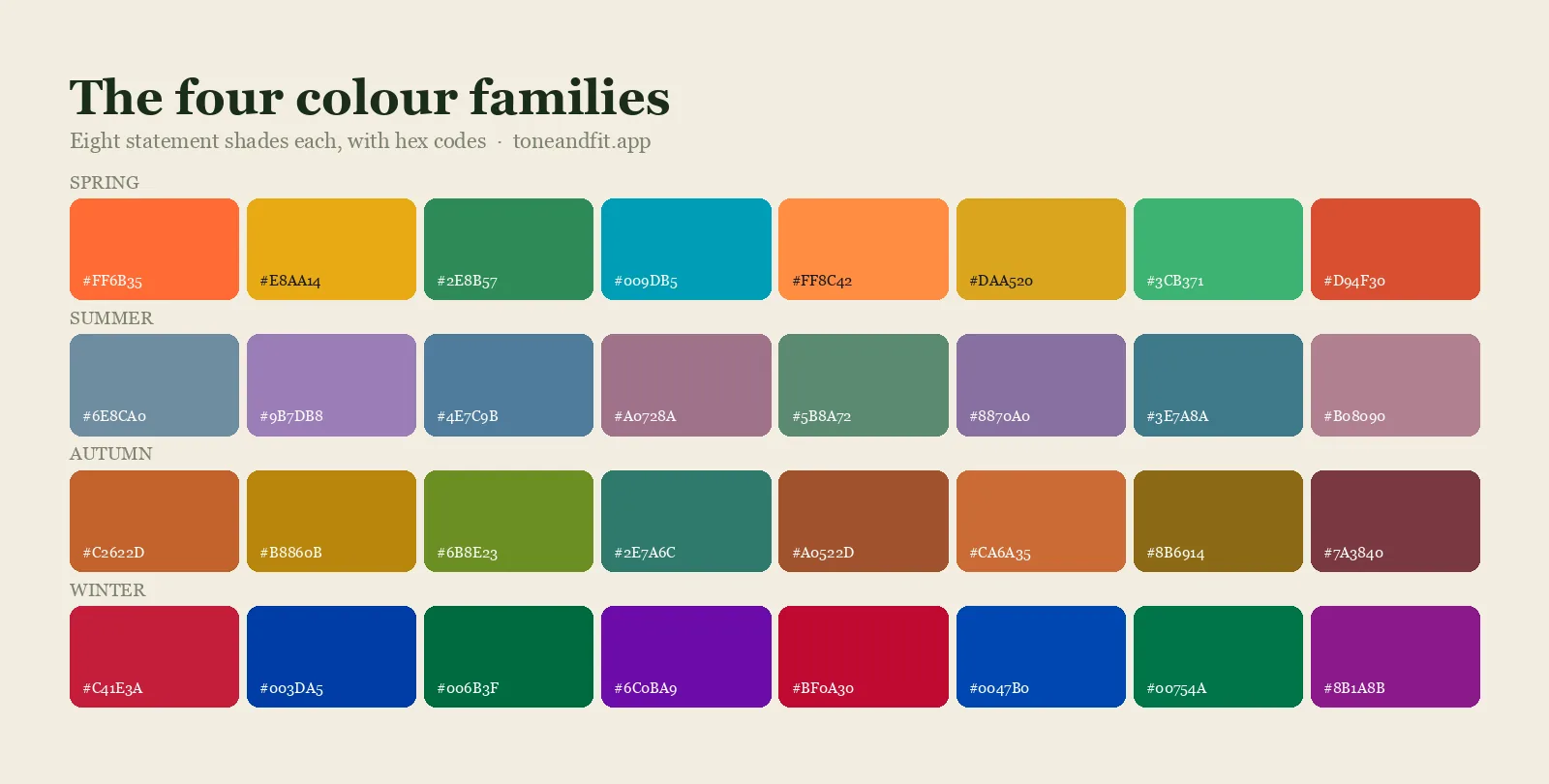
Spring's best Halloween costume colors are warm and clear: golden orange, coral, warm turquoise, and a true, tomato-based red. These are the same colors that make Spring skin glow in daylight, and they read just as well under a porch light or a phone flash.
What to lean into
Pumpkin orange, warm gold, coral, and clear green all work in Spring's favor, which makes a pumpkin, sunflower fairy, or golden mermaid an easy win. If a cloak calls for dark fabric, choose warm brown or rust over black; a chocolate brown witch reads just as spooky.
What to soften or skip
Stark black, icy pastel princesses, and cool grey ghost sheets tend to flatten Spring's warmth. If the costume must be black, move the fix to the wig, face paint, or a collar in warm gold or rust instead.
Best Halloween costume colors for Summer
Summer's best Halloween costume colors are cool and soft: powder blue, lavender, dusty rose, and a muted, blue-grey charcoal. These colors match the low-contrast, cool undertone that defines the Summer family, and they read as elegant rather than washed out under the orange-toned lighting most porches and parties use in October.
What to lean into
A lavender or powder-blue fairy, a dusty-rose ballerina, or a blue-grey pirate all sit comfortably in Summer's palette. For dark fabric, soft charcoal or blue-black reads as dramatic as true black, without the harsh edge pure black puts on softer coloring.
What to soften or skip
Head-to-toe pumpkin orange, mustard, and warm camel tend to work against Summer's cool undertone and can leave skin looking sallow next to the costume. A cooler swap, like a blue-red devil instead of an orange-red one, keeps the drama without the clash.
Best Halloween costume colors for Autumn
Autumn's best Halloween costume colors are warm and deep: rust, olive, mustard, and chocolate brown. This is arguably the easiest season to dress for on Halloween, since so many classic costume tropes, scarecrows, witches, and forest creatures, are already built from the same warm, earthy palette Autumn wears every day.
What to lean into
A scarecrow, a woodland witch in olive and rust rather than plain black, or a vampire in chocolate and burgundy instead of stark black all let Autumn's richness do the work. Mustard and warm teal make strong accents for a collar or hat band.
What to soften or skip
Icy blue fairies, cool pink princesses, and bright silver metallics tend to sit on top of Autumn coloring rather than blend with it. Swap silver trim for brushed or antique gold and it reads better in every photo.
Best Halloween costume colors for Winter
Winter's best Halloween costume colors are cool and bold: true black, stark white, true red, and jewel tones like emerald and royal purple. Winter is the one season built for the classic, high-contrast Halloween look, which is why the basic black-cape vampire or witch tends to work better on Winter coloring than on any other season.
What to lean into
A true-black cape, a stark-white ghost or geisha look, and a jewel-toned evil queen in emerald or royal blue all sit at the center of Winter's palette. High contrast is the theme: a black-and-white harlequin or skeleton reads especially sharp.
What to soften or skip
Head-to-toe camel, rust, or mustard, Autumn's earthy palette, can look muddy against Winter's cool clarity. A pastel fairy in the softest pinks can read flat too; a brighter, more saturated version usually suits Winter better.
How the classic costume colors change by season
The classic costume colors change by season mainly in how dark, warm, or saturated the shade should be, even when the costume idea stays the same. The table below maps five common Halloween costumes to the version each season wears best.
| Costume | Spring | Summer | Autumn | Winter |
|---|---|---|---|---|
| Witch's robe | Warm brown or rust, not black | Charcoal or soft plum, not black | Olive or chocolate brown | True black |
| Vampire cape | Deep warm burgundy | Blue-black or soft charcoal | Chocolate or espresso brown | True black or deep plum |
| Ghost or spirit | Warm ivory, not stark white | Soft, cool white | Warm cream | Stark, bright white |
| Devil or demon | Tomato red or golden orange | Blue-based red | Rust or burnt orange | True, blue-based red |
| Fairy or mermaid | Coral and warm turquoise | Powder blue and lavender | Teal and mustard gold | Emerald and royal blue |
Notice that black only tops the list for Winter. Every other season has a warmer or softer substitute that keeps the costume idea intact while working with the face wearing it. For the logic behind why one color name covers so many shades, our warm versus cool skin undertone guide breaks down the undertone half.
Do wigs and face paint follow the same rules?
Yes, because a wig sits directly next to the skin and face paint sits directly on it, so the same undertone rules apply. A wig color that flatters you as a haircut, covered in our guide to the best hair color for your skin tone, generally flatters you as a costume wig too: warm honey blonde for a Spring, cool ash blonde for a Summer.
Face paint is different because it usually covers the skin entirely, so undertone matters most at the edges, the jawline and neck, where paint meets untouched skin. A stark, blue-white paint can leave a visible grey seam on a warm season; an ivory or bone-toned white blends more smoothly and still reads convincingly pale. A colored design, like an orange sugar-skull or a green zombie tint, should lean warm or cool the same way a lipstick would, which our guide to finding your skin undertone at home can confirm before you buy the paint.
How do you find your season before Halloween?
The fastest way to find your season before Halloween is a short selfie scan, though a simple fabric test works too if you would rather not wait. Try this the night before you shop:
- Hold up a black top, then a chocolate brown one. Whichever makes your face look clearer is a first clue toward Winter or Summer versus Autumn or Spring.
- Hold up something stark white, then cream or ivory. Whichever looks brighter on you, rather than the fabric outshining you, points to your temperature.
- Hold up a bright jewel tone, then a dusty, muted version. Whichever one your face outshines tells you how saturated your best costume colors should be.
If you want a faster, more precise answer than fabric-holding gives you, take the seasonal color analysis quiz or run a photo through the free color analysis tool to get your season and full palette before you shop for a costume.
Know your colors before you shop for a costume
Take a selfie, get your season and a full personal palette, and shop for a cape, wig, or face paint that actually works with your coloring instead of against it.
Download Tone & FitFrequently asked questions
Do I really need to match my Halloween costume to my color season?
No one checks color seasons at the door, but it changes how the costume reads in photos. The same witch costume looks different with a cool, blue black cape versus a warm chocolate brown one: one can make your face look lit from within, the other like you are fighting your own outfit. Nobody notices the matching. They notice that your photos look better.
What is the most universally flattering Halloween costume color?
There is not one. Every color here flatters roughly a quarter of people and works against the rest, which is the whole premise of color season. The safest default is your own best dark neutral, black, chocolate, charcoal or navy depending on season, rather than whatever dark fabric the costume store happens to sell, since the darkest piece sits closest to your face.
My costume is mostly black. How do I fix it without buying new fabric?
Move the color instead of the fabric. Keep the black base and change what sits nearest your face and hands: a wig, hood lining, face paint, gloves, or a scarf in your season's best shade does most of the correcting work a full recolor would. A warm season can line a black hood in rust or gold; a cool season can swap in lavender or icy blue.
Does face paint follow the same undertone rules as makeup?
Yes, especially for anything meant to look like skin, such as a zombie pallor, a ghost, or a vampire. A stark, blue-white paint reads convincingly undead on a Winter and slightly grey on a warm season, where an ivory or bone-toned white does the same job without the grey cast. Colored paint follows the same warm-versus-cool split as the rest of your palette.
What if I'm dressing as a specific character with a fixed costume color?
Work the correction into whatever part the character does not dictate. A red superhero suit has to stay red, but you can choose whether that red leans orange, like tomato, or blue, like cherry, based on your undertone, and still tune the wig color, mask lining, or cape underside without breaking the costume's identity.
Can accessories fix a costume color that does not suit me?
Partially, and the closer the accessory sits to your face, the more it helps. A hood lining, glasses frames, jewelry, a headpiece, or the makeup under a mask sits exactly where eyes go first. A full-body costume in the wrong color is harder to rescue than a hat or collar, but swapping the items nearest your face closes most of the gap.