Holiday Party Colors by Season
Holiday party outfit colors that actually work have very little to do with red, green, or the calendar. They come down to the same three things that decide every color choice you make: your undertone, your depth, and your chroma. Here is the version of festive that flatters each season.
In this guide
Why holiday party colors depend on your season
Holiday party colors depend on your color season because the same red or gold that glows on one person's skin can flatten another's, regardless of what the calendar or the greeting cards suggest. "Wear red and green" is calendar advice, not styling advice, and it treats every red and every green as interchangeable when they are not.
The psychology around holiday colors is real: red reads as festive and confident, gold reads as celebratory, and a jewel tone reads as polished rather than costume-like. But which red, which gold, and which jewel tone depends on the relationship between the color and your own undertone, depth, and chroma, the same three variables that decide any outfit color, holiday or otherwise. Our guide to color combinations by season covers the same logic for outfits year round.
General rules for holiday party dressing
Four rules apply no matter which season you are. Build the outfit around one jewel tone or metallic from your own palette instead of a generic "holiday color." Keep the rest of the look in your best neutral, whether that is black, navy, chocolate, or warm ivory. Limit the total outfit to two or three colors so the look reads intentional rather than costume-like. And match your metals, jewelry, buttons, and any sequin trim, to your undertone: warm seasons wear gold and rose gold, cool seasons wear silver and platinum.
One accent is usually enough. A single statement piece, a sequin top, a velvet blazer, a jewel-toned dress, does more for a holiday look than color from head to toe, and it is far easier to get right for your season.
Holiday party colors, season by season
Not sure which season you are? A quick selfie with Tone & Fit answers it in under a minute, or read our guide to seasonal color analysis for the full picture. Here is what each season should reach for this year.
Spring: warm and bright
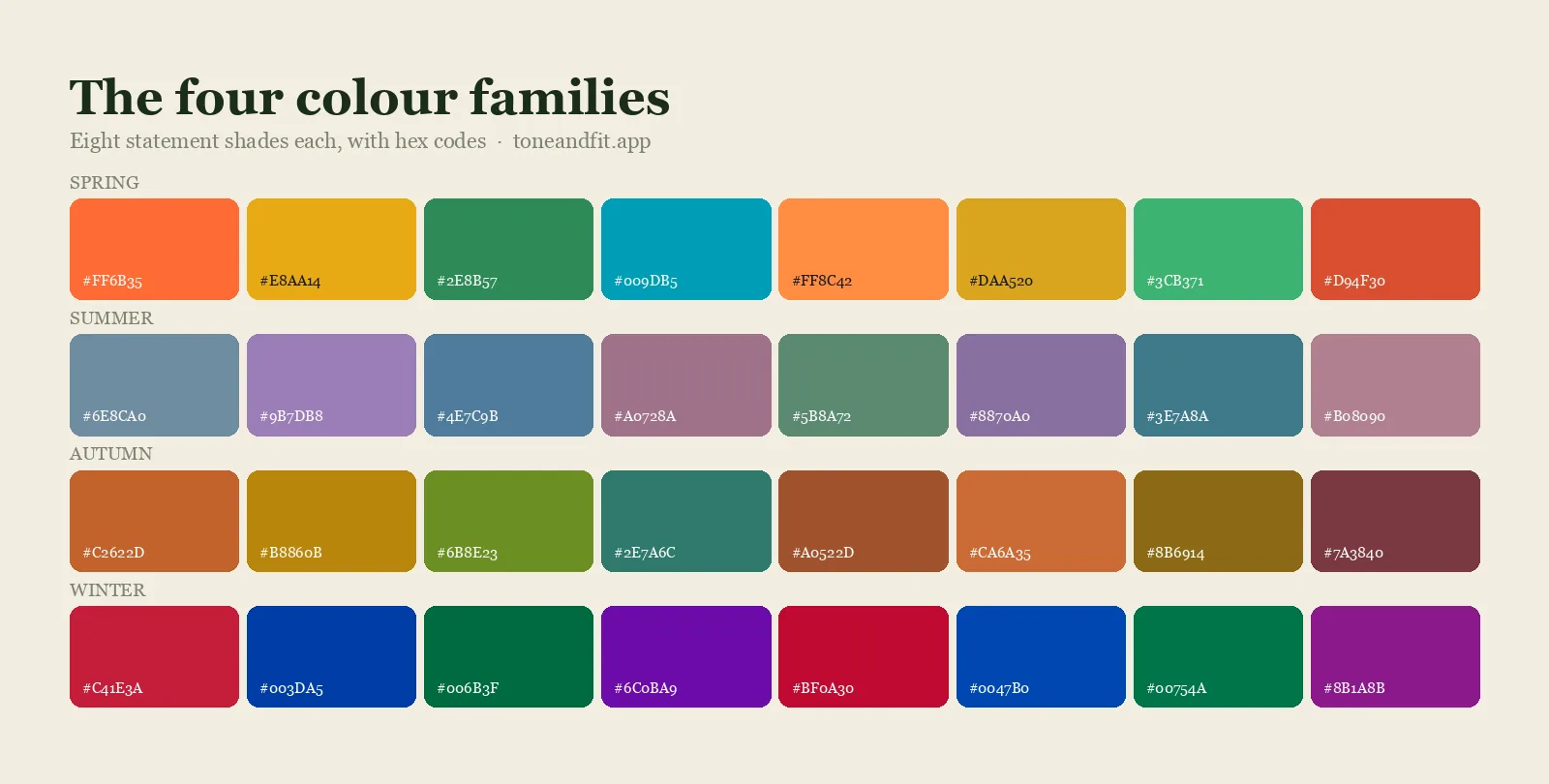
Best jewel tone: warm emerald, coral red, or golden yellow. These carry the vibrancy Spring coloring wants without tipping cool.
Best metallic: warm gold or rose gold, bright rather than antiqued.
Best neutral: warm ivory or camel rather than black, which can look heavy against Spring's light coloring.
Avoid: icy silver, cool burgundy, and true black head to toe. They mute the warmth that makes Spring coloring glow. See the full Spring palette for more.
Summer: cool and muted
Best jewel tone: soft sapphire, dusty rose, or muted plum, clear but never harsh.
Best metallic: silver or pewter, kept soft rather than mirror-bright.
Best neutral: soft navy or cool grey rather than stark black, which can overwhelm Summer's low-contrast coloring.
Avoid: gold sequins, bright orange-red, and warm bronze tones, which clash with Summer's cool undertone. See the full Summer palette for more.
Autumn: warm and deep
Best jewel tone: deep teal, burnt orange, or a true red with a brown base, closer to brick than fire-engine red.
Best metallic: antique or warm gold, bronze, or copper.
Best neutral: chocolate brown or warm charcoal rather than black, which can look flat against Autumn's rich coloring.
Avoid: icy silver, cool pink, and stark white, all of which fight Autumn's warm depth. See the full Autumn palette for more.
Winter: cool and bold
Best jewel tone: true red, emerald, or sapphire at full saturation. Winter is the one season built for maximum holiday sparkle.
Best metallic: silver, platinum, or white gold, as bright and clear as you can find.
Best neutral: true black or deep navy, both of which read as sharp rather than heavy on Winter coloring.
Avoid: muted earth tones, warm gold, and dusty pastels, which soften the clarity that is Winter's main asset. See the full Winter palette for more.
Know your colors before the invitations go out
The free web tool names your season from one selfie, with no sign-up. The app's scan is free too and shows your undertone, best metals and starter colors; your season and full palette in the app are an optional upgrade.
Find my season free → Get the app ↗Gold or silver: which metallic is yours?
Metallics matter more at holiday parties than at any other time of year, since sequins, jewelry, and even the wrapping paper in the room all compete for attention at once. Your undertone decides your metallic the same way it decides every other color.
| Season | Best metallic | Best jewel accent | Colors to skip |
|---|---|---|---|
| Spring | Warm gold, rose gold | Coral, warm emerald, golden yellow | Black, icy pastels, cool silver |
| Summer | Silver, pewter | Dusty rose, soft sapphire, muted plum | Gold, orange, warm bronze |
| Autumn | Antique or warm gold, bronze | Rust, deep teal, brick red | Silver, icy brights, stark white |
| Winter | Silver, platinum | True red, emerald, sapphire | Gold, muted earth tones, dusty pastels |
Do sequins and velvet change the rules?
Sequins and velvet follow the exact same undertone and chroma rules as any other fabric, they just make the effect more visible because both catch and hold light. A sequin in the wrong undertone doesn't just look slightly off the way a matte fabric might, it throws colored light directly onto your face from every angle, which can exaggerate a clash. Velvet does the opposite: its deep pile absorbs light and reads even richer than the same shade in a flat fabric, which is why velvet tends to favor the deeper seasons, Autumn and Winter, slightly more than it favors Spring and Summer.
The practical takeaway is to be more careful about undertone, not less, whenever a fabric sparkles or has texture. A gold sequin top on a cool Winter reads noticeably worse than a matte gold blouse would, simply because the sequins amplify the mismatch.
Common holiday color mistakes
- Wearing "Christmas red and green" without checking the shade. A true, blue-based red and a true emerald green flatter Winter types. Autumn types need a brick or rust red and a deep, warm forest green instead of the generic versions.
- Choosing a metallic by trend instead of undertone. Rose gold has been fashionable for years, but it only genuinely flatters warm and warm-neutral seasons. Cool seasons look better in silver or platinum regardless of what is trending.
- Over-layering color. Holiday outfits tend to accumulate a sequin top, a colored bag, patterned tights, and a bold lip all at once. Pick one true statement and let your best neutral carry the rest.
- Copying someone else's "holiday palette." A palette that reads sophisticated on a Deep Winter can read costume-like on a Light Spring wearing the exact same shades at the exact same saturation.
How to check this on yourself
The fastest way to confirm your holiday palette is to test your undertone directly rather than guess from a trend forecast. Hold a piece of gold and a piece of silver jewelry against your bare face in daylight and see which one makes your skin look clearer. Then hold a true red and a brick red, or an emerald and a forest green, next to your face the same way. Our seasonal color quiz walks through this same test in full, and the free photo tool or the Tone & Fit app can confirm it from a selfie in under a minute if you would rather skip the manual comparison.
Once you know your season, our guides to Thanksgiving outfit colors and costume colors by season apply the same undertone logic to the rest of the holiday calendar, and building a capsule wardrobe around your season helps make sure this year's party pieces actually get worn again in January.
Ready to find your season?
The free web tool names your season from one selfie, with no sign-up. The app's scan is free too and shows your undertone, best metals and starter colors; your season and full palette in the app are an optional upgrade.
Find my season free → Get the app ↗For the underlying reading, analyze your skin tone explains what undertone, depth and contrast actually are.
If the party is a date rather than a crowd, the same season logic applies with a warmer read on the fabric; our date night colors by season guide covers that case on its own.
Frequently asked questions
What color should I wear to a holiday party if I don't know my season?
Reach for your best neutral, black, navy, chocolate, or warm ivory, whichever already looks best on you in daylight, and add one metallic that matches your jewelry preference, gold or silver. That combination works reasonably well for most people even before you've confirmed your exact season, and you can add a jewel-toned accent once you know it.
Is red and green still the safest holiday combination?
Only if you choose the right version of each. A true, blue-based red and emerald green flatter cool Winter types, while a brick or rust red with a deep forest green flatters warm Autumn types. The pairing works across every season; the specific shades of red and green do not.
Should everyone avoid black at holiday parties?
No, but not every season should reach for the same black. Winter types tend to look sharp in true black. Spring and Autumn types often look better in a warm charcoal, chocolate, or navy instead, since true black can read as slightly heavy or harsh against warmer, lighter coloring.
What if my holiday party has a dress code or theme color?
Work within it. If the theme is red, choose the version of red closest to your own season, brick or rust for warm seasons, true or blue-based red for cool seasons, rather than whichever red is easiest to find. A dress code sets the category; your season still decides the exact shade.
Do sequins and metallics follow the same season rules as regular clothes?
Yes, and the effect is even more noticeable, since sparkle and shine reflect light directly onto your face. Warm seasons generally do better in gold, bronze, and copper sparkle, and cool seasons generally do better in silver and platinum, the same undertone logic as any other fabric.
Can I check my color season from a photo?
Yes. The free Tone & Fit web tool reads your color season from one selfie in about 30 seconds, with no sign-up and no photo stored by us. The Tone & Fit app for iPhone and Android then builds your full palette of 38 named shades.