Olive Undertone: Signs, Colors and Seasons
An olive undertone is a soft green or grey-green cast that sits over warm or neutral skin, most often seen in Mediterranean, Middle Eastern, South Asian, Southeast Asian, Latin American, and mixed-heritage complexions, though it can appear on any background. It is not a fourth undertone next to warm, cool, and neutral: it is a surface layer that usually rides on top of one of those three, which is exactly why standard undertone tests give olive skin such mixed results.
Quick answer
Olive is a green-gray cast, not a fourth undertone. Underneath it, most olive skin reads neutral to warm, which usually lands it in Soft Autumn, Warm Autumn, Deep Autumn, or occasionally Soft Summer. Jump to the four olive subtypes to find your exact lean, or skip straight to how to check it on yourself.
What's in this guide
What is an olive undertone?
An olive undertone is the term for a green or grey-green tint that lies over the surface of your skin, on top of whatever warm, cool, or neutral undertone sits underneath it. Colorists treat it as an extra layer of pigment rather than a fourth category, because the green cast can sit over a warm base, a cool base, or a neutral one, and each combination wears a slightly different palette.
The confusion starts because most undertone tests, paper, veins, jewelry, were built to sort warm from cool, and olive skin can pull an ambiguous result from all three at once. That is not a flaw in you: it is the tests missing a variable they were not designed to measure. Our broader guide to neutral undertone skin covers the same problem from the neutral side, since olive and neutral overlap for a large share of people.
Olive skin is most commonly associated with Mediterranean, Middle Eastern, South Asian, Southeast Asian, Latin American, and mixed-heritage complexions, but the cast is not strictly tied to ancestry. Plenty of people outside those groups are olive, and plenty of people within them are not.
7 signs you have an olive undertone
The clearest sign of an olive undertone is a faint green or khaki cast visible at your jawline or inner forearm in daylight, most obvious next to true white. If that single check feels inconclusive, run through the fuller list below; most olive skin shows at least four or five of these.
- Next to pure white paper or fabric, your skin reads green or khaki rather than clearly pink or clearly golden.
- Your veins look blue-green rather than confidently blue or confidently green, which is why the classic vein test rarely gives olive skin a clean answer.
- Gold and silver both look acceptable against your neck, but neither one makes your skin visibly brighten the way it does on non-olive skin, until you find the right shade of each.
- You tan quickly and deeply, rarely burn, and the tan holds its color for weeks instead of fading to pink.
- Foundation shades labeled pink-beige or rosy-beige consistently look chalky or ashy on you, even when the depth is correct.
- Grey, dove, and other greige neutrals wash you out rather than balancing you, because they add more grey-green on top of a cast your skin already carries.
- Your eyes are commonly hazel, amber, warm brown, or deep brown with gold flecks, though this sign is the least reliable on its own.
Olive vs warm, cool, and neutral undertone
Olive is not a fourth undertone sitting next to warm, cool, and neutral: it is a cast that lies over one of those three, most often a neutral or warm base. The table below shows how each undertone reads on its own, and where olive sits relative to them.
| Undertone | What's underneath | How it reads next to white |
|---|---|---|
| Warm | Yellow, golden or peach cast | Skin looks golden or peachy |
| Cool | Pink, red or blue cast | Skin looks pink or rosy |
| Neutral | An even balance of warm and cool | No strong cast either way |
| Olive (a cast, not a fourth undertone) | Usually a neutral or warm base underneath | Skin looks green or khaki, veins read ambiguous |
Because olive sits on top of another undertone rather than replacing it, the practical question is never just "am I olive." It is "am I olive-warm, olive-neutral, olive-cool, or olive-deep," since that second word is what actually decides your palette. For a full breakdown of how neutral and olive relate, see our dedicated piece on neutral undertone skin, and for the deeper mechanics of how olive specifically behaves in a color analysis, this companion guide goes further than we can here.
The four types of olive undertone
Olive skin splits into four practical types, warm olive, cool olive, neutral olive, and deep olive, and the type matters more than the word olive on its own for deciding what to wear. If you have read the descriptions below and still cannot place yourself, work through the four comparison tests built for a green cast, which are designed for exactly the case where the vein test and the jewellery test disagree.
| Type | How to spot it | Colors that work | Usual season family |
|---|---|---|---|
| Warm olive | Golden-green skin, deep even tan, gold jewelry clearly wins | Olive green, rust, camel, mustard, teal | Warm Autumn or Soft Autumn |
| Cool olive | Grey-green skin, burns before it tans, silver reads cleaner | Sage, slate blue, mulberry, cocoa | Soft Summer, sometimes Cool Winter |
| Neutral olive | No clear metal winner, the most common type | Camel, teal, warm cream, dusty coral | Wide range, often Soft Autumn or Soft Summer |
| Deep olive | Rich depth, common in Mediterranean, South Asian, Middle Eastern, Latin American and mixed skin | Emerald, aubergine, saffron, chocolate | Deep Autumn or another deep season |
These four are a starting point, not a verdict. Undertone still needs to be confirmed against value (how light or deep your whole coloring reads) and chroma (how soft or bright your best colors are) before a specific 12-season answer is safe to commit a wardrobe to.
Which color season fits an olive undertone?
There is no single season assigned to olive skin: it can land in Soft Autumn, Warm Autumn, Deep Autumn, or Soft Summer, depending on how warm or cool the base underneath the green runs and how much depth and softness the rest of your coloring carries. Warm olive tends toward the Autumn family, cool olive tends toward Summer, and deep olive of any temperature tends toward whichever deep season matches its warmth.
This is also why olive skin gets misread so often by quick, single-question quizzes. A quiz that only asks "gold or silver" or "do you tan or burn" cannot separate the surface cast from the undertone underneath it, and olive is exactly the case where those two questions can point in different directions. Testing value and chroma alongside undertone, not undertone alone, is what actually narrows an olive complexion down to one of the twelve seasons.
Best colors and metals for olive undertones
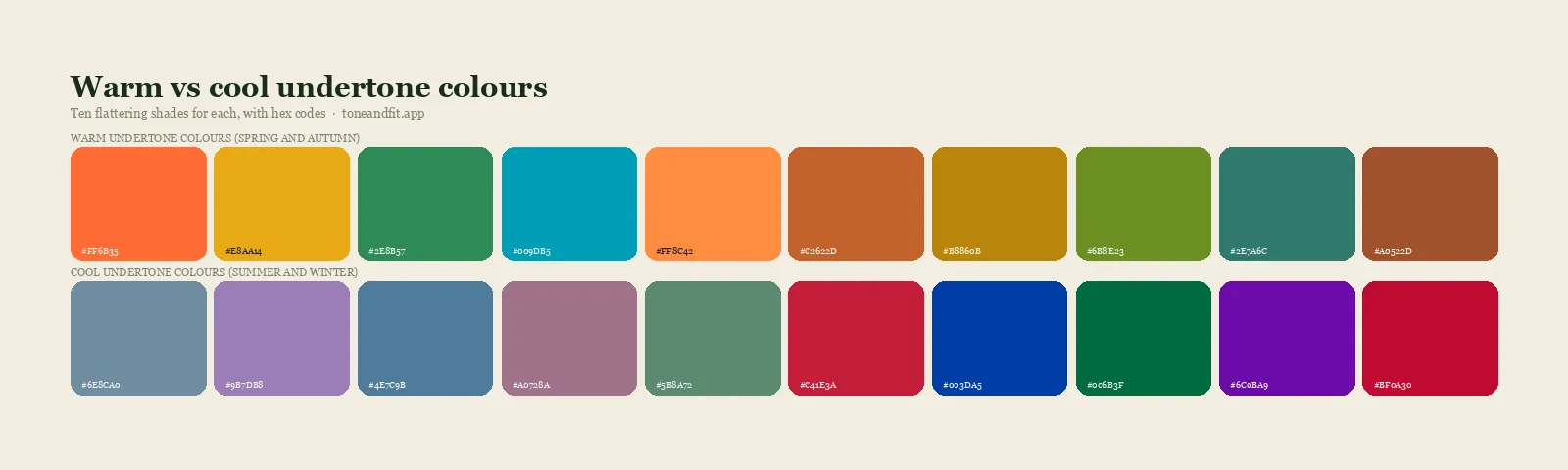
The colors that flatter an olive undertone are the ones that share its green-gold quality instead of fighting it: olive green, moss, sage, teal, rust, camel, mustard, and warm cream. Icy pastels, stark white, and cold dusty pink tend to fight it, because they sit opposite the green cast on the color wheel and make it more visible instead of less.
For the complete shade list broken down further by subtype, our guide to the best colors for olive skin tone has the full table across nine color families.
Metal follows the same subtype logic as clothing. Gold and antique brass generally read richer on warm and deep olive skin, silver and platinum read cleaner on cool olive, and neutral olive is the one type where both metals genuinely work, so the deciding factor becomes finish rather than color: brushed usually beats bright polished for most olive skin regardless of temperature. Our full breakdown in gold or silver for your undertone covers the jewelry test in more depth.
Stop guessing your undertone.
Tone & Fit's AI reads your undertone, value, and chroma from one daylight selfie, olive cast included, and hands you the palette that actually works.
Try the App ↗How to check your own undertone at home
The fastest reliable way to confirm an olive undertone is to combine the white paper test with a photo reading, because the vein test alone is the least trustworthy check for olive skin specifically. Veins already read blue-green on most olive skin regardless of the true undertone underneath, so a test built around vein color is measuring the wrong variable for you.
Start with the white paper test: hold true white paper at your jawline in indirect daylight. A green or khaki cast against the white confirms the olive surface tone; whether that cast sits on a warm or cool base is the harder call, and it usually needs a second check. Our step by step guide to finding your skin undertone at home walks through the paper, vein, and jewelry tests in full, with notes on where each one tends to mislead olive skin.
For a faster, more direct answer, a photo reading removes the guesswork a mirror cannot resolve. Tone & Fit's seasonal color analysis quiz is a reasonable first pass if you cannot take a photo right away, and the free photo analysis tool reads your undertone, value, and chroma directly from a daylight selfie and returns your full season and palette in about a minute.
Ready to find your season?
One selfie, your 12-season result, and the palette that goes with it. Free, no sign-up.
Find your season free ↗FAQ
Is olive undertone a real undertone, or just a skin tone?
Olive is best understood as a surface cast, not a fourth undertone alongside warm, cool, and neutral. It is a green or grey-green tint that sits over one of those three, most often a neutral or warm base, which is why two olive-skinned people can still test as different undertones once you look underneath the cast.
Can olive skin be cool toned?
Yes. Cool olive is real, though less common than warm or neutral olive. It shows up as a greyer, ashier version of the green cast, burns before it tans, and usually looks cleaner in silver than in gold. Most cool olive skin lands in Soft Summer or, less often, Cool Winter.
Does having an olive undertone mean I'm neutral?
Not automatically. Most olive skin leans neutral to warm underneath the cast, but a smaller share leans cool. Olive describes what you see on the surface, neutral describes the warm to cool balance underneath it, and the two only overlap for some people.
Do gold and silver both look good on olive undertones?
It depends on the subtype. Warm and deep olive usually look richer in gold, cool olive usually looks cleaner in silver, and neutral olive is the one subtype where both metals genuinely work. If neither metal makes your skin look brighter, try a brushed or antique finish before ruling out a whole metal family.
Does an olive undertone change with a tan?
No. A tan adds surface pigment, which can make the green cast more or less obvious depending on how deep it gets, but the undertone chemistry underneath does not change. A tanned warm olive is still warm olive.
What is the best foundation match for olive skin?
Look for a foundation described as olive, neutral-warm, or golden-beige rather than pink-beige or rosy-beige, since pink-undertoned foundations are the most common mismatch on olive skin. Testing along the jawline in daylight, not under store lighting, is still the most reliable check regardless of what the label says.