Gold or Silver? The Jewelry Test for Your Skin Undertone (And When It Lies)
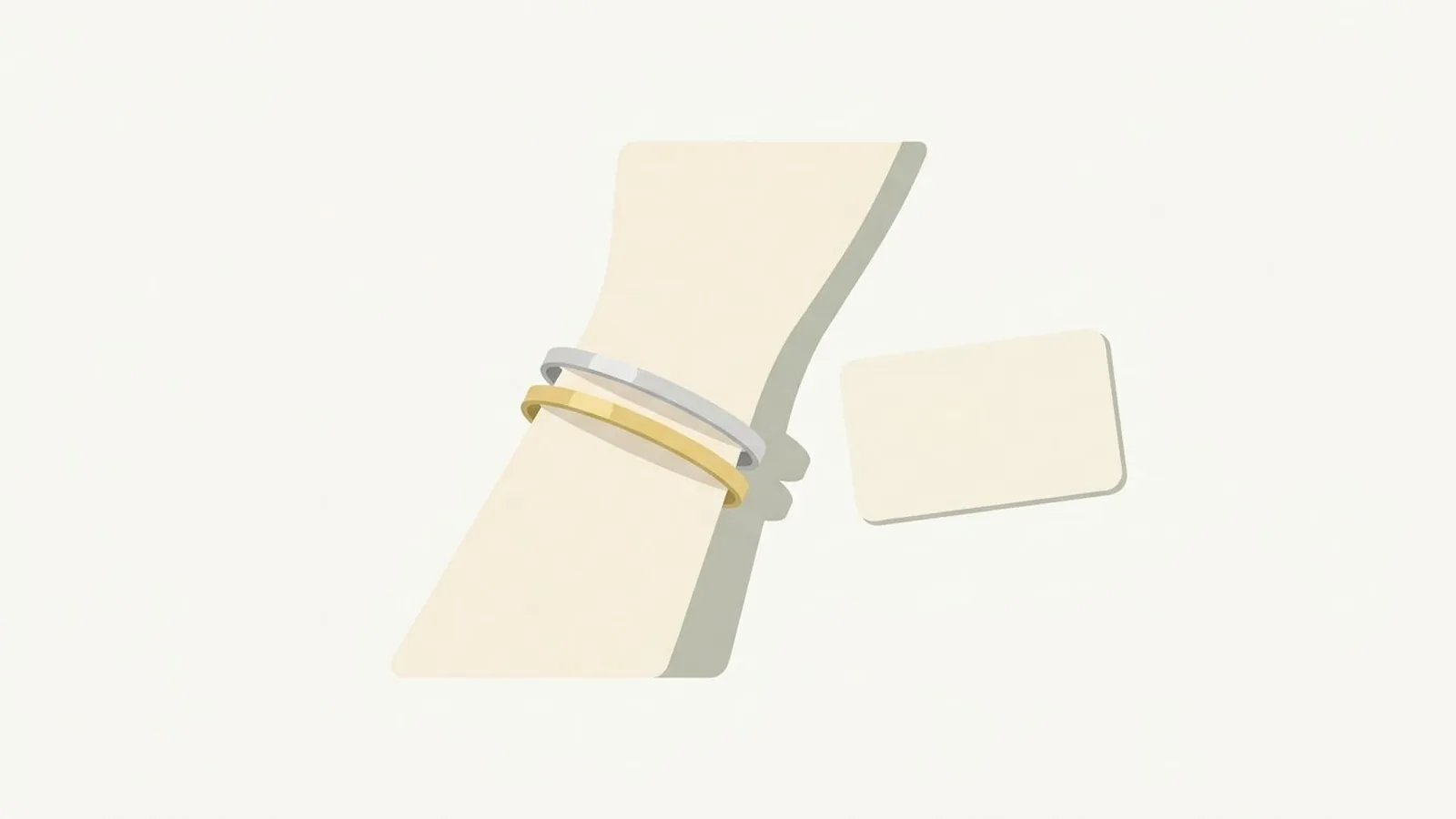
The jewelry test is the fastest undertone check there is, and also the one most likely to give you the wrong answer. Here is how to run it so it actually tells you something.
What's in this guide
- Why metal reveals your undertone at all
- How to run the test properly
- Reading your result: gold, silver, or both
- Five ways the jewelry test lies to you
- Beyond gold and silver: rose gold, copper, platinum
- Your best metal by color season
- What to do if you love the "wrong" metal
- How to confirm the result
- FAQ
Why metal reveals your undertone at all
Jewelry is not magic. It is a mirror. Polished metal reflects light back onto the skin directly beneath and around it, and the color of that reflected light is not neutral. Yellow gold throws warm, amber-toned light upward onto your jaw, neck, and wrist. Silver throws cool, bluish-white light. What you are actually judging when you hold up a necklace is not the necklace. It is what a small, targeted wash of warm or cool light does to your face.
That is the principle behind professional draping, where a colorist holds fabric under your chin and watches how your skin responds. The metal version is smaller and more portable. It works because your skin has a bias built in: melanin reads yellow to golden brown, hemoglobin reads pink to bluish red, and whichever leads sets your temperature. The full mechanics are in the warm vs cool skin undertone guide.
Warm light on warm skin reinforces what is already there, so the eye reads the surface as even and healthy. Warm light on cool skin fights it: the amber reflection collides with the pink underneath and produces the muddy middle ground we register as sallow. Silver on warm skin does the reverse, draining the gold out and leaving skin gray.
So the test is real. It is also fragile, because everything else in the room is throwing light at your face too.
How to run the test properly
Most people run this test badly and then trust the answer for years. Five minutes of setup makes the difference between a real signal and a coin flip.
What you need
- Two pieces of similar size, shape, and finish. A chunky gold cuff against a thin silver chain is not a fair fight. Surface area and shine both matter, so match them as closely as you can.
- Indirect natural daylight. Stand a step back from a window, facing it, ideally mid-morning or mid-afternoon. Avoid direct sun, which blows out the comparison, and avoid a north-facing room at dusk, which turns everything blue.
- Bare skin. No foundation, no bronzer, no tinted moisturizer, no self tanner residue. These are the single biggest source of false results.
- A neutral background. Wear white or light gray, or drape a plain white towel over your shoulders. A red top or a saturated blue wall will bounce color onto your neck and quietly decide the answer for you.
The four steps
- Hold the gold piece against the inside of your wrist, resting on the skin, for about ten seconds. Then swap to silver on the same spot for ten seconds.
- Repeat at the collarbone and jaw. The wrist is convenient but thin-skinned and vein-heavy, so face-adjacent skin is the better read.
- Watch your skin, not the metal. This is the step nearly everyone gets wrong. You are not judging which piece is prettier. You are judging what happens to the skin around it.
- Go back and forth three or four times. First impressions drift, and the difference is often subtle enough that it only becomes obvious on the third pass.
The question is never "which metal do I like more?" It is "which metal makes my skin look like it is doing less work?"
Reading your result: gold, silver, or both
You are looking for a specific set of effects, and they show up on your skin rather than on the jewelry.
Gold wins if
- Skin looks warmer and more even, with a lit-from-within quality
- Under-eye shadows soften
- Redness around the nose and cheeks calms down
- Silver, by contrast, makes you look gray, washed out, or slightly ill
Silver wins if
- Skin looks clearer and brighter, with more definition at the jaw
- Any yellow or sallow cast recedes
- Your eyes and features look sharper against the skin
- Gold, by contrast, makes you look sallow, jaundiced, or muddy
If neither result is decisive, that is a result too, not a failure. Roughly one in five people is neutral, meaning warm and cool pigment sit close to balanced, and both metals settle in comfortably. Neutrals get told constantly that they must be running the test wrong. They are not. The guide to neutral undertone skin covers how to find your faint lean when both metals pass, which is the more useful question at that point.
Olive skin deserves a note. Its green-gray surface cast sits on a usually neutral-to-warm undertone, and high-shine yellow gold can exaggerate the green while bright silver flattens it. Softer, less reflective versions of both work better. Fuller breakdown in the olive skin tone guide.
Skip the squinting.
Tone & Fit measures the actual pixel temperature of your skin from one selfie and tells you exactly how warm, cool, or neutral you are. No lighting setup required.
Analyze My Colors ↗Five ways the jewelry test lies to you
This test has a reputation for being unreliable, and the reputation is earned. But it is not the method that fails. It is the conditions. Here are the five culprits, roughly in order of how often they wreck the result.
1. Indoor lighting
A warm incandescent bulb at 2700K pours yellow over everything, flattering gold and making silver look dead. A cool white LED at 5000K does the reverse. Bathroom vanity lighting is the worst offender, usually both harsh and strongly tinted. If you have ever gotten one answer at home and the opposite in your car, this is why.
2. A tan, recent or fading
A tan adds melanin to the surface of your skin, and melanin reads warm. Cool-undertoned people frequently find that gold suddenly looks better in August and stops working by November. Your undertone did not change. Your surface did. The fix is to test on skin that has not seen sun, such as the inner upper arm or the skin just below the collarbone under a shirt line.
3. Makeup and self tanner
Foundation is formulated with its own undertone, and if yours is a shade too warm or too cool it will decide the test before you start. Bronzer, blush, and self tanner all do the same. Test bare or do not bother testing. If your foundation has always looked slightly off on you, that is a clue in itself, and the at-home undertone test guide walks through several checks that use it as evidence rather than interference.
4. Metal that is not what it claims
Gold-plated brass, rose-tinted "gold," rhodium-plated silver, white gold, and stainless steel all sit at different points on the warm-cool scale despite being sold under similar names. White gold in particular is a warm-hued alloy plated with cool rhodium, and as the plating wears the piece drifts warmer. Test with pieces you are confident about, and prefer solid metals over plated ones.
5. Familiarity bias
If you have worn silver every day for a decade, gold will look wrong on you for the first thirty seconds regardless of your undertone, simply because it is unfamiliar. This is the reason for the back-and-forth passes. The first impression is often habit talking. By the third pass, habit has quieted down and you are looking at actual skin response.
Worth saying plainly: none of this means color analysis is guesswork. It means a single at-home test has real error bars, which is a different claim. If you have run into people dismissing the whole field, the argument is examined properly in is color analysis a scam.
Beyond gold and silver: rose gold, copper, platinum
The binary is convenient but incomplete. Metals sit on a spectrum, and the ones between the two poles are often the most useful for people who do not land cleanly on either side.
| Metal | Temperature | Best for |
|---|---|---|
| Yellow gold | Strongly warm | Warm and neutral-warm skin, especially medium to deep depth |
| Rose gold | Warm with pink cast | Warm and neutral-warm skin, particularly lighter and pink-leaning warm coloring |
| Copper and bronze | Deeply warm, low shine | Rich warm coloring that gets overwhelmed by high-shine yellow gold |
| Antique or brushed gold | Warm, muted | Soft and muted seasons that find polished gold too loud |
| Sterling silver | Cool | Cool and neutral-cool skin across all depths |
| White gold and platinum | Cool, bright | High-contrast cool coloring that can carry a very bright metal |
| Brushed or oxidized silver | Cool, muted | Soft cool seasons where bright white metal looks stark |
The row people underuse is antique gold. Someone who has decided gold "does not suit them" has often only ever tried the high-polish version. The same applies to brushed silver on the cool side.
The same spectrum governs eyeglass frames, which sit even closer to your face than a necklace does. If you wear glasses, our guide to choosing frames that match your undertone maps these metals and their acetate equivalents onto the frame wall.
Your best metal by color season
Metal choice is really a downstream consequence of your season, because a season already encodes temperature along with depth and clarity. If you know your season, you can skip the test entirely. If you do not, the 12 color seasons overview is the fastest way to place yourself, and seasonal color analysis explained covers the three measurements underneath it.
| Season | Best metal | Note |
|---|---|---|
| Cool Winter | Silver, white gold, platinum | Bright, high-shine cool metals hold up to the contrast |
| True Winter | Silver, platinum | Gold reads distinctly off against clear cool coloring |
| Deep Winter | Silver, gunmetal | Can carry the boldest metals of any season |
| Cool Summer | Silver, brushed silver | Softer finishes over mirror shine |
| Soft Summer | Brushed silver, pewter | Bright white metal can look stark on muted coloring |
| Light Summer | Silver, light rose gold | Delicate pieces suit the low contrast |
| Warm Spring | Yellow gold, rose gold | Bright, clear gold is the natural match |
| True Spring | Yellow gold | Polished and warm, the more luminous the better |
| Light Spring | Light gold, rose gold | Fine gauges over heavy statement metal |
| Warm Autumn | Gold, copper, bronze | Rich, low-shine warm metals |
| Deep Autumn | Antique gold, bronze | Depth and warmth together, matte over mirror |
| Soft Autumn | Antique gold, brushed brass | Muted warmth, nothing highly polished |
Three of these deserve a closer look because they are the seasons where the metal question comes up most. Cool Winter is the clearest silver case in the system, and gold on Cool Winter skin is one of the most visible mismatches in color analysis. Warm Spring is the mirror image on the gold side, bright and clearly warm. Deep Autumn is the one people most often get wrong, because the depth suggests silver while the underlying temperature is firmly warm, which is why antique gold rather than bright gold is usually the answer.
Whatever your season, treat the metal as a layer of the palette rather than an afterthought. Watch cases, belt buckles, zips and glasses frames all sit next to skin and all read as color, so picking one primary metal is part of building a personal color palette that actually coordinates, alongside the neutrals, main colors and accents.
What to do if you love the "wrong" metal
Color analysis is a tool for making choices easier, not a set of rules to feel guilty about. Wear what you like. That said, there are ways to wear a non-ideal metal that keep it from working against you.
- Move it away from your face. The effect is strongest within about a foot of your jawline. A silver watch on a warm-skinned person is nearly invisible as a problem. Silver hoops are a different story.
- Mix, with a clear lead. Mixed metals look deliberate when one leads at roughly a three-to-one ratio. Put your flattering metal at the ears and neckline, and let the other appear on wrists and fingers.
- Change the finish. If bright silver drains you, brushed or oxidized silver may not. If yellow gold overwhelms you, antique gold often will not. Shine is a separate variable from temperature.
- Use stones as a buffer. A setting where the stone dominates and the metal is a thin frame largely sidesteps the issue.
- Balance at the neckline. Wearing a color from your own palette next to the skin does more work than the metal does, so a flattering top can carry a non-ideal necklace.
This is the same logic that applies to hair, where the color closest to your face has an outsized effect. The hair color for skin tone guide covers that side of it, and the two decisions tend to point in the same direction.
How to confirm the result
One test is a data point. Three agreeing tests are a conclusion. Before you rebuild a jewelry box around a single wrist comparison, cross-check it.
Run the white paper test, holding pure white against ivory next to your face. Check your veins in daylight for blue versus green. Think about which lipsticks have historically looked right on you, since blue-based reds favor cool skin while corals favor warm. All of these are laid out step by step in the at-home undertone testing guide. Consistent disagreement across them points to neutral, which is a real category rather than a null result.
The alternative is to remove the lighting variable entirely. Software analysis samples the actual color values of your skin in a photograph and computes temperature numerically, sidestepping the bulb-and-tan problem that makes the jewelry test wobble. The mechanics are in how AI color analysis works, and if you are weighing that against a professional session, app versus consultant compares the two. For the wider system, start with the complete personal color analysis guide.
Two last notes. The test is not gendered, and gold versus silver is one of the most practical entry points into color for men, covered in color analysis for men. And Korean color analysis, which weights metal choice heavily, explains how that framework maps onto the twelve-season system.
Get the answer in 60 seconds.
One selfie gives you your exact undertone, your 12-season match, and the metals, colors, and neutrals that go with it. Free to try on iPhone.
Try Tone & Fit ↗FAQ
Does gold or silver suit me better?
Gold generally suits warm undertones, where yellow and golden pigment dominates, and silver generally suits cool undertones, where pink and blue pigment dominates. The reliable way to tell is to hold both metals against bare skin in indirect daylight and watch your skin rather than the metal. The flattering metal makes your skin look even and clear. The wrong one pulls shadows, sallowness, or redness to the surface.
Is the gold or silver jewelry test accurate?
It is directionally useful but easily corrupted. Indoor bulbs, a fresh tan, foundation, self tanner, and the color of your clothing all shift the result. The test is at its most accurate on bare, makeup-free skin in indirect natural light, using two pieces of similar size and finish. Treat it as one data point among several rather than a verdict.
What if both gold and silver look good on me?
That is the classic signature of a neutral undertone, which describes roughly one in five people. Neither warm nor cool pigment dominates, so both metals sit comfortably against your skin. Most neutrals still have a faint lean, which shows up when you compare a soft antique gold against a soft brushed silver rather than two high-shine pieces.
Who does rose gold suit?
Rose gold is copper alloyed into gold, so it reads warm with a pink cast. It flatters warm and neutral-warm skin especially well, and it is often the easiest metal for people with pink-leaning warm coloring or light warm seasons like Light Spring. Deep cool skin usually finds it too soft to hold its own.
Can I wear gold and silver together?
Yes. Mixed metals work best when one metal clearly leads and the other appears as an accent, ideally at a ratio of around three to one. Keeping your dominant metal closest to your face, in earrings or a short necklace, preserves the flattering effect while letting the second metal appear on wrists and hands.
Does the jewelry test work on deeper skin tones?
Yes, though the tell is different. On deeper skin the contrast between metal and skin is larger, so instead of watching for sallowness you watch for whether the metal looks integrated or looks like it is floating on top. Deep skin spans the full warm to cool range, and gold flatters a large share of it, but plenty of deep skin is genuinely cool and looks sharper in silver or white gold.
Which color seasons wear silver?
The cool seasons wear silver best: Cool Winter, True Winter, Cool Summer, and Soft Summer, with Deep Winter usually preferring bright white metals for their contrast. Light Summer suits softer, less reflective silvers. The warm seasons, including Warm Spring, True Spring, Warm Autumn, and Deep Autumn, are the gold group.
Does my jewelry metal change if I tan?
Your underlying undertone does not change with a tan, but the surface of your skin does, which can shift how a metal reads for a few weeks. A tan adds melanin and warmth to the surface, so gold may temporarily look better on cool skin. Run the test on an untanned area, such as the inner upper arm, to get a stable answer.