How to Tell If Your Olive Skin Is Warm or Cool
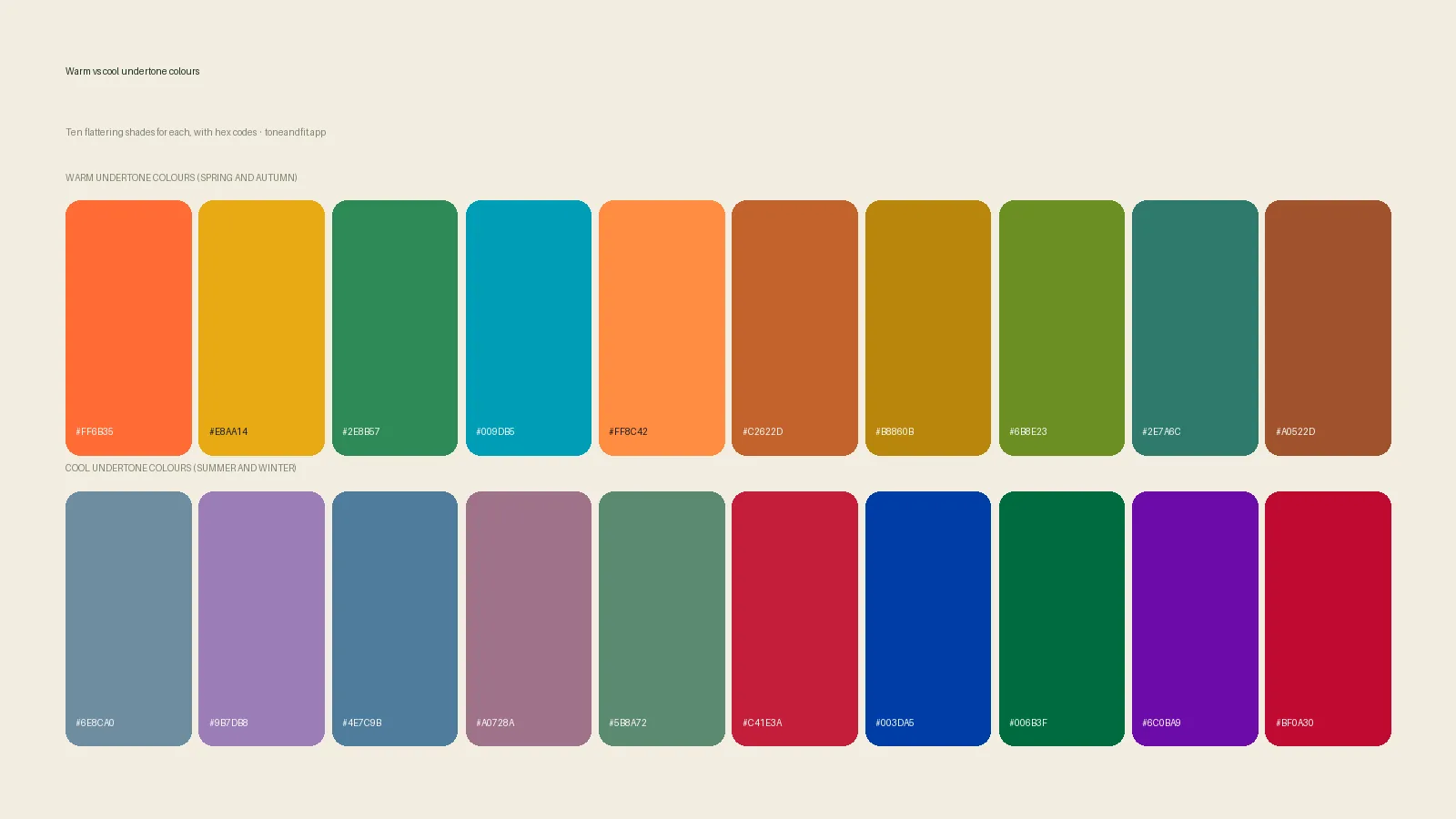
Olive skin can be warm or cool. The green cast everyone fixates on is not a temperature, it is a layer sitting over one, which is exactly why the standard undertone tests keep handing olive people contradictory answers.
The short version: stop asking what colour your skin is and start asking which of two colours makes it look better. Olive complexions fail the tests that require you to name a single colour in isolation, because the green tints whatever you are looking at. They pass comparison tests easily. Below are four comparisons that work, in the order that gets you to an answer fastest, plus what each result means for your season.
What's in this guide
- The short answer, in one table
- Why the usual undertone tests fail on olive skin
- Test 1: camel against charcoal
- Test 2: the two-white comparison
- Test 3: gold and silver, side by side
- Test 4: how you flush and how you age
- Reading a mixed result
- What your answer means for your season
- Five mistakes that send olive people to the wrong season
- FAQ
The short answer, in one table
Olive skin is not a fourth undertone sitting next to warm, cool and neutral. It is a green-grey cast that can sit over any of them. Think of it as a second dial: one dial sets temperature, the other sets how muted your skin looks. That is why olive undertone gets described as warm on one website and neutral on the next.
Here is what each version actually looks like in a mirror.
| Type | What sits under the green | How you flush | The tell |
|---|---|---|---|
| Warm olive | Golden, bronze, honey | Peachy or ruddy orange | Camel and rust look rich on you, charcoal looks heavy |
| Cool olive | Grey, slightly ashy, faint mauve | Pink, mauve or dusty red | Charcoal and cool burgundy look clean, camel looks muddy |
| Neutral olive | Even, neither golden nor grey | Soft rose that fades fast | Both camel and charcoal are fine, neither is exciting |
If you already recognise yourself in one of those rows, you can skip to what your answer means for your season. If you have read three articles and still cannot tell, keep going, because the tests below are built specifically for the case where the quick ones failed. For the full picture of how temperature works before you start, our skin tone analyzer guide covers what an undertone is and how a photo can be read for one.
Why the usual undertone tests fail on olive skin
Almost every undertone test you have seen asks you to look at one thing and name its colour. Are your veins blue or green? Is your skin peachy or pink? Does your face look yellow or rosy? These work reasonably well on fair skin with a clear cast, and they fall apart on olive.
The reason is simple. A green cast is a filter. Whatever you look at through it picks up a little green. The vein test asks about the colour of a blood vessel seen through your skin, so on an olive wrist the vessel reads green regardless of whether the skin above it is golden or grey underneath. Olive people take the vein test, see green, and conclude warm. Half of them are wrong.
The second problem is that olive skin is muted. Colour analysis has three axes: temperature (warm or cool), value (light or deep) and chroma (muted or bright). Olive complexions sit low on the chroma axis, which means every colour reaction you get is quieter than the textbook version. When an article tells you the wrong colour will make your skin look grey and tired, an olive person thinks "my skin always looks a little grey" and cannot use the signal. You need bigger contrasts to see the reaction at all.
The fix for both problems is the same: compare two things rather than describe one. Your eye is unreliable at naming an absolute colour and very reliable at spotting which of two options looks better. Every test below is a comparison.
If a test asks you to name a colour, it will not work on olive skin. If it asks you to pick a winner between two, it will.
Set up once, then run all four tests
Do this properly and it takes ten minutes. Do it badly and you will get a different answer every time you try.
- Daylight only, and indirect. Stand near a window, facing it, with no direct sun on your face. Overhead bulbs push olive skin yellow, which is exactly the variable you are trying to isolate. Lighting changes results enough that we wrote a separate piece on how your season reads under different light.
- Bare face. No foundation, no bronzer, no lipstick. Remove the necklace you forgot you were wearing.
- Neutral surroundings. A coloured wall behind you will bounce onto your face. A white or off-white background is ideal.
- Hair back. If your hair is dyed, pull it away from your face entirely. Dyed hair is one of the biggest sources of a bad reading, warm or cool.
- No phone screen as a mirror. Phone cameras apply colour science to faces before you ever see the image, and that processing is not neutral. We tested this in what your phone camera does to your skin tone.
Test 1: camel against charcoal
This is the highest-yield test for olive skin, and if you only do one, do this one.
Find two items in your wardrobe, or borrow them: something in camel (a warm mid-brown with gold in it, the colour of a classic trench lining) and something in charcoal (a cool dark grey, not black, not brown-grey). Hold each up under your chin in turn, and look at the area between your cheekbone and your jaw rather than at the fabric.
What you are watching for:
- Camel wins if your skin looks warmer and more alive, the green cast reads as golden rather than sallow, and any shadows under your eyes soften. Charcoal, by contrast, makes you look drained and slightly grey, and your face feels like it is competing with the fabric. This points to warm olive.
- Charcoal wins if your skin suddenly looks cleaner and more even, redness settles down, and your features look crisper. Camel makes you look muddy, as though someone put a beige filter over your face, and the green in your skin turns to a yellowish flatness. This points to cool olive.
- Neither does much and both are perfectly wearable. That is a genuine result, not a failure, and it points to neutral olive.
The reason this pair works so well is that camel and charcoal are roughly matched in how muted they are. Most warm-versus-cool drapes compare a bright warm to a bright cool, and a muted olive complexion rejects both of them for being too saturated, which tells you nothing. Camel and charcoal are both quiet, so the only variable left is temperature.
Test 2: the two-white comparison
Get two pieces of paper or fabric: a sheet of optical white printer paper and a piece of cream or ivory. Hold them one at a time beside your bare face in daylight.
Optical white is aggressively cool. Cream is warm. The one that makes your skin look worse is telling you where your skin sits.
- If pure white makes your face look yellow, sallow or dirty by comparison, and cream makes it look healthy, you are reading warm.
- If pure white makes your face look clean and even, and cream makes it look dull or slightly green, you are reading cool.
- If white is slightly harsh and cream is slightly flat but neither is a disaster, you are reading neutral.
One warning specific to olive skin: a fair number of cool olives fail this test because optical white is not just cool, it is also extremely bright, and a muted complexion can get overpowered by the brightness before the temperature registers. If pure white feels like it is shouting at you, swap it for a soft cool white or a pale grey and run the comparison again. Our white versus cream breakdown goes deeper on which whites suit which complexions.
Test 3: gold and silver, side by side
The jewellery test is famous and usually done wrong. People try on a gold ring, take it off, try on a silver one, and compare a memory against a current impression. Your eye cannot do that.
Do it properly: put gold on one wrist and silver on the other, at the same time, then hold both against your face in daylight and look at your skin, not at the metal.
- Gold side looks better: your skin looks warmer and more luminous, the metal appears to belong to you rather than sit on top of you. Warm olive.
- Silver side looks better: your skin looks brighter and clearer, the gold side by comparison looks slightly orange or dull against you. Cool olive.
- Genuinely cannot choose: neutral olive, and you can wear both, including mixed metals, which very few people can.
Two olive-specific notes. First, a lot of olive people look reasonable in gold simply because gold is a muted warm metal and muted suits them, so a mild preference for gold is weaker evidence than a strong preference for silver. Second, if you can get your hands on rose gold and pewter, run the same test with those two, because they are the muted versions of the same comparison and olive skin reacts to them more visibly. We cover the full method in gold or silver jewellery and what it says about your undertone.
Test 4: how you flush and how you age
The last test uses evidence your skin has already given you, which makes it useful when the drapes disagree.
Think about what your face does when you are hot, embarrassed, or have just come in from the cold. Then look at your skin somewhere it has aged, such as the backs of your hands or your chest.
| Evidence | Warm olive | Cool olive |
|---|---|---|
| Flush colour | Peach, coral, orange-red | Pink, mauve, dusty rose |
| Sun damage | Golden brown freckles, tans deeply | Grey-brown patches, burns then tans |
| Under-eye shadow | Brown or bronze | Purple, blue-grey or greenish grey |
| Scars and marks | Heal brown or tan | Heal pink, red or purple |
| Lip colour, bare | Brownish rose, terracotta | Mauve, blue-pink, plum |
Bare lip colour is the single most useful line in that table for olive skin. Lips are thin enough that the undertone shows through with very little interference from the green cast above it. If your unmade-up lips are a brownish rose you are almost certainly warm. If they are a mauve or blue-pink you are almost certainly cool. If they are a dusty rose you are somewhere in the middle, which is real.
Skip the guesswork on a complexion that resists it
One selfie. Tone & Fit reads undertone, value and chroma together, which is the combination olive skin needs.
Try Tone & Fit free ↗Reading a mixed result
You will probably not get four clean matching answers. Here is how to weigh them.
Three out of four in one direction. Take that direction. A single dissenting test is normal, especially the jewellery one, which is the most affected by what suits your personal style rather than your skin.
Two and two. You are most likely neutral olive, and that is a real category rather than a cop-out. Neutral olive is common. You will want the version of your season that sits closest to the middle, and you will get more mileage from working out your contrast level than from squeezing out a temperature answer. Contrast, not temperature, is what will actually change how you dress.
The camel-and-charcoal test disagrees with everything else. Trust the camel and charcoal. It is the most reliable of the four on olive skin because it controls for chroma, and the others do not.
Everything disagrees with everything. Two likely causes. Either your lighting changed between tests, or your hair colour is interfering. If your hair is dyed, read how to find your colour season with dyed hair before you try again, because a warm balayage on a cool olive will make every drape look wrong. If you would rather have the comparison done under controlled conditions, that is precisely what the app-based analysis is for.
What your answer means for your season
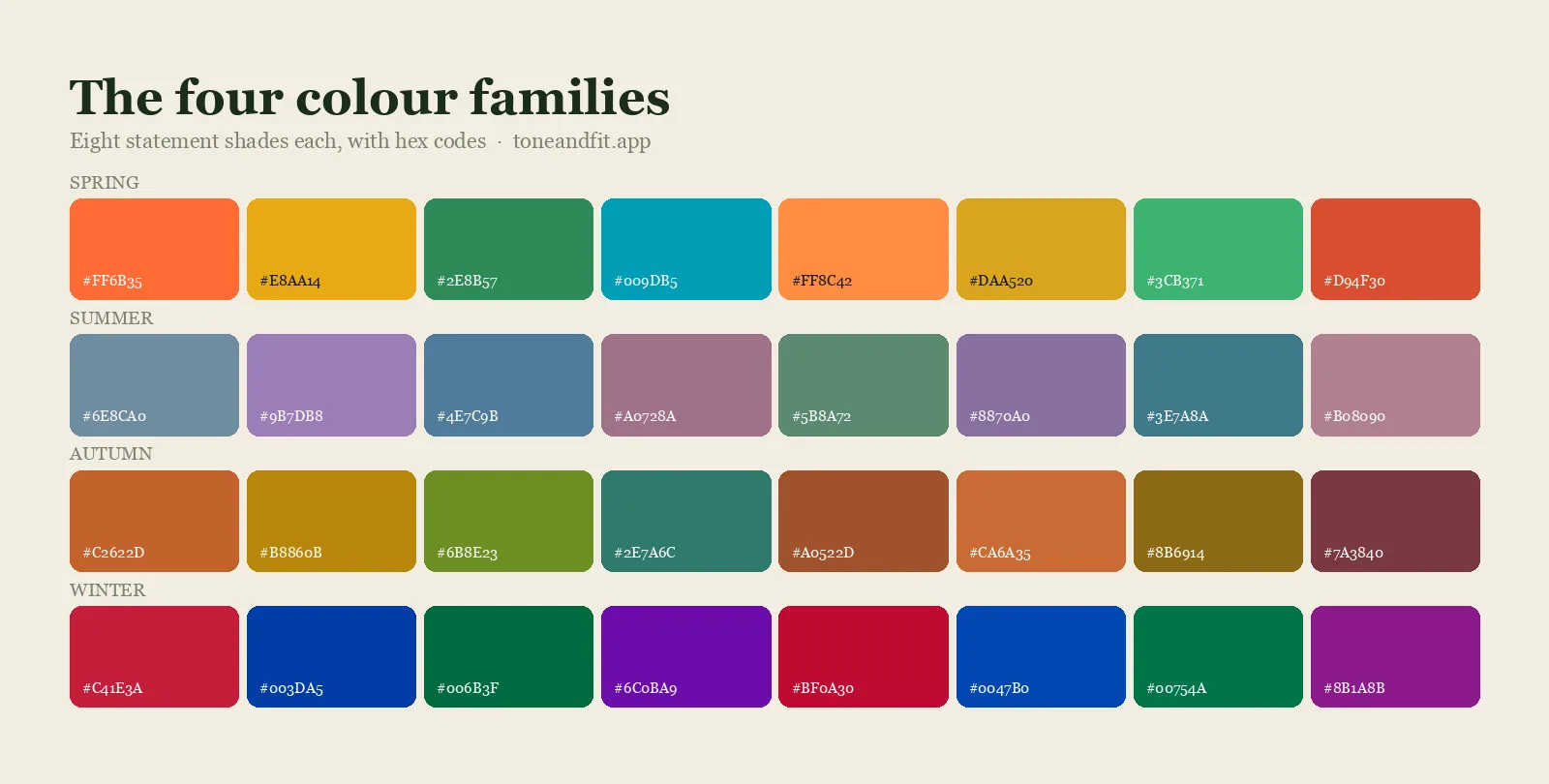
Temperature is one third of a season. Once you know whether you are warm or cool olive, you need your value (how light or deep your overall colouring is) and your chroma (how muted or bright). Olive skin is muted by default, which narrows the field considerably: it steers you away from the brightest seasons and toward the soft and deep ones. The full mechanics are in seasonal colour analysis explained, and the twelve outcomes are laid out in the 12 colour seasons.
| Your result | Your depth | Most likely season |
|---|---|---|
| Warm olive | Light to medium | Soft Autumn |
| Medium, clearly golden | Warm Autumn | |
| Deep | Deep Autumn | |
| Cool olive | Light to medium, soft features | Soft Summer |
| Medium to deep, high contrast | True Winter | |
| Deep | Deep Winter | |
| Neutral olive | Any | Soft Autumn or Soft Summer, decided by contrast |
Deep Autumn and Deep Winter are the two seasons most often confused by deep olive complexions, because both are dark and both handle strong colour well. The separator is the temperature of the darks: Deep Autumn wears chocolate, forest and rust, Deep Winter wears black, pine and true burgundy. Our Deep Autumn versus Deep Winter comparison settles it properly.
Once you have a season, the practical payoff is the palette. The best colours for olive skin tone covers the shades that work across all olive subtypes, and every season's full list lives on the palette pages.
Five mistakes that send olive people to the wrong season
1. Treating green as warm
The most common error, and the source of the myth that all olive skin is Autumn. Green is a chroma signal, not a temperature signal. Plenty of Winters have olive skin. Read warm versus cool undertone for the underlying distinction, which applies to olive exactly as it does to everyone else.
2. Testing in the wrong month
Olive skin tans easily and holds a tan for a long time. In August you will read warmer and deeper than you actually are. If you are testing in late summer, use the inner upper arm, which rarely sees sun, as your reference patch.
3. Confusing the surface colour with the undertone
The green you see is closer to an overtone than an undertone, and the two get muddled constantly. The distinction is worth ten minutes: undertone versus overtone explains which one your season actually depends on.
4. Copying a celebrity with the same skin tone
Two people can share a depth and a green cast and sit in different temperature families. Copying someone else's palette skips the only step that matters, which is the comparison against your own face.
5. Stopping at temperature
Warm or cool answers roughly a third of the question. If you take one thing from this article beyond the camel-and-charcoal test, take this: olive skin is defined at least as much by being muted as by being warm or cool, and dressing for the mute is what makes the difference. The practical version of that is in how to shop your colour palette, and the broader method in our personal colour analysis guide.
Get warm, cool, depth and chroma in one go
Tone & Fit returns your 12-season result and its palette from a single selfie. Free, no sign-up.
Find your season free ↗FAQ
Is olive skin warm or cool?
Olive skin can be either. Olive is a green cast that sits on top of your undertone rather than replacing it, so olive complexions split across warm and cool. Warm olive reads golden and bronze under the green, cool olive reads grey and slightly ashy under it, and neutral olive sits between the two. The green itself tells you nothing about temperature, which is why the usual quick tests keep giving olive skin contradictory answers.
Why does the vein test not work on olive skin?
The vein test asks whether your wrist veins look blue or green, and it reads the colour of the skin sitting over the vein as much as the vein itself. A green cast tints everything underneath it green, so olive wrists tend to show green veins whether the person is warm or cool. Olive skin needs tests that compare two colours against each other instead of tests that ask you to name one colour in isolation.
Can olive skin be cool toned?
Yes. Cool olive is common and frequently missed. It shows up as a complexion with a grey or slightly ashy quality under the green, skin that flushes pink or mauve rather than peach, and a face that looks cleaner next to charcoal and cool burgundy than next to camel and rust. Cool olive complexions usually land in the Winter or Summer families rather than Autumn.
What colour season is olive skin?
There is no single olive season. Warm olive most often lands in Warm Autumn, Soft Autumn or Deep Autumn. Cool olive lands in Deep Winter, True Winter or Soft Summer. Neutral olive can sit in Soft Autumn or Soft Summer, which are the two most similar seasons in the whole system. Your value and contrast decide which member of the family you belong to.
Does olive skin have a green undertone or a yellow undertone?
Both descriptions point at the same thing from different angles. The green cast in olive skin comes from a combination of yellow pigment and a muting grey-green quality in the skin. Many olive people read as yellow in strong daylight and green in flat indoor light. Treat olive as its own axis rather than as a subtype of warm yellow, because the green can sit over cool pink skin just as easily. Our neutral undertone explainer covers the neighbouring case.
Can my olive skin change from warm to cool when I tan?
A tan changes how deep your skin is, not what temperature it is. Olive skin often tans quickly and deeply, which makes the green cast look more golden and can push people toward a warm answer in summer and a cool answer in winter. Run your tests at the same point in the year twice, or test on skin that rarely sees sun, such as the inner upper arm.