Best Colors for Olive Skin Tone: The Complete Shade List

Olive skin is the complexion most often given the wrong advice. The colors sold as universally flattering are frequently its worst options, and the shades it wears better than anyone rarely make the list. Here is the list that actually applies.
What's in this guide
- The short answer: your best colors
- Why olive skin needs its own color list
- The master list of best colors for olive skin
- Best colors by olive subtype
- The best neutrals (skip pure white and pure black)
- Worst colors for olive skin, and why
- Best makeup colors for olive skin
- Best hair colors and jewelry metals
- How to narrow the list to your exact palette
- FAQ
The short answer: your best colors
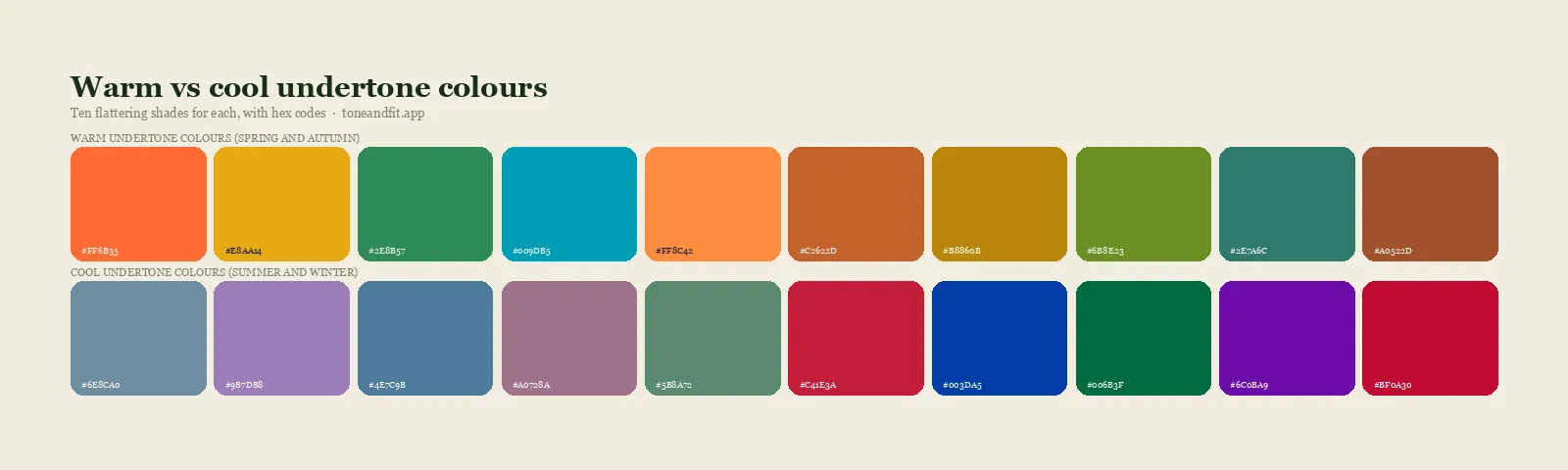
The best colors for olive skin tone are the ones that share olive's own green-gold cast rather than fight it: olive green, moss, sage, forest, teal, petrol blue, camel, bronze, rust, terracotta, tomato red, warm cream, and deep aubergine. The colors that consistently fail on olive skin are icy pastels, cold dusty pinks, pure optic white, and any shade with a chalky grey base, because those push olive's natural yellow-green cast forward and read as sallow.
That is the answer if you only have thirty seconds. The rest of this article turns it into a shortlist you can actually shop from, split by olive subtype, and extended to makeup, hair, and metals. If you are not sure whether your skin is olive in the first place, start with our diagnostic piece on how olive skin behaves in color analysis, then come back here for the shade lists.
Olive is also the single most misread complexion in DIY color analysis, which is why it deserves a dedicated page inside our broader answer to what colors look good on me. Everything below assumes you have olive skin and want the wearable list, not another undertone quiz.
Why olive skin needs its own color list
Most color advice sorts people into two buckets: warm or cool. Olive skin does not sit cleanly in either. It carries a green or grey-green cast layered over a warm or neutral base, and that green layer is what makes standard advice misfire.
Here is the mechanism. When you hold a color next to skin, the eye compares the two and exaggerates the difference. Put a cold pink next to olive skin and the green in your complexion becomes more visible, because green and pink sit opposite each other on the color wheel. Put a soft olive green next to the same skin and the green in your complexion stops being the thing you notice, because the fabric is now carrying that job. Your face reads as clear instead.
This is why olive people so often report that the colors everyone told them were universally flattering are the exact ones that make them look tired. Baby pink, powder blue, lavender, and dove grey are frequently recommended as safe. On olive skin they are among the least safe options in the room.
It is also why olive skin can wear colors that would overwhelm other complexions. Deep bronze, mustard, and petrol blue are all considered demanding shades. Olive skin has enough depth and enough pigment complexity to hold them without being flattened.
The rule that actually works for olive skin: choose colors that contain a little of what your skin contains. Green, gold, and warmth in the fabric let the same qualities in your face recede into the background instead of standing out.
The master list of best colors for olive skin
These are the shades that work across the majority of olive complexions. Screenshot this table before your next shopping trip.
| Family | Best shades for olive skin | Why it works |
|---|---|---|
| Greens | Olive, moss, sage, fern, forest, emerald, khaki | Shares your skin's green cast, so the cast stops reading as a flaw |
| Blues | Teal, petrol, deep denim, peacock, slate blue | Green-leaning blues stay in your temperature family |
| Reds | Tomato, brick, rust, terracotta, warm burgundy | Orange-based reds echo the gold under the green |
| Yellows and golds | Mustard, ochre, antique gold, honey, bronze | Deep warm yellows brighten olive without going acidic |
| Purples | Aubergine, plum, deep berry, mulberry | Depth and warmth keep them from turning ashy |
| Pinks | Coral, salmon, dusty rose with a peach base, watermelon | Warm-based pinks flatter where cold pinks clash |
| Browns and neutrals | Camel, caramel, chocolate, taupe, warm cream, ivory | Your natural neutrals, and better than grey or white |
If you want a single starter capsule from that table, take five: olive green, camel, teal, rust, and warm cream. Every one of those pieces will pair with the others, and every one of them supports the same underlying temperature. That is the shortcut behind our approach to building a capsule wardrobe around your color season.
Get your exact olive palette
One selfie and Tone & Fit returns your 12-season result with the shade list built for your skin, not for olive skin in general.
Analyze my photo free ↗Best colors by olive subtype
Olive is a surface quality, not a season. Two people can both be olive and land in different places on the 12 color seasons map. The four subtypes below cover almost everyone.
Warm olive
Golden-green skin, tans easily and deeply, gold jewelry clearly wins, eyes are usually hazel, amber, or warm brown. Most warm olives land in Warm Autumn or Soft Autumn territory.
- Best: olive green, mustard, rust, terracotta, camel, bronze, warm ivory, tomato red, teal
- Good: forest green, chocolate, brick, ochre, coral
- Skip: icy pastels, cold fuchsia, optic white, silver-grey
- Read next: Am I a Warm Autumn? and Am I a Soft Autumn?
Cool olive
Grey-green skin, burns before tanning, silver looks cleaner than gold, veins lean blue-green. Cool olives usually sit in Soft Summer or occasionally Cool Winter.
- Best: sage, eucalyptus, slate blue, teal, mulberry, soft aubergine, cocoa, stone
- Good: pewter, muted raspberry, deep denim, soft charcoal
- Skip: mustard, orange-red, bright coral, pure black next to the face
- Read next: Am I a Soft Summer?
Neutral olive
The most common version. No obvious gold or grey dominance, both metals look acceptable, the vein test comes back inconclusive. Neutral olives have the widest wearable range and the smallest margin for extremes.
- Best: olive, teal, camel, warm cream, dusty coral, forest, denim blue, cocoa
- Good: nearly any mid-depth muted shade in either temperature
- Skip: anything at the extremes, so no icy pastels and no fluorescent brights
- Read next: Neutral undertone skin explained
Deep olive
Rich olive with real depth, common in Mediterranean, South Asian, Middle Eastern, Latin American, and mixed complexions. Deep olive can carry saturation that would swamp lighter skin.
- Best: emerald, deep teal, aubergine, saffron, burnt orange, bronze, chocolate, oxblood
- Good: forest, deep mustard, brick, ink blue
- Skip: washed pastels, beige that matches your skin depth, muddy mid-greys
- Read next: Am I a Deep Autumn? and color analysis for deep skin tones
The best neutrals (skip pure white and pure black)
Neutrals are where olive skin loses the most ground, because the default neutrals sold everywhere are the two worst options for it.
Pure optic white is the bigger problem. It is a cold, brightened white with a blue or violet brightener in the dye, and against olive skin it acts like a spotlight on your yellow-green cast. Swap it for warm cream, ivory, bone, oat, or ecru. You lose nothing and your face stops looking dull.
Pure black is a smaller problem but a real one, especially for warm and light olives. Black is the deepest possible cool neutral, and against a mid-depth warm complexion it can drain color out of the face and sharpen shadows. Deep olive skin often carries black perfectly well. If yours does not, use chocolate, espresso, deep forest, ink navy, or oxblood as your dark neutral instead. They photograph as black at a glance and do none of the damage.
| Instead of | Wear |
|---|---|
| Optic white | Warm cream, ivory, bone, oat |
| Pure black | Espresso, deep forest, ink navy, oxblood |
| Cool mid-grey | Taupe, stone, mushroom, khaki |
| Cool beige or greige | Camel, sand, caramel |
| Silver-grey | Pewter with a warm cast, or bronze |
If your skin is olive but sits in the middle of the depth range, our list of the best colors for medium skin tone compares flattering shades across warm, cool and neutral versions.
Worst colors for olive skin, and why
Nothing here is forbidden. These are simply the shades that make olive skin work hardest, and the fix in each case is a small adjustment rather than abandoning the color.
- Icy pastels, meaning baby pink, powder blue, mint, and lilac. They are light, cold, and low in pigment, which is the opposite of olive skin on all three counts. Move to warmer, deeper versions: peach instead of baby pink, sage instead of mint, periwinkle instead of powder blue.
- Cold dusty pink and mauve. The classic olive-skin trap. The pink pulls green forward in your face. Shift the same shade toward salmon or dusty coral and it works.
- Chalky mid-grey. It flattens olive skin into the same greyish register and the whole look goes lifeless. Taupe or khaki does the same job with life in it.
- Neon and fluorescent brights. Olive skin is naturally muted and complex. Neon has no complexity at all, so the contrast reads as harsh rather than striking.
- Beige matched to your own depth. If a neutral is the same lightness as your skin, it erases the boundary between fabric and face and you look washed out. Go lighter or deeper, never level.
The pattern behind all five is the one we cover in detail in why certain colors wash you out: the offenders are almost always too cold, too light, or too flat for the skin they are sitting against.
Best makeup colors for olive skin
Wardrobe color is forgiving because the fabric sits inches from your face. Makeup sits on it, so the temperature match has to be closer.
Foundation
Olive skin needs a foundation with a green or neutral-olive base, not a yellow one and definitely not a pink one. Yellow-based foundation on olive skin turns orange within an hour of wear. Pink-based turns grey. Many brands now label these shades with a W for warm or an N for neutral plus an olive marker. Test on your jawline in daylight, never under store lighting. Our walkthrough on finding your foundation undertone covers the swatch test in full.
Blush and bronzer
- Blush: terracotta, warm peach, brick rose, muted coral. Avoid cool pink and anything with visible blue shimmer.
- Bronzer: a neutral-to-warm bronze with no orange. Olive skin already has depth, so heavy bronzer often reads muddy. Use less than you think.
Lipstick
Olive skin is excellent at wearing complex, slightly unusual lip colors: brick red, terracotta, warm nude with a caramel base, brown-rose, deep berry, and true tomato red. Where it struggles is cool blue-red, cold fuchsia, and pale frosted nudes, all of which sit on top of the skin rather than belonging to it. The full breakdown by temperature lives in our guide to the best lipstick colors for your undertone.
Eyeshadow
Bronze, copper, olive green, deep teal, and warm taupe are the reliable performers. Olive skin also handles green eyeshadow better than almost any other complexion, which is worth knowing since most people never try it.
Best hair colors and jewelry metals
Hair
Hair color is the largest single block of color you wear, so the temperature rule matters more here than anywhere else. Warm and neutral olives look best in chocolate, chestnut, caramel, warm espresso, and golden brown. Cool olives do better with cool chestnut, mushroom brown, and soft espresso. The shade nearly all olives should approach carefully is ash blonde, which strips warmth out of the frame around your face and leaves the green cast unopposed. If you want to go lighter, warm honey and bronde do the job without that side effect. Our hair color chart by undertone and depth has the full grid.
Jewelry
Gold wins for most olive skin, and specifically yellow gold or antique gold rather than bright polished gold. Bronze and brass are underrated and often look better on olive than either precious metal. Cool olives can wear silver, but usually look richer in white gold or platinum, which have less of silver's cold flash. If you are unsure, run the side-by-side comparison in our piece on choosing gold or silver by undertone.
Nails
The same logic carries over to nail color: warm and neutral olives get the most wear out of terracotta, brick, warm rose, and deep olive itself, while cool olives lean better into mulberry, cool berry, and muted plum. See the full breakdown in best nail colors for your undertone.
How to narrow the list to your exact palette
Everything above is olive-wide advice. Your personal palette is narrower, because it is set by three things at once: your undertone, your depth, and how muted or vivid your coloring is. Two olive people with the same undertone can need different shades of the same green.
Three ways to close that gap:
- Confirm your undertone properly. The vein test is unreliable on olive skin specifically, because olive veins often look green regardless of undertone. Use the jewelry comparison and the white paper test instead, both covered in how to find your skin undertone at home, and see warm vs cool skin undertone for the underlying temperature test in more depth.
- Find your season, not just your undertone. Undertone gets you halfway. The season tells you the depth and saturation to shop for. Start at our guide to finding your color season.
- Test with a photo. Cameras and analysis models read pixel values without the bias your eye brings to your own face, which is the single most common source of DIY error. Our explainer on how AI color analysis works covers what the model measures and where it has limits.
Once you have a season, the corresponding palette hub gives you the exact hex swatches to shop against, and the skin tone analyzer is the fastest way to read your undertone off a photo you already have.
Stop guessing which olive you are
Tone & Fit reads your undertone, depth, and contrast from one photo and returns the palette that matches. Free, no sign-up.
Find my palette free ↗Going deeper: what olive skin is and which season it lands in
Merged in from our olive skin colour analysis guide, so the whole subject lives on one page.
What olive skin actually is
Olive skin is defined by an undertone, not a depth. You can have light olive, medium olive, or deep olive skin, and what ties them together is a subtle green or gray cast that sits underneath the surface color. That green is the signature. It comes from a particular mix of melanin and the way light scatters through the skin, and it is the reason olive complexions look slightly muted and earthy rather than bright pink or bright golden.
This is a different question from how warm or cool your skin is. People often use "olive" to mean "tan" or "Mediterranean," but plenty of fair-skinned people have an olive undertone too. If your skin looks faintly green or grayish in certain lighting, especially around the jaw and forehead, and if foundation that matches everyone else somehow turns orange or ashy on you, there is a good chance you are working with olive undertones.
The practical upside: olive skin is wonderfully versatile and tans easily. The practical headache: most beginner color advice is written for clearly warm or clearly cool people, and it falls apart on you. That is what the rest of this guide fixes.
Why olive skin confuses undertone tests
The classic tests assume your undertone is a simple slider between warm (yellow, golden, peachy) and cool (pink, blue, rosy). Olive skin adds a third axis, that green-gray muting, which sits on top of whatever warm or cool lean you have. So the usual shortcuts misfire.
The wrist-vein test is the worst offender. The theory says green veins mean warm and blue veins mean cool. But olive skin casts a green tint over everything, so your veins can look green even when your undertone is neutral or slightly cool. The white-paper test gets muddy too, because olive skin rarely looks clearly pink or clearly yellow against white. It just looks a little dull, which tells you almost nothing.
If you have run those tests and come away more confused than when you started, you are not doing them wrong. They are simply not built for your skin. We cover the more reliable methods in how to find your skin undertone at home, and the underlying warm-versus-cool question in warm vs. cool skin undertone. For olive skin specifically, the trick is to stop asking "warm or cool" first and start asking "how muted, and which way does it lean."
Is your olive skin warm, cool, or neutral?
Most olive skin is neutral. The green cast pulls you toward the middle of the warm-cool slider, which is exactly why the binary tests struggle. But there is usually a slight lean, and finding it is what unlocks your best colors. Here is how to read yours.
Olive skin leaning warm
Your skin reads golden-green or honey-toned. In sunlight you go bronze, not rosy. Gold jewelry looks made for you, and warm earthy colors like terracotta and mustard light up your face. You probably suit Warm Autumn or Soft Autumn.
Olive skin leaning neutral
Both gold and silver look fine, neither obviously better. White and off-white both work without making you look ill. You can wear a surprising range, but everything looks best when it has some depth and a slightly muted, dusty quality. Soft Autumn or Deep Autumn is common here.
Olive skin leaning cool
Your green cast tips toward gray or ashen rather than gold. Silver jewelry looks cleaner on you than gold. Deep, cool-toned colors like emerald, pine, and plum make your skin look clear and lit, while warm oranges make you look muddy. Deep Winter is the usual landing spot, sometimes Deep Autumn.
Notice the common thread across all three: depth and a touch of muting. Olive skin almost never suits pale, washed-out, or neon colors, regardless of which way it leans. Hold that thought, because it is the single most useful rule in this whole guide.
Which color season olive skin usually lands in
Olive complexions cluster heavily in the richer, softer seasons. That is not a coincidence. Color seasons are built from three measurements, undertone, depth (value), and clarity (chroma), and olive skin tends to bring its own built-in muting to the chroma axis. We break the whole framework down in seasonal color analysis explained, but here is where olive skin most often lands.
| Season | Olive fit | What it looks like |
|---|---|---|
| Soft Autumn | Very common | Light to medium olive, neutral-warm, soft features, low contrast. Loves dusty, muted earth tones. |
| Warm Autumn | Common | Golden olive, clearly warm, medium depth. Thrives in rich rust, olive green, and warm teal. |
| Deep Autumn | Common | Deeper olive with dark hair and eyes, warm-neutral. Suits saturated, dark, earthy colors. |
| Deep Winter | Common for cool olive | Olive with high contrast, dark hair, cool-neutral lean. Wears deep jewel tones beautifully. |
| Soft Summer | Occasional | Cooler, lighter olive with a gray cast and soft contrast. Suits muted cool tones. |
If you want to narrow down which of these is yours, the 12 color seasons guide walks through the tells for each. And if you are deciding what to do with your hair while you are at it, best hair color for your skin tone covers how olive undertones interact with warm and cool dye.
FAQ
What are the best colors for olive skin tone?
Olive green, moss, sage, forest, teal, petrol blue, camel, bronze, rust, terracotta, tomato red, mustard, warm cream, and deep aubergine. The common thread is that all of them contain warmth or green, which is what olive skin already contains. Colors that share your skin's qualities let those qualities recede instead of standing out.
What colors should olive skin avoid?
Icy pastels such as baby pink and powder blue, cold dusty pink and mauve, chalky mid-grey, neon brights, pure optic white, and any beige at the same lightness as your own skin. Each of these either pushes the green in your complexion forward or flattens it. In every case there is a warmer or deeper version of the same color that works.
Can olive skin wear black and white?
Deep olive skin usually wears black well. Light and warm olive skin often looks drained in it, and does better with espresso, deep forest, ink navy, or oxblood. Pure optic white is the harder one: it is cold and brightened, and it highlights olive's yellow-green cast. Warm cream, ivory, bone, or oat gives you the same effect without that cost.
Is olive skin warm or cool?
Olive is a separate axis from warm and cool, not a point on it. Olive describes a green or grey-green cast that sits over an underlying temperature, so you can be warm olive, cool olive, or neutral olive. That is why the standard vein test misleads olive people so often. It reads the green cast rather than the underlying undertone.
What color season is olive skin?
Most olive skin lands in Soft Autumn, Warm Autumn, Deep Autumn, or Soft Summer, because those seasons are muted and complex in the same way olive skin is. Cool Winter is possible for high-contrast cool olives. There is no single olive season, which is why the shade lists above are split by subtype rather than given as one list.
What is the best pink for olive skin?
Anything with a peach, coral, or salmon base. Watermelon, dusty coral, and warm dusty rose all work. What to avoid is cold blue-based pink and mauve, which sit directly opposite olive's green cast on the color wheel and make that cast more visible. If a pink looks slightly orange in the bottle, it will probably suit you.
Does gold or silver look better on olive skin?
Gold for most olive skin, especially yellow gold and antique gold rather than a high polish. Bronze and brass are frequently the best of all and get overlooked. Cool olive skin can wear metal in the silver family but generally looks richer in white gold or platinum, which are less cold than sterling silver.