Warm Autumn vs Deep Autumn: The Difference
Warm Autumn and Deep Autumn share the same warm undertone and the same muted, earthy color family. The one axis they split on is depth, how light or dark the overall coloring runs, and that single measurement is the whole story.
What's in this guide
Both are firmly warm. If you have already confirmed that using our guide to warm versus cool skin undertone and you are stuck choosing between these two specific Autumns, you are dealing with a genuinely close call. Warm Autumn and Deep Autumn agree on undertone, agree on rejecting icy brights and stark neutrals, and both live inside the rust-and-olive core of the Autumn family. What separates them is value, and once you know where to look, it stops being a coin flip.
Warm Autumn vs Deep Autumn Side by Side
Here is every dimension compared at once. Undertone barely moves between the two columns. Value and contrast move the most.
| Warm Autumn | Deep Autumn | |
|---|---|---|
| Undertone | Warm, the purest of the three Autumns | Warm, with extra depth borrowed from Winter |
| Value (depth) | Medium | Deep, the darkest Autumn |
| Chroma | Rich and glowing rather than dusty | Rich and saturated, holds up at near-black strength |
| Contrast | Low to medium, blended | Medium to high |
| Best colors | Camel, honey, warm olive, pumpkin, mustard | Espresso, deep brick, pine green, dark teal, deep plum |
| Colors to avoid | Icy pastels, true black, stark white | Pale pastels, dusty light neutrals, icy cool tones |
| Best metals | Warm gold, soft brass | Antique gold, bronze, copper |
| Often-cited celebrities | Julia Roberts is a name often cited as a Warm Autumn example | Most analysts place Zendaya in Deep Autumn |
The Tell
Depth is the tell. Warm Autumn's coloring sits at a medium value and stays glowing rather than dark, the most purely warm reading in the whole Autumn family. Deep Autumn takes that same warm base and pulls it toward the darkest, richest end of the range, the same direction Deep Winter sits on the seasonal wheel. If your undertone is already settled as warm and your only open question is how dark your natural coloring runs, this is the one measurement to nail down.
Picture every Autumn color mixed two ways: at half strength or at full, near-black strength. Warm Autumn wants the half-strength version, camel rather than espresso, mustard rather than dark olive. Deep Autumn wants the full-strength version and can wear it without the color reading like a costume. Neither reading is really about skin tone alone. A fair-skinned person can be a Deep Autumn if their hair and eyes carry enough darkness to balance it, and a person with deeper skin can still be a Warm Autumn if their overall value lands in the medium range rather than the darkest one.
Where the Palettes Agree, and Where They Split
They agree in the middle. Rust, terracotta, warm olive and mustard sit comfortably in both wardrobes, because these mid-depth, warm, muted colors do not force a wearer toward either extreme. Below is the real Warm Autumn palette, pulled from the full Autumn palette guide, and it doubles as the answer to where Warm Autumn pulls ahead: the glowing, medium-golden range that Deep Autumn can find a little flat on its own coloring.
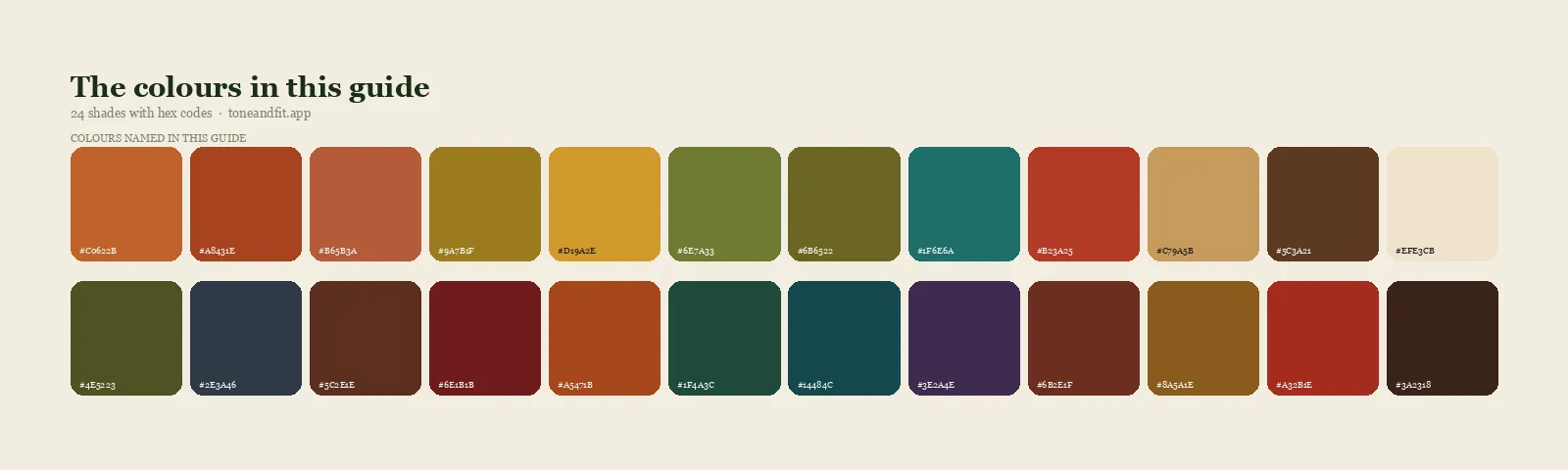
- Pumpkin#C0622B
- Rust#A8431E
- Terracotta#B65B3A
- Mustard#9A7B1F
- Golden Yellow#D19A2E
- Moss Green#6E7A33
- Olive#6B6522
- Teal#1F6E6A
- Tomato Red#B23A25
- Camel#C79A5B
- Chocolate#5C3A21
- Warm Ivory#EFE3CB
- Deep Olive#4E5223
- Warm Navy#2E3A46
Warm Autumn neutrals & anchors. See the full breakdown in the Warm Autumn color palette guide.
Deep Autumn keeps the same warm foundation but takes it dark. Espresso, deep brick, pine green, dark teal and aubergine belong to Deep Autumn alone, and a medium-value Warm Autumn can look a little swallowed by them rather than lifted. If you have ruled out Warm Autumn and want the mirror image of this comparison, our Deep Autumn vs Warm Autumn breakdown and the dedicated Deep Autumn color palette guide cover it shade by shade.
- Chocolate#5C2E1E
- Deep Brick#6E1B1B
- Burnt Orange#A5471B
- Pine Green#1F4A3C
- Dark Teal#14484C
- Deep Plum#3E2A4E
- Mahogany#6B2E1F
- Burnt Caramel#8A5A1E
- Tomato Red#A32B1E
- Espresso#3A2318
- Deep Olive#3E4322
- Warm Charcoal#33302B
- Aubergine#3E2A3A
- Deep Camel#A97C43
Deep Autumn neutrals & anchors.
4 Tests to Settle It
Description alone rarely settles this one. Run all four of these in indirect daylight, no makeup, hair pulled back, and count which season wins more rounds.
1. The camel-and-espresso swap
Hold a medium camel next to your face, then swap it for a rich espresso brown. A Warm Autumn tends to glow next to the camel and look a little weighed down by the espresso, as if the color is sitting on top of the skin rather than working with it. A Deep Autumn usually does the opposite: the espresso sharpens the features, and the camel can look slightly flat by comparison. Whichever depth makes your under-eye area look rested rather than heavy is doing the telling.
2. The metal test
Try a warm yellow gold piece against your skin, then swap it for antique bronze or copper. Warm Autumn tends to look cleanest in the brighter, lighter warm gold, since it matches the season's medium glow. Deep Autumn usually reads better in the deeper, more oxidized bronze and copper tones, which carry enough weight to match the season's own depth. A piece of jewelry that looks slightly thin or a little too shiny on you is a mild vote against that metal, and by extension against that season.
3. The grayscale contrast test
Take a photo of your face in neutral daylight and convert it to black and white. Deep Autumns tend to show medium to high contrast, with hair and eyes reading clearly darker than the skin. Warm Autumns show a softer, more blended pattern, where hair, skin and eyes sit closer together in value with no sharp jump between them. A gently graded grayscale photo points toward Warm Autumn. A photo with a clear dark-against-light split points toward Deep Autumn.
4. The root test
Look at your hair at the root, the color that grows in before any box dye or salon color reaches it, ideally a few weeks after a color appointment. A root that reads as a deep, near-black brown with no visible red or gold when it catches direct sun is a real Deep Autumn signal. A root that reads as a warm, medium chestnut or golden brown, lighter and more golden even in shade, points toward Warm Autumn. This test is useful precisely because it ignores whatever color is currently on the ends of your hair.
If You Sit Between Them
Some people genuinely land in the middle, a medium-deep value that is darker than a classic Warm Autumn but not quite as dark as a classic Deep Autumn. That is not a failure of the four tests. Undertone was never in question for either of you, so when the tests split two and two, treat depth as the swing vote rather than looking for a tiebreaker somewhere else. If three of the four tests lean one direction, trust that lean over any single test in isolation, especially the metal test, which is the softest signal of the four.
A few mistakes are worth ruling out first. Dark hair alone does not make someone a Deep Autumn. A Warm Autumn can have quite dark auburn hair, and the season is decided by overall value across skin, hair and eyes together, not by one dark feature. Bad lighting is the other common culprit: indoor bulbs throw warm or cool casts that can shift how deep or how golden a color reads, so always retest in daylight near a window before you commit. Our guides to Am I a Warm Autumn and Am I a Deep Autumn both walk through the full set of signals in more depth if you want a second pass at either season on its own.
Stop guessing which Autumn you are.
Tone & Fit's AI measures your undertone, value and chroma from a selfie and tells you whether you are Warm Autumn, Deep Autumn, or something else, with your full palette in 60 seconds.
Try the App ↗FAQ
What is the difference between Warm Autumn and Deep Autumn?
Depth. Warm Autumn sits at a medium value and stays glowing rather than dark, the most purely warm of the three Autumns. Deep Autumn takes that same warm undertone and pulls it toward the darkest, richest end of the range, borrowing intensity from its Winter neighbor on the seasonal wheel.
Is Warm Autumn the same as Deep Autumn?
No, though they are close relatives in the same Autumn family. Both share a warm, golden undertone and a muted rather than icy quality, so they agree on undertone and largely on chroma. They diverge on value: Warm Autumn reads medium, Deep Autumn reads deep, and that single difference changes which end of the palette flatters each one.
Which season is darker, Warm Autumn or Deep Autumn?
Deep Autumn is darker. It is the deepest of the three Autumn sub-seasons, able to wear espresso, deep brick, and near-black tones without being overwhelmed. Warm Autumn sits at a medium depth and tends to look better in camel and honey than in the darkest shades.
Can a Warm Autumn wear black?
Not usually near the face. True black is cool and stark enough to flatten Warm Autumn's medium, golden coloring. A warm dark brown like chocolate or espresso gives a similar depth without the coldness, and it is the safer swap for a Warm Autumn who wants a dark neutral.
What colors flatter Deep Autumn but not Warm Autumn?
Espresso, deep brick, pine green, dark teal, deep plum, and aubergine. These colors need real depth behind them to look rich rather than heavy, and a medium-value Warm Autumn can look a little swallowed by them. Warm Autumn gets more mileage from camel, honey, and mustard instead.
What is the fastest way to tell Warm Autumn and Deep Autumn apart?
Hold an espresso brown next to your face, then swap it for a medium camel. If the espresso makes your features look sharper and more awake, you lean Deep Autumn. If camel makes you glow and espresso looks heavy or borrowed, you lean Warm Autumn. A professional drape or an AI color analysis app can confirm it by measuring value directly.