Warm Spring Makeup Guide: Clear, Warm Shades for Your Skin Tone

Warm Spring coloring is built for light, clear warmth, the kind of coral lip and peach cheek that looks like early morning sun on skin. Here is exactly which makeup shades make that coloring glow, and which cool, dusty, or heavy tones quietly flatten it.
What's in this guide
What Warm Spring coloring looks like
Warm Spring is one of the three Spring seasons in the modern 12-season system, sitting between True Spring and Warm Autumn. People in this season share three things: a warm undertone, light-to-medium overall coloring, and skin that comes alive in clear, fresh, sunlit color rather than muted or heavy ones. If you have not pinned down your season yet, our guide to whether you are a Warm Spring walks through the tells in detail, and the broader seasonal color analysis explainer covers how all twelve seasons are organized.
The practical picture is usually some version of warm, light, and clear. Skin tends to read as warm or neutral-warm with a golden, peachy, or ivory cast rather than a pink or bluish one, and it often tans easily to a warm honey. Hair is frequently golden: warm blonde, strawberry, golden brown, or light auburn, usually with warm rather than ashy tones. Eyes are commonly warm and bright, from clear golden-green and warm hazel to light warm brown, often with a sunny, sparkly quality. The defining feature is a fresh clarity. A Warm Spring rarely looks smoky or muted. The coloring is light and lively, and makeup that keeps that freshness tends to look effortless rather than done.
The reason this matters for makeup is simple. Cosmetics are just color held very close to your face, even closer than clothing. A lipstick or blush in the wrong undertone sits right next to your skin and either harmonizes with your natural coloring or argues with it. For a Warm Spring, the colors that harmonize are warm, clear, and light-to-medium, and the colors that argue are cool, dusty, and heavy. If you have ever wondered why a cool berry lipstick that looks gorgeous in the tube turns your face slightly hard and drained, that argument is exactly what you are seeing.
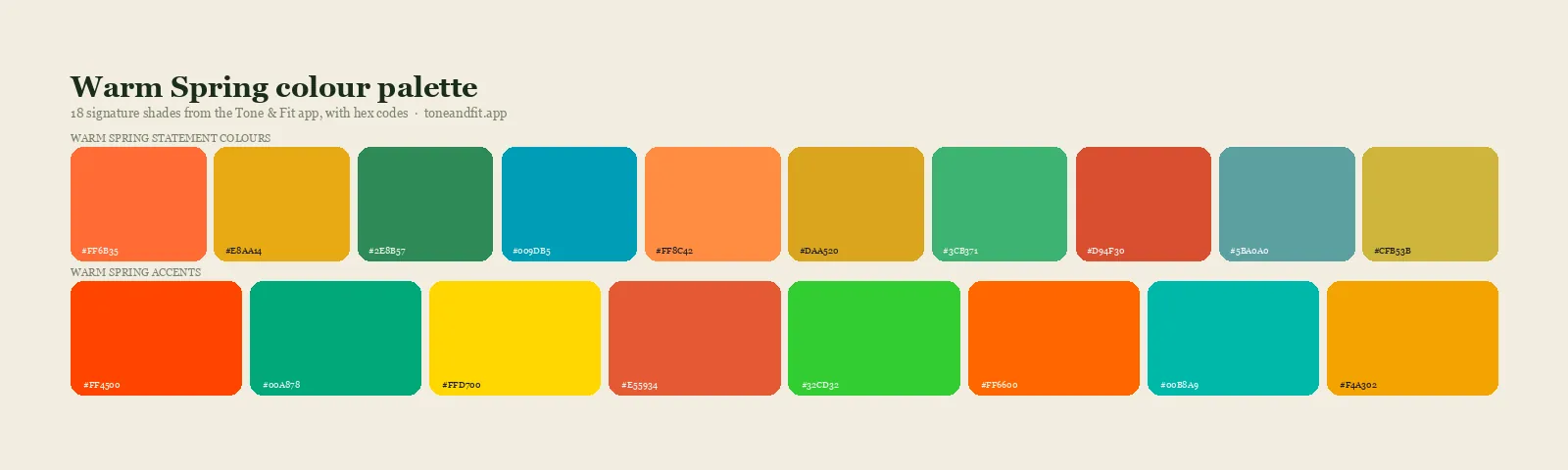
The 3 rules every Warm Spring makeup choice follows
Before any specific product, it helps to internalize the three qualities that decide whether a shade flatters a Warm Spring. They map directly onto the three measurements color analysts use for every season: undertone, value, and chroma. If those terms are new, the complete personal color analysis guide defines each one, but the short version is below.
Rule 1: Stay warm, not cool
Warm Spring undertones are warm, so flattering makeup leans golden rather than blue. Choose coral over cool pink, warm coral-red over blue-red, peach over mauve, and gold over silver. When two shades of a color sit side by side, pick the one that feels warmer and sunnier. The single most useful test for any product is to ask whether it leans warm or cool, the same warm-versus-cool question covered in our warm vs cool skin undertone guide.
Rule 2: Stay light-to-medium, not heavy
Warm Spring is one of the lighter, fresher seasons. The coloring is delicate enough that very dark, heavy shades overwhelm it, the way a smoky vampy lip can wear a Warm Spring rather than the other way around. Reach for fresh, medium-depth color rather than blackened darks. If a shade looks like it belongs on a dramatic winter evening, it will usually swamp a Warm Spring in daylight.
Rule 3: Keep it clear, not muddy or dusty
Warm Spring sits in a clear, relatively high chroma zone: the color should feel fresh and lively, like a tulip or a ripe apricot, not greyed or dusty. Muted, smoky, or dusty tones tip too soft and can look tired on this season, while the right clear warmth looks like the face is lit from within. Aim for freshness, the difference between a bright warm coral and a dusty brick.
Hold those three rules in mind, warm, light, and clear, and most product decisions answer themselves. The sections below apply them category by category.
Foundation and concealer
Base makeup is where many Warm Springs can go wrong, usually by reaching for a shade that is too cool or too deep for their actual coloring. A Warm Spring typically needs a warm foundation with a golden or yellow lean, matched honestly to a light or medium value. The wrong undertone is easy to spot: a too-cool base goes grey, pink, or ashy within a few minutes of wearing, while the right one melts into the skin and looks like nothing at all.
Match in daylight, not store lighting, and test on the jaw rather than the back of your hand, since your hand is often a different tone from your face. Many brands label shades by undertone with words like warm, golden, or yellow, and those are your starting points. When a shade chart uses letters, warm undertones are often marked W and neutral N, while cool is C. If you are torn between a neutral and a warm shade, the warm is usually the safer choice for a Warm Spring, since this season leans clearly golden. Your undertone is the same one you would find with an at-home check, and our walkthrough on how to find your skin undertone at home is worth running before you buy.
For concealer, follow the same warm-leaning logic, and keep it light-handed. Warm Springs rarely need heavy coverage, and a thick, cool-toned concealer under the eye can read grey against fresh coloring. If you have faint bluish under-eye shadows, a warm peach corrector neutralizes them well, which suits Warm Springs naturally since the correcting tone is already in your family. Powders should be warm or golden rather than pink or translucent-cool, and used sparingly so the skin keeps its natural glow rather than looking flat.
Lipstick: your warm signature
If a Warm Spring only owned one piece of makeup, it should be a great clear coral lipstick. This is the season that can wear a fresh warm coral with very little else on the face and look bright and polished. The whole range of warm, clear, sunlit lip colors is open to you.
A Warm Spring lip range: clear coral, peach, warm coral-red, salmon, golden apricot, and warm coral-pink.
The signature Warm Spring lip is a clear, warm coral, the kind of shade that looks fresh and lit rather than heavy or cool. From there, branch into peach and salmon for softer days, and warm coral-red or a bright golden-tinged red when you want a statement. Warm corals and peaches are the everyday workhorses, flattering and forgiving. Even a true red works as long as it stays warm and clear rather than tipping toward blue or brick.
For softer days, a Warm Spring can absolutely wear a nude, but it has to be a warm nude. Choose a peachy or warm caramel-beige rather than a pink or mauve one. Cool nudes are the classic Warm Spring mistake: they make the lips look grey and the whole face look tired. A warm peach-nude keeps things fresh. Here is the quick map:
| Wear these | Skip these |
|---|---|
| Clear coral | Blue-based and cool red |
| Peach and salmon | Icy pink and cool baby pink |
| Warm coral-red | Cool berry and raspberry |
| Golden apricot | Deep vampy plum and wine |
| Peach or caramel nude | Pink or mauve-grey nude |
One finish note: Warm Spring coloring loves freshness and light, so cream, satin, and glossy finishes tend to suit it better than heavy flat mattes or frosty ones. A juicy warm coral almost always looks fresher on a Spring than a dense, dark shade weighing the face down.
Not sure you are a Warm Spring? Find out in 60 seconds.
Free · No account · Photo never stored
Download Tone & Fit ↗Blush
The most natural-looking blush mimics the flush you would get from fresh air and warm sun, and on a Warm Spring that flush is warm and peachy, never cool and blue-pink. Reach for coral, peach, warm apricot, and warm salmon-pink. These read as a genuine sun-warmed glow and tie the cheek to a warm coral lip beautifully.
Apply with a light hand and build gradually, since Warm Spring coloring looks best with a fresh wash of color rather than a heavy sculpt. The goal is a lit-from-within warmth, not a stripe. Cool blue-pinks, icy mauves, and dusty berries are the ones to leave behind: against a warm undertone they turn flat and can make the skin look ashy rather than glowing. If you like a little dimension, a soft warm bronzer or a warm peach cream blush is genuinely flattering here, where a cool taupe contour can look muddy and drab on this fresh, warm season.
Eyeshadow, liner, and brows
Warm Spring eyes look best in a warm, clear palette rather than a cool, smoky one. The everyday neutrals that flatter are warm camel, peach, soft gold, and a light warm brown rather than a cool grey or ashy taupe. For more color, this season can carry shades that look fresh and lively rather than heavy: warm copper, golden apricot, soft warm green, warm teal, and a bright warm gold as a highlight or inner-corner glow.
Warm Spring eyeshadow: soft gold, peach, warm camel, soft warm green, copper, and warm brown.
For liner, warm brown is genuinely flattering on a Warm Spring, and a golden bronze or warm olive works beautifully too. Softening the eye with brown rather than stark black keeps the look fresh, since a hard black line can look heavy against light warm coloring. Copper and warm bronze liners are excellent alternatives that define the eye without going cold. Skip cool grey, icy silver, and blue-black liners, which fight the warm brightness of the eye.
Brows should stay warm and true to your hair depth. If your hair is golden blonde, strawberry, or golden brown, a warm-toned brow product looks right, while cool grey-taupe or ashy brow shades tend to read as the wrong temperature and can age the face. The same warm-versus-cool logic applies if you color your hair: our notes on the best hair color for your skin tone are useful for keeping brows and hair in the same warm family. Finish the eye with a warm brown or soft black-brown mascara for fresh, light definition rather than a heavy black.
What to avoid
It is often faster to learn a season by its mistakes. Almost every Warm Spring makeup miss falls into one of two buckets: too cool, or too heavy. Coolness shows up as blue-red lipstick, cool berry and icy pink shades, silver and cool-grey eyeshadow, cool-toned highlighter, and pink-heavy foundation. Heaviness shows up as deep vampy darks, dense flat mattes, smoky charcoal eyes, and hard black liner that overwhelm the season's lightness. Both drain the face in the same way, by erasing the warm, fresh clarity that defines the season.
This is also where Warm Spring gets confused with its neighbors. A Light Spring shares the warmth but wants even lighter, softer, more delicate versions of these colors, while a Warm Autumn wants the same warmth but deeper, richer, and more muted. If you find that clear bright shades feel slightly too strong and softer earthy tones look better, you may lean Warm Autumn, and if even medium shades feel a touch heavy and pastels suit you more, you may be closer to Light Spring. Our guides to whether you are a Light Spring and whether you are a Warm Autumn cover those borders, and the comparison of Warm Spring versus Warm Autumn is especially useful since the two share an undertone but differ in depth. The 12 color seasons overview shows where each season sits relative to the others. If you want the full wardrobe-side companion to this makeup guide, the Warm Spring color palette lays out the clothing shades, neutrals, and outfit formulas in detail.
The single fastest fix for most Warm Springs: swap every cool-toned product, your icy pink blush, your blue-red lip, your grey shadow, for its warm coral or golden equivalent. The face reads fresher and more glowing immediately.
A simple Warm Spring face
You do not need a large collection to dress Warm Spring coloring well. A small, correctly-toned kit beats a drawer full of cool shades that all fight your undertone. A reliable everyday set looks like this: a warm or golden foundation matched at the jaw, a coral or warm peach cream blush built gradually, a warm camel-and-peach eye with warm brown mascara, a warm-toned brow, and a clear coral or peach-nude lip. That is a complete, harmonized face in five steps.
For a bolder moment, swap the lip for a vivid warm coral-red, add a copper or warm gold wash to the outer eye, and let a bright warm gold inner corner do the brightening. Because the foundation, blush, and brows are already in the warm family, you can change the intensity without anything clashing, as long as you keep the shades clear and warm rather than dark and cool. That is the quiet advantage of building around a single, correct undertone. The same wardrobe logic applies if you ever build a small, season-true clothing kit, as our notes on a capsule wardrobe by color season explain, and the wider Spring color palette guide shows how all the Spring seasons relate.
If you are still unsure whether you are truly a Warm Spring, or whether you sit closer to Light Spring or Warm Autumn, it is worth confirming before you invest in products. Guessing from a mirror is hard, because undertone and depth are exactly the things our eyes judge poorly on ourselves. A consultant can drape you in person, and an app can do the same measurement from a selfie in about a minute. Our comparison of a color analysis app versus a consultant lays out the tradeoffs if you want to decide which route fits you.
Ready to find your season?
One selfie, your 12-season result, and the palette that goes with it. Free, no sign-up.
Find your season free ↗For the underlying reading, our skin tone analyzer explains what undertone, depth and contrast actually are.
FAQ
What makeup colors suit a Warm Spring?
Warm, clear, light-to-medium shades. Think coral, peach, warm coral-red, and salmon lips, coral or warm apricot blush, warm gold, peach, camel, and copper eyeshadow, and a foundation with a warm, golden or yellow undertone. Warm Spring coloring rewards fresh, sunlit warmth and rejects anything cool, dusty, icy, or very dark.
What lipstick is best for a Warm Spring?
Coral, peach, warm coral-red, salmon, and golden apricot. A clear warm coral is the signature Warm Spring lip. Avoid blue-based reds, cool berry, icy pink, and deep vampy plum, which read as heavy and cold against light, warm, clear coloring.
Can a Warm Spring wear a bold lip?
Yes, as long as it stays warm and clear rather than dark and cool. A vivid warm coral-red or bright warm coral is a genuine statement lip for a Warm Spring. Deep cool wines and blackened berries tend to overwhelm the season's lightness, so keep bold shades warm and fresh.
What foundation undertone should a Warm Spring look for?
Warm and golden rather than pink or rosy. Most Warm Springs do best in shades labelled warm, golden, or yellow-based, matched to a light or medium value. If a foundation looks pink, grey, or ashy after a few minutes, the undertone is too cool. Match in daylight and check the jaw, not the back of the hand.
What blush suits Warm Spring skin?
Coral, peach, warm apricot, and warm salmon-pink. A blush that looks like a fresh, sun-warmed flush looks most natural. Avoid cool blue-pinks, icy mauves, and dusty berries, which fight the warm undertone and can look flat or ashy on the cheek.
How do I know for sure I am a Warm Spring?
Warm Springs have a warm undertone, light-to-medium coloring, and look best in clear, fresh, warm color. Gold flatters more than silver and sunlit coral looks better than icy pastels or heavy darks. The fastest way to confirm is an AI color analysis app or a professional drape, which measures undertone, depth, and chroma directly instead of relying on guesswork.