Free Color Analysis Quiz: 6 Questions
A color analysis quiz free of charge asks a handful of questions about your veins, jewelry, hair and eyes, then uses your answers to guess whether you read warm or cool, light or deep, and bright or muted, and turns that combination into one of the 12 color seasons. It costs nothing, needs no photo or email, and takes about two minutes, but because it runs on what you report about yourself rather than a measurement, treat the season it hands you as a strong first guess, not a final verdict.
Search for a color analysis quiz free of charge and you will find dozens of versions of the same six or so questions dressed up in different fonts. This is the honest walkthrough: what each question actually checks, how six answers turn into a season, why two honest attempts can disagree, and exactly where to go next when you want an answer that does not depend on how well you can see your own face.
What's in this guide
What a free color analysis quiz actually checks
A color analysis quiz checks three things about your natural coloring, undertone, depth and clarity, then matches the combination to one of the 12 color seasons that group people by which clothing colors suit them best. Everything else about the format, the wording of the questions, the number of them, the graphics, is decoration around that one job.
For decades, getting an answer meant booking a professional consultant who drapes fabric under your chin and watches how your face responds, or working it out yourself with mixed results. A text quiz is the fastest of the free options: no photo, no appointment, just honest answers to a handful of questions about how you actually look. If the seasons themselves are new to you, our breakdown of the 12 color seasons lays out all twelve palettes a quiz can point you toward.
What the quiz format cannot do is look at you. Every answer you give is filtered through your own eyes, your bathroom lighting, and how objectively you can judge your own face, which is exactly the limitation the rest of this guide is about.
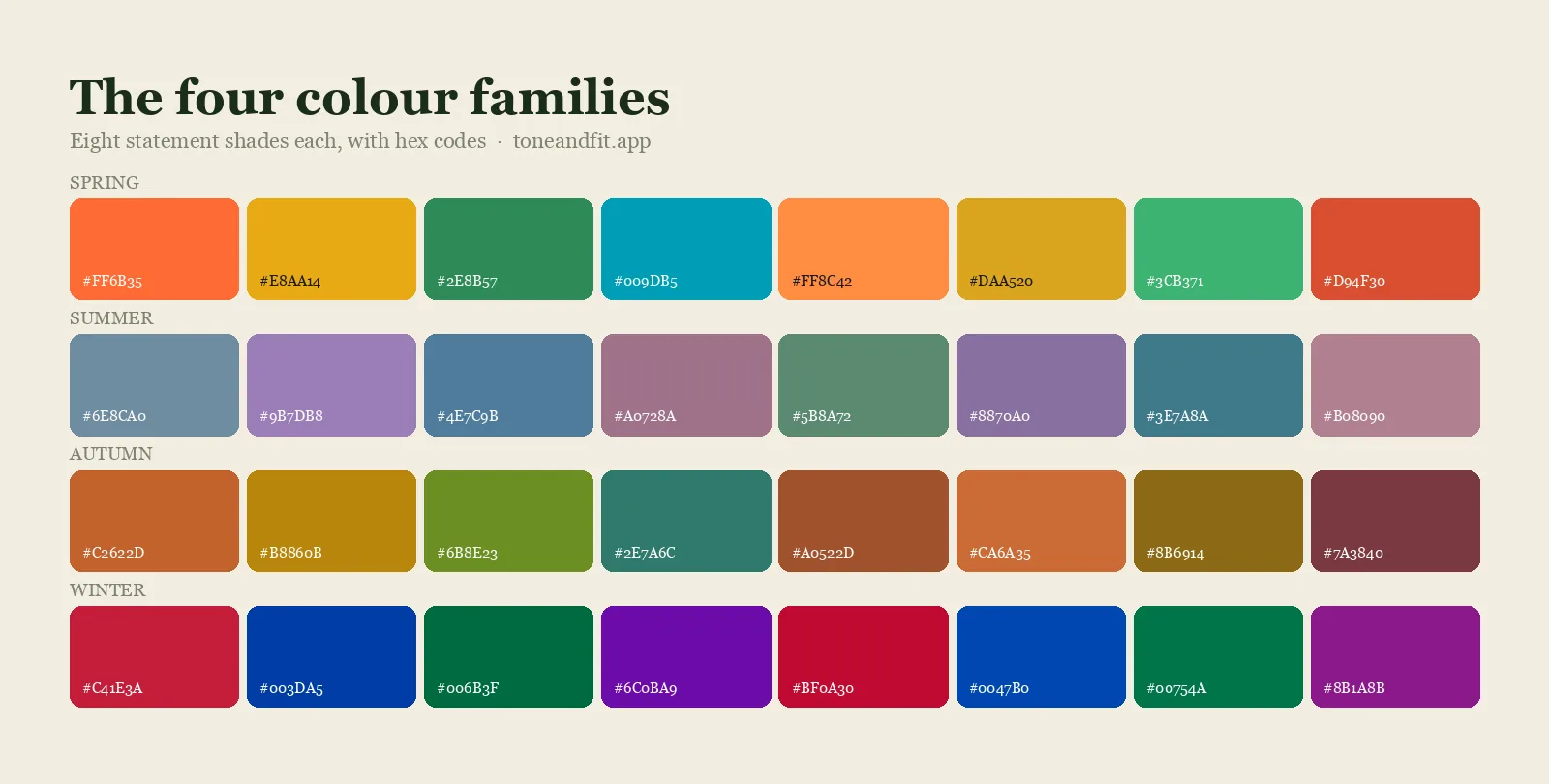
The six questions that decide your season
Strip away the branding and nearly every serious color quiz, including the one on this site, is really asking six questions: about your veins, your jewelry, your reaction to sun, your childhood hair color, your eyes, and a plain white shirt versus a cream one.
| Question | What it measures | The tell |
|---|---|---|
| Veins in daylight | Undertone | Green or olive reads warm; blue or purple reads cool. |
| Gold or silver jewelry | Undertone | Gold flatters warm undertones; silver flatters cool ones. |
| Reaction to sun | Undertone and depth | Tans easily leans warm; burns and freckles leans lighter and cooler. |
| Childhood hair color | Depth and clarity | Platinum and black sit at the two extremes of depth; red and golden blonde add warmth. |
| Eyes up close | Clarity | A crisp, defined ring reads bright; soft, blended color reads muted. |
| White or cream shirt | Undertone and clarity | Pure white flatters cool, bright coloring; cream flatters warm, softer coloring. |
None of these six is decisive alone. A quiz adds your answers up across all six, because undertone, depth and clarity only mean something in combination, which is also why warm vs cool skin undertone takes an entire guide to explain properly rather than a single yes or no question. Three of the six are worth a closer look, because they carry the most weight and trip people up the most.
The vein test, in more depth
Look at the inside of your wrist in daylight, not under a bathroom bulb. Veins that read green or olive sit on top of a warm, golden undertone. Veins that read blue or purple sit on top of a cool, pink undertone. If you genuinely see a mix, or the color changes depending on which window you stand near, that itself is useful: it usually means your undertone sits closer to neutral than to either extreme, and a photo will settle it faster than a fourth look at your wrist.
Childhood hair color, in more depth
Dye and years of sun exposure erase the cleanest signal you have, so the quiz asks about your hair before any of that happened. Platinum and very light blonde sit at the lightest end of depth. Black and near black sit at the deepest end. Red and golden blonde carry extra warmth and often extra brightness, which is why they tend to push toward Autumn or Spring rather than Summer or Winter. Mid brown is the closest thing to neutral this question can return.
The eye test, in more depth
This one measures clarity, not color. Hold a mirror at arm's length in good light and look at the edge between your iris and the white of your eye, and at how many distinct rings or flecks of color you can see. A crisp, dark ring around a clear iris reads bright. Color that blends and softens toward the edges, with no strong ring, reads muted. Hazel and green eyes usually read as more blended than a dark brown or ice blue eye, which is one reason this question carries so much weight in the scoring.
How six answers become one of 12 seasons
Your six answers sort into three dials, warm or cool, light or deep, and bright or muted, and the specific combination of all three is what names your season.
Temperature does the first split: a warm reading points you toward Spring or Autumn, a cool reading points toward Summer or Winter. Depth and clarity then decide which of the three seasons inside that family fits. Light, soft answers land you in the lightest member of the family, strong and saturated answers land you in the most dramatic member, and answers in between land you in the true season at the center. Add it up and that is the entire 12 season system in three sentences. Our full breakdown of the 12 color seasons shows every palette that comes out the other end, with the shades that belong to each one.
If your answers pulled in different directions, say a warm undertone paired with very muted, soft clarity, that tension is not a bug. It is the quiz correctly noticing that you sit closer to a border between two neighboring seasons than most people do.
Guessing is optional
Tone & Fit reads your undertone, depth and contrast from one selfie and hands you your season in about 60 seconds.
Get Tone & Fit Free ↗Why the same person can get two different results
You can answer the same six questions honestly on two different days and land on two different seasons, because self reported answers move with your lighting, your mood, and how objectively you can judge your own reflection.
You are the least objective observer of your own face
Self perception bias is the biggest factor. People who tan easily tend to over report warmth. People who flush easily mistake surface redness for a cool pink undertone when it is not undertone at all. If you have worn black your whole adult life, you will describe yourself as someone who suits black, because your eye has normalized it.
Lighting rewrites your answers
The same wrist can show green veins under a warm bulb and blue veins in open shade. Two quiz attempts taken in two different rooms are, in effect, two different people answering the veins and jewelry questions.
Some of the questions are genuinely ambiguous
Gold or silver forces a binary choice on people whose honest answer is that both look fine. Continuous traits like hair color get chopped into a handful of buckets, so anyone near a boundary gets rounded, sometimes up and sometimes down. None of this means the seasonal system itself is unreliable, only that a text quiz has a lower ceiling than a measurement. A quiz result is a hypothesis, not a verdict.
Free quiz vs free photo tool
A quiz scores what you report about your own coloring, while a photo tool measures the actual pixels in a picture of your face, which is the difference between a guess and a reading.
The six question format above needs nothing but honest self observation: no camera, no upload, no account. That is its whole appeal, and it is a genuinely useful two minute starting point. A photo based tool removes several of the failure points from the section above, because it is not asking you to judge your own veins or your own undertone by eye. It reads the color values directly from the image and returns your closest season along with your undertone and contrast. The trade is that photo quality becomes the new variable: harsh lighting, filters and heavy makeup can shift a photo reading the same way bad light shifts a wrist reading. If you want the mechanics before you upload anything, we have written up how a photo tool turns skin pixels into a season, including what it does when the image is not good enough to call.
How to check your result on yourself
The fastest way to sanity check a quiz result is to take the real interactive quiz for a scored season, then confirm it against a photo for a measured one.
- Take the interactive quiz. This guide walks through the six questions in the abstract. The actual color season quiz scores your specific answers and shows your season and palette immediately, with no email step.
- Cross check with a photo. Run the free color analysis tool on one well lit, makeup free photo. If it agrees with your quiz season, that is real confirmation from two different methods rather than one opinion repeated twice.
- Retake the quiz in better light. A north facing window, a bare face, no filters. If an answer changes between attempts, trust the daylight version and discard the other.
- Audit your actual clothes. Think of the two or three garments that reliably earn a comment about you rather than the outfit, then check whether they sit inside the palette your quiz result gave you.
When a quiz answer is not enough
A quiz answer stops being enough once you are sitting near a border between two seasons, or two honest attempts disagree, because that is exactly where self assessment runs out of resolution.
Borderline coloring is common, not rare. Someone whose depth sits between light and medium, or whose undertone carries both warm and cool signals at once, will bounce between two neighboring seasons depending on the day, the light, and which side of a close call they round to. A quiz cannot resolve that on its own, because it was never built to see you, only to collect your description of yourself. Once you have a season from any method, how to read your color analysis results covers what to actually do with it, including how to treat a borderline call.
Ready for the measured version?
One selfie gets you the same three answers this quiz just asked you to guess, plus the full palette that goes with your season.
Find your season free ↗FAQ
Is a color analysis quiz really free?
Yes. The quiz on this site scores your six answers in your browser the moment you finish, with no email, no account and no photo required. The free photo tool works the same way if you want to check the result against a picture instead.
How many questions does a color season quiz need?
Six is enough to estimate the three things a season is built from: undertone, depth and clarity. Some quizzes ask far more questions, but the extra length mostly repeats those same three measurements in different words rather than adding new information.
Can I take a color analysis quiz without uploading a photo?
Yes. A text based quiz like the six question version on this site never asks for a photo. It works entirely from how you describe your veins, jewelry, hair, eyes and sun reaction. A photo is only needed if you want the measured result from the free photo tool instead of a self reported one.
Is a quiz or a photo tool more reliable?
A photo tool reads the color values in your picture directly, so it does not depend on how well you can judge your own veins or undertone in a mirror. A quiz depends entirely on your self reporting, which is why two honest attempts on two different days can land on two different seasons. Neither replaces a live session with a professional consultant for someone who wants an in person opinion.
What should I do if my quiz result feels wrong?
Retake it in natural daylight with a bare face and no filters, since lighting is the biggest source of disagreement between attempts. Then run the free photo tool on a well lit photo and see whether the two agree. If they still do not, you are likely sitting near a border between two seasons, which a quiz format cannot resolve on its own.