What Fall Colors Should You Wear This Season?

The fall colors to wear are not one universal palette. They are your own personal color season, pushed toward its richest, deepest register: rust for a Warm Autumn, plum for a Winter, warm camel for a Spring. Once you know your season, dressing for fall is a matter of degree, not a wardrobe overhaul.
In this guide
Why are fall colors different for every color season?
Fall colors are different for every color season because "fall" describes a temperature and a mood, warm, rich, earthy, not a fixed set of hex codes that flatters every face the same way. Retail stores lean hard into one interpretation of that mood every September: pumpkin, plaid, olive, chunky knits in mustard and rust. That interpretation happens to be a close match for the Autumn color palette, which is why an actual Autumn season person can walk into any store in October and look flawless in the window display.
Everyone else is being sold a palette that was never built for their undertone. A cool-toned Summer in a mustard sweater does not look "seasonal," they look faintly jaundiced, because mustard fights a cool undertone regardless of the calendar. The fix is not to skip fall colors altogether. It is to translate the fall mood, richer, deeper, warmer-feeling, into your own season's actual palette rather than borrowing someone else's.
What are the universal rules for dressing well every fall?
Four rules apply no matter which of the twelve seasons you are, and they are worth setting before the season-specific detail below.
Go deeper, not warmer. The seasonal shift that actually works for a cool season is depth, not temperature. A Summer moving into fall should reach for a deeper version of their own cool palette (cranberry instead of pink, charcoal instead of dove grey), not a warm one.
Let outerwear carry the season. Coats, jackets and scarves are the easiest place to introduce a fall-specific color without touching the rest of your wardrobe, because they sit furthest from your face and get worn over whatever is underneath.
Keep one true neutral working overtime. Whatever your best neutral is (chocolate, charcoal, navy, camel) buy it in a heavier fabric for fall and let it anchor half your outfits. Fall is the season where fabric weight does as much visual work as color.
Match your metals to the season, not the calendar. Warm seasons keep wearing gold in fall, cool seasons keep wearing silver. Nothing about autumn changes which metal sits well against your skin, whatever seasonal jewelry displays might suggest.
What fall colors should each color season actually wear?
Not sure which of the four families you belong to? The Tone & Fit app places you in under a minute from one selfie, or read the seasonal color analysis explainer for the full framework first. Here is what each family should actually reach for once fall hits.
Spring: keep it warm and clear, just deeper
Reach for: Rust, warm camel, golden mustard, and a leaf-green knit. These are Spring's own warm undertone pushed to a richer depth, not borrowed from another season.
Outerwear: A camel or rust wool coat does more seasonal work for a Spring than any single sweater.
Skip: Black outerwear, deep aubergine, and anything the color of wet bark. These are muted or cool enough to drain a Spring's natural clarity, even in October.
Summer: cooler, deeper versions of your own palette
Reach for: Cranberry, soft plum, dusty navy, and a muted forest green. All of these stay cool and soft while adding the depth fall calls for.
Outerwear: A charcoal or soft navy wool coat reads seasonal without borrowing an Autumn's warmth.
Skip: Pumpkin orange, golden mustard, and rust. These are warm-season fall staples that will look muddy rather than rich against cool, soft coloring.
Autumn: this is your season, go all in
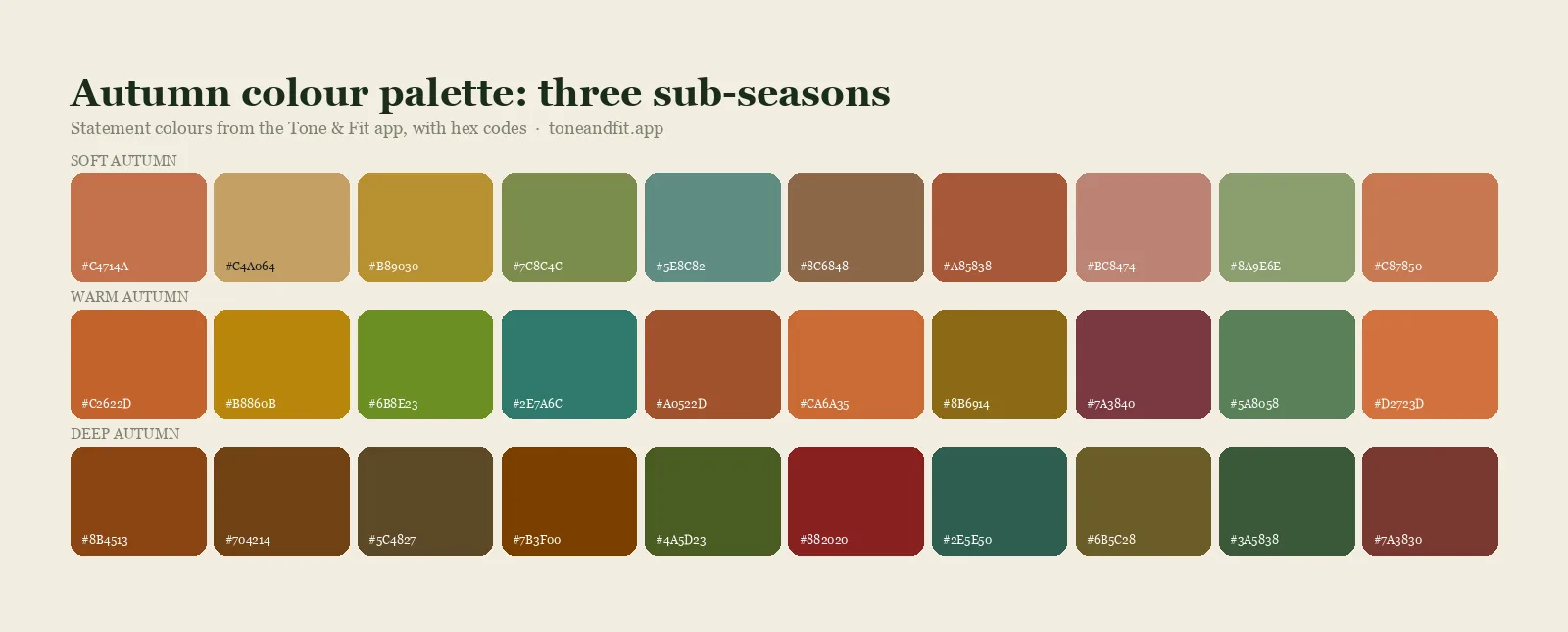
Reach for: Rust, olive, chocolate brown, teal, and mustard. Autumn is the one family that can wear the retail "fall palette" exactly as displayed, because it was built around this coloring in the first place.
Outerwear: Camel, chocolate or olive wool all read as effortless rather than costume-like on Autumn coloring.
Skip: Icy pastels and stark white are the only real misses, and they are unlikely to tempt you in a fall shopping trip anyway.
Winter: jewel tones instead of earth tones
Reach for: Burgundy, emerald, sapphire navy, and true black leather. Winter gets the fall mood of depth and richness through saturated jewel color rather than earthy warmth.
Outerwear: A true black or deep navy wool coat is one of the few places Winter can wear black near the face and have it read as sharp rather than heavy.
Skip: Muddy olive and warm camel. Both mute the high contrast that makes Winter coloring work, turning a Winter's usual sharpness into something flat.
Quick fall palette reference by season
| Season | Fall colors to reach for | Fall colors to skip |
|---|---|---|
| Spring | Rust, camel, golden mustard, leaf green | Black, aubergine, muddy brown |
| Summer | Cranberry, soft plum, dusty navy, forest green | Pumpkin, mustard, rust |
| Autumn | Rust, olive, chocolate, teal, mustard | Icy pastels, stark white |
| Winter | Burgundy, emerald, sapphire, true black | Muddy olive, warm camel |
Know your season before the fall shopping starts
One selfie, your season and your full palette, so every fall purchase actually earns its place in your closet.
Download Tone & FitHow do you build a fall capsule around your color season?
You build a fall capsule by choosing one hero color from your season's fall range, two supporting neutrals, and letting layering do the rest, rather than buying an entirely new set of clothes every September. Most of what makes an outfit read as "fall" is fabric weight and layering, a knit over a shirt, a scarf added to a look you already wore in July, not a completely different set of hues.
Start with the piece you will wear most: a coat or a knit in your best fall neutral. Add one hero color from the tables above as your accent, in a scarf, a bag or a sweater. From there, most of your spring and summer pieces in your own palette carry over fine once you layer them under something heavier. Our full guide to building a capsule wardrobe around your color season walks through the process piece by piece, and works for any time of year, not just fall.
If your calendar also includes specific fall events, the same season-first logic applies. Our guides to Halloween costume colors by season and Thanksgiving outfit colors apply this exact framework to two of the most photographed days of the season.
How do you check your season before fall shopping starts?
The fastest way to check your season before you spend money on fall pieces is to run a proper color analysis first, so every purchase this season fits a confirmed palette instead of a guess. If you already suspect a season from the guide above, confirming it takes one selfie.
Once your season is confirmed, the tell-cards above stop being general advice and become a literal shopping list. That is the entire point of doing color analysis before a seasonal wardrobe refresh rather than after: it changes fall shopping from browsing to filtering.
Ready to find your season?
One selfie, your 12-season result, and the palette that goes with it. Free, no sign-up.
Find your season free ↗Frequently asked questions
Can I wear pumpkin orange if I am not a Warm Autumn?
Not the full-strength version. Pumpkin is a Warm Autumn signature because it is warm, deep and fairly saturated all at once. A Spring can borrow the same family in a clearer, lighter apricot or coral. A Summer can borrow it as a soft terracotta rather than true orange. A Winter generally skips orange altogether and reaches for a saturated red instead, which does the same energetic job in a cooler register.
Is black a fall color for every season?
No. Black is a genuine fall neutral for Winter types, whose depth and contrast can carry it near the face. Spring, Summer and Autumn types generally get more mileage out of a warm chocolate, soft charcoal or deep navy instead, which give the same grounded, cold-weather feeling without the harsh line black can draw against lighter or warmer coloring.
What is the single best fall color if I do not know my season yet?
There is no color that flatters all twelve seasons equally, but a mid-depth burgundy comes closest to a safe universal choice, since it sits between warm and cool without swinging hard toward either. It is still worth confirming your actual season before you commit to a whole fall wardrobe around any one color.
Do I need a whole new wardrobe for fall?
No. Most of a fall wardrobe is your existing personal palette layered differently: a knit over a summer shirt, a coat in your best neutral, boots instead of sandals. Budget for one or two new pieces in your season's richest fall shade and let layering and fabric weight do the rest of the seasonal work.
How should a Spring or Summer person approach fall colors differently?
By adding richness through fabric and layering rather than by copying an Autumn's exact hues. A Spring stays in clear, warm color but chooses deeper versions of it: rust instead of coral, olive instead of mint. A Summer stays cool and soft but chooses deeper, heavier versions: cranberry instead of pink, charcoal instead of pale grey. The undertone does not change with the calendar, only the depth and weight of what you wear.