Best Colors for Medium Skin Tone: Flattering Shades by Undertone
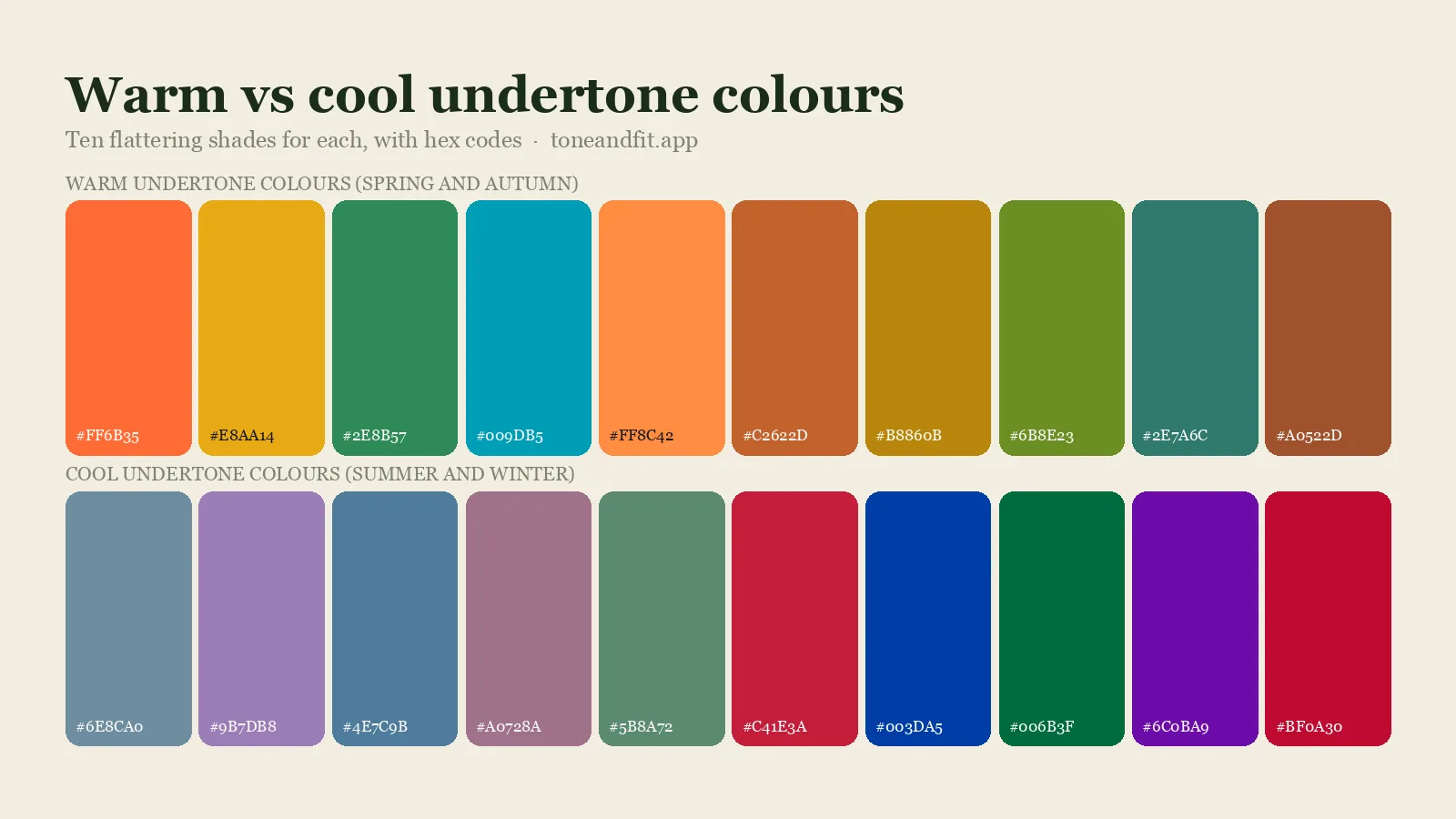
The best colors for medium skin tone are rich, medium-to-saturated shades: terracotta, coral, olive and warm teal if your undertone is warm; emerald, raspberry, sapphire and plum if it is cool; and sage, jade, burgundy and soft coral if it is neutral or olive. Medium skin has enough depth to carry real color, so the biggest mistake is going too pale or too chalky.
The short version: medium skin sits in the middle of the lightness scale, which means it looks best against colors that match its energy. Skip the very pale pastels and the heavy, dull neutrals, and choose colors with some pigment in them. The one thing that decides which pigmented colors work is your undertone. This page is the medium-skin companion to our what colors look good on me guide, which explains how undertone, depth and intensity combine into a full palette.
What's in this guide
- The quick answer by undertone
- What "medium skin tone" actually means
- Step one: find your undertone
- Best colors for warm medium skin
- Best colors for cool medium skin
- Best colors for neutral and olive medium skin
- Which color seasons medium skin tends to fall into
- How hair and eye color change the picture
- Colors that tend to work against medium skin
- Neutrals, white and black for medium skin
- Makeup and metals for medium skin
- How to put your palette to work in four steps
- FAQ
The quick answer by undertone
Medium skin comes in warm, cool and neutral versions, and the best colors differ for each. Find the row that sounds most like you, then read the matching section for the details.
| Your medium skin | Colors that usually flatter | Usually works against you |
|---|---|---|
| Warm (golden, peachy or yellow-leaning) | terracotta, coral, olive, warm teal, mustard gold | Icy pastels, cool grey, stark white |
| Cool (rosy, pink or blue-leaning) | emerald, raspberry, sapphire, plum, cool blue-grey | Orange, mustard, rust near the face |
| Neutral or olive (a mix, or a green-gold cast) | sage, jade, burgundy, soft coral, deep teal | Neon brights, very pale yellow, ashy pastels |
These are starting points, not laws. They come from how colors behave next to mid-depth skin, and the sections below explain the reasoning so you can adapt the lists to your own face.
What "medium skin tone" actually means
"Medium" describes depth, which is how light or dark your skin is. It does not describe temperature. A medium-depth person can have a warm golden undertone, a cool rosy one, or a neutral blend, and two people with identical depth can need nearly opposite palettes. That is why generic advice such as "wear jewel tones" is only half an answer: it fits depth but ignores undertone.
Medium skin usually sits between the very light range and the deep range, and it is often described with words like beige, tan, olive, honey, caramel or golden brown. If your skin is clearly lighter than that, our guide to the best colors for pale skin will fit better. If it is clearly deeper, see the best colors for dark skin tones. Anything in between belongs here, and many people find that their skin shifts across that range during the year, which is worth knowing before you shop.
Depth also affects contrast. Skin that is neither very pale nor very deep makes it easy to create a pleasing difference between your face and your clothes, as long as you avoid colors that sit at exactly your own lightness. A sand-colored sweater on beige skin removes all definition. A slightly deeper or slightly more saturated shade does the opposite. If you want to measure how much natural contrast you have, our walkthrough on how to find your contrast level takes a couple of minutes.
Step one: find your undertone
Undertone is the quiet color beneath the surface of your skin. It stays the same when you tan, flush or change your makeup. For medium skin it is especially worth getting right, because medium tones sit in the range where warm, cool and neutral undertones look surprisingly similar at a glance. Our guide to four tests for finding your skin undertone at home covers the vein check, the jewelry test and the white paper test. Do at least two of them in daylight, because indoor bulbs can tilt the result.
A few quick signals specific to medium skin:
- Warm: gold jewelry looks better than silver, skin turns golden or bronze in the sun, and veins on the inner wrist look green or olive.
- Cool: silver looks better than gold, skin turns pink or red before it tans, and veins look blue or purple.
- Neutral: both metals work and your veins look like a mix. Our piece on neutral undertone skin explains why you can wear more than you expect.
- Olive: the skin has a faint green or grey-gold cast, which is easy to mistake for cool or warm. The olive undertone explainer and our guide on how to tell if olive skin is warm or cool sort this out.
If the tests disagree with each other, you are probably neutral or olive, and that is a perfectly useful answer. If you would rather not run the tests by hand, the Tone & Fit app reads skin, hair and eyes together from a selfie and returns a season and palette. That is a convenience, not a requirement, and everything on this page works either way.
Find your exact palette in one selfie
Tone & Fit reads your skin, hair and eyes and returns your season and a full color palette.
Try Tone & Fit free ↗Best colors for warm medium skin
Warm medium skin glows in colors with a golden or earthy base. The common thread is a little yellow in the pigment, which echoes the skin and makes it look healthy rather than sallow.
Earth tones and oranges
Terracotta, burnt orange, rust, cinnamon and warm brown are the signature family for warm medium skin. They look rich rather than heavy because your depth can hold them. Try them as a sweater, a shirt or a scarf close to the face, and use the deepest versions for coats and trousers.
Greens
Olive, moss, fern and warm forest green flatter golden skin. They are a quiet alternative to black and work especially well if you have hazel or green eyes. Our guides to the best colors for hazel eyes and best colors for green eyes show how to pair them with an accent.
Blues and teals
Choose blues with a little green in them: turquoise, peacock, warm teal and petrol. A cool, pure royal blue can look a bit stiff on warm skin, though a deeper navy usually works fine.
Pinks, corals and yellows
Coral, salmon, peach and warm watermelon are your pinks. Golden yellow, saffron and mustard work well when they have enough depth, but pale lemon yellow can look sickly, so keep yellows warm and rich.
Best colors for cool medium skin
Cool medium skin has a pink, red or blue-leaning base, and it looks best against colors that share that cool, clear energy. The goal is to avoid anything that turns the skin yellow-green by contrast.
Jewel tones
Emerald, sapphire, amethyst, ruby and deep magenta are the natural territory for cool medium skin. The depth of the skin holds the saturation, so these colors look vivid without overwhelming you.
Berries and plums
Raspberry, fuchsia, mulberry, plum and deep wine suit cool undertones and make the skin look clear. For lips and cheeks, our guide to blush by undertone has matching shades.
Cool blues and greys
Cobalt, cornflower, steel blue, charcoal and slate are strong choices. Cool medium skin can also carry navy and true black better than most, particularly when your hair and brows are dark. If black is a staple for you, read black and your color season for the placement rules.
Soft pastels, used carefully
Pastels work when they are cool and slightly dusty: rose, lavender and periwinkle. Avoid pale shades with a yellow base, which tend to look chalky against rosy skin.
Best colors for neutral and olive medium skin
If your undertone is neutral or olive, you sit between the two camps. The most reliable approach is to choose colors that are medium in warmth and not extreme in either direction, then use your hair and eyes to nudge the choice.
Muted and mid-tone greens
Sage, jade, teal and deep pine are classic wins for olive skin. They harmonize with the green-gold cast instead of fighting it. Our guide to the best colors for olive skin tone goes deeper on this family.
Reds and wines
Burgundy, cranberry, brick and soft tomato red make olive and neutral skin look warm and alive. Avoid very blue-based reds and very orange reds, which sit at the extremes.
Soft corals and dusty pinks
Soft coral, dusty rose and muted berry work because they add a little color to the face without pushing it hard in one direction.
Why neutral is flexible
Neutral medium skin can borrow selectively from both the warm and cool lists, as long as the colors are not too icy and not too orange. The practical test is to hold a color under your chin in daylight. If your skin looks clearer and your eyes look brighter, keep it. If shadows appear under the eyes, put it further from the face.
Which color seasons medium skin tends to fall into
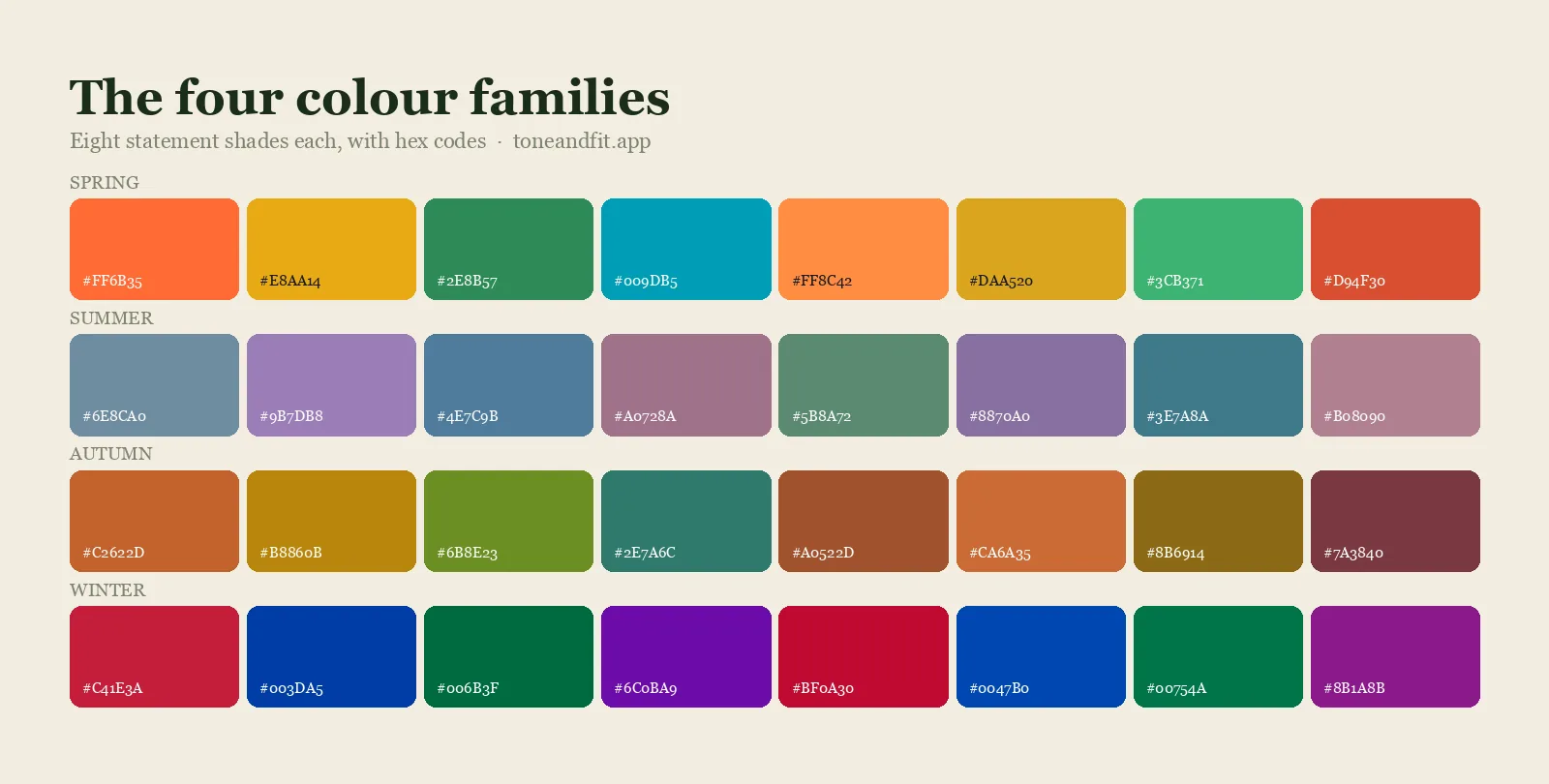
Seasonal color analysis sorts people into twelve palettes by combining undertone, depth and intensity. Medium skin can land in many of them, so the season is a more precise answer than "medium" alone. If the system is new to you, start with seasonal color analysis explained, then the full list of 12 color seasons. Here is how medium skin commonly maps:
- Warm and golden: often Warm Spring, True Spring or Warm Autumn. See how to tell if you are a Warm Autumn and Warm Spring versus Warm Autumn.
- Warm but muted: often Soft Autumn, whose palette is rich but never sharp. The Soft Autumn guide has the diagnostics.
- Cool and muted: often Soft Summer or True Summer. Compare them in True Summer versus Soft Summer.
- Cool and clear, with deep contrast: sometimes Cool Winter or True Winter, especially with dark hair. See how to tell if you are a Cool Winter.
- Neutral and olive: usually Soft Autumn, Soft Summer or one of the deeper seasons depending on hair and eyes.
The point is not to force yourself into a box but to use the season as a shortcut to a tested palette. If you want the broader how-to, our personal color analysis guide walks through the whole process.
How hair and eye color change the picture
Once undertone and depth point you to a family, hair and eyes fine-tune the choice. They mainly affect contrast and which accent color you reach for.
- Dark brown or black hair with medium skin creates higher contrast, so you can wear bolder, more saturated colors and deeper darks.
- Light brown or golden hair with medium skin is lower contrast, so softer mid-tones and muted versions of your colors look more natural than harsh brights.
- Brown eyes are flexible and pair well with rich warm or cool colors. See the best colors for brown eyes for ways to make them look deeper.
- Blue, green or hazel eyes in medium skin are striking, and echoing them with an accent color is the simplest trick. The guide to the best colors for blue eyes covers the blue case.
If your hair has been dyed away from its natural shade, treat it as a modifier and rely on your skin undertone as the anchor. The same logic appears in our article on finding your color season with dyed hair.
Colors that tend to work against medium skin
Any color can be made to work with the right fit and placement, but these cause the most trouble near medium skin:
- Very pale pastels with a grey or yellow base. They can look chalky or ashy and make the skin look dull. If you love pastels, pick ones with a clear hue, such as a soft coral or a light jade.
- Beige and tan that match your skin. A sweater the color of your face removes definition and can make you look washed out. Go a shade deeper or lighter, or add a contrasting scarf.
- Neon colors on muted or olive skin. Highly electric shades can overpower softer coloring.
- The wrong temperature near the face. Orange-leaning colors on cool skin and icy blue-leaning colors on warm skin are the most common mismatches.
Our article on colors that wash you out explains how to spot the effect in a mirror, and it applies to any depth of skin.
Neutrals, white and black for medium skin
Neutrals are the part of a wardrobe you wear most, so they deserve the most care. Warm medium skin usually looks best in camel, chocolate, olive and warm cream. Cool medium skin usually looks best in charcoal, navy, soft white and taupe-grey. Neutral and olive medium skin can wear stone, deep teal-navy and oat. Our overview of the best neutrals for each color season gives lists for every palette.
White is worth a closer look. Optic white can be stark against medium skin, particularly warm skin, where it reads cold. Warm cream, ivory and oat are kinder. The comparison in white versus cream helps you decide. Black is usually easiest on cool medium skin with dark hair and can be softened with charcoal or deep navy near the face for everyone else.
Makeup and metals for medium skin
For metals, follow undertone: gold for warm, silver for cool, and either for neutral. If you are unsure, gold or silver: which suits your undertone gives a simple test. For makeup, medium skin carries more pigment than pale skin, so lips and cheeks can be richer. Warm medium skin suits terracotta, brick and warm nude lipsticks, cool medium skin suits berry, rose and wine, and neutral skin suits soft coral and rosewood. The best lipstick colors for your undertone guide has swatch-level detail. For base makeup, matching your undertone matters more than matching depth, so see how to find your foundation undertone before you buy.
How to put your palette to work in four steps
- Decide your undertone. Use daylight and at least two tests, or a selfie-based tool, and settle on warm, cool or neutral.
- Pick two or three core neutrals. Choose ones that sit a clear step away from your skin depth, such as chocolate and cream for warm, or navy and charcoal for cool.
- Add three accent colors. Choose them from the lists above, with at least one that echoes your eyes and one that you would happily wear as a statement piece.
- Test near the face. Hold each item under your chin in daylight. Keep what makes your skin look clearer. Put the rest in trousers, shoes or bags.
When you are ready to shop, how to shop your color palette shows how to turn the list into purchases without overbuying, and how to clean out your closet by color season helps you edit what you already own.
Skip the guesswork
Get your 12-season result and palette from a single photo. Free to try, no sign-up.
Find your season free ↗FAQ
What colors look best on medium skin tone?
Medium skin looks best in medium-to-saturated colors rather than very pale ones. Warm medium skin suits terracotta, coral, olive and warm teal. Cool medium skin suits emerald, raspberry, sapphire and plum. Neutral or olive medium skin suits sage, jade, burgundy and soft coral.
What colors should I avoid with medium skin?
Very pale pastels with a grey or yellow base, beige that matches your skin, neon shades on muted coloring, and colors of the wrong temperature near the face tend to cause the most trouble. These are tendencies, not strict rules, and fit and placement matter.
What is the best color for medium skin tone to wear?
There is no single best color because undertone changes the answer. Deep green works for many medium skin tones, from emerald on cool skin to olive on warm skin. Teal is another flexible choice, though warm skin prefers a greener teal and cool skin a bluer one.
Does medium skin tone mean warm or cool undertone?
No. Medium describes depth, not temperature. Medium skin can have a warm, cool or neutral undertone, and olive skin is common in this range. Check your undertone in daylight with a few simple tests before you choose a palette.
Can medium skin wear pastel colors?
Yes, if the pastel has a clear hue and suits your undertone. Soft coral, light jade, rose and periwinkle often work. Chalky, grey or yellow-based pastels can look dull, so try them near your face in daylight first.
What color season is medium skin?
Medium skin can fall into many of the twelve seasons. Warm and golden skin is often a Spring or Autumn type, cool and muted skin is often a Summer type, and cool skin with strong contrast can be a Winter type. Undertone, hair, eyes and contrast decide the final season.
Should medium skin wear gold or silver jewelry?
Follow your undertone. Warm medium skin usually looks best in gold, cool medium skin in silver, and neutral or olive skin can wear either. Hold each metal against your skin in daylight and see which one makes your skin look clearer.