Cool Winter or Deep Autumn? How to Tell Them Apart
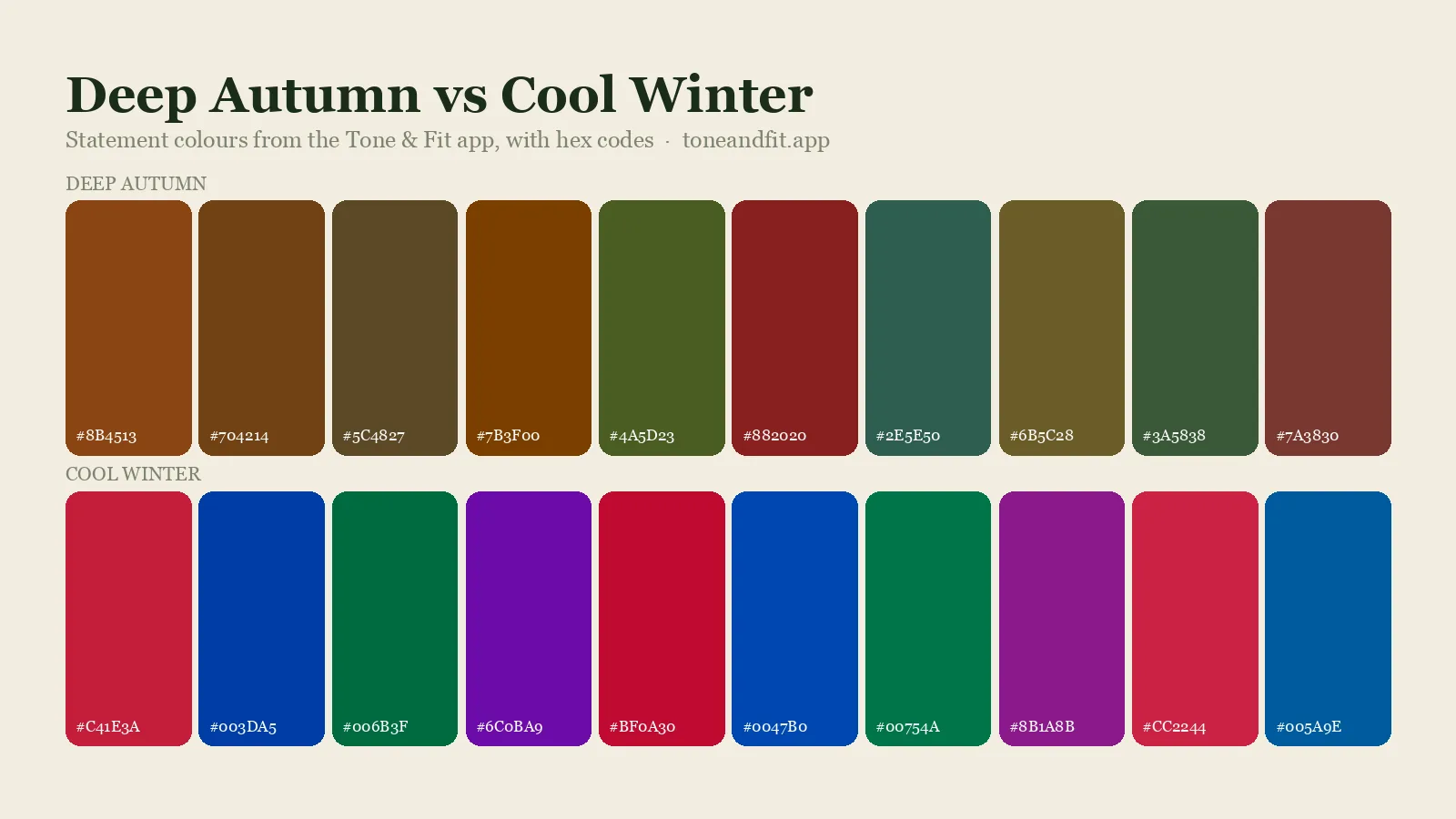
Short answer: Cool Winter and Deep Autumn are both deep, high impact seasons, but they sit on opposite sides of the undertone line. Cool Winter is cool and icy, so it wears true red, emerald, icy blue, fuchsia and charcoal. Deep Autumn is warm and earthy, so it wears rust, olive, burnt orange, deep teal and chocolate brown. The five tests below show which one is you.
If you have dark hair, strong features and a result that flips between Winter and Autumn, you are not doing anything wrong. These two seasons share depth and contrast, and they split on one thing that is easy to misjudge in a mirror: the temperature of your skin. Once you know where to look, the answer tends to show up quickly.
What's in this guide
Why these two get confused
Cool Winter belongs to the Winter family and Deep Autumn belongs to the Autumn family, so on paper they should be easy to separate. In practice they are two of the most commonly mixed up seasons in the 12-season system. Both usually have dark brown or near black hair, deep eyes and enough contrast between hair and skin to look strong in photos. Both also look dramatic in deep, saturated colors, which means a quick quiz that scores depth and contrast can send either one to the other.
The confusion usually starts when someone knows that pale pastels wash them out and that dark, rich colors suit them, but cannot tell whether those colors should be cool and jewel-like or warm and earthy. If you have read our guides on whether you are a Cool Winter and whether you are a Deep Autumn and felt that both described you, that is a very common experience.
If the vocabulary is new, our explainer on seasonal color analysis covers undertone, value and chroma from scratch. For the full grid showing where every sub-season sits, see the 12 color seasons.
The axes that separate them
Every season is a mix of three measurements: undertone (warm or cool), value (light or deep) and chroma (clear or muted). Cool Winter and Deep Autumn are both fairly deep. They split on undertone first, and on clarity second.
Undertone: cool or warm?
This is the main split. A Cool Winter has a blue-based or pink-based undertone, so the skin can look rosy, porcelain, olive with a gray cast, or deep with a blue sheen. A Deep Autumn has a golden, peachy or bronze undertone, so the skin looks warm, sunlit or richly tanned even without sun. The honest way to settle it is to confirm the warm or cool side first. Start with our guide to finding your skin undertone at home and the breakdown of warm versus cool undertones, then come back to the tests below.
Chroma: icy and clear, or rich and muted?
Cool Winter colors are clear and high in chroma, like a true red or an electric blue. Deep Autumn colors are rich but slightly softened by warmth, like rust, olive or a deep teal with a hint of green. A Cool Winter looks best in colors that look crisp, almost lit from within. A Deep Autumn looks best in colors that look like they have been warmed by the sun or aged like leather. Put simply, Cool Winter is defined by cool clarity, and Deep Autumn is defined by warm depth.
Cool Winter: true red, emerald, icy blue, fuchsia, charcoal.
Deep Autumn: rust, olive, burnt orange, deep teal, chocolate brown.
Cool Winter vs Deep Autumn side by side
| Cool Winter | Deep Autumn | |
|---|---|---|
| Undertone | Cool, blue-based | Warm, golden, slightly neutral |
| Defining trait | Icy contrast and clarity | Rich, earthy depth |
| Value | Deep to medium-deep | Deep |
| Contrast | High | Medium-high |
| Saturation | Clear, vivid and cool | Muted-rich and warm |
| Signature colors | True red, emerald, icy blue, fuchsia, royal purple | Rust, burnt orange, olive, deep teal, mustard |
| Neutrals | Charcoal, navy, black, pure white, cool gray | Chocolate brown, espresso, cream, warm khaki, olive |
| Best metal | Silver, white gold, platinum | Yellow gold, bronze, copper |
5 tests to settle it
You cannot separate these seasons from a description alone. Sit by a window in indirect daylight, remove makeup, pull your hair back, and hold fabric or paper close to your face. Run all five tests and count which season wins more rounds.
1. The red test
Hold a true blue-red next to your face, then swap it for a brick or rust red. On a Cool Winter, the blue-red makes the skin look clean and the eyes bright, while rust can make the skin look sallow or yellow. On a Deep Autumn, rust and brick look rich and natural, while the blue-red can look harsh and slightly gray against the skin.
2. The white test
Drape pure white, then cream. Cool Winter looks sharp and clear in pure white, since high contrast is part of the look. Deep Autumn looks better in cream or ivory, and stark white can make the warmth in the skin look dull or orange.
3. The green test
Compare an emerald green with an olive green. Emerald lifts a Cool Winter and makes the eyes stand out. Olive lifts a Deep Autumn and makes the skin glow. If emerald looks too cold and olive looks flattering, lean Deep Autumn. Our guide to neutrals by color season shows how this carries over to everyday basics.
4. The black and brown test
Drape black, then a dark chocolate brown. Cool Winter often looks excellent in black, which matches the contrast in the face. Deep Autumn usually looks better in espresso or chocolate, since black can flatten warm skin. For more on this, read how black affects your color season.
5. The metal test
Hold a silver chain against your neck, then a yellow gold one. Cool Winter looks best in silver, white gold and platinum, which echo the cool skin. Deep Autumn looks best in yellow gold, bronze and copper, which echo the warmth. Our guide on gold versus silver jewelry explains why.
If your tests keep pointing in different directions, measure your contrast directly with our guide to finding your contrast level. If you want to practice with fabric, our walkthrough on color draping at home shows how to set it up.
Stop guessing between Winter and Autumn.
Tone & Fit's AI measures your undertone, value and chroma from a selfie and tells you whether you are Cool Winter, Deep Autumn or something else, with your full palette in 60 seconds.
Try the App ↗How the palettes differ
The wardrobe payoff of getting this right is real. The two palettes overlap in the deep, saturated middle and part ways on temperature.
Where they overlap
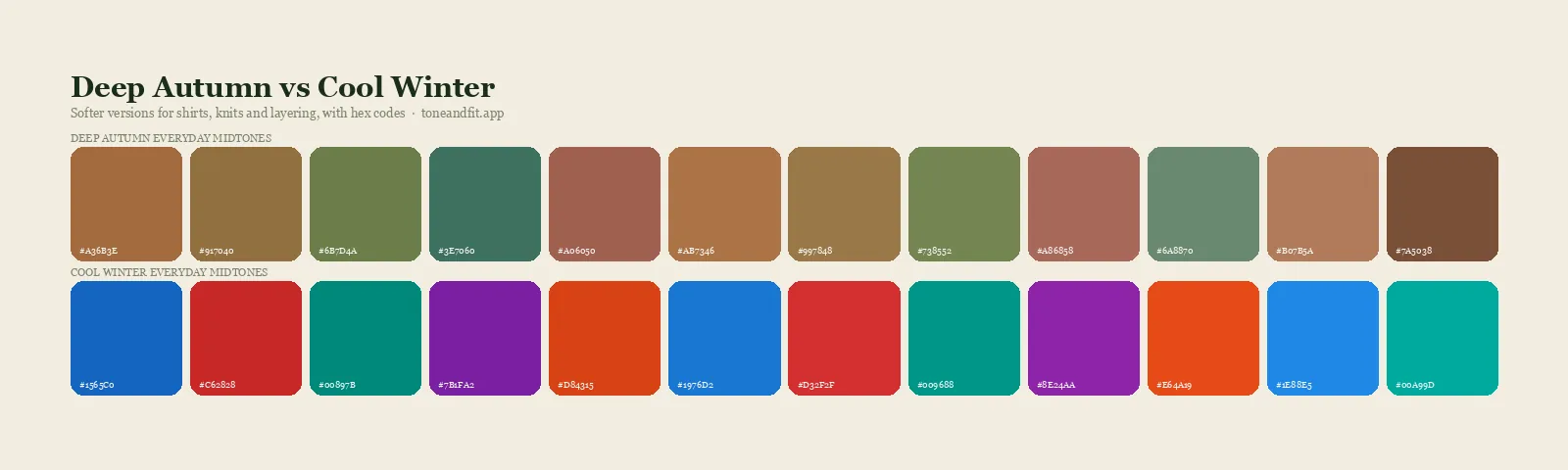
Deep teal, forest green, burgundy and plum can work on both seasons, as long as you choose the version that matches your undertone. A cool, bluish burgundy suits a Cool Winter, while a warm, brownish burgundy suits a Deep Autumn. Both seasons also handle depth well, so neither should be afraid of dark colors.
Where Cool Winter pulls ahead
Cool Winter owns the icy, jewel-toned end: true red, fuchsia, royal blue, emerald, icy pink, pure white and charcoal. These colors need cool skin and strong contrast to look right, and on a Deep Autumn they can look cold and flat. The full list with hex codes is on the Cool Winter color palette page, and our Cool Winter outfit ideas show how to put them together. For a ready-made plan, try the Cool Winter capsule wardrobe.
Where Deep Autumn pulls ahead
Deep Autumn owns the warm, earthy end: rust, burnt orange, mustard, olive, moss, camel and chocolate brown. These colors need warm skin to look right, and on a Cool Winter they can look muddy. See the Deep Autumn color palette for every shade, Deep Autumn outfit ideas for how to wear them, and the Deep Autumn capsule wardrobe for a full set.
If you want to see each family as a whole, the full Winter palette and the full Autumn palette show every sub-season in one place.
Hair, makeup and metals
The same temperature split shows up in everything you put near your face.
Hair. Cool Winter suits blue-black, espresso with cool undertones and ashy dark brown. Deep Autumn suits dark chocolate, auburn, mahogany and warm brown with copper glints. Our guides to Cool Winter hair color and Deep Autumn hair color go through both.
Makeup. Cool Winter can carry a blue-red lip, a berry or plum blush and a smoky charcoal eye. Deep Autumn looks better in brick, terracotta and warm brown-red lips with a bronze or olive eye. See the Cool Winter makeup guide and the Deep Autumn makeup guide for specific shades.
Metals. Cool Winter is a silver person at heart, with white gold and platinum as close seconds. Deep Autumn is a yellow gold person, with bronze and copper as strong seconds.
Celebrity examples can help you picture the difference. Browse our lists of Cool Winter celebrities and Deep Autumn celebrities to see how each season looks in real life.
Common mistakes and look-alikes
Assuming dark hair means Winter. Plenty of Deep Autumns have very dark brown hair. The test is the warmth of the skin and the glints in the hair, not just the darkness.
Assuming deep colors always mean Autumn. Winter is also a deep season. A Cool Winter looks excellent in dark, saturated colors, as long as they are cool and clear rather than warm and muted.
Confusing Cool Winter with Deep Winter or True Winter. The names overlap across systems. Our comparisons of Cool Winter vs Deep Winter and Cool Winter vs True Winter clear up the naming, and Cool Winter vs Soft Summer covers the split on softness.
Confusing Deep Autumn with Deep Winter. Both are deep, but Deep Winter is cool and clear while Deep Autumn is warm and rich. Read Deep Winter vs Deep Autumn if you sit between those two. If instead you wonder whether you are softer and more muted, see Deep Autumn vs Soft Autumn and Deep Autumn vs Warm Autumn.
Wearing your closest wrong palette. A Cool Winter in rust and mustard can look tired without knowing why, while a Deep Autumn in icy blue and stark white can look drained. Our lists of Cool Winter colors to avoid and Deep Autumn colors to avoid can help you spot what is working against you.
This is a fine distinction, and judging undertone from a mirror is hard for anyone, especially under warm indoor lighting. When the tests split, measuring directly is the fastest route to a confident answer. If you are weighing your options, our guide to personal color analysis covers the DIY, app and professional routes, and you can also take the free color analysis quiz as a first pass.
Ready to find your season?
One selfie, your 12-season result, and the palette that goes with it. Free, no sign-up.
Find your season free ↗FAQ
What is the main difference between Cool Winter and Deep Autumn?
Undertone. Cool Winter has a cool, blue-based undertone with high contrast, so its best colors are icy blue, true red, emerald and fuchsia. Deep Autumn has a warm, golden undertone with rich depth, so its best colors are rust, olive, burnt orange and deep teal. Both seasons are deep and striking, but one is crisp and cool while the other is warm and earthy.
Can a Cool Winter wear Deep Autumn colors?
A few of them. Deep teal, forest green and burgundy cross over when they lean cool. Rust, mustard and warm olive usually pull yellow in the skin on a Cool Winter.
Why do I get both Cool Winter and Deep Autumn in quizzes?
Both seasons have dark hair, strong contrast and deep eyes, so quizzes that lean on depth alone cannot separate them. The split is undertone, which is easier to judge with a measurement than by eye.
Is Deep Autumn warm or neutral?
Deep Autumn is warm, but it sits at the deeper, slightly more neutral edge of the warm side. That is why dark browns and deep greens flatter it so well, and why some Deep Autumns can borrow a few Deep Winter shades.
Does dark hair mean Deep Autumn or Cool Winter?
No. Both seasons often have dark brown or black hair. Look at the warmth of the skin and the tone of the hair highlights in daylight. Warm red or golden glints point to Deep Autumn, blue-black or ashy tones point to Cool Winter.
How do I confirm which one I am?
Run the drape tests in daylight, then confirm with a measurement. An AI color analysis from a selfie measures undertone, value and chroma directly, which is more reliable than judging a subtle difference by eye.