Warm Spring Outfit Ideas: How to Build a Wardrobe Around Your Palette

Short answer: a Warm Spring outfit works when it uses camel, ivory, warm tan and toffee as neutrals with coral, golden yellow, warm turquoise and leafy green as power colours, in gold. Five ready-to-copy formulas, the capsule to build and the colours to avoid are below.
Warm Spring coloring is built for sunlight: golden neutrals, clear corals, and greens that look freshly grown rather than mossy. Here are the exact colors, neutrals, metals, and ready-to-copy outfit formulas that make that coloring glow instead of getting buried under black and grey.
What's in this guide
What makes an outfit work on a Warm Spring
Warm Spring is one of the three Spring seasons in the modern 12-season system, sitting between True Spring and Warm Autumn. Everyone in this season shares three qualities: a golden, warm undertone, coloring that reads light to medium rather than deep, and a natural brightness that asks for clear color rather than muted color. If you have not confirmed your season yet, our breakdown of whether you are a Warm Spring walks through the tells, and the broader seasonal color analysis explainer shows how all twelve seasons fit together.
Clothing is color worn against the face and body, so the same logic that governs makeup governs your wardrobe. Three qualities decide whether a garment flatters a Warm Spring: it should be warm rather than cool, clear rather than dusty, and light enough to match your natural freshness rather than weigh it down. When those three align, an outfit looks like it was made for you. When they clash, even a beautiful piece can leave you looking tired or shadowed. Almost every rule below is just those three ideas applied to fabric.
The single most useful habit is to ask whether a color leans warm or cool before anything else. A coral flatters, a blue-pink flattens. A golden camel glows, a blue-grey drains. If temperature is a new idea, our warm vs cool skin undertone guide explains how to read it, and how to find your skin undertone at home gives you a quick self-check before you shop.
Your neutrals: the wardrobe backbone
Most of a wardrobe is neutrals, so getting them right matters more than any single statement piece. Warm Spring neutrals are golden and sunlit rather than dark and stark. The workhorses are warm ivory, cream, camel, tan, golden beige, light warm khaki, and a golden or chocolate brown for depth. Where a Winter builds on black and white, you build on ivory and camel, and the effect is just as polished with none of the harshness.
Warm Spring neutrals: warm ivory, cream, golden beige, camel, golden brown, and chocolate.
The neutrals to treat with caution are the cool and heavy ones. Black, pure optic white, charcoal, and blue-grey all pull against a golden undertone, and black in particular tends to cast shadows on light, warm coloring and make the face look drained. You do not have to bin every black piece: keep it below the waist, in shoes and bags, or break it near the face with a coral scarf or gold jewelry. For a fuller list of every shade in your range, the Warm Spring color palette guide lays out the whole set, and it is the page worth bookmarking before a shopping trip.
One practical trick: choose a single dominant light neutral and a single dominant deep one. Warm ivory plus camel, or cream plus chocolate brown, gives you the same light-dark structure other people get from white and black, but in temperatures that actually agree with your skin. Everything you layer over that base will read more expensive because the foundation already harmonizes.
Your power colors
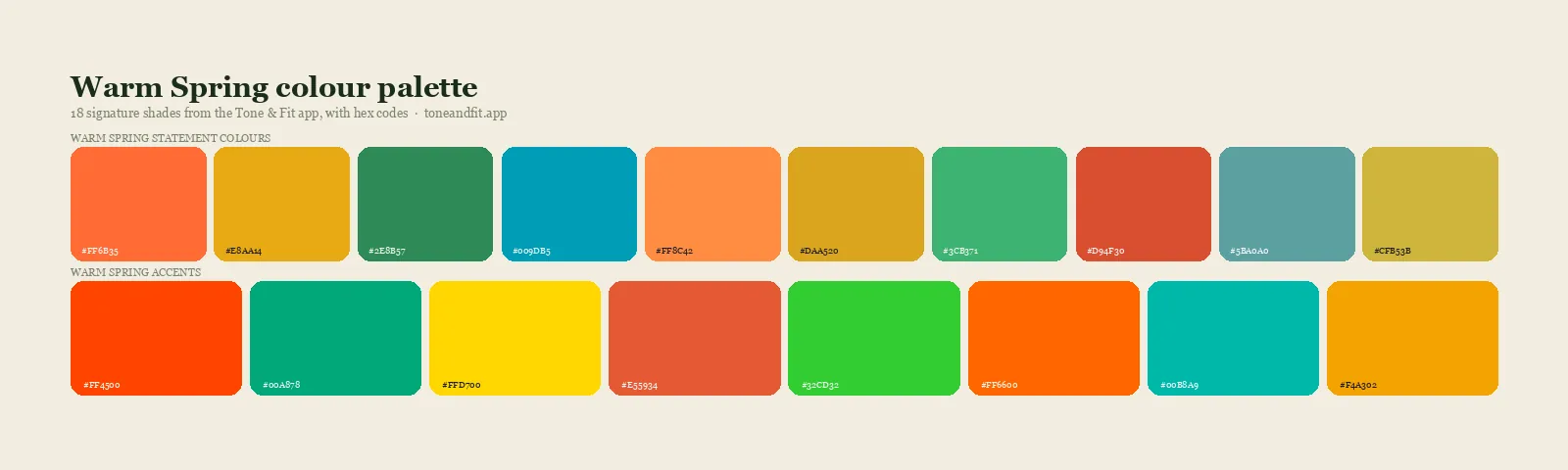
Warm Spring is the season for fresh, sunlit brights. Where an Autumn wants its warmth deepened and muted, you want yours clean and lit up. These are the shades to reach for when you want an outfit to do the talking.
Warm Spring brights: coral, peach-apricot, golden yellow, leaf green, turquoise, and tomato red.
Your signature is coral, the warm pink-orange that does for you what blue-red does for a Winter: it wakes up the whole face. Around it sits a family of clear warm colors: peach, apricot, salmon, golden yellow, marigold, warm leaf green, grass green, turquoise, warm aqua, and a tomato or poppy red with orange rather than blue in its base. Even your blues are warm-leaning, so reach for turquoise and warm periwinkle rather than icy or navy-cold blues. The common thread is that every one of these looks like it belongs in a garden in May rather than a city in January.
The guiding idea is clarity with a golden lean. A color should look freshly mixed, never dusty or greyed. When you see the same idea worn well, it clicks quickly, which is why looking at real people in your season helps. Our roundup of Warm Spring celebrities shows how these exact colors read on camera, and it is a good visual reference when a swatch alone is hard to judge.
Five outfit formulas to copy
Rules are easier to use as outfits. Each formula below leans on one golden neutral plus one clear warm color, which is the simplest way to look pulled together without overthinking it.
1. The ivory-and-camel classic
Warm ivory shirt or knit, camel trousers or skirt, gold jewelry, tan shoes. This is your version of the black-and-white uniform: quiet, expensive-looking, and impossible to get wrong. Add a coral lip or a turquoise bag and it goes from calm to radiant.
2. The coral statement
One clear coral or tomato-red piece, whether a dress, a blazer, or a knit, with warm ivory or golden beige everywhere else. Coral near the face is the single most flattering move a Warm Spring can make, so let it sit on top rather than on the bottom half.
3. The golden base with a pop
Camel or golden brown as the base, whether a trench, a suit, or a knit-and-trouser pairing, with one bright as the accent: a turquoise scarf, a marigold bag, or a leaf-green sweater underneath. The warm base lets the bright do all the work.
4. The fresh daytime look
Peach or warm aqua on top, cream or light tan on the bottom, gold accents. Warm Springs wear light color beautifully as long as it stays warm and clear rather than icy or dusty. This is the everyday alternative to always reaching for a statement bright.
5. The interview and boardroom look
A warm mid-brown, camel, or warm navy suit with a cream or warm ivory shirt, gold watch, and a coral or turquoise accent. Skip the black suit: on Spring coloring it reads severe rather than sharp. For a deeper take on dressing to impress, see our guide to what colors to wear to a job interview.
Notice the pattern across all five: one golden neutral does the heavy lifting and one clear warm color carries the interest. You almost never need three loud colors at once. A Warm Spring looks most expensive with a sunlit base plus a single, clear, correctly-warm hit.
Not sure you are a Warm Spring? Find out in 60 seconds.
Free · No account · Photo never stored
Download Tone & Fit ↗Metals, denim, and accessories
Metals matter more than people expect, because a necklace or watch sits right at the face and neck. Yellow gold is the most flattering metal for a Warm Spring, since it echoes the golden undertone and makes skin look lit from within. Warm rose gold, brass, and bronze work in the same way. Silver and platinum can read slightly icy against warm skin. If you love silver, wear it mixed so gold stays dominant near the face, which keeps the cool metal from pulling your complexion off.
Denim needs a warm eye. Light and mid-blue washes with a slightly warm, faded quality sit comfortably in your palette, and ecru, cream, and tan denim are quiet wins most seasons cannot wear. The washes to avoid are inky blue-black and true black denim, which bring all the problems of black with none of its polish on you. If a dark jean is non-negotiable, a warm chocolate-brown pair does the same job in your temperature.
For bags, shoes, and outerwear, tan, cognac, camel, cream, and golden brown are endlessly useful, and a turquoise or coral accessory is the easiest way to inject color without committing a whole outfit to it. Scarves are especially valuable because they land near the face, so a warm-toned scarf can rescue an otherwise-cool coat by putting the right color where it counts most.
The fastest wardrobe upgrade for most Warm Springs: switch your everyday metal to yellow gold and your default dark neutral from black to camel or chocolate brown. Two small changes, and everything you already own starts looking more intentional.
Colors to avoid
It is often faster to learn a season by its misses. For a Warm Spring, almost every wardrobe mistake is either too cool or too dusty. Cool offenders include black, pure white, charcoal, blue-red, burgundy, fuchsia, icy pastels, and blue-greys. These carry blue where your skin carries gold, and the mismatch shows up as shadows and dullness in the face. Dusty offenders include mauve, greyed rose, muted sage, and any color that looks like it has had grey stirred into it, since Spring coloring wants freshness and goes flat in a haze.
This is also where Warm Spring gets confused with its neighbor, and the confusion is worth understanding rather than avoiding. A Warm Autumn shares your golden undertone but wants deeper, richer, more muted versions of the same colors, think rust and olive instead of coral and leaf green. If your brights ever feel slightly too loud, you may lean Autumn, and if deep earthy tones feel heavy on you, that is a vote for Spring. Our comparison of Warm Spring vs Warm Autumn covers that border in detail, and the 12 color seasons overview shows where each warm season sits relative to the others.
Building a Warm Spring capsule
You do not need a huge closet to dress Warm Spring coloring well. A tight, correctly-toned capsule beats a stuffed wardrobe of black and grey that all quietly fights your undertone. A strong starting set looks like this: warm ivory and camel as your two base neutrals, a chocolate brown anchor piece, a pair of warm mid-blue or ecru jeans, two or three clear warm brights you love wearing (say a coral, a turquoise, and a golden yellow), one peach or aqua light top, gold-toned jewelry, and tan or cognac shoes and outerwear. From those pieces you can build weeks of outfits that all harmonize, because every item shares the same golden base.
The reason a capsule works so well for this season is that Warm Spring has a generous, mixable palette. Once you commit to golden neutrals and clear warm accents, almost everything pairs with everything else. If you want a structured approach to sizing and sequencing that wardrobe, our guide to building a capsule wardrobe around your color season walks through it step by step. And because clothing and coloring should agree top to bottom, it is worth keeping hair in the same golden family, which our Warm Spring hair color guide and the broader notes on the best hair color for your skin tone can help with.
Makeup is the finishing layer that ties an outfit to the face. A coral lip and a bronze-and-gold eye pick up the same tones as your clothes, so the whole look reads as one deliberate palette rather than separate pieces. Our Warm Spring makeup guide pairs directly with this wardrobe, and if you want the full method behind seasons, undertone, value, and contrast, the complete personal color analysis guide explains how every piece fits together.
If you are still unsure whether you are truly a Warm Spring, or whether you sit closer to True Spring or Warm Autumn, it is worth confirming before you rebuild a wardrobe around it. Undertone and clarity are exactly the things our own eyes judge poorly in the mirror. A consultant can drape you in person, and an app can run the same measurement from a selfie in about a minute, so you shop with a clear palette instead of a guess.
Ready to find your season?
One selfie, your 12-season result, and the palette that goes with it. Free, no sign-up.
Find your season free ↗For the underlying reading, our skin tone analyzer explains what undertone, depth and contrast actually are.
FAQ
What colors should a Warm Spring wear?
Warm, clear, sunlit colors. Coral, peach, golden yellow, turquoise, warm aqua, bright leaf green, tomato red, and salmon pink all flatter Warm Spring coloring. For neutrals, reach for warm ivory, camel, tan, golden beige, and light golden brown rather than black, pure white, or cool grey.
Can a Warm Spring wear black?
Black is one of the hardest colors for a Warm Spring, because it is both cool and heavy against light, golden coloring. It tends to create shadows and drain warmth from the face. If you must wear black, keep it below the waist or break it up near the face with a warm scarf, a coral lip, or a golden accessory. Chocolate brown and deep warm navy make far better dark neutrals.
What neutrals are best for a Warm Spring wardrobe?
Warm ivory, cream, camel, tan, golden beige, light warm khaki, and golden or chocolate brown. These sunlit neutrals form the backbone of a Warm Spring wardrobe. Cool neutrals like black, pure white, and blue-grey tend to dull the complexion and are better used only in small doses away from the face.
Should a Warm Spring wear gold or silver jewelry?
Yellow gold is the most flattering metal for a Warm Spring, because it echoes the golden undertone. Warm rose gold, brass, and bronze also work beautifully. Silver and platinum can look slightly icy against warm skin. If you love silver, wear it mixed so gold stays dominant near the face.
What colors should a Warm Spring avoid wearing?
Cool and dusty colors. Black, pure white, burgundy, icy pastels, blue-red, cool grey, and any greyed or muted shade all fight the warm, clear quality of Spring coloring. When a color looks like it has grey or blue stirred into it, it usually drains a Warm Spring.
How do I know if I am a Warm Spring?
Warm Springs have a golden undertone, light-to-medium coloring, and look best in clear, warm color. Gold flatters more than silver, coral beats blue-pink, and black near the face looks heavy. The fastest way to confirm is an AI color analysis app or a professional drape, which measures undertone, value, and clarity directly.