Color Analysis, Explained From Scratch

Color analysis is the practice of measuring your natural coloring, your skin's undertone, how light or deep you are overall, and how bright or muted your features read, then matching that combination to one of twelve seasonal palettes of clothing and makeup colors. Once you know your season, you have a fast, repeatable filter for whether any given color will make you look clear and healthy or flat and tired, before you ever put it on.
This page is the long version. If you already know your season, skip to what to do with your result. If you have never heard of any of this, start at the top: we are going to build the whole system up from three simple measurements, show you all twelve seasons, and then walk through every real way to find out which one is yours.
What's in this guide
- What color analysis actually is
- A short history: how we got to 12 seasons
- The three measurements that decide your season
- The 12 seasons, one by one
- 12 seasons versus the original 4
- The four ways to actually get analyzed
- What to do with your result
- Common mistakes that wreck a self-analysis
- Check this on yourself right now
- FAQ
What color analysis actually is
Color analysis is a method for figuring out which colors work with your natural coloring instead of against it, based on three measurable traits of your skin, hair, and eyes rather than which colors you simply like. The idea traces back to a much older observation from painters and designers: colors do not exist in isolation, they change how they read depending on what sits next to them. Put the same charcoal grey top on two different people and it can look expensive and sharp on one, and can make the other look tired and washed out. Color analysis is the system for predicting, in advance, which effect a given color will have on a given face.
The output is a season, one of twelve categories such as Deep Autumn or Light Summer, each built from a specific combination of undertone, value, and chroma, the three measurements this whole system runs on. Each season comes with a palette, a set of colors in clothing, makeup, and hair dye that harmonize with that combination. Learn your season and you get a genuinely useful shortcut: instead of trial and error at the mirror, you can glance at a color and have a reasonable prediction of how it will read on you before you buy it or wear it out the door.
It is worth being clear about what color analysis is not. It is not a rule that certain people are allowed to wear certain colors and forbidden from others, and it is not a claim about attractiveness. Two people can be equally striking in completely different palettes. What color analysis actually predicts is harmony: whether a color makes your natural features look clearer and more vivid, or whether it competes with them and drags them down. If you want the deeper version of this specific idea, our seasonal color analysis explainer goes further into the theory behind why this happens.
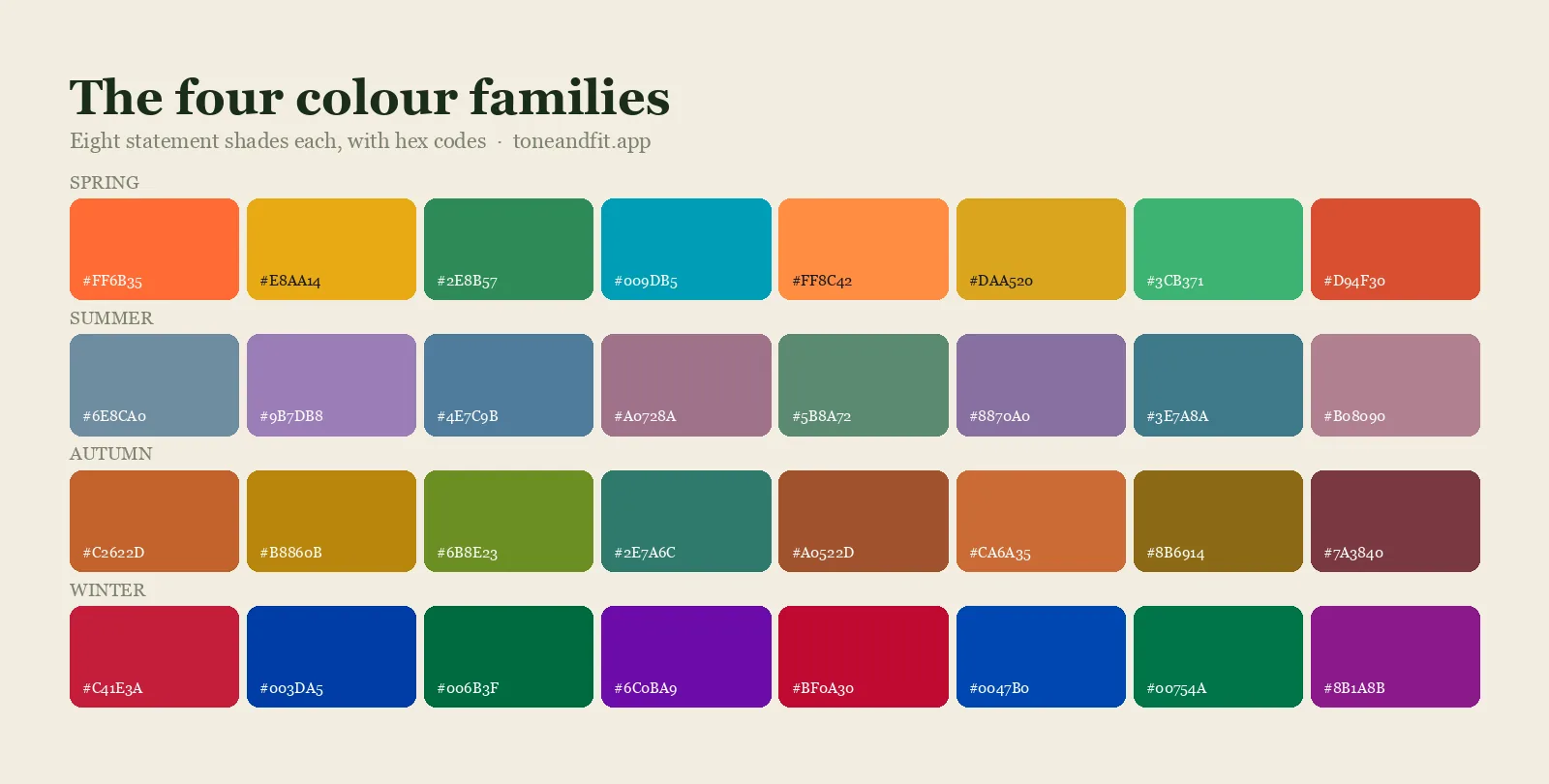
A short history: how we got to 12 seasons
The modern system did not appear all at once. The four-season framework, Spring, Summer, Autumn, and Winter, entered the mainstream through Carole Jackson's 1980 book Color Me Beautiful, and it was genuinely useful: it gave ordinary people, not just professional designers, a shared vocabulary for personal coloring. The problem showed up almost immediately in practice. Plenty of people did not fit cleanly into one of the four buckets. Someone could have a clearly warm undertone but coloring far too deep and rich for the classic golden Spring palette, or a clearly cool undertone but far too soft and muted for an icy Winter one.
Colorists responded by splitting each of the four seasons into three, producing the twelve sub-seasons in use today. This extra resolution is what lets the system describe someone as, say, a Deep Autumn rather than a generic Autumn: warm and rich, but darker and moodier than a Warm Autumn, and warmer than a Deep Winter. The twelve-season system is now the standard used by most professional colorists and every serious AI color analysis app, including the one built into this site's own free color analysis tool.
The three measurements that decide your season
Every one of the twelve seasons is just a specific combination of three measurements. Learn these three and you can understand your own coloring, or anyone else's, without memorizing a single season name.
1. Undertone: warm or cool
The cast underneath your skin's surface color, independent of how light or dark you are. Golden, peachy, and olive-warm casts read warm. Pink, rosy, and blue-based casts read cool. This is the single most important measurement and the one people misjudge most often on themselves, because surface shade and tanning disguise it. A deep tan and a fair complexion can share the exact same underlying undertone.
2. Value: light or deep
How light or dark your overall coloring is, and how much contrast sits between your skin, hair, and eyes. Platinum hair on fair skin is light value with low contrast. Black hair on medium skin is deep value with high contrast. Value is usually the easiest of the three measurements to see, because it does not require judging temperature, only lightness and darkness.
3. Chroma: bright or muted
How clear and saturated your coloring is versus how soft and blended it is. Bright, clear coloring has jewel-toned eyes and sharp boundaries between features. Muted coloring blends gently, with grayed, low-contrast transitions between skin, hair, and eyes. Chroma is the hardest of the three to judge on yourself, and it is usually what separates two neighboring seasons that otherwise look similar.
Every season is a fixed combination of these three dials. Once you know where your own coloring sits on each one, the correct season is not really a guess anymore, it is closer to arithmetic. That is also exactly what an AI color analysis tool is doing behind the scenes, reading the three measurements from your photo and matching the combination to a season, a process our explainer on how AI color analysis works walks through end to end.
The 12 seasons, one by one
Each of the twelve seasons sits inside one of the four families, and within a family, the three sub-seasons share an undertone but differ on value and chroma. The four families themselves have a recognizable character before you even get to the sub-seasons. Spring is warm and bright: think fresh, clear color with a golden cast, the visual opposite of anything dusty or heavy. Summer is cool and soft: gentle, blue-based color that never quite goes fully saturated. Autumn is warm and muted: rich, earthy color that reads like it has been steeped in tea. Winter is cool and clear: high-contrast, jewel-toned color that can stand up to true black and stark white. Every one of the twelve seasons is a more specific version of one of those four identities. Here is the full chart, with each season's dominant traits and a link to the detailed tells for that season.
| Season | Family | Undertone | Value | Chroma |
|---|---|---|---|---|
| Light Spring | Spring | Warm | Light | Bright |
| True Spring | Spring | Warm | Medium | Bright |
| Warm Spring | Spring | Warm | Medium | Mid-bright |
| Light Summer | Summer | Cool | Light | Soft |
| True Summer | Summer | Cool | Medium | Mid-soft |
| Soft Summer | Summer | Cool | Medium | Soft |
| Soft Autumn | Autumn | Warm | Medium | Soft |
| Warm Autumn | Autumn | Warm | Medium | Mid-saturated |
| Deep Autumn | Autumn | Warm | Deep | Medium |
| Cool Winter | Winter | Cool | Medium | Mid-bright |
| True Winter | Winter | Cool | Medium | Bright |
| Deep Winter | Winter | Cool | Deep | Bright |
A pattern worth noticing: within each family, one sub-season is always the "purest" expression of that family's undertone (True Spring, True Summer, True Winter, and, on the warm side, Warm Autumn), while the other two sub-seasons borrow a trait from a neighboring family. Deep Autumn, for example, shares its warmth with the rest of Autumn but shares its depth with Winter. That borrowing is exactly why some faces sit close to a border between two seasons, a case we cover in detail in our guide to the 12 color seasons, which also includes a self-matching exercise if you want to try assigning your own season by eye before reading further.
12 seasons versus the original 4
The twelve-season system did not replace the four-season one, it refined it. Every one of the twelve seasons still belongs to one of the four original families, so nothing about the older system was wrong, it just was not detailed enough to place everyone confidently. Think of the four seasons as the four quadrants of a map and the twelve seasons as the actual cities inside each quadrant.
The practical difference shows up in the palette you get at the end. A generic Autumn palette will hand you a wide, muted range of warm colors and expect you to figure out which end of that range flatters you. A Deep Autumn palette narrows that down to the darker, richer half of the range, which is a meaningfully more useful shopping list. If you are curious how a personal color analysis session or app actually decides between the four-season and twelve-season framing, our complete guide to personal color analysis covers both systems side by side and where each one is still used today.
The four ways to actually get analyzed
There are four real paths to finding your season, and they trade off cost, speed, and precision in predictable ways. None of them is a scam and none of them is definitively "best" for everyone; the right one depends on how much time and effort you want to spend.
1. AI photo analysis
You submit one selfie and a model measures your undertone, value, and chroma directly from the pixels after correcting for lighting. This is the fastest option, typically under a minute, and it is objective in a way self-judgment cannot be: it measures the same way on every face, every time. Our own free color analysis tool works this way, and needs nothing but a phone camera and a well-lit face.
2. Professional in-person drape
A trained colorist holds fabric swatches up against your face under controlled lighting and watches how each one changes your complexion in real time. This is the slowest and most expensive path, and it adds something the other three cannot: a human eye reacting live, and the ability to ask questions and adjust on the spot. It remains the gold standard for genuinely difficult borderline cases.
3. Self-analysis at home
Using tests like checking whether your wrist veins read blue or green, whether gold or silver jewelry looks more natural against your skin, and how your skin responds to a day in the sun, you can estimate your own undertone and value without any tool at all. It costs nothing and teaches you to actually see the traits you are measuring, but chroma in particular is difficult to judge on your own face, since we are all too familiar with our own reflection to see it neutrally.
4. Online quiz
A short set of multiple-choice questions about your natural coloring, answered from memory rather than a photo. It is the fastest option that needs no camera at all, which makes it useful when you cannot take a clean photo or would rather not. It is also the least precise of the four, since it depends entirely on how accurately you know your own natural hair color, eye color, and undertone already. Our own seasonal color analysis quiz takes about a minute and is a solid starting point before you commit to a photo analysis or a professional session.
Skip the guesswork. Try the fast method.
One selfie, your season and full palette back in about a minute. Free, no sign-up, photo never stored.
Find your season free ↗What to do with your result
Use your season as a filter you check against, not a rulebook you obey. The first useful step is learning your palette's core colors well enough to recognize them without looking them up every time, which our guide on how to read your color analysis results walks through in detail. From there, the highest-impact place to apply your palette is close to your face: tops, scarves, jackets you wear open, and lipstick shades, since these are the colors that actually sit next to your skin and influence how it reads. Pants, bags, and shoes matter far less, because they are physically farther from your face and have a much smaller effect on your complexion.
You do not need to discard anything that falls outside your palette. Plenty of neutral colors, and even some colors technically assigned to other seasons, will still look fine on you, especially away from your face. What color analysis actually buys you is a fast, repeatable way to predict your best options rather than your only acceptable ones, and a reason to stop buying the specific shades that reliably make you look tired. If you want to rebuild your wardrobe around your season more deliberately rather than piece by piece, our guide to a capsule wardrobe built around your color season shows how to do that without starting over completely.
Common mistakes that wreck a self-analysis
Most bad results trace back to a handful of repeatable errors, all of which are easy to avoid once you know to watch for them.
- Judging undertone from a tan. Tanning changes your surface shade, not the cast underneath it. A tanned cool-undertone person is still cool underneath, just darker on top.
- Starting from hair color instead of skin. Dyed hair, sun-bleaching, and natural graying all disconnect hair color from your actual season. Skin and eyes are more honest witnesses.
- Picking a season because you like its palette. Preference is not evidence. Wanting to be a Winter does not make cool, icy colors flatter warm, golden skin.
- Analyzing under artificial light. Indoor bulbs and mixed lighting shift every color reading. Natural, indirect daylight near a window is the only consistently reliable light source.
- Stopping at undertone and skipping value or chroma. Undertone alone narrows you to one of four families. You need all three measurements to land on one of the twelve actual seasons.
Photo quality causes the same failures in an AI analysis that bad lighting and heavy makeup cause in a mirror. If you want the full checklist for getting a clean result from a photo specifically, our guide to doing a color analysis at home covers the setup step by step, and our breakdown of the best color analysis apps in 2026 is useful if you want to compare more than one tool on the same photo before trusting a single result.
Check this on yourself right now
You have two free ways to put everything above into practice immediately. If you want the fastest, most direct read, upload a clean, makeup-free selfie in natural daylight to the free color analysis tool and you will have your undertone, value, chroma, and season back in under a minute. If you would rather not use a photo yet, take the seasonal color analysis quiz instead, six questions about your natural coloring and no camera required. Either way, you will land on one of the twelve seasons above, with a real palette to start testing against your own wardrobe.
Ready to find your season?
One selfie, your 12-season result, and the palette that goes with it. Free, no sign-up.
Find your season free ↗FAQ
What is color analysis?
Color analysis is the practice of identifying your natural undertone, value, and chroma, then matching that combination to a season, one of twelve categories of coloring, each with a palette of clothing and makeup colors that harmonize with it. It can be done by a professional with fabric drapes, by an AI app reading a photo, or by yourself at home.
What are the three things color analysis measures?
Undertone (whether your skin leans warm or cool), value (whether your overall coloring is light or deep), and chroma (whether your features are bright and clear or soft and muted). Every one of the twelve seasons is a specific combination of these three measurements.
How many color seasons are there?
The modern system has twelve seasons, three each within Spring, Summer, Autumn, and Winter. It grew out of an older four-season system from the 1980s that grouped everyone into just Spring, Summer, Autumn, or Winter, which worked for some people and left many others feeling like they did not fully fit any bucket.
How do I find my color season?
Four common paths: an AI photo analysis app, a professional in-person drape, a self-analysis using tests you can do at home, or an online quiz. Each has different tradeoffs in cost, speed, and precision, and many people start with a free option and only book a professional session if the result still feels uncertain.
Is color analysis accurate?
It is a measurement, not a guess, so accuracy depends heavily on the input. A well-lit, makeup-free photo or an experienced consultant's drape will produce a consistent, repeatable result. Poor lighting, filters, heavy makeup, or a rushed quiz will produce a shakier one, regardless of which method you use.
What do I do after I get my color season?
Use it as a filter, not a rulebook. Learn your palette's core colors, check new clothing and makeup against it before you buy, and prioritize your season's best shades near your face, in tops, scarves, and lipstick, where the effect is strongest. You do not need to throw out everything that falls outside your palette.
Can I check my color season from a photo?
Yes. The free Tone & Fit web tool reads your color season from one selfie in about 30 seconds, with no sign-up and no photo stored by us. The Tone & Fit app for iPhone and Android then builds your full palette of 38 named shades.