Korean Personal Color: The 12 Types
Korean personal color sorts people into 12 types by pairing each of the four seasonal families, Spring, Summer, Autumn and Winter, with a bright, light, true, muted or deep intensity label. Each of the 12 types lines up with one season in the Western 12-season system, just grouped and named differently.
In this article
What are the 12 Korean personal color types?
The 12 Korean personal color types are the four base seasons, Spring Warm, Summer Cool, Autumn Warm and Winter Cool, each split into three intensity variants that describe how bright, light, true, muted or deep the coloring runs. Every one of the 12 maps directly onto a season in the Western 12-season system, so if you already know your season from an app or a drape, you already know your Korean type too.
| Korean Type | Korean Term | Western 12-Season Equivalent |
|---|---|---|
| Spring Warm (Bright) | 봄웜 브라이트 | Bright Spring |
| Spring Warm (Light) | 봄웜 라이트 | Light Spring |
| Spring Warm (True) | 봄웜 트루 | True (Warm) Spring |
| Summer Cool (Light) | 여름쿨 라이트 | Light Summer |
| Summer Cool (True) | 여름쿨 트루 | True (Cool) Summer |
| Summer Cool (Muted) | 여름쿨 뮤트 | Soft Summer |
| Autumn Warm (True) | 가을웜 트루 | True (Warm) Autumn |
| Autumn Warm (Muted) | 가을웜 뮤트 | Soft Autumn |
| Autumn Warm (Deep) | 가을웜 딥 | Deep Autumn |
| Winter Cool (Bright) | 겨울쿨 브라이트 | Bright Winter |
| Winter Cool (True) | 겨울쿨 트루 | True (Cool) Winter |
| Winter Cool (Deep) | 겨울쿨 딥 | Deep Winter |
The table reads the same in both directions. If a Seoul studio tells you that you are 여름쿨 뮤트 (Summer Cool Muted), that is the identical coloring a Western consultant would call Soft Summer. Neither label is more correct than the other; they are two vocabularies describing one underlying measurement of undertone, depth and clarity, the same three measurements behind the 12 color season system. For the fuller comparison of how the two systems are organized and where they diverge, see our guide to Korean color analysis versus Western seasonal analysis.
How the 12 types build on the 4 base types
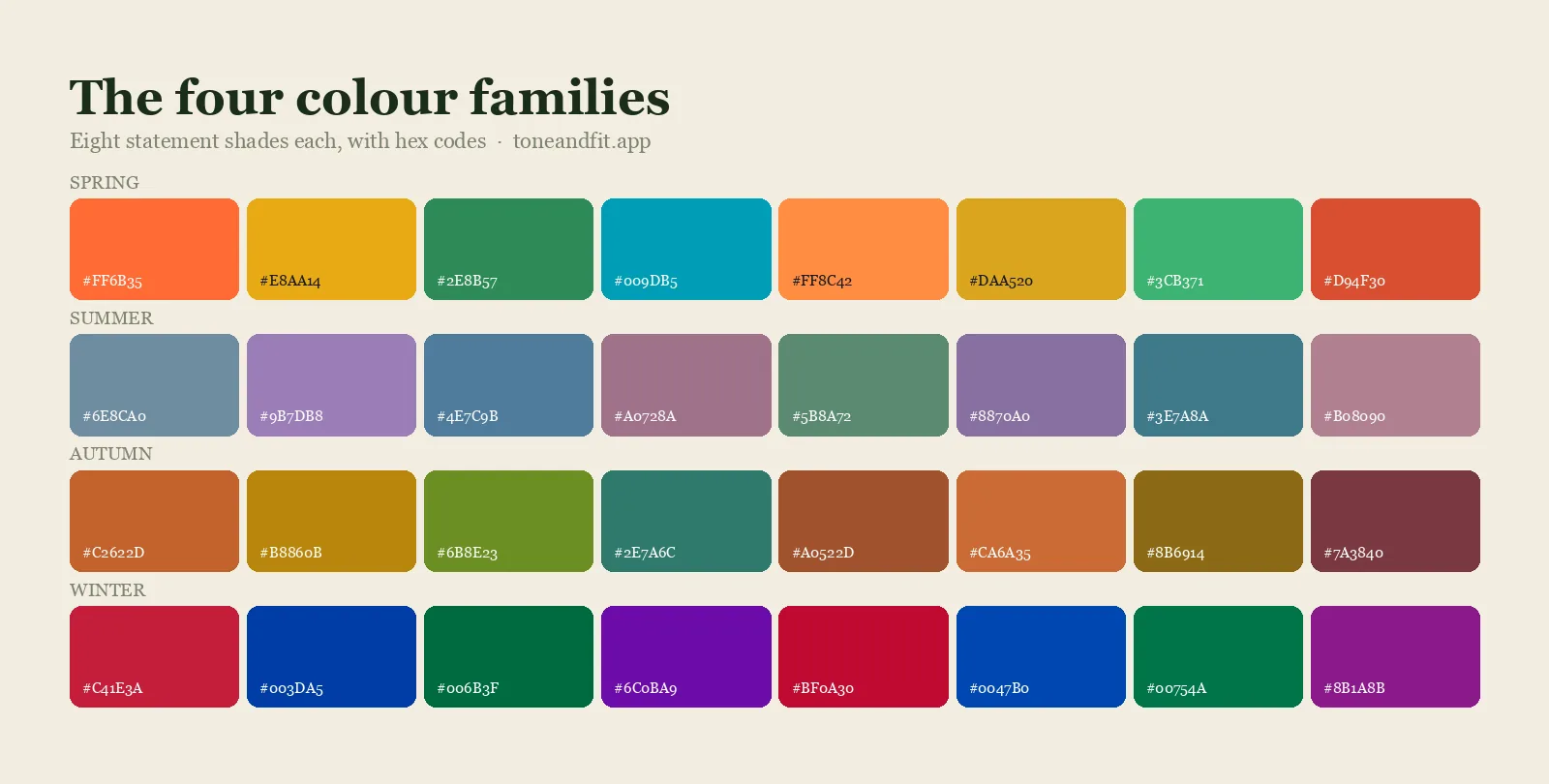
The 12 types exist because the original 4 base types, Spring Warm, Summer Cool, Autumn Warm and Winter Cool, only capture undertone and season, not how bright, light, muted or deep a person's coloring actually is. Two people can both be Spring Warm and still look noticeably different: one pale and delicate, one saturated and vivid. Splitting each base type into three intensity variants, bright, light or true for the clearer seasons, light, true or muted for the softer ones, and true, muted or deep for the richer ones, captures that second dimension without abandoning the warm-cool-first logic Korean analysis is built around.
Some studios go further still, using a 16-type system with additional transitional categories for coloring that sits between two types, which mirrors how Western analysis occasionally adds transitional labels at the border of two seasons. The 12-type system, though, is the version most people mean when they talk about Korean personal color today, and it is detailed enough for makeup, hair and wardrobe recommendations without requiring the extra fabrics a 16-type session needs.
The 12 types, season by season
Each of the four base types splits into three variants below, with the trait that separates them from its siblings.
Spring Warm: Bright, Light and True
Spring Warm types share a warm, clear undertone, and the three variants differ in how light or how saturated that clarity runs. Bright Spring, 봄웜 브라이트, is the most vivid of the three and wears saturated warm color best; camel and ivory can look flat on this type next to a clear coral or warm red. Light Spring, 봄웜 라이트, keeps everything pale and delicate, so soft peach and warm ivory suit it far better than anything dark or richly saturated. True Spring, 봄웜 트루, sits at the center of the family, the purest warm-and-clear expression, and can carry a little more depth than Light Spring while staying lighter than Bright Spring.
Summer Cool: Light, True and Muted
Summer Cool types share a cool, soft undertone, and the three variants differ in depth and how muted the coloring should be. Light Summer, 여름쿨 라이트, wants the least pigment of the three and looks best in pale lavender and powder blue rather than anything saturated. True Summer, 여름쿨 트루, is the clearest of the three and can carry a cool raspberry or rose pink at more strength than Light Summer without tipping into Winter's high contrast. Soft Summer, 여름쿨 뮤트, is the most muted Summer of all, and dusty, greyed colors like rosewood work because they blend into the skin rather than standing apart from it.
Autumn Warm: True, Muted and Deep
Autumn Warm types share a warm, earthy undertone, and the three variants differ in how muted or how deep that warmth runs. True Autumn, 가을웜 트루, is the purest expression of the family, warm and rich at a medium depth, and terracotta or brick shades suit it without needing to be softened or deepened. Soft Autumn, 가을웜 뮤트, wants the same warmth toned down into something hazier, so a muted sage or toasted coral reads as elegant where a bright version of the same hue would look loud. Deep Autumn, 가을웜 딥, can carry the richest, darkest color of the three, and shades like mahogany or deep olive hold their own against dark hair and high natural depth.
Winter Cool: Bright, True and Deep
Winter Cool types share a cool, high-contrast undertone, and the three variants differ in temperature, clarity and depth. Bright Winter, 겨울쿨 브라이트, is the most saturated and vivid of the three, and a true red or hot pink matches its natural intensity better than anything muted. True Winter, 겨울쿨 트루, sits at the clearest, most archetypal center of the Winter family, the coloring most people picture when they hear the word Winter. Deep Winter, 겨울쿨 딥, can carry the darkest, richest color of the three, and a near-black wine or deep emerald holds up against the season's dark hair and high contrast.
Find your type in 60 seconds
Tone & Fit uses AI to determine your 12-season color type from a single selfie, no studio visit required. Get your Korean-style personal color result, plus palettes for makeup, wardrobe and hair.
Try Tone & Fit Free ↗How Korean studios determine your type
Korean studios determine your type through fabric draping under controlled, daylight-balanced lighting, holding a sequence of colored fabrics against your face and watching how each one changes your apparent skin clarity, under-eye shadows and overall brightness. A trained consultant works through swatches methodically, first narrowing warm versus cool, then testing bright against muted and light against deep until one of the 12 types produces a clearly better result than its neighbors. The session usually ends with a printed or digital color card listing specific makeup shades, hair colors and fabric swatches matched to your type, which is the detail that sets the Korean approach apart from a purely wardrobe-focused Western consultation.
Fans and stylists frequently discuss celebrities' personal color in these same terms online. BLACKPINK's Jennie is often described as a Winter Cool type and BTS's Jimin as Summer Cool, though these are fan and stylist observations rather than confirmed studio diagnoses, and worth treating as informed guesses rather than fact.
How to find your type without visiting Seoul
You do not need a studio visit to get a reasonable read on your Korean personal color type. The DIY version uses the same warm-cool-first logic: hold clearly warm fabric, golden yellow or orange, and clearly cool fabric, blue-pink or silver, against your face in daylight and note which one makes your skin look clearer. From there, the general skin tone chart and our dedicated Korean skin tone chart line up depth and undertone against the types that usually result from each combination, though brightness and mutedness still need a second check beyond depth and undertone alone.
The color analysis quiz is a fast starting point if you are new to the system, and an AI color analysis app can measure your undertone, depth and contrast directly from a selfie, returning one of the 12 types in under a minute without a trip to Hongdae or Gangnam.
Ready to find your type?
One selfie, your 12-type result, and the palette that goes with it. Free, no sign-up.
Find your type free ↗Frequently Asked Questions
What are the 12 Korean personal color types?
The 12 types are the four base seasons, Spring Warm, Summer Cool, Autumn Warm and Winter Cool, each split into three intensity variants such as bright, light, true, muted or deep. Together they map one-to-one onto the Western 12-season system, so Summer Cool Muted and Soft Summer describe the identical coloring.
How is the 12-type system different from the basic 4-type system?
The 4-type system only sorts by season and undertone, Spring Warm, Summer Cool, Autumn Warm or Winter Cool, without capturing how bright, light, muted or deep a person's coloring actually is. The 12-type system adds that second dimension by splitting each base type into three variants, which is why two people can share a base type and still look quite different from each other.
Do the 12 Korean types match the Western 12 seasons exactly?
Yes, in substance. Both systems classify the same underlying combination of undertone, depth and clarity; they simply use different names and a different primary sort order. Korean analysis leads with warm versus cool and adds intensity second, while Western analysis builds intensity directly into each season's name.
Can I find my Korean personal color type without going to a studio in Korea?
Yes. The warm-cool fabric test gives a rough starting point, a skin tone chart narrows it further by depth and undertone, and an AI color analysis app or online quiz can return one of the 12 types directly from a selfie. A professional drape is still the most thorough option, but it is not the only way to get a usable answer.
What is the difference between Spring Warm Bright and Spring Warm True?
Both are warm and clear, but Spring Warm Bright is the more saturated and vivid of the two, matched to naturally high clarity, while Spring Warm True sits at a calmer, medium intensity that is still clearly warm and clear without being the most vivid version of it. Spring Warm Light is the third variant, keeping the same warm clarity but at the palest, most delicate end.
Does the 12-type system apply to all skin tones, not just Korean or East Asian skin?
Yes. The system was developed with East Asian coloring in mind, but the underlying measurements, warm versus cool undertone, depth and clarity, apply across every skin tone and ethnicity. Studios and apps built on this framework, including AI tools trained on diverse skin tones, return a usable type regardless of background.