Deep Skin Undertone: How to Tell Yours
A deep skin undertone can be warm, cool, or neutral, exactly like any other depth of skin: being deep tells you nothing about which way you lean. The fastest reliable read comes from the white paper test and the gold-versus-silver test, not from your veins.
What's in this guide
- What a deep skin undertone actually is
- Why "deep skin is warm" is a myth
- The tests that actually work on deep skin
- The tests that fail on deep skin, and why
- How your camera can lie about deep skin
- Deep skin undertone by category: warm, cool, neutral
- How to check your own undertone right now
- What your undertone means for your color season
- FAQ
What a deep skin undertone actually is
A deep skin undertone is the warm, cool, or neutral cast sitting underneath deep, richly pigmented skin, the same three-way split that exists at every other depth. Depth is how much melanin your skin carries, running from fair to very deep. Undertone is a completely different axis: whether that skin leans golden and peachy, pink and blue, or sits neutral between the two. The two measurements are independent, which is why two people can share nearly identical deep skin and still need opposite color palettes to look their best.
Most guides to undertone were written with fair and medium skin in mind, so the classic tests (hold up white paper, check your veins, try on gold and silver) assume a certain amount of visible contrast that deep melanin can hide. That does not mean deep skin cannot be read for undertone. It means a couple of the classic tests need to be dropped and the reliable ones need to be run more carefully. For the fuller story of where this framework came from and why it strains at deeper skin tones, see our guide to color analysis for deep and dark skin.
Why "deep skin is warm" is a myth
Deep skin is not automatically warm, and treating that as true is one of the most common errors in color analysis content. The mistake comes from collapsing two separate properties into one: how much melanin is in your skin (depth) and which direction your skin's underlying pigment leans (undertone). Melanin absorbs light and makes skin read as deeper. It does not, on its own, decide whether that skin looks golden or rosy next to a neutral reference. There are deeply pigmented complexions that are unmistakably cool, plenty that are warm, and plenty that are neutral.
The myth persists because a lot of online advice defaults untrained eyes to "if the skin is dark, the season must be Deep Autumn," since Deep Autumn is warm and deep. That default is wrong often enough to matter: a cool-undertone person who follows warm-season advice ends up buying rust, mustard, and camel that look perfectly fine on a hanger and slightly muddy against their actual skin. Getting the undertone right first is what prevents that mismatch, which is also why the full shade list for dark skin tones is split by undertone rather than treated as one single dark-skin palette.
The tests that actually work on deep skin
Two home tests hold up well on deep skin, because both compare your skin to an outside reference instead of asking you to see something faint through it.
The white paper test
Hold a sheet of true white printer paper directly against your jaw or the side of your neck, in indirect daylight, with no makeup. Look at the direction your skin shifts against that neutral white, not at how light or dark it is.
This test works at any depth because the reference point, true white, is absolute. It does not depend on seeing a vessel through skin or judging a subtle color against another subtle color. Read the shift at your jaw or the side of your neck rather than the back of your hand or the inside of your arm, since those spots often carry more redness, sun exposure, or hyperpigmentation that can be mistaken for undertone.
The gold-versus-silver test
Hold a piece of yellow gold jewelry against one side of your bare neck and a piece of silver against the other, in the same light. Notice which metal makes your skin look clearer and brighter rather than dull.
On deep skin this test has one extra wrinkle worth knowing before you try it: both metals often look genuinely good, and people read that as a failed test. It is not a failed test. It is a result, and the result is a neutral undertone, which is a legitimate and fairly common answer rather than a sign you did something wrong.
The tests that fail on deep skin, and why
The vein test and the sun-and-burn test both fail on deep skin, because each depends on seeing or measuring something that deep melanin hides or overrides.
- The vein test. It asks you to judge whether the veins on your inner wrist read green (warm) or blue (cool). Vein color is affected by how much melanin sits above the vessel, and on deep skin there is usually enough of it that the veins just read as one dark line with no usable color information. This test was never fully reliable at any depth. On deep skin it is close to useless, so skip it rather than force an answer out of it.
- The "do you burn or tan" test. This one was always measuring the wrong thing. Burning versus tanning is a function of how much melanin your skin produces, which is depth, not undertone. Someone can tan easily and never burn while still having a distinctly cool undertone, and the reverse is just as common.
If a guide leans heavily on either of these two tests, that is a sign it was not written with deep skin in mind. Lean on the white paper and gold-versus-silver tests instead, and treat undertone and surface tone as different things: redness, an olive cast, ashiness, and hyperpigmentation all sit on the surface and shift with sun, season, and skin health, while undertone sits underneath and does not move.
How your camera can lie about deep skin
Your phone camera can distort a deep skin undertone reading more than it does on lighter skin, because auto-exposure and auto white balance were tuned on datasets that historically underrepresented deep skin. In practice this means a casual selfie against a bright window or a busy background often comes back underexposed, and an underexposed photo loses exactly the color detail an undertone reading needs.
A few adjustments fix most of this before you ever take the photo:
- Tap to expose on your cheek, not the background, so the camera meters your actual skin instead of the wall behind you.
- Avoid strong backlighting even more strictly than the usual daylight-by-a-window rule, since a bright window behind you pushes your face further into shadow.
- Use one indirect daylight source, no lamps, no mixed indoor bulbs, no direct sun.
- Never brighten or filter the photo afterward. Editing changes the exact color values an analysis, human or automated, is trying to read.
Get a properly exposed photo in even daylight and most of the difficulty disappears, whether you are judging the photo yourself or running it through an app.
Deep skin undertone by category: warm, cool, neutral
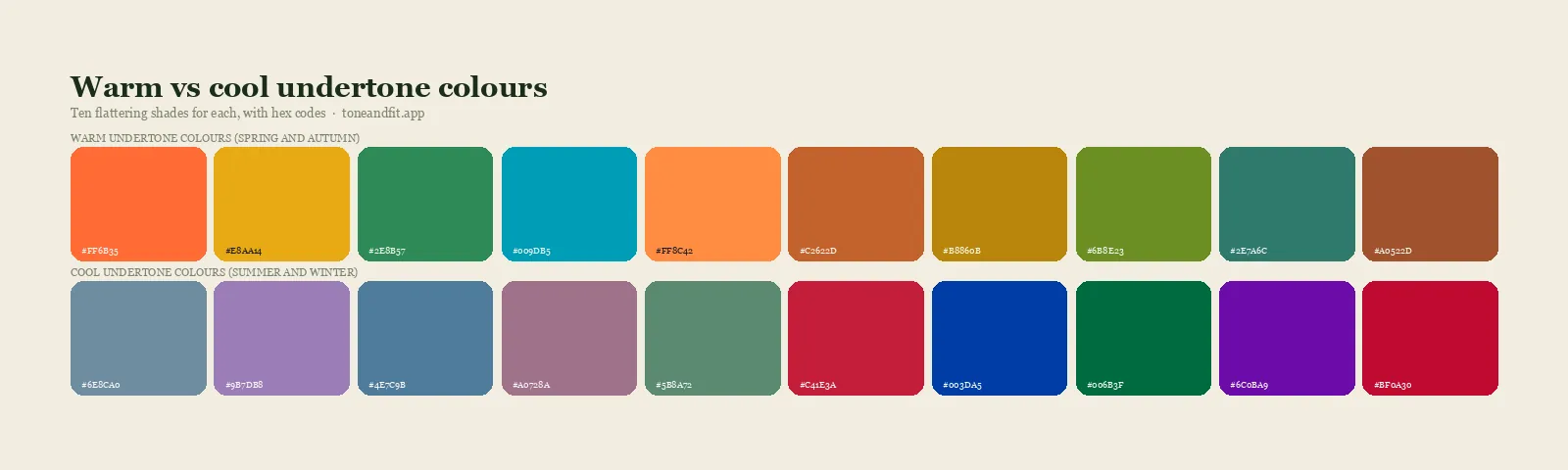
Warm, cool, and neutral deep skin each carry a distinct set of signs once you know where to look. Here is the side-by-side comparison. If you want the named shades and hex codes that sit in the deep and rich rows, they are set out in our full skin tone chart.
| Undertone | Skin cast against white | Metal that wins | Colors that make skin glow | Colors that flatten it |
|---|---|---|---|---|
| Warm | Golden, yellow, or bronze | Gold | Marigold, rust, bronze, olive, warm ivory | Icy pastels, cool blue-pink, stark optic white |
| Cool | Pink, red, or blue | Silver | Fuchsia, cobalt, emerald, icy pink, optic white | Mustard, rust, warm camel, orange-based reds |
| Neutral | No clear shift either way | Both look good | A wide range from both sides, worn one at a time | Whichever direction fights your specific balance |
The common thread across all three: deep skin has enough visual weight to carry a fully saturated color that would overwhelm a lighter face, so the shades that fail are usually the weak, chalky, or washed-out ones rather than the bold ones. The direction you lean, warm or cool, decides which bold colors those are.
How to check your own undertone right now
The quickest way to check your own undertone is to run the white paper test and the gold-versus-silver test back to back in the same five minutes, then treat agreement between the two as your answer. If they disagree, or if metals and neutrals all look equally fine, that is usually a genuine neutral undertone rather than a mistake in how you ran the tests.
For a faster, more precise confirmation, Tone & Fit reads undertone directly from the color values in a well-exposed photo rather than from a written description of what deep skin is supposed to look like, so it will not default to calling you warm just because you are deep. If you would rather answer a few questions first, the seasonal color analysis quiz is a reasonable starting point, and the skin tone analyzer walks through the same undertone, depth, and contrast readings from a single photo. Whichever route you take, confirm the result with a hands-on test in good light before you build a wardrobe around it.
Skip the guesswork. Get your undertone in about 30 seconds.
The free web tool names your season from one selfie, with no sign-up. The app's scan is free too and shows your undertone, best metals and starter colors; your season and full palette in the app are an optional upgrade.
Find my season free → Get the app ↗What your undertone means for your color season
Your undertone slots into one of four deep-value color seasons once you add how clear or muted your overall coloring reads, because undertone alone only answers one of the three questions a full season depends on. Cool and clear together land you in Deep Winter, which wears true black, pure white, and cool jewel tones like emerald and sapphire at full strength. Warm and muted together land you in Soft Autumn or, at a richer and more saturated level, Deep Autumn, both of which favor rust, bronze, deep olive, and warm browns over anything icy. Cool and high-contrast without the extra depth points toward Cool Winter (also called True Winter) instead.
If undertone, value, and chroma are new terms, our seasonal color analysis explainer defines each one, and the full 12-season matcher walks you from those three traits to a specific season. Undertone is the piece most people get wrong on deep skin, so getting it right first, with the white paper and gold-versus-silver tests above, makes the rest of the process far more reliable.
Ready to find your season?
The free web tool names your season from one selfie, with no sign-up. The app's scan is free too and shows your undertone, best metals and starter colors; your season and full palette in the app are an optional upgrade.
Find my season free → Get the app ↗FAQ
Is deep skin always warm?
No. Depth and undertone are two separate measurements. Depth is how much melanin your skin carries, from fair to very deep. Undertone is whether that skin leans golden, pink or blue, or sits neutral between them. A guide that assumes deep skin is automatically warm is guessing, not measuring, and it is one of the most common errors in color analysis content.
Why doesn't the vein test work on deep skin?
The vein test asks you to see vessel color through your skin, and deep melanin absorbs enough light that the veins often read as one dark, ambiguous line instead of a clear green or blue. It was never a fully reliable test at any depth. On deep skin it usually gives you nothing to work with, so skip it rather than force a reading.
What if gold and silver both look equally good on me?
That is a real result, not a failed test. It means you likely have a neutral undertone, which is a legitimate and fairly common outcome, not a sign you did the test wrong. Neutral undertones can borrow flattering colors from both the warm and cool sides of the palette.
Does a tan or more sun exposure change my undertone?
No. A tan adds melanin to the surface of your skin, which changes your depth and can shift your surface tone, but it does not change the underlying warm, cool, or neutral cast that defines your undertone. That stays fixed.
Why do my photos come out too dark or the wrong color?
Camera auto-exposure meters the whole scene, and it commonly underexposes deep skin against a bright background, which crushes the color information a good reading needs. Tap directly on your cheek in the camera app to set exposure there, shoot in even daylight, and do not brighten or filter the photo afterward.
Can an AI photo reading actually work for deep skin?
Yes, provided the photo is properly exposed. A tool that measures the actual pixel values in your skin rather than relying on a written description of what deep skin is supposed to look like will not default to calling you warm just because you are deep. Exposure and lighting are still what determine whether the read is usable.
Can I check my color season from a photo?
Yes. The free Tone & Fit web tool reads your color season from one selfie in about 30 seconds, with no sign-up and no photo stored by us. The Tone & Fit app for iPhone and Android then builds your full palette of 38 named shades.