How to Find Your Undertone With Redness: A Step-by-Step Guide
To find your undertone when your skin has redness, test on the calmest, least flushed skin you have, such as the inner upper arm, the side of the neck or behind the ear, in daylight and with a few different methods, then trust the pattern rather than any single test. Redness sits on the surface and makes almost everyone look cooler than they are, so the goal is to look past it.
The short version: redness from blushing, breakouts, irritation, sun or a skin condition tints the surface of your face, and that tint fools the vein check, the mirror and most filters. Move your tests to calmer areas, use cues that redness cannot touch (hair, eyes, freckles and how you tan), and confirm with metal and fabric tests. This is a focused companion to our skin tone analyzer guide, which covers the full process of reading depth and undertone.
What's in this guide
- Why redness throws off undertone tests
- Step 1: Get your skin as calm as you can
- Step 2: Choose the right places to test
- Step 3: Set up daylight and a neutral background
- Step 4: Run four tests that work around redness
- Step 5: Use cues that redness cannot change
- Step 6: Read your results together
- Step 7: Check with a selfie tool, carefully
- Common mistakes with redness
- Choosing colors once you know
- Makeup that works with redness-prone skin
- FAQ
Why redness throws off undertone tests
Undertone is the subtle, steady color beneath the surface of your skin, and it is separate from what you see on top. Redness is a surface effect. It can come from blushing, a flare of irritation, healing blemishes, a sunburn, windburn, a skin condition, or simply thin, reactive skin with visible capillaries. Whatever the cause, it adds a pink or red layer that makes skin look cooler than its true undertone, which is why a warm or neutral person with a flushed face can easily conclude they are cool.
That error carries into every downstream choice. People with redness-prone skin often avoid warm colors they would look wonderful in, or buy foundations that turn orange or grey. Our explainer on undertone versus overtone breaks down the difference between the permanent base and the surface color, and it is the single most useful idea for this problem. Redness is an overtone. Your job is to find the undertone underneath.
If your redness is persistent, painful or you are not sure what is behind it, a dermatologist is the right person to ask. This page is about color, not about treating skin, and nothing here is medical advice.
Step 1: Get your skin as calm as you can
You will get a cleaner read if you test when your skin is at its most settled. Wait until a flare has passed. Avoid testing right after a hot shower, a workout, exfoliation, a facial, or a glass of wine, because heat and friction bring blood to the surface and deepen the red. Come in from the cold and give your face fifteen to twenty minutes to even out before you look closely.
Take off makeup if you can. Foundation and color correctors change the surface you are trying to read. If your skin is sensitive, use a gentle cleanser and pat dry rather than rubbing. The aim is not perfect skin but your usual baseline, with no active irritation on the areas you plan to check.
It also helps to avoid testing during a tan or a sunburn. Sun exposure changes surface color for weeks. If you recently tanned, our guide on how to find your undertone with a tan covers how to compensate, and the same logic applies to a sunburn.
Step 2: Choose the right places to test
The face is often the worst place to read undertone when you have redness, because it is where redness shows up most. Look for areas that stay calm, are rarely exposed to sun, and have not been irritated by products. Good candidates include:
- The inner upper arm. It is shielded from sun and rarely flushes. This is usually the best single test site.
- The side of the neck or the area behind the ear. Often calmer than the cheeks, though it can pick up some of the face's redness.
- The upper chest or collarbone, if it is not prone to flushing for you.
- The inner wrist, for the vein test, though thin skin there can show blue regardless of undertone.
- The jawline or temple, only if it is clearly calmer than your cheeks and nose.
Compare two or three sites. If the inner arm looks golden or peachy and your cheeks look pink, the arm is closer to your undertone. If every site looks pink, that is a sign of a cool or rosy undertone, and the next steps will confirm it.
Step 3: Set up daylight and a neutral background
Lighting changes color more than almost anything else. Warm bulbs add yellow and make everyone look warmer. Cool LED bulbs add blue and make everyone look cooler. Redness shows up most strongly under harsh overhead light and can nearly disappear under soft, indirect light. For testing, stand near a window with indirect daylight, in the morning or late afternoon if possible, and face the light rather than having it behind you.
Use a neutral background. Wear a plain white or grey top, remove bright jewelry and pull your hair back so it does not reflect onto your face. Our article on how lighting changes your color season shows how large this effect can be, and why one bad mirror can send you in the wrong direction.
If you plan to use photos, read the notes in why your phone camera skin tone lies first. Phone cameras boost red and shift white balance, which exaggerates redness in selfies.
Step 4: Run four tests that work around redness
No single test is reliable on its own, and redness makes some tests worse than others. Use all four of these and look for agreement. For the complete versions of each, see our four tests for finding your skin undertone at home.
Test 1: The vein check, on the inner arm
Look at the veins on the inside of your wrist or forearm in daylight. Greenish veins suggest a warm undertone, blue or purple veins suggest cool, and a mix suggests neutral. Redness does not affect the arm much, which makes this useful, but thin skin and the angle of the light can mislead, so treat it as one clue. Our guide to what blue or green veins mean explains its limits.
Test 2: The metal test
Hold a gold item and a silver item against the calm skin on your inner arm or neck, one at a time. Gold tends to make warm skin look fresh and cool skin look sallow. Silver tends to do the reverse. Do not judge by your cheeks, where redness will confuse the comparison. If both look fine, you may be neutral. The longer walkthrough is in gold or silver: which suits your undertone.
Test 3: The white paper test
Hold a plain sheet of bright white paper next to the calm skin and then a sheet of cream or off-white paper. Against pure white, warm skin tends to look yellower and cool skin tends to look pinker, though redness can exaggerate the pink. Because of that, put extra weight on the cream paper comparison: if the cream makes your skin glow and the white makes it look flat or grey, warm is more likely.
Test 4: The fabric swatch test
Drape a warm color (such as camel or terracotta) and a cool color (such as navy or raspberry) under your chin, then compare. Redness can make the cool color look better at first because pink echoes pink, so focus on the eyes and the overall freshness of the face rather than how the redness reads. The complete method is in how to do color draping at home.
Find your undertone from one selfie
Tone & Fit reads your skin, hair and eyes together and returns your season and a full color palette.
Try Tone & Fit free ↗Step 5: Use cues that redness cannot change
Some of the best evidence for your undertone lives outside the part of your skin that flushes. These cues are not proof on their own, but they pull the answer toward the truth when your face is giving mixed signals.
- Natural hair color. Golden, red, strawberry or warm brown hair leans warm. Ash blonde, blue-black or cool brown hair leans cool. Dyed hair does not count, so think back to your natural shade. Our guide to finding your color season with dyed hair explains how to account for this.
- Eye color and flecks. Golden or amber flecks in the iris lean warm, while cool grey or blue-grey rings lean cool.
- How you tan. Skin that turns golden or bronze tends to be warm. Skin that burns pink first and tans slowly tends to be cool, though sun sensitivity varies a lot, so use this as a hint rather than a rule.
- Freckle color. Golden-brown or ginger freckles lean warm, while greyish-brown freckles lean cool.
- Natural lip color. The natural color of your bare lips can lean peach-coral for warm or berry-pink for cool, but this varies and should carry little weight.
If you have very pale skin as well as redness, our guide to pale skin undertone covers how to read an undertone that is hard to see. If your skin is deeper, deep skin undertone addresses redness and ashiness together.
Step 6: Read your results together
Write down what each test suggested, then look for the majority. A simple tally works well.
| Pattern across tests | Likely undertone | What to do next |
|---|---|---|
| Calm sites look golden or peachy, gold looks better, green veins, warm hair and eyes | Warm, with redness on top | Treat redness as surface only and choose warm palettes |
| Calm sites look pink or rosy, silver looks better, blue veins, cool hair and eyes | Cool | Choose cool palettes |
| Mixed results, both metals work | Neutral | Read the neutral undertone guide |
| Green-gold or grey-gold cast on calm sites | Possibly olive | See olive undertone explained |
If the answers split roughly in half, that is common and usually means neutral. If you are leaning warm but your face looks pink, check that your final choice still looks good on the inner arm and neck, not just in a mirror. The calmer skin is usually the more honest witness.
Step 7: Check with a selfie tool, carefully
A selfie-based tool can be a useful tiebreaker because it reads more than your cheeks. The Tone & Fit app looks at skin, hair and eyes together and returns a season and palette, which can help when your own tests disagree. To get the best photo, use soft indirect daylight, turn off any beauty filter, wear no makeup if you can, and take the shot when your skin is calm. If you want to understand what the tool is and is not doing, our posts on how AI color analysis works and how accurate AI color analysis is are honest about the limits.
Treat any result as a starting point. Wear the suggested colors for a few days, and see whether they make your skin and eyes look clearer. The best evidence is always how the color looks on you in good light.
Common mistakes with redness
- Judging only from the cheeks. They are the most reactive part of the face and the least reliable test site.
- Testing after heat, exercise or exfoliation. Flushing deepens the red and tilts you cool.
- Trusting a single test. Each test has a weakness. Agreement across several is what matters.
- Using bad light. Cool LEDs and harsh overhead lights exaggerate redness.
- Relying on filtered or edited photos. Many camera apps smooth and shift color automatically.
- Mistaking a surface tint for an undertone. If the color changes when you are calm versus flushed, it is surface, not base.
- Overcorrecting with green. Green concealer and green clothing can neutralize redness in the short term, but they do not change your undertone and should not decide your palette.
Choosing colors once you know
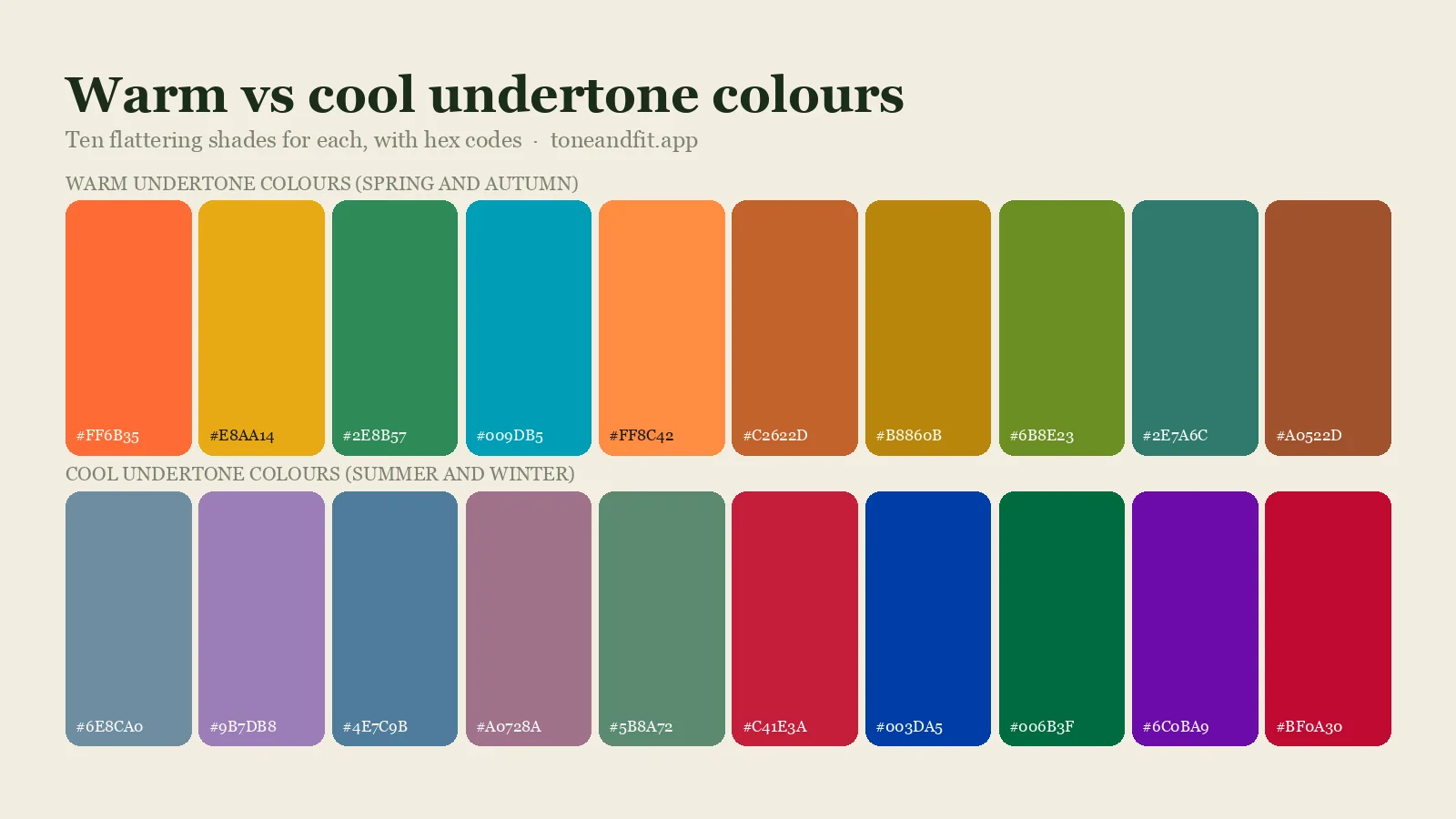
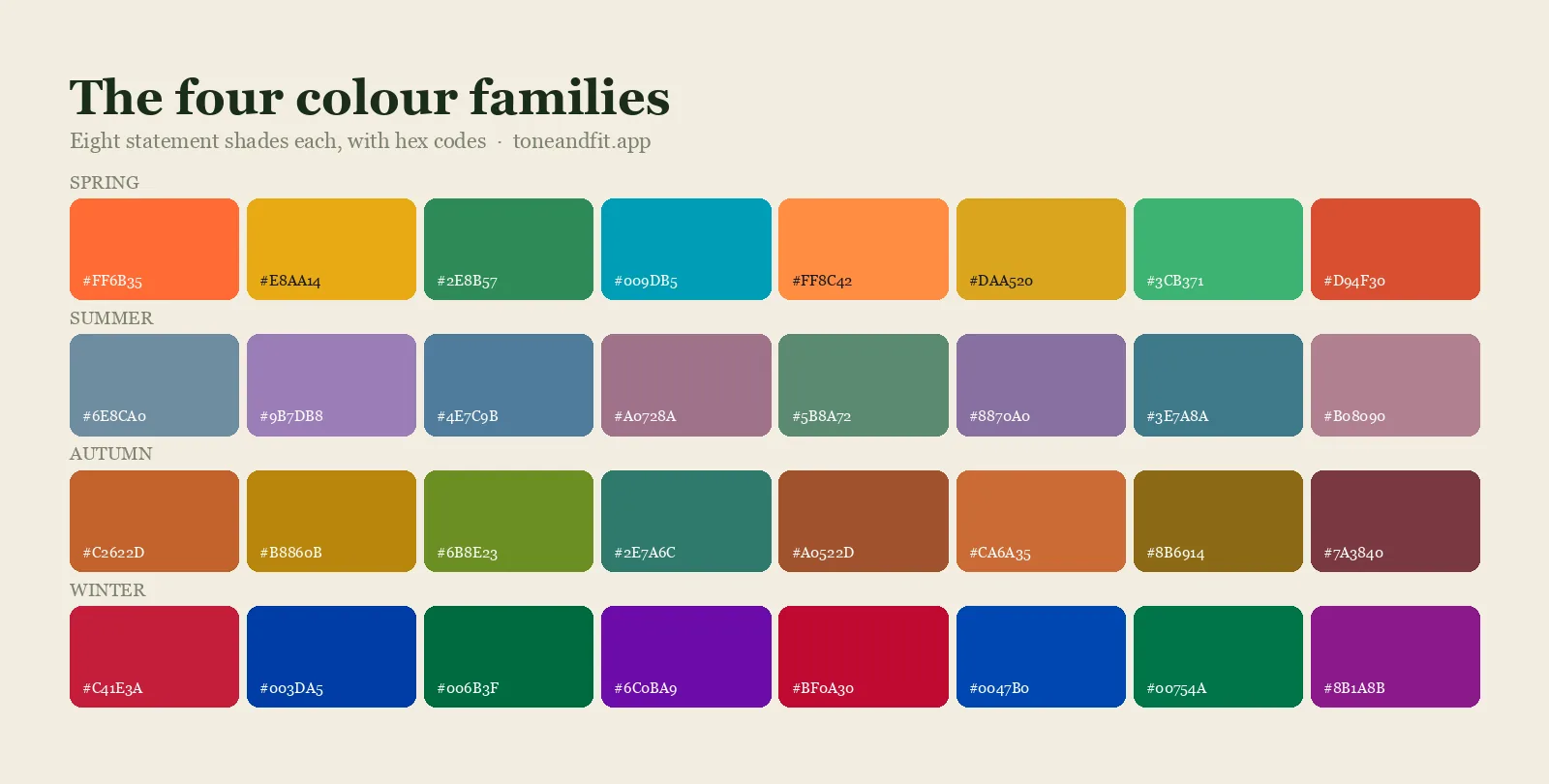
Once you have an undertone, the next step is turning it into a palette. If you are warm, you will usually look best in terracotta, olive, warm teal and camel, and the rest of the story is in our warm skin tones explained guide. If you are cool, rose, raspberry, navy and cool green tend to work, which our cool skin tones explained post covers. To go from undertone to a full seasonal palette, start with seasonal color analysis explained and then the full list of 12 color seasons.
A practical tip for redness-prone skin: muted and mid-depth colors near the face often look calmer than very bright or very saturated reds, which can echo and amplify the flush. That is a styling preference rather than a rule, so try a few and watch how your skin responds. If you want a shortlist for your skin depth, the what colors look good on me guide is a good next step.
Makeup that works with redness-prone skin
Because redness changes how foundation looks on the skin, matching your undertone to your base makeup is especially important. A foundation that is too pink will amplify redness, and one that is too yellow can look flat, so test shades on your jawline and neck in daylight. Our guides on how to find your foundation undertone and the best foundation undertone match go through the process. For blush, choose shades that suit your true undertone rather than ones that mimic the flush, and see blush by undertone for examples.
Skip the guesswork
Get your 12-season result and palette from a single photo. Free to try, no sign-up.
Find your season free ↗FAQ
How do I find my undertone if I have redness in my skin?
Test on calmer skin such as the inner upper arm or the side of the neck, in indirect daylight, and use several methods: the vein check, the metal test, the white and cream paper test and a fabric swatch test. Add cues like natural hair color and how you tan, then look for the majority result.
Does redness mean I have a cool undertone?
No. Redness is a surface color that makes almost any undertone look cooler. Warm and neutral people with rosy or reactive skin often mistake themselves for cool. Check calmer areas of skin and compare several tests before deciding.
Can rosacea or blushing change my skin undertone?
They change how your skin looks on the surface but not the undertone beneath it. If you have a skin condition, ask a dermatologist about it. For color purposes, read your undertone from calmer areas and from cues such as hair and eye color.
What is the best place on the body to check undertone?
The inner upper arm is usually best, because it sees little sun and rarely flushes. The side of the neck and behind the ear can also work if they are calm. Avoid relying on the cheeks and nose when you have redness.
Why do I look pink in every photo?
Phone cameras often boost reds and shift white balance, and beauty filters change skin color automatically. Redness shows more under harsh light too. Use soft indirect daylight with no filter and compare with how your skin looks in person.
Should I wear green to cancel out redness?
Green can visually calm redness for a moment, but it does not change your undertone and should not decide your palette. Choose colors from your undertone and season, and use muted mid-depth shades if bright reds make your flush more noticeable.
Can an app find my undertone if my skin is red?
A selfie tool can help as a tiebreaker because it reads skin, hair and eyes together, but redness and lighting can still affect any photo. Use soft daylight, turn off filters, and confirm the result by seeing how the suggested colors look on you.