Best Shirt Colors for Men by Skin Tone
The best shirt colors for men come down to one question: does your skin run warm or cool? Warm skin wears cream, warm blue, olive, rust and tobacco. Cool skin wears crisp white, true blue, burgundy, charcoal and emerald. Mid blue is the one shade that flatters almost everyone, which is exactly why it has been the default business shirt for a century.
What's in this guide
- The short answer
- Find your undertone in three minutes
- The white shirt question, settled
- Best shirt colors for each undertone
- Blue, and which blue is yours
- Depth: matching the shirt to your contrast
- The full chart
- Casual shirts, polos and tees
- Building the suit and tie around the shirt
- Shirt colors to skip
- The six shirt starter set
- FAQ
The short answer
A shirt is the single most important color decision in a man's wardrobe, because it is the layer closest to your face and it is in every photograph of you from the chest up. A jacket you can take off. A tie sits below the collar. The shirt is right there under your jaw, reflecting light onto it all day.
Which means the correct way to shop for shirts is not by what looks good on the hanger but by what your skin does next to it. That comes down to three properties: your undertone, meaning whether your skin has a golden or a pink cast; your depth, meaning how light or dark your overall coloring is; and your contrast, meaning the gap between your skin and your hair. The skin tone analyzer reads all three from a photo, and this guide turns them into shirt colors you can actually buy.
If you only change one thing after reading this: stop buying bright white shirts if your skin is golden. Buy cream. It is the highest impact swap in menswear and it costs nothing extra.
Find your undertone in three minutes
You do not need a consultation for this. Three checks, done in daylight, agreeing with each other, is enough for shirt shopping.
Three checks, one answer
The paper test. Hold a sheet of plain printer paper under your chin at a window. Golden or yellow cast on your skin means warm. Pink, red or blue cast means cool. A slightly grey or green cast means olive. No obvious shift means neutral.
The metal test. Put a gold item and a silver item on your bare wrist. Whichever one makes the skin around it look clearer rather than muddier matches your undertone. Gold reads warm, silver reads cool, and if both look fine you are likely neutral. The full version is in gold or silver jewelry by undertone.
The shirt test. Hold a bright white shirt and a cream shirt to your face in turn. One of them will make your skin look healthier and the other will make it look slightly grey or slightly yellow. That is your answer, and it is also the single most useful thing this page can tell you.
Do this by a window, not under bathroom bulbs, and not from a photo you already took. If you want the long form of every at home test, it is in how to find your skin undertone at home, and the wider men's context is in the color analysis guide for men.
The white shirt question, settled
Almost every man owns a white shirt, and a large share of them own the wrong white. There are two whites in menswear and they are not interchangeable.
Optic white is the bright, blue leaning, slightly cold white of a new poplin dress shirt. It is a cool color. Against cool or deep skin it looks clean and sharp, and it creates strong contrast that reads as crisp.
Cream, ecru and oyster are warm whites with yellow or grey in them. Against golden, olive or tanned skin they look expensive and soft, and they stop the shirt from outshining the face.
Put optic white on warm golden skin and the shirt wins. It is the brightest, cleanest thing in the frame, and your complexion looks yellow by comparison. Put cream on cool pink skin and the shirt looks slightly dirty, like a white that has been washed with something red. Neither failure is dramatic, which is why men wear the wrong one for years without diagnosing it. The full comparison, with the in between shades, is in white versus cream, which suits you.
Best shirt colors for each undertone
Warm undertones
Golden, peachy or yellow based skin. Gold jewelry looks natural, and you tan more easily than you burn. Your shirts should carry some warmth so the color and the skin agree rather than compete.
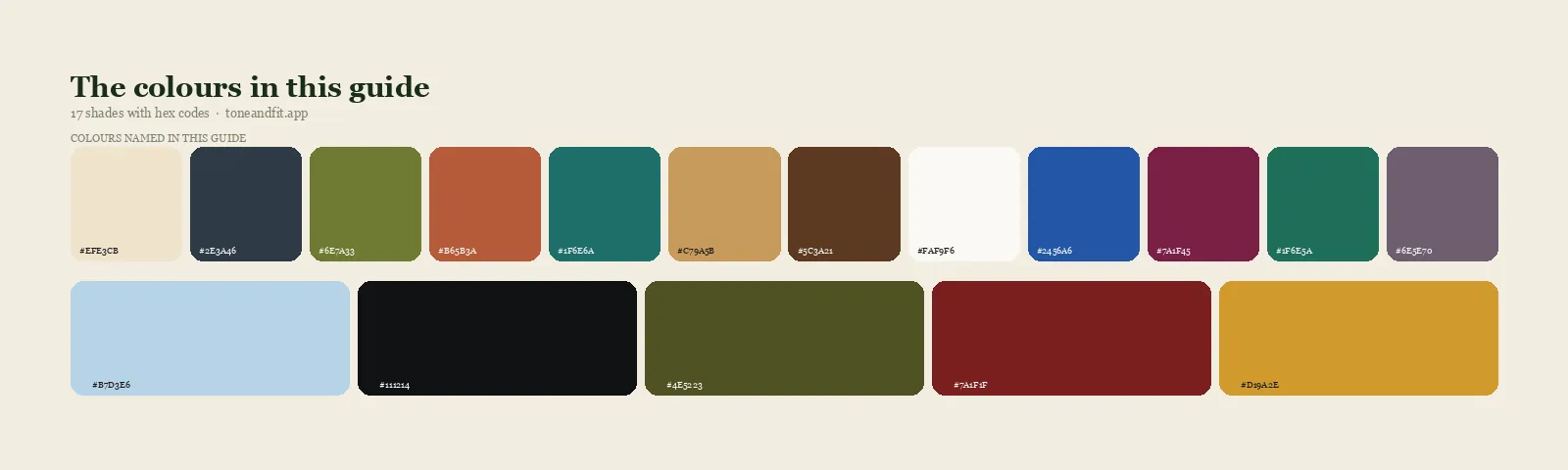
- Cream#EFE3CB
- Warm Navy#2E3A46
- Olive#6E7A33
- Terracotta#B65B3A
- Teal#1F6E6A
- Camel#C79A5B
- Tobacco#5C3A21
Cool undertones
Pink, red or blue based skin. Silver jewelry looks natural, and you burn before you tan. Blue based shirt colors will make your skin look clearer and your features sharper.
- Optic White#FAF9F6
- True Blue#2456A6
- Burgundy#7A1F45
- Emerald#1F6E5A
- Plum Grey#6E5E70
- Ice Blue#B7D3E6
- Charcoal#111214
Neutral undertones
No strong cast either way, and gold and silver both look fine. You have the widest field of any undertone, so your limiting factor is depth rather than temperature. Stay away from the extremes of each side, meaning very icy blues and very golden yellows, and almost everything in the middle is available to you. Soft blues, slate, sage, warm grey, dusty rose and mid navy all work.
Olive undertones
Olive skin carries a faint green cast that is separate from being warm or cool, and it is the undertone most often misdiagnosed in menswear. The mistake is treating olive as simply dark, which pushes men toward greys and pale pastels that flatten it. Olive skin wants colors with some depth and some warmth to push against.
- Ecru#EFE3CB
- Deep Olive#4E5223
- Brick#7A1F1F
- Teal#1F6E6A
- Warm Navy#2E3A46
- Ochre#D19A2E
If that description sounds like you, the dedicated breakdown is in best colors for olive skin tone, which goes shade by shade including the greys that work and the ones that do not.
Deep skin tones
Deep complexions have more range than any color advice traditionally gave them, and the old instruction to stick to neutrals is simply wrong. Saturation is your advantage: rich, clear colors that would overwhelm a lighter complexion sit comfortably against deep skin. Cobalt, emerald, true red, violet, marigold and optic white all work. What needs care is the middle ground, specifically muddy mid browns, dusty beiges and olive greens that land at your own depth and stop registering as a separate color. More detail is in color analysis for deep skin tones.
Blue, and which blue is yours
Blue deserves its own section because it is the most worn shirt color in the world and because "blue" covers an enormous range that behaves very differently on different men.
- Sky and chambray are light, slightly greyed blues. Flattering on almost everyone, and the safest second shirt after white. Light skin gets gentle contrast; deep skin gets a soft, easy alternative to white.
- French blue sits in the middle and leans slightly warm. This is the most universally flattering single shirt color there is.
- True blue and cobalt are saturated and cool. Excellent on cool and deep skin, strong enough to be the focal point of an outfit, and a little sharp against very warm pale skin.
- Navy functions as a neutral. Warm undertones want a navy with a touch of green or brown in it; cool undertones want a navy that leans blue black.
- Teal and petrol bridge blue and green. Outstanding on warm and olive skin, and consistently underused.
If you are choosing between two blues in a shop and cannot decide, hold each one under your chin and look at the skin along your jaw rather than at the shirt. The right blue lifts it. The wrong one leaves a faint grey or yellow line where the collar meets your neck.
Depth: matching the shirt to your contrast
Undertone tells you which family. Contrast tells you how bold to go inside it.
Contrast is the gap between your skin and your hair. A man with pale skin and near black hair is high contrast, and he can carry a white shirt with a charcoal suit without either piece overwhelming him. A man with fair skin and light brown hair is low contrast, and that same combination will wear him rather than the other way round: the outfit becomes two hard blocks with a soft face floating between them. He is better served by mid tones, a soft blue shirt and a mid grey or tan jacket.
Deep skin with black hair is usually low contrast in the technical sense, because the skin and hair are close in value, which is why saturated color works so well: it adds interest through hue rather than through brightness. The full method for measuring this on yourself is in how to find your contrast level, and it is the step that separates advice that nearly works from advice that fits.
The full chart
| Undertone | Your white | Best blues | Best color shirts | Handle with care |
|---|---|---|---|---|
| Warm | Cream, ecru | French blue, teal, warm navy | Olive, rust, tobacco, ochre, forest | Optic white, icy pastels, cold grey |
| Cool | Optic white | True blue, cobalt, blue black navy | Burgundy, emerald, plum, charcoal | Camel, mustard, orange based rust |
| Neutral | Soft white | Sky, French blue, mid navy | Slate, sage, dusty rose, warm grey | The extremes of either temperature |
| Olive | Ecru, oyster | Teal, petrol, warm navy | Deep olive, brick, ochre, chocolate | Baby pink, mint, grey green, pale lilac |
| Deep | Optic white | Cobalt, royal, navy | Emerald, true red, violet, marigold | Muddy mid brown, dusty beige at your depth |
Casual shirts, polos and tees
Everything above holds for casual shirts, with two adjustments.
Texture changes the reading. The same shade in oxford cloth, linen and flannel will not photograph or read identically, because texture breaks up the surface and softens the color. A slightly too strong shade often becomes wearable in a heavily textured fabric, and a slightly too weak one gains depth. This is useful when a color is nearly right.
Tees and polos sit closer to the skin and cover more of the chest, which means the color does more work and mistakes show faster. This is where plain black and plain white catch men out most, because both are worn by default rather than by choice. If black is not in your palette it will still be the thing draining your face on a Saturday. The honest treatment of when black works and when it does not is in black and your color season, and the broader neutral set for each palette is in the best neutrals for every color season.
Building the suit and tie around the shirt
Choose in this order: shirt for your undertone, suit for the occasion, tie as the accent. The shirt is nearest your face, so it has first claim on your coloring. The suit is further away and can be governed by dress code. The tie is the one piece small enough to carry a color that would be too much as a whole garment.
The most common formal mistake is putting three items at the same depth next to each other: mid grey suit, mid blue shirt, mid blue tie. Nothing is wrong with any individual piece, but there is no hierarchy, so the eye has nowhere to go and the whole thing reads as flat. Keep the shirt clearly lighter than the suit and let the tie be either the deepest or the most saturated element.
For the tailoring side of that decision, the best suit colors for your season covers which greys, navies and browns belong in your palette, and the season specific men's pages such as deep autumn for men put shirt, suit and outerwear together for one coloring at a time. The full men's index is at the men's color season pages.
Shirt colors to skip
| Shirt color | Why it fails | Better version |
|---|---|---|
| Optic white on warm skin | Outshines the complexion and leaves it looking yellow | Cream or ecru |
| Pale department store pink | Cool and desaturated, which suits a narrow set of complexions | Salmon for warm skin, dusty rose for cool |
| Cold mid grey on warm skin | Adds a grey cast along the jaw and neck | Warm grey, taupe or stone |
| Beige at your own depth | Merges with the skin so the collar line disappears | The same shade two steps lighter or darker |
| Pale mint and lilac on olive skin | Repeats and amplifies the green cast | Teal, deep olive or brick |
| Anything neon | Reflects colored light onto the neck and jaw | The saturated but non fluorescent version |
None of these are rules of etiquette. They are all the same underlying failure, which is a color sitting too close to your skin in temperature or depth to do anything useful. The general case is covered in colors that wash you out.
The six shirt starter set
If you were rebuilding a shirt drawer from nothing, this is the order to buy in.
- Your white. Optic if you are cool or deep, cream if you are warm or olive. Poplin for formal, oxford for everything else.
- Sky or chambray. The easiest shirt you will own and the one you will reach for most.
- Your navy or charcoal. Warm undertones take a navy with green or brown in it; cool undertones take blue black.
- One deep color from your palette. Burgundy, emerald, deep olive or teal, depending on temperature.
- A second blue at a different depth. French blue if you started with sky, sky if you started with French blue.
- One earth or jewel shade you actually like. This is the shirt that stops the drawer being a uniform.
Six shirts chosen this way will cover work, weddings, interviews and weekends without a single one hanging unworn. If you want the exact shades rather than the categories, the personal color analysis guide explains the system, the twelve color seasons places you inside it, and seasonal color analysis explained covers the reasoning behind the whole framework.
Stop guessing in the fitting room
Tone & Fit reads your undertone, depth and contrast from one selfie and gives you the full palette behind every shirt recommendation on this page.
Get your color season ↗FAQ
What color shirt looks best on men?
Mid blue is the closest thing to a universal answer, because it is far enough from every skin tone to create contrast and neutral enough in temperature to suit warm and cool complexions alike. Beyond that, the best shirt color depends on your undertone: warm skin looks strongest in cream, olive, rust and warm blues, while cool skin looks strongest in crisp white, true blue, burgundy and charcoal.
Should men wear white or cream shirts?
Cool undertones should choose optic or bright white, and warm undertones should choose cream, ecru or oyster. Crisp white against warm golden skin tends to make the skin look sallow by comparison, while cream against cool pink skin can look slightly dingy. If you only ever buy one dress shirt, buy it in the white that matches your undertone rather than defaulting to the brightest one on the rail.
What shirt colors should men with darker skin wear?
Deep skin has enormous range and is best served by saturation rather than by pale shades. Rich jewel colors such as emerald, cobalt, true red and violet hold their own, and crisp white creates strong, clean contrast. The shades to be careful with are muddy mid browns and dusty beiges close to your own depth, which sit too near the skin to register as a separate color.
What color shirt is most flattering for olive skin?
Olive skin carries a slight green cast, so it looks best in colors that either echo that warmth or contrast it cleanly. Cream, olive green, rust, teal, terracotta and warm navy all work well. The shades to avoid are pale cool pastels such as baby pink and mint, along with grey green tones that repeat the cast rather than balancing it.
Can men wear pink and still look sharp?
Yes, provided the pink matches your undertone. Warm skin wants a peachy or salmon pink, and cool skin wants a blue based pink such as dusty rose or raspberry. The reason pink gets a poor reputation on men is that the standard pale department store pink is cool and washed out, which flatters a narrow slice of complexions and leaves everyone else looking tired.
Does my shirt color need to match my suit and tie?
It needs to sit at a different depth from both, not match them. The shirt is the layer nearest your face, so it does the most work on your complexion, and the suit and tie should be built around it. A practical order is to choose the shirt for your undertone first, then the suit for the occasion, then the tie as the one piece that can introduce a contrasting accent.
How many shirt colors do I actually need?
Four covers most men: your correct white, a mid blue, one deep neutral such as navy or charcoal, and one color from your own palette for weekends. Adding a second blue at a different depth and one earth or jewel shade takes you to six, which is enough to dress for work, weddings and interviews without ever buying a shirt that sits unworn.